3 DAY MATTRESS SALE! TUESDAY - WEDNESDAY - THURSDAY!
LABOR DAY SALE EXTENDED ENDS SATURDAY, OCTOBER 3RD AT 5PM!
NO CREDIT CARD FEES!
1000's of Items IN-STOCK + 500 Mattresses!
Largest selection of USA Made Furniture & Mattresses + Amish Made!
FREE In-Store Design Services!
BUY LOCAL & LOVE YOUR HOME!
3 DAY MATTRESS SALE! TUESDAY - WEDNESDAY - THURSDAY!
LABOR DAY SALE EXTENDED ENDS SATURDAY, OCTOBER 3RD AT 5PM!
NO CREDIT CARD FEES!
1000's of Items IN-STOCK + 500 Mattresses!
Largest selection of USA Made Furniture & Mattresses + Amish Made!
FREE In-Store Design Services!
BUY LOCAL & LOVE YOUR HOME!
OPEN LABOR DAY | Tuesday-Thursday 10am to 6pm | Friday 10am to 7pm | Saturday 10am to 5pm | Sunday Closed To Be With Family & Friends | Monday Showroom Closed
5430 West Layton Ave, Greenfield - Metro Milwaukee
A sore lower back after a long day at work has a way of making even the couch feel unfinished. In that moment, a vibration massage chair can sound appealing because it doesn't ask the body to do much at all, it just adds steady motion under the seat, the back, and sometimes the thighs or calves. The catch is that not every chair with a buzz inside is doing the same job, and buyers who understand the difference usually end up more comfortable with their choice.
A vibration chair sits inside the larger massage chair family, but it solves a different problem than a roller-heavy model. Instead of kneading deep along the spine, it sends rapid pulses through foam and upholstery so the user feels a hum, a shake, or a light throb depending on the design. That makes it a common starting point for shoppers who want daily comfort without jumping straight to a more complex full-body system.
What a Vibration Massage Chair Actually Does for You
A long Tuesday can leave someone feeling stiff in the lower back, especially after hours in one chair. A vibration massage chair tries to answer that problem with small motors that pulse through the seat, lumbar area, backrest, and sometimes the legs. It feels more like a steady hum than a kneading hand, and that difference matters because the goal is usually comfort, not deep tissue work.
What the body actually feels
The sensation comes from repeated movement, not pressure from rollers pressing into a single track. For many people, that translates into a looser feeling in the muscles and a lighter seat-to-body contact that can be easier to tolerate than stronger mechanical massage. That's why vibration often shows up in chairs meant for everyday lounging, short recovery breaks, or seated relaxation after work.
Practical rule: if the chair feels like it's shaking the whole seat evenly, it's acting like a vibration chair. If it feels like fingers moving up and down the spine, that's a different system.
Why shoppers start here
Vibration usually sits at the more approachable end of the category because it's familiar, simple, and often easier to fit into a living room or home office. It also tends to be the first feature people notice when testing chairs in person, since the effect is immediate, obvious, and not hard to understand. For a lot of first-time buyers, that matters more than chasing a long feature list.
A useful way to think about it is this. A vibration chair is a supportive accessory for daily seated comfort, not a replacement for a more aggressive massage system. That's why it helps to try one in person and notice whether the sensation feels calming, distracting, too strong, or too mild for the way the body sits.
How the Vibration Mechanism Works Under the Cushion
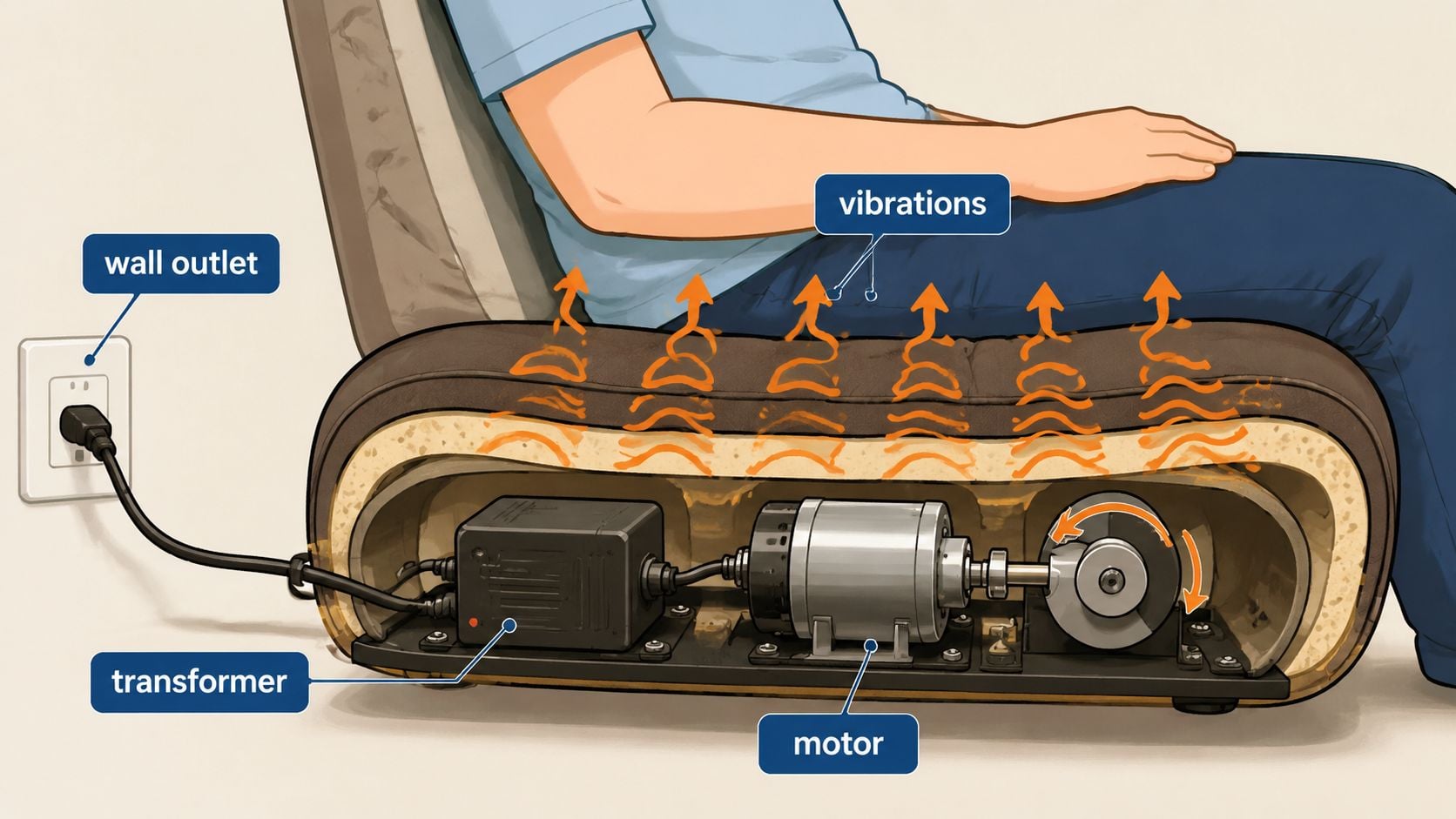
The parts hidden under the upholstery do most of the work. Power comes in from the wall, passes through a low-voltage system, and drives small motors with an off-center spin. Once that motion reaches the foam and fabric, it becomes vibration at the body. In plain English, the chair does not push the way a roller does, it shakes in controlled pulses.
That difference helps shoppers feel what they are buying. A roller follows a track and presses into specific areas, while vibration spreads motion across a wider surface. If you sit in a showroom chair and feel a steady hum through the cushion, that is the mechanism doing its job under the padding rather than at the surface.
Frequency, intensity, and node count
The clearest spec to watch is frequency, which tells how fast the motor pulses. Some premium chairs list back vibration at about 1,975 to 2,925 times per minute and seat vibration at about 1,840 to 4,170 times per minute, with a 30-minute rated time and 208 W power consumption, which shows how higher-end chairs describe vibration with real operating ranges instead of a simple on-off label (Inada DREAMWAVE specifications). Frequency shapes the feel, while intensity shapes how forceful the pulses seem against the body.
Node count matters too, because more motors usually means broader coverage across the back, seat, or legs. A lower-power office-style chair may use a simpler electrical budget and a smaller massage layout, while a heavier-duty chair may spread multiple vibrating points across more of the frame. For buyers, that usually tells more about comfort than wattage alone.
Helpful way to test it in store: sit down, lean back, and pause for a full minute. If the vibration feels focused only in one spot, ask where the other nodes are placed. If the whole chair moves but the seat still feels flat, the distribution may not suit long use.
A showroom visit also makes it easier to judge whether the motion feels pleasant or just busy. Some chairs give a soft, even tremor that works well for everyday lounging, short recovery breaks, or seated relaxation after work. If the cushion buzzes in a way that feels distracting, that tells you more than a spec sheet ever will.
Why runtime limits show up on spec sheets
That 30-minute shutoff on some chairs is not a gimmick. It helps with heat management and safety, especially in appliances with repeated motion and powered components. A published runtime gives the shopper a better idea of how the chair is meant to be used, and it makes comparison easier than a vague “multiple massage modes” label.
A machine with clear vibration rates, a defined timer, and an honest load rating is usually easier to judge than one that hides behind marketing language. That matters on a showroom floor, where the body can tell very quickly whether the seat feels steady, noisy, or tiring. If you are comparing chair motion with other relaxation setups, a massage-equipped adjustable bed frame can also be worth a look for a different kind of room and use case.
Comparing Vibration to Rollers and Airbags
Not every massage chair does the same job, and buyers usually feel the difference in the first minute. Vibration gives broad, gentle coverage. Rollers go deeper and follow a more defined track. Airbags squeeze and release, which creates a compression-style feeling that can help with stretching and circulation.
Where each system wins
Vibration tends to be the friendliest starting point for daily relaxation because it's usually simpler, lighter, and less intense. Roller systems are better when the goal is a more targeted mechanical massage along the back, especially for people who want a stronger sensation near the spine or shoulders. Airbags shine when the user wants a wrapping, compressive feel around the arms, hips, calves, or legs.
That difference matters because a chair can look impressive online and still feel wrong in person. A chair loaded with features can be overkill for someone who just wants a soothing evening sit-down, while a simpler vibration model can be exactly right for a smaller space or a home office corner.
What to look for in a hybrid chair
Many mid-range and premium chairs mix these systems, and that's where the choice gets practical. A mixed system can offer vibration for general comfort, rollers for stronger back work, and airbags for compression. Shoppers who only want light relaxation often don't need all of that, though, and paying for extra mechanisms makes sense only when the body benefits from them.
A pure-vibration chair also tends to fit more easily into tighter rooms because it's usually less complex and often less bulky. That makes it attractive for an apartment, den, or office where the chair needs to serve more than one purpose.
Massaging reclining sofa options can make sense for families who want the relaxation feature built into a different kind of seating layout.
Health and Comfort Benefits Worth Expecting
The best way to think about a vibration chair is as a comfort tool, not a cure. A 2023 review reported that massage chairs may positively affect stress reduction, mental fatigue decline, muscle stiffness improvement, pain reduction, and possible quality-of-life benefits (PubMed review). That's a useful starting point, but it still leaves room for honest limits.
What vibration can reasonably do
Gentle vibration can feel helpful after a long commute, a long workday, or a long stretch sitting still. Some people notice that it takes the edge off muscle tightness or helps them settle down before bed. Broader guidance on whole-body vibration also notes that lower frequency and magnitude can be used safely and effectively to improve peripheral circulation, while the evidence for massage chairs and mechanical-bed massage remains largely inconclusive because strong clinical proof is still limited (narrative review).
That's why the smarter promise is comfort, not treatment. A chair can help a tired body feel less wound up, but that doesn't make it a medical device for pain conditions.
What makes the effect stronger
A randomized controlled trial of massage chair therapy for lower-back pain used a 20-minute session with 3 minutes of constant stretching, 5 minutes of vibration mode and stroke mode, and 40-degree heating. The massage-chair group improved in both pain and quality-of-life outcomes (trial). The important detail is that vibration was part of a bundle, not the whole story.
Worth remembering: vibration often works best as part of a bigger relaxation setup, especially when heat and gentle positioning are included.
That's where shoppers should stay realistic. If the goal is a calmer evening seat, a vibration chair can make sense. If the goal is a fix for nerve pain, chronic back trouble, or a diagnosis that changes how pressure should be handled, a chair alone is not the answer.
Buying Criteria That Actually Matter in a Showroom
Specs matter, but a chair either fits the body or it doesn't. That's why a showroom visit beats a screen full of product descriptions. The right chair should feel stable, easy to control, and sized for real life, not just for a sales photo.
What to check before sitting down
Maximum load rating: Make sure the chair supports the user comfortably, not just barely. A rating above body weight is not enough by itself, because long-term stability and frame strength matter too.
Node count and placement: More motors are not automatically better. The key question is where the vibration lands, because placement shapes whether the chair feels soothing or strangely concentrated.
Upholstery feel: Leather, fabric, and performance microfiber each change how vibration travels and how warm the seat feels during longer sessions.
Controls: A simple handheld remote can be easier to use than a cluttered panel, especially for seniors or anyone who wants quick adjustments.
Warranty and service terms: Frame coverage and electronics coverage deserve separate attention, because the moving parts and the structure don't age the same way.
Dimensions: Check depth, width, and whether the chair can turn or fit through doorways before delivery day.
Feature to Check
Why It Matters
What to Look For
Maximum load rating
Tells whether the frame matches the intended user
A rating that leaves real room above the user's weight
Node count
Shapes how the vibration feels across the body
Enough points to spread comfort, not just one hot spot
Control layout
Affects daily ease of use
Remotes or panels that are simple to reach and understand
Upholstery
Changes comfort, cleanup, and vibration feel
A surface that suits the room and the way the chair will be used
Warranty
Protects the frame and electronics differently
Clear coverage terms in writing
Dimensions
Decides whether the chair fits the space
A setup that clears doors, corners, and walking paths
The five-minute test that tells the truth
Sit down, place both feet flat, and let the chair run long enough to notice whether the vibration stays pleasant or turns tiring. Lean into the backrest, recline once, then return upright and check whether the controls are intuitive without looking down every second. A good chair should feel easy to live with, not merely impressive for thirty seconds.
A local showroom also makes it easier to compare seating feel with other comfort options, including a BILTRITE Furniture-Leather-Mattresses massage category item, if the shopper wants to understand how vibration fits alongside other home seating choices.
A vibration chair can be a smart daily comfort piece, but it isn't for everyone. Remote workers, gamers, caregivers, and older adults who want a gentler seated experience often appreciate the light motion because it can reduce the feeling of sitting still too long. People who want deep therapeutic pressure usually need a different system.
Good fit, caution, and pause
Good fit: Someone who wants light relaxation after work, a softer seated feel, or a chair that can live in a home office without dominating the room.
Use caution: Someone with a pacemaker, a recent injury, diagnosed nerve pain, or pregnancy should check with a medical professional before regular use.
Wait and ask first: Anyone with a condition that changes how pressure, heat, or motion should be handled needs a doctor's okay before making a massage chair a routine.
That caution is especially important for sciatica and similar nerve-related issues. Ergonomic guidance for that kind of discomfort focuses on seat angle, zero-gravity recline, and lumbar positioning as the features that reduce nerve pressure, while vibration alone is mostly a symptom-management feature. In other words, the chair's shape may matter more than the buzz.
How to start without overdoing it
New users usually do better with short sessions and gentle settings. The safest habit is to start low, notice how the body responds, and stop if the chair creates soreness, numbness, or more discomfort instead of less. A chair that feels good for five minutes may not be the right one for a long evening sit.
Lift chairs for elderly can be worth exploring for shoppers who care more about easier standing support than massage intensity.
Common Myths Worth Putting Aside Before You Shop
The internet makes vibration chairs sound either magical or useless, and neither version helps a shopper. The truth sits in the middle. A vibration chair can be pleasant, helpful for daily comfort, and easy to live with, but it's not a cure-all and it's not automatically the right choice for every body.
Three myths that deserve a reality check
Myth, vibration cures stubborn back or nerve pain. It can help someone feel looser or more relaxed, but medical pain conditions need a more careful answer.
Myth, more motors always mean a better massage. Placement, frequency, and how the chair fits the body matter at least as much as raw count.
Myth, vibration chairs are unsafe for healthy adults. Modern chairs are generally designed for regular household use, though certain health conditions still call for medical advice first.
A controlled study of a vibrating massage mat found that the vibration did not produce a physiologically relaxed response in healthy college-aged subjects, and the authors said the changes had no practical value for proving real relaxation (study). That's a useful reminder that a buzzing seat doesn't automatically equal measurable relief.
What a smarter shopper believes instead
A better rule is simple. Use vibration for comfort, look for posture support when pain is part of the picture, and judge each chair by how the body feels in the showroom rather than by the biggest feature count on the tag. The chair that feels quiet, balanced, and easy to use is usually the one that gets chosen again and again at home.
For shoppers in Greenfield and Metro Milwaukee, that means bringing the questions to the floor, sitting in a few different options, and letting the body do the voting. The right chair should fit the room, the routine, and the person using it.
BILTRITE Furniture-Leather-Mattresses offers a wide showroom selection, plus in-person guidance for shoppers who want to compare massage seating, recliners, and other comfort pieces in a real room, not just on a screen. Visit BILTRITE Furniture-Leather-Mattresses in Greenfield to sit down, try the feel for yourself, and let our team help you find a chair that matches your body and your home.