Living Room Furniture Sets Near Me: A Local Buyer’s Guide

Your sofa sags, the loveseat doesn't match anything, and family movie night means someone always loses the good seat. So the phone comes out, living room furniture sets near me goes into the search bar, and suddenly there are dozens of pins, photos, and prices to sort through. Proximity helps, but it doesn't tell you which store is worth the drive, which set fits your doorway, or which cushions still feel good after years of daily use. That's where shopping locally, in person, changes everything.
Table of Contents
- What Shopping Locally Really Gets You
- Measure Your Room and Your Delivery Path First
- Match the Set to Your Space and How You Actually Live
- Decoding the USA Made and Amish Made Icons in Store
- Choosing a Complete Set Versus Mixing Individual Pieces
- Your Store Visit Checklist for Living Room Sets
- Come See Us in Greenfield When You're Ready
What Shopping Locally Really Gets You
A Metro Milwaukee family walks in on a Saturday with a phone full of screenshots. The sectional looked great online. In person, the seat is too deep for grandma, the fabric color reads gray instead of blue, and nobody can answer whether it comes apart for a tight hallway. That's the gap a local showroom closes.

At BILTRITE, we're a fourth-generation, family-owned business serving Metro Milwaukee since 1928. We don't sell online, and that's intentional. A living room set is something you sit on, lean on, nap on, and gather around for years. You should test the cushion, feel the leather or fabric, open the recliner, and ask questions face to face before you commit.
Why the in-person test matters
Budget is real, and we respect that. Average annual spending on household furnishings and equipment was $2,414 per consumer unit in 2024, down from $2,508 in 2023 and $2,701 in 2021, according to the Bureau of Labor Statistics 2024 consumer expenditures report. That category is broader than living room furniture alone, so it isn't the price of a sofa set. It does show households are spending carefully and comparing complete sets, durability, delivery, and long-term value, not just a sticker price.
We're not the cheapest option, and we won't pretend to be. Our focus is affordable, better-quality furniture that earns its keep. We're also closed on Sundays to be with our families, and we're proud of that. Family time built this business.
When you visit, look for our in-store icons. They flag USA Made, Amish Made, Solid Wood, Heavy Duty, and Come Apart pieces right on the floor. Those little markers save you guesswork and start better conversations with our team. Families comparing family-owned furniture stores near me often tell us the difference is simple. Someone local knows the product, knows the neighborhoods, and will be here next year if a question comes up.
Sit on it, recline in it, and ask how it gets through your front door. If a store can't answer that last one, keep shopping.
Measure Your Room and Your Delivery Path First
Don't fall in love with a sectional before you measure. We see it every week. A set fits the wall beautifully, then fails at the front door, the stair landing, or a tight hallway turn. Measuring first prevents that heartbreak.
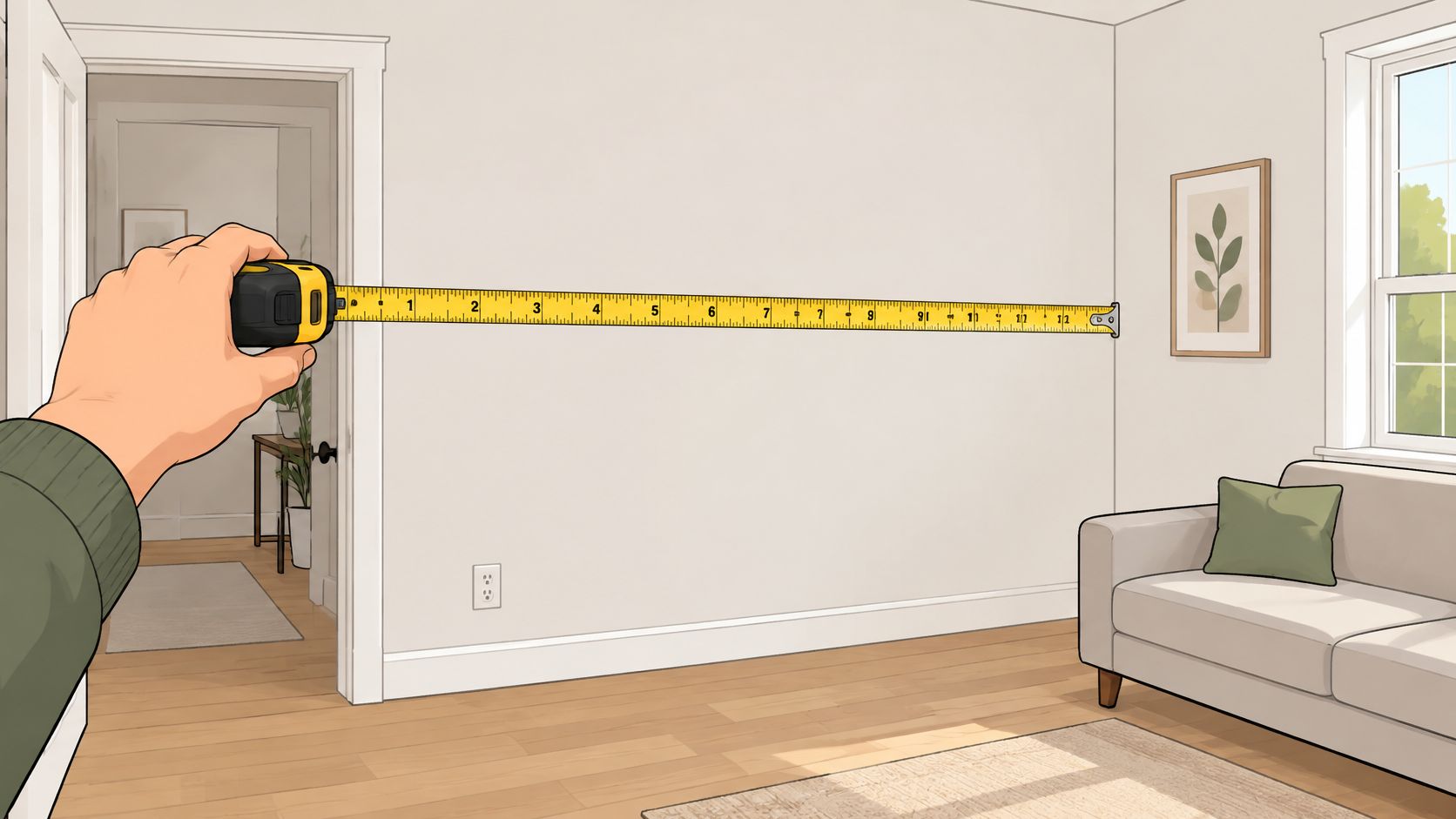
Start with the room itself. Record wall lengths at more than one height, ceiling height, door locations and swing arcs, windows, HVAC registers, outlets, and the fireplace. Then measure the full delivery path, including entry doors, hallways, stair turns, elevators, and tight corners. Bring those numbers with you, along with photos.
The painter's tape test
Transfer the footprint of the sofa, sectional, recliner, and tables to painter's tape on your floor. Open every door. Walk the route you'd take carrying a laundry basket or helping a child through. If the tape layout feels cramped on a quiet Tuesday, it'll feel worse during a holiday gathering.
Useful planning benchmarks are approximately 30 to 36 inches for primary walkways and about 18 inches between a sofa and coffee table, as outlined in living room furniture dimension guidance. Treat those as planning references, not guaranteed code requirements. Mobility devices, kids, older adults, and busy routes need more room, not less.
Size surprises people. A standard three-seat sofa commonly measures about 83 to 94 inches wide and 34 to 37 inches deep in that same guidance, while a 72-inch sofa often suits compact rooms better. Our guide to sofa dimensions in inches helps you compare those footprints before you shop.
Questions to ask before delivery day
- Packaged dimensions: Ask for packaged size, not just assembled size, since packaging can change what fits.
- Removable parts: Confirm whether legs, backs, arms, or cushions come off for the trip inside.
- Separation points: Ask where a sectional separates and whether the sofa comes apart.
- Recliner clearance: Measure the piece fully extended, not just upright.
Write it all on one worksheet. Room, path, tape results, and must-keep clearances. That single page turns a showroom visit from browsing into decision-making, and our team can verify the details with you before anything is scheduled.
Match the Set to Your Space and How You Actually Live
A set can fit the room and still fit your life badly. The fix is honest self-assessment. Is this room mainly for upright conversation, television viewing, reclining, entertaining, or a mix of everything? Answer that first, then shop seat dimensions.
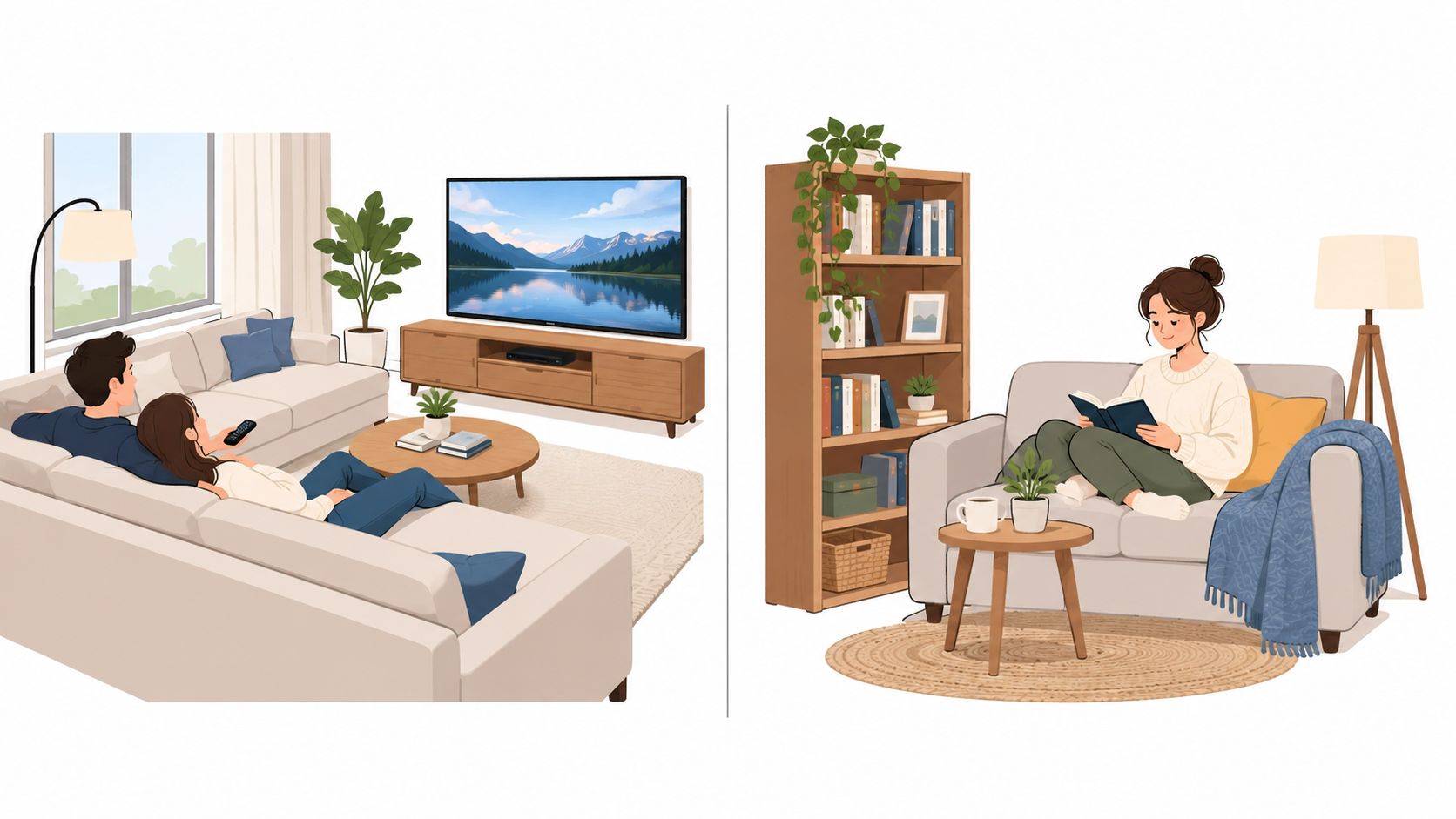
Published dimensional guidance places typical seat height around 16.5 to 18 inches and seat depth around 20 to 24 inches, with deeper lounge seating approaching 28 inches, according to room-by-room interior design measurement guidance. That deep lounge seat feels dreamy for a movie. For upright sitting, reading, or getting up easily, it can leave feet dangling and backs unsupported.
Test ergonomics like you mean it
Sit the way you sit at home. Check whether feet rest flat, whether standing takes excessive forward momentum, and whether the arm height supports you or shrugs your shoulders. Compare cushion firmness and usable seat width across every piece in the set, not just the sofa.
Keep the coffee table roughly level with the seat cushion or slightly lower. Preserve about 14 to 18 inches of legroom between the seat edge and the table in that same measurement guidance. Then tape the complete arrangement again and check sightlines to the TV, plus conflicts with vents, outlets, and doors.
Small scale versus heavy duty
Apartments, condos, smaller homes, and senior living often call for small-scale furniture that's proportioned down without feeling flimsy. Our collection of small-scale furniture for the living room is built for exactly those footprints. Look for the small-scale options on the floor and test them beside standard pieces. The scale difference is obvious once you're standing there.
Busy families need the opposite conversation. Our Heavy Duty icon flags pieces built for harder daily use. Inspect seam construction, ask about frame materials, and check whether cushions are reversible so wear spreads evenly.
Practical rule: Buy for the Tuesday night you actually live, not the dinner party you host twice a year.
Don't assume a showroom arrangement transfers home unchanged. Compare the largest item's length against your target wall, tape it, walk it, and sit in the piece. When scale, seat depth, and daily use line up, the room stops fighting you.
Decoding the USA Made and Amish Made Icons in Store
Labels shout in furniture stores. They don't all mean the same thing, and shoppers deserve plain language. Our icons are starting points for questions, not substitutes for them.
For an unqualified Made in USA claim, the Federal Trade Commission requires a product to be "all or virtually all" made in the United States, with final assembly or processing at home, as explained in the FTC guide to complying with the Made in USA standard. The FTC also weighs the share of U.S. manufacturing costs and how significant any foreign content is to the finished product. A qualified claim must state the limit, for example "Made in USA of U.S. and imported parts."
That distinction matters. The FTC notes a qualified statement can read like "Couch assembled in USA from Italian Leather and Mexican Frame" in its business guidance on Made in USA claims. Assembly alone doesn't mean every major component is domestic. Ask whether the claim covers the whole piece or one stage, then ask about frame, upholstery, mechanisms, and cushions.
What Amish made does and doesn't promise
Amish-made furniture is a distinct manufacturing sector, not a rustic style label. A USDA Forest Service study describes Ohio's Amish furniture cluster as an emerging manufacturing sector that has stayed competitive, while noting relatively little information is available about it, in research on the Amish furniture industry. Because public information is limited, store-level identification helps.
Our Amish Made symbol identifies pieces represented as made by skilled Amish artisans. It describes manufacturing origin. It doesn't automatically guarantee solid wood content, a specific finish, or particular warranty terms. Ask who made the piece, where it was produced, and what's documented. Our overview of what Amish furniture is gives helpful background before you visit.
The Solid Wood icon adds another layer. It identifies real solid wood pieces on our floor, which is different from assuming every wood-look surface is solid. Ask which parts are solid, how the piece is finished, and what care the maker recommends.
Quick Reference for In-Store Furniture Icons
| Icon | What It Means | Smart Question to Ask |
|---|---|---|
| USA Made | Marketed under a U.S. origin claim | Is the claim unqualified or qualified, and which components does it cover? |
| Amish Made | Represented as Amish-made in origin | Who made it, where, and with what documented methods? |
| Solid Wood | Identified as real solid wood | Which parts are solid, and how is it finished? |
| Heavy Duty | Flagged for harder daily use | What construction details support that designation? |
| Come Apart | Designed to separate for delivery | Where does it separate, and what are the packaged dimensions? |
Read the exact wording, then ask the follow-up. That's confident shopping.
Choosing a Complete Set Versus Mixing Individual Pieces
Some families want it done in one trip. Others enjoy building a room piece by piece. Both paths work. The right one depends on your room shape, timeline, and budget priorities.
A complete set saves time and keeps scale cohesive. Sofa, loveseat, and chair arrive speaking the same design language, with matched upholstery and proportions that were planned together. For a straightforward rectangular room and a household that wants the decision finished, that's a genuine advantage.
Mixing individual pieces solves different problems. An unusual room shape, a fireplace competing with the TV, or a needed recliner can make a matched set awkward. Mixing lets you invest more in the seat used every day and spend less on a secondary piece, or pair a stationary sofa with one recliner instead of committing the whole room to motion furniture. Our tips on how to mix furniture styles can help pieces feel intentional rather than accidental.
Durability should drive either choice. The EPA reported furniture and furnishings in municipal solid waste reached 12.1 million tons in 2018, with approximately 80.1% landfilled, in its durable goods product-specific data. That figure includes sofas, tables, and chairs. Buying pieces that last, and that can be repaired or rehomed later, beats replacing a whole set on a short cycle.
| Household Situation | Often the Better Path | Why |
|---|---|---|
| Standard room, wants it finished quickly | Complete set | Cohesive scale, one decision, coordinated delivery |
| Odd layout, tight path, competing focal points | Mixed pieces | Each piece sized to its spot and delivery route |
| Mobility needs in the household | Mixed pieces | Room for a lift recliner without forcing a matched layout |
| Long-term home, specific fabric or finish in mind | Either, with custom order | Choice of fabric, leather, wood, finish, and hardware |
In-stock selection gets furniture home sooner, and we carry a huge in-stock range. Custom orders take longer but let you choose fabric, leather, wood, finish, and hardware at affordable prices. Ask which route fits your timeline. A rushed custom expectation helps nobody, and neither does settling for an in-stock color you'll dislike daily.
Your Store Visit Checklist for Living Room Sets
Bring your homework and the visit gets fun fast. Our sales associates bring over 400 years of combined experience to the floor, and they're here to help, not pressure. Good information from you lets them do their best work.
What to bring and what to test
- Your worksheet: Room and delivery path measurements, plus tape-test notes and photos.
- A tape measure: Verify showroom dimensions against your wall and doorway numbers on the spot.
- Your real sitting test: Sit, recline, stand up, and repeat. Check feet, back support, and arm height.
- Construction checks: Inspect seams, flip reversible cushions, and ask about frame materials and replaceable cushions.
- Care questions: Ask about finish, placement, and cleaning guidance for wood and upholstery.
That last point matters for solid wood tables and entertainment pieces. USDA Forest Service research states keeping wood and wood products dry is essential to maintaining service life, as noted in USDA Forest Service wood service life research. Quality construction helps, and so does keeping pieces away from persistent moisture and following the maker's finish and cleaning guidance.
Delivery, removal, and a Wisconsin bonus
Ask about our Come Apart sofas, loveseats, sectionals, and recliners if your home has tight doorways or narrow halls. Confirm separation points before delivery day, not during it. Ask, too, about white-glove delivery on qualifying purchases and what happens to old furniture or an old mattress. Donation, resale, repair, or removal should be settled while you're still in the store.
Shoppers considering mobility help should remember this. In Wisconsin, all power lift recliners are exempt from sales tax, which makes comfortable mobility assistance more affordable. Test the lift motion in person and confirm the fully extended footprint leaves a clear path at home.
While you're here, peek at our mattress department with over 60 models. Living room comfort gets the glory, but sleep usually needs the upgrade more.
Come See Us in Greenfield When You're Ready
Measure first. Match the set to your space and your real daily life. Look for the USA Made, Amish Made, Solid Wood, Heavy Duty, and Come Apart icons, read the exact wording, and ask the follow-up questions. That's the whole playbook, and it works whether you're furnishing a first apartment or a family room you plan to keep for decades.
Our Greenfield showroom at 5430 West Layton Avenue serves Milwaukee, New Berlin, Franklin, Oak Creek, Muskego, Whitefish Bay, Menomonee Falls, Waukesha, Tosa, Brookfield, and surrounding communities. We don't sell online, so the sitting, testing, and chatting happen here with us. We're closed on Sundays so our team can be with their families too.
Come say hi, sit on the sofas, and ask every question you've got. We'd love to help you find a living room set you'll enjoy coming home to.
Ready to find your new favorite piece of furniture? Visit BILTRITE Furniture-Leather-Mattresses to plan your trip, then come see us in Greenfield for affordable, better-quality living room sets, including USA-made, Amish-made, solid wood, small-scale, heavy-duty, and come-apart options. Bring your measurements, test the comfort in person, and let our family help yours, with no pressure.