3 DAY MATTRESS SALE! THURSDAY - FRIDAY - SATURDAY!
98TH ANNIVERSARY SALE-A-BRATION ENDS SATURDAY, NOVEMBER 7TH AT 5PM!
NO CREDIT CARD FEES!
1000's of Items IN-STOCK + 500 Mattresses!
Largest selection of USA Made Furniture & Mattresses + Amish Made!
FREE In-Store Design Services!
BUY LOCAL & LOVE YOUR HOME!
Tuesday-Thursday 10am to 6pm | Friday 10am to 7pm | Saturday 10am to 5pm | Sunday Closed To Be With Family & Friends | Monday Showroom Closed
5430 West Layton Ave, Greenfield - Metro Milwaukee
Does a sofa that looks great against the wall still work when the footrests are open, the family settles in, and someone needs to walk past? That's the question worth answering before choosing fabric or color.
Sofas and recliners are long-term purchases, not just finishing touches. The right choice combines comfortable proportions, room to move, dependable construction, and a realistic repair path. For Metro Milwaukee households, a hands-on comparison can separate seating that looks inviting from seating that makes everyday life easier.
Lifts the occupant forward; needs a nearby outlet and operating clearance
Seniors and caregivers
Sleeper sofa
Guest beds in small spaces
Opens to a bed
Guest rooms and studios
A stationary sofa has a fixed seating position, with no reclining back or extending footrest. It's a straightforward choice for conversation, visiting grandchildren, and rooms where furniture gets rearranged.
A sectional connects seating into a larger arrangement, while a loveseat offers shared seating in a narrower package. Neither term automatically means reclining, so shoppers should distinguish stationary configurations from motion models.
Match the style to the household
A recliner chair changes the back angle and extends a footrest for individual relaxation. A reclining sofa places reclining seats within a shared frame, commonly at the ends; those seats may operate independently rather than moving together.
A power lift recliner adds assistance with getting up, while a sleeper sofa provides a deployable guest bed. Those functions solve different problems, so choosing between them starts with identifying the job the furniture needs to do.
Practical rule: Choose the seating arrangement for an ordinary evening at home, not only for the largest holiday gathering.
For example, a family that regularly watches movies together may appreciate a sectional. A household with different comfort preferences may get more flexibility from a stationary sofa paired with a recliner.
Keep the whole room usable
Upholstered seating anchors the living room, but it shouldn't consume every usable corner. A large sectional can provide generous lounging space while making another chair, a side table, or a clear route through the room difficult to accommodate.
A smaller piece isn't automatically less comfortable, either. Narrower arms and a shallower overall profile can leave more usable floor space without forcing a household to abandon supportive seating.
Room layout and the primary users come first; fabric and finish come afterward. BILTRITE's team walks shoppers through seating styles on the showroom floor without pressure to buy, so differences can be felt rather than guessed from a photograph.
How Recliner Mechanisms and Lift Chairs Work
Manual recliners use a lever, pull handle, or push-back action to release the mechanism. The sitter then shifts position to adjust the back or close the footrest, depending on the design. This option suits someone who can operate the mechanism comfortably and prefers a chair without an electrical connection.
Power recliners use motors and buttons or a handset to adjust the chair. Check that the intended user can reach and understand the controls. Choose the adjustments that meet their needs, since extra controls can make daily operation harder.
Power lift recliners raise and tilt the seat to assist a controlled transition toward standing. They don't swivel. BILTRITE offers 48 models of power lift chairs, so shoppers can compare different options in person.
Decide whether lift assistance is necessary
If someone rises easily from supportive stationary seating, a standard recliner may be enough. Choose lift assistance to address a specific transfer need, rather than based on age alone.
For restricted weight-bearing, balance difficulties, or postoperative movement restrictions, a clinician or occupational therapist can help determine whether lift-assisted seating is appropriate. The chair should fit the person's transfer plan, not replace one.
A useful feature is one the sitter can operate confidently, every day.
Plan for power and movement
Power seating needs an appropriate nearby outlet and a cord route clear of walking paths. The footrest needs unobstructed space in front, and the back needs the clearance specified for that model.
Wall-clearance requirements vary by chair. Have the intended sitter operate the controls during a showroom demonstration, and watch the full lift, footrest, and reclining movement. Check that each control is easy to reach and that the sitter can stop the movement comfortably. A mechanism they can use confidently is more valuable than extra settings they won't use.
Measure Your Room and Delivery Path First
Measurement
Guideline or example
Why it matters
Main walkway
762–914 mm (30–36 in)
Comfortable movement past the piece
Sofa to coffee table
356–457 mm (14–18 in)
Room to reach, stand, and set things down
Side clearance
76–152 mm (3–6 in)
Practical gap at the sides where space allows
Closed sofa width, example
2,159 mm (about 85 in)
Check against the wall space
Closed sofa depth, example
965 mm (about 38 in)
Footprint against the wall when closed
Fully reclined depth, example
1,727 mm (about 68 in)
Check how far the piece extends into the room
These planning dimensions distinguish circulation space from the furniture's footprint; the reclining-sofa example expands from 965 mm closed to 1,727 mm fully extended, alongside the industry reference at the U.S. Bureau of Labor Statistics.
Mark both operating positions
A tape measure, painter's tape, and a simple floor sketch make a useful planning kit. Marking only the closed furniture outline misses the space needed during use.
Shoppers should record three separate things:
Closed footprint: Overall width and depth, including projecting arms or backs.
Reclined footprint: Maximum operating depth, rear clearance, and any moving headrest.
Delivery route: The narrowest openings and tightest turns between the entrance and final position.
Painter's tape can show whether an extended footrest blocks the route to the kitchen or whether a coffee table must move whenever someone reclines. That's a better discovery before delivery day!
Walk the entire delivery route
Doorway width alone doesn't establish whether a sofa will fit. Hallways, stair landings, elevator openings, low ceilings, handrails, and the space available to turn all deserve attention.
Shoppers should measure clear openings with doors positioned as they'll be during delivery. Photographs of awkward corners can help the delivery team understand an obstacle that a flat sketch doesn't explain.
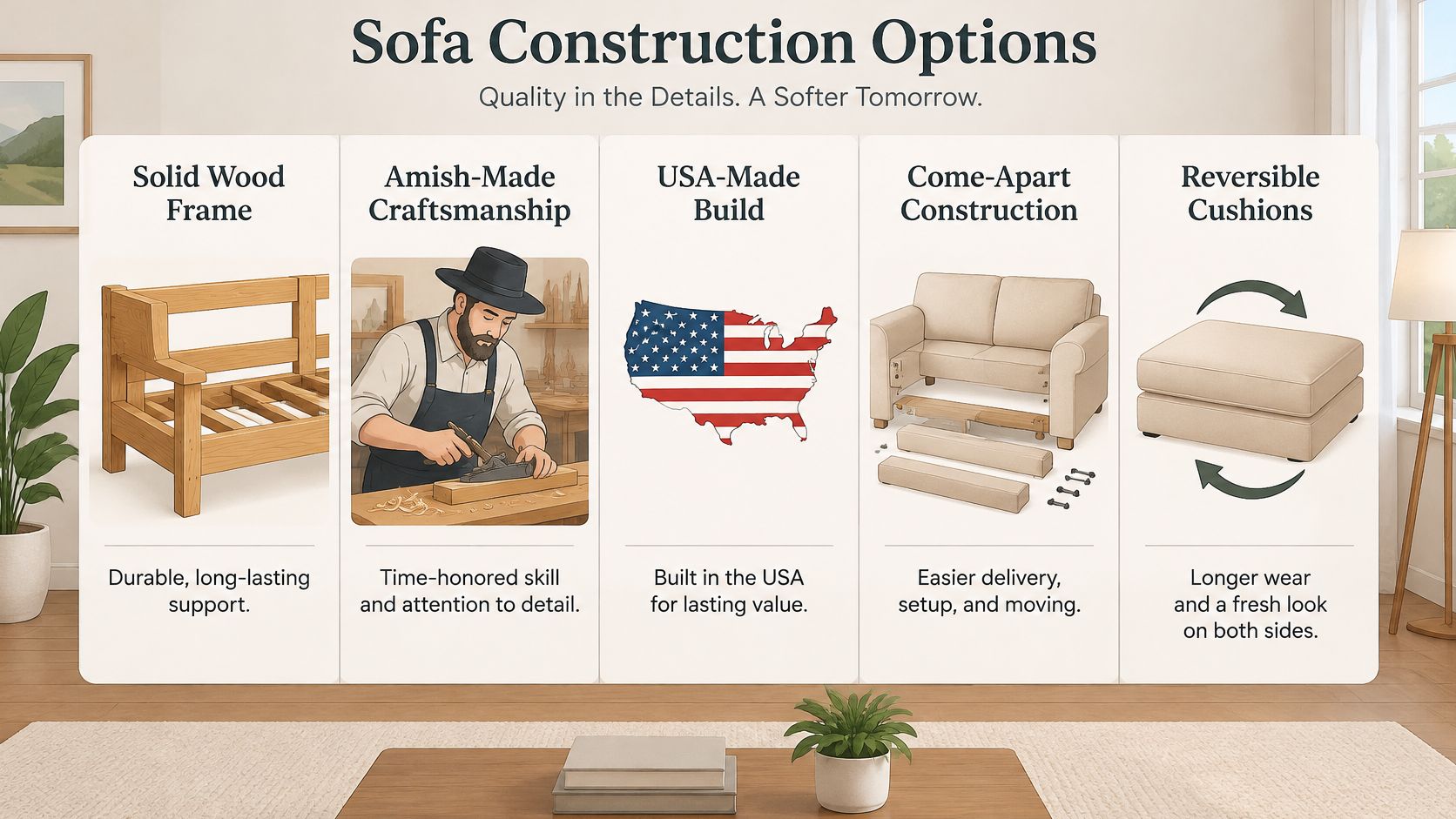
Come-apart construction can solve access problems when a one-piece frame can't make the turn. Removable legs, detachable backs, and separate modules help only when the remaining components also fit through the route.
The guidance on furniture for narrow doorways can help households identify which delivery details to record. Apartments, condos, and smaller homes especially benefit from checking access before choosing an oversized silhouette.
For senior and caregiver households, circulation needs go beyond squeezing past furniture. Space in front of the chair should allow the intended transfer, with an unobstructed walking route available when the footrest is extended.
Test Comfort and Safety Step by Step
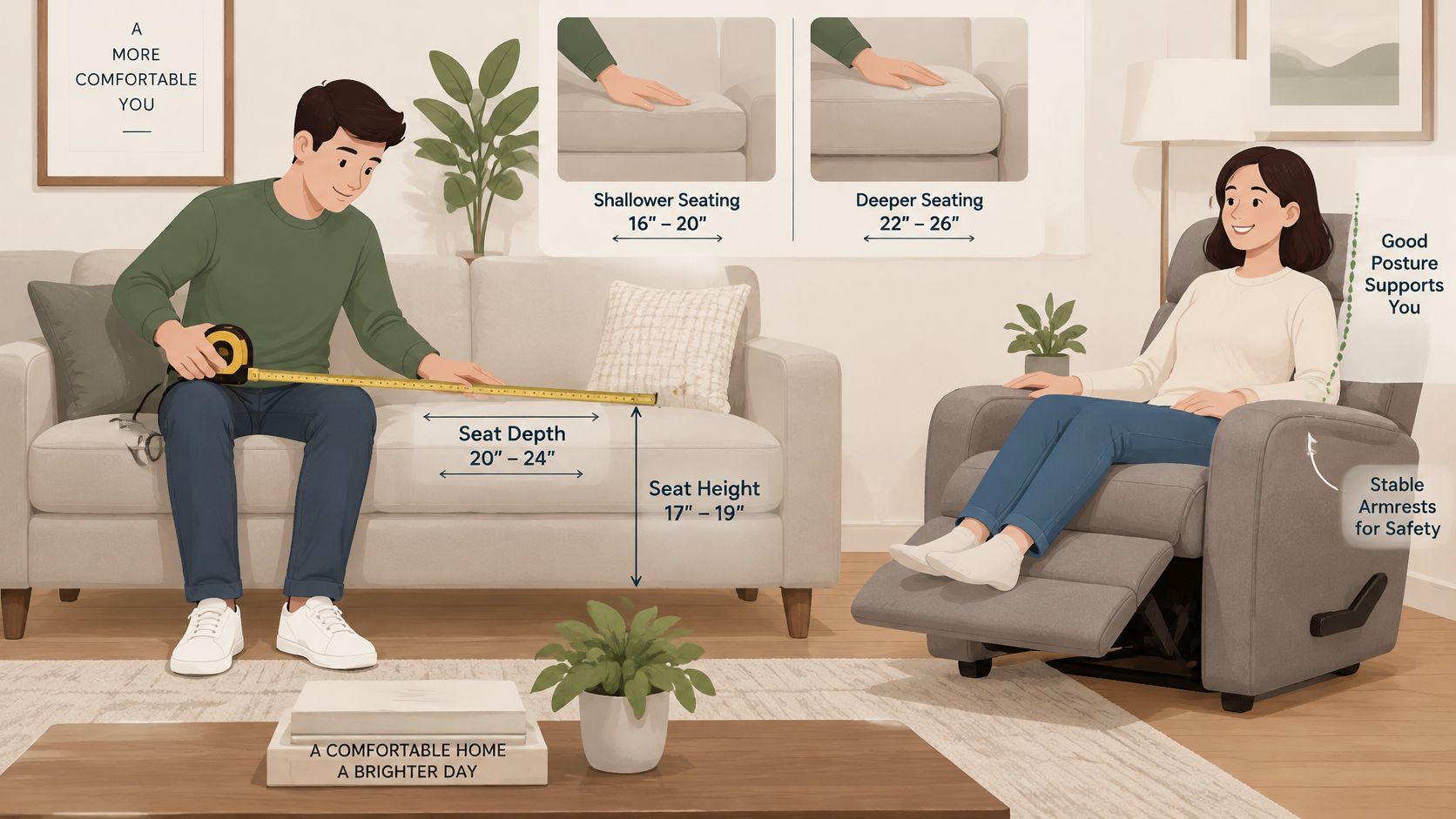
Could you sit comfortably through a full conversation, then operate the recliner without strain? Start with fit, not with how plush the seat feels at first. Ergonomics guidance summarized alongside published sofa-comfort research describes about 16.5 inches as a useful fixed-seat depth and roughly 14–18.5 inches for adjustable seating.
A seat deeper than the sitter's buttock-to-knee length can leave a gap behind the back and encourage slouching. In the study's flat-seat testing conditions, peak pressure below approximately 2 N/cm² was associated with improved comfort. Test seat depth on the sitter, not on a dimension chart. Supportive contouring and resilient cushioning can help, but comfort still depends on the person and the seat.
Run a repeatable showroom check
Sit fully back. Settle against the backrest without scooting forward or needing a cushion behind the waist. Check that your lower back feels supported.
Check feet and knees. In the upright position, feet should rest firmly on the floor, and the seat edge should not press into the backs of the knees.
Cycle the footrest. Extend and retract it several times with the controls you expect to use at home. The motion should feel smooth, without binding or requiring a struggle to close.
Inspect moving gaps. Ask the demonstrator to point out pinch and entrapment areas. Keep hands, children, pets, clothing, and loose objects clear while the mechanism moves.
Check stability. With the footrest extended, the seat should feel supported during ordinary repositioning. Unexpected rocking, tipping, or a visibly uneven base deserves attention.
Discuss power failure. Ask whether the powered model has a backup or release provision and how it works. Everyone who may need to use it should understand the exit plan.
Verify capacity and transfers. For heavy-duty or senior-use seating, confirm the rated occupant capacity, arm support, and transfer height. Sitting down and standing up should feel controlled.
Compare operating dimensions. Check the demonstrated reclined position against your floor plan. The chair should operate without hitting furniture or blocking the walking route.
Ask what the testing covers
UL 962 and ANSI/BIFMA X5.4-2020 contain provisions relevant to stability, leg-rest performance, and pinch points. EN 12520 seating safety and durability testing addresses static loads, durability cycles, impact, and stability. General seating certification does not establish that every reclining mechanism or upholstery component has been tested.
Ask which parts a test or certification covers, especially the mechanism. The sofa and chair buying checklist can help keep fit, operation, and repair questions in view.
Solid Wood, Amish-Made and USA-Made Construction Compared
Construction
What to check
Why it matters
Repair question
Solid wood frame
Joined hardwood with a well-finished surface
Supports shape retention and resistance to loosening
Can the frame be reached for tightening?
Amish-made pieces
Hand-built with skilled craftsmanship
Emphasizes workmanship suited to long-term ownership
Who performs service and where are parts sourced?
USA-made pieces
Domestically assembled
Can simplify communication and service logistics
Who handles warranty repairs?
Come-apart construction
Removable legs, backs, or modules
Solves narrow doorways and tight stairs
Can modules be replaced or reordered?
Refillable or reversible cushions
Cushions that can be turned or refilled
Refreshes comfort without replacing the whole piece
Can the cushion be refilled or recovered?
The frame matters, but so does access to it. A sturdy component hidden behind construction that can't reasonably be opened may still be difficult to repair.
Solid wood, Amish-made, and USA-made describe different attributes. None replaces a close look at joints, seat support, mechanism mounting, upholstery, or service arrangements.
Look beyond the label
Well-joined hardwood can provide a durable foundation, but heavier doesn't automatically mean better. Shoppers should examine how the frame is reinforced and how the seat suspension connects to it.
Amish-made furniture emphasizes skilled hand craftsmanship; the actual materials and construction should still be identified piece by piece. USA-made furniture offers domestic production, but service arrangements need confirmation rather than assumptions about nearby parts or immediate repairs.
The explanation of solid wood and Amish-made furniture helps distinguish those categories. Shoppers can then compare the construction details of the actual pieces under consideration.
Come-apart construction deserves equal scrutiny. Connections should lock securely, and instructions should explain safe disassembly without treating every future move as a repair job.
Apply the repairability test
Furniture owners sometimes abandon repairs because they consider an item unrepairable or the cost excessive, according to a 2025 study of repair behavior. A useful purchase comparison therefore includes these questions:
Frame access: Can a technician reach joints and mounting points?
Mechanical parts: Are motors, switches, cables, and control units replaceable?
Cushion renewal: Are cushions reversible, refillable, or recoverable?
Future moves: Can the piece be disassembled without damaging upholstery?
Covering repairs: Can the selected fabric or leather be repaired, and what limitations apply?
Service responsibility: What does the warranty cover, and who performs the work?
Reversible cushions need usable upholstery on both sides; a loose cushion isn't necessarily reversible. Refillable cushions also need a practical opening and an available replacement insert.
Long-term value: Repairability means an identifiable part, an accessible attachment, and someone able to perform the work.
A stronger frame and replaceable components can make cushion wear or a motor failure manageable instead of forcing complete replacement. At BILTRITE Furniture-Leather-Mattresses, all customers purchase brand new furniture and mattresses; repairability is a way to protect that new purchase over time.
Choosing for Aging in Place and Mobility
38% of U.S. adults aged 65 and older say they'll need home modifications or additional modifications to age in place, with cost the leading concern, according to the poll summarized by the International Council on Active Aging. Seating deserves attention because it affects everyday sitting, standing, and movement through the home.
Supportive furniture doesn't need an institutional appearance. Suitable proportions, accessible controls, and a clear transfer area can coexist with familiar upholstery and a welcoming living room.
Evaluate the complete sitting-and-standing task
Seat height: The sitter should be able to prepare to stand without an exaggerated forward lean or unstable foot position.
Seat depth: Shorter users may find a shallower seat easier to use while maintaining back contact.
Firm support: The cushion should support the sitter rather than collapse into a deep pocket.
Arm strength: Secure arms provide a stable place for pushing up when that matches the person's transfer technique.
Transfer ease: A caregiver needs working space, not a narrow gap between a chair and coffee table.
Footrest clearance: The full movement must clear nearby furniture, with rear space checked separately.
Power controls: Buttons or a handset should remain reachable without twisting or searching.
First-floor fit: The chair belongs where daily routines happen, with a usable route to other essential rooms.
Test with the people involved
A family member or caregiver can notice difficulties the sitter might overlook, such as a handset falling out of reach or an arm shape that makes standing awkward. The most useful demonstration includes approaching the chair, sitting, adjusting it, and getting up again.
For wheelchair users, transfer direction and the location of an adjacent mobility aid deserve special attention. General guidance on wheelchair-accessible furniture can help households prepare questions, while a therapist can advise on individual transfer needs.
A power lift chair works best within a clear, organized layout. Loose rugs, tangled cords, and furniture crowding the approach can undermine the benefit of otherwise suitable seating.
Balancing Budget and Long-Term Value
A low purchase price can lead to higher ownership costs if a sofa needs replacing after a cushion or mechanism problem. Compare the repair options and construction alongside the price.
BILTRITE Furniture-Leather-Mattresses focuses on affordable, better-quality furniture and mattresses. Compare each piece by how well its features and construction serve your household, rather than paying for options you are unlikely to use.
Compare value without inventing a lifespan
No one can guarantee how long every frame or mechanism will last. Household use, care, occupant needs, and parts availability all affect the outcome.
A useful value discussion centers on three questions:
Expected use: Is the frame and mechanism suited to the household's daily routine?
Renewal options: Can worn cushions or coverings be refreshed at a reasonable cost?
Warranty responsibility: Which parts, labor, and service arrangements are included, and which are excluded?
A sectional can be a cost-effective choice when the household uses the full seating arrangement. A single recliner may offer better value for a reading corner if a larger motion sofa would duplicate seating you already have.
Spending more makes sense when it buys useful support, accessible repairs, or construction suited to the household.
A manual mechanism can keep a purchase straightforward. Power operation earns its place when easier adjustment improves daily use.
Check the written warranty and ask for a clear explanation of service before deciding. Comparing those details with the features you will use helps you choose the right level of investment.
How Recliners Grew From Simple Chairs to Sofas
Reclining furniture has deep roots: Encyclopedia.com's history of the recliner traces a published design to Ackermann's Repository of Arts in 1813, Browne and Ash's reclining-chair and sofa advertising to 1855, and William Watt's Morris Chair design, manufactured by Morris and Company, to 1883. Each development moved adjustable comfort toward upholstered household furniture.
The same history records cousins Edward Knabusch and Edwin Shoemaker's wooden reclining-chair patent in 1928, followed by an upholstered mechanical version in 1930. Those developments helped establish the mechanisms behind today's integrated reclining seating.
Local roots in upholstered comfort
BILTRITE Furniture-Leather-Mattresses has served customers since 1928 and remains a fourth-generation, family-owned business rooted in Metro Milwaukee. Irwin Kerns' upholstery shop sold custom-made sofas for $1,000 in 1929, connecting the family story directly to upholstered craftsmanship.
Recliners are a mature furniture design, not a novelty. The useful distinction today is how well a particular piece fits the sitter, the room, and the demands of long-term ownership.
Visit Our Greenfield Showroom to Test Your Pick
A recliner can look right and still feel awkward when you sit down or operate its controls. At BILTRITE Furniture-Leather-Mattresses, 5430 West Layton Avenue in Greenfield, you can compare seating in person and check how each mechanism feels.
The showroom includes come-apart sofas and sectionals, 150 styles of recliners, and 48 models of power lift chairs, alongside small-scale and heavy-duty options and USA-made and Amish-made furniture. BILTRITE also carries senior living furniture and mattresses. Take time to assess seat support, control placement, and how the reclined position fits your comfort needs.
Bring the details that matter
Use the measurements and delivery-path notes from the earlier section to help narrow your choices. During your visit, focus on who will use the seating, how they will get in and out, and which activities the furniture needs to support.
BILTRITE is closed Sundays and Mondays. Visit another day to sit in the available options, operate the mechanisms, and ask questions. A useful showroom test can reveal whether a simpler chair suits your needs better than a more complex model.
BILTRITE Furniture-Leather-Mattresses offers sofas, recliners, and power lift seating for households weighing comfort, room fit, and long-term value. Visit BILTRITE Furniture-Leather-Mattresses in Greenfield to compare the options hands-on.