Wide Rocker Recliner Buying Guide for Comfortable Living


After a long day, the most inviting seat in the house may be the one with room to stretch, rock gently, and lift the feet. A wide rocker recliner can become the family's movie-night headquarters, a quiet reading spot, or a comfortable place for a grandparent to rest with a child nearby. But a chair that looks generously sized can still feel cramped if its inside seat is narrow, or become frustrating if it blocks a walkway.
The right choice depends on more than the word “wide.” Shoppers need to compare outside dimensions, usable seat width, seat depth, seat height, rocking movement, reclining clearance, delivery access, and daily care. A hands-on visit also matters, because sitting upright, rocking, reclining, and standing tell a clearer story than a product photo.
Table of Contents
- Settling Into the Right Wide Rocker Recliner
- What a Wide Rocker Recliner Really Is
- Sizing Up the Footprint
- Matching the Chair to the Person
- Power, Lift, and Upholstery Options
- Doorways, Hallways, and Rocking Clearance
- Keeping the Chair Feeling New
- Your Next Step Toward a Comfortable Chair
Settling Into the Right Wide Rocker Recliner
A family's favorite chair often earns that title gradually. Someone settles in after work, raises the footrest, and rocks gently while watching the evening news. Later, a child climbs up for a story, or a grandparent takes a quiet nap. During a movie, extra room lets the sitter shift position without feeling pressed against the arms.
That flexibility separates a wide rocker recliner from a basic recliner. The chair combines space for movement, an adjustable back, extending leg support, and a rocking base. It can support several kinds of relaxation, but only when its proportions suit the person using it.
Comfort depends on the person
A larger exterior frame doesn't guarantee a generous seat. One chair may look oversized from across a showroom yet leave little room between the arms. Another may offer plenty of width but use a deep seat that makes a shorter sitter slide forward.
Shoppers should ask practical questions before choosing upholstery or controls:
- Who uses the chair most? One adult, several family members, or a caregiver and senior?
- How will it be used? Reading upright, rocking, stretching out, napping, or watching television?
- Where will it sit? A spacious family room has different needs from an apartment, condo, or senior-living room.
- How will it arrive? Doorways, corners, stairs, and narrow hallways can determine whether the chair reaches its intended spot.
Practical rule: A wide rocker recliner should fit the person first and the room second. A chair that fails either test won't feel comfortable for long.
The best shopping experience lets people test the chair without pressure. A shopper can sit upright, rock, recline, extend the footrest, and stand again. That simple routine reveals whether the arms provide useful support, whether the feet stay comfortable, and whether the chair feels inviting rather than oversized.
What a Wide Rocker Recliner Really Is
A wide rocker recliner brings together three basic functions. The adjustable back changes the sitter's posture, the extending leg support raises the lower legs, and the rocking base creates gentle movement while the chair is upright. “Wide” refers to the chair's larger scale or usable seating area, but outside width and inside seat width aren't interchangeable.
The category has a long history. The Henry Ford's account of adjustable reclining chairs places early adjustable reclining furniture in American homes from roughly 1876 to 1900. Those early chairs favored function and appeared as novelty furnishings in parlors and sitting rooms. Around 1928, Edward Knabusch and Edwin Shoemaker developed a reclining porch chair and then adapted the mechanism for upholstered indoor seating. Their company adopted the La-Z-Boy name in 1929, establishing a major milestone in modern recliner history.
The terms become easier with a simple comparison
- A standard recliner adjusts the back and leg support but may have a stationary base.
- A rocker recliner adds a curved base that allows rocking while upright.
- A wall-hugger recliner uses a mechanism designed to reduce rearward movement toward the wall.
- A glider recliner generally moves in a smoother, forward-and-back path rather than rocking on a curved base.
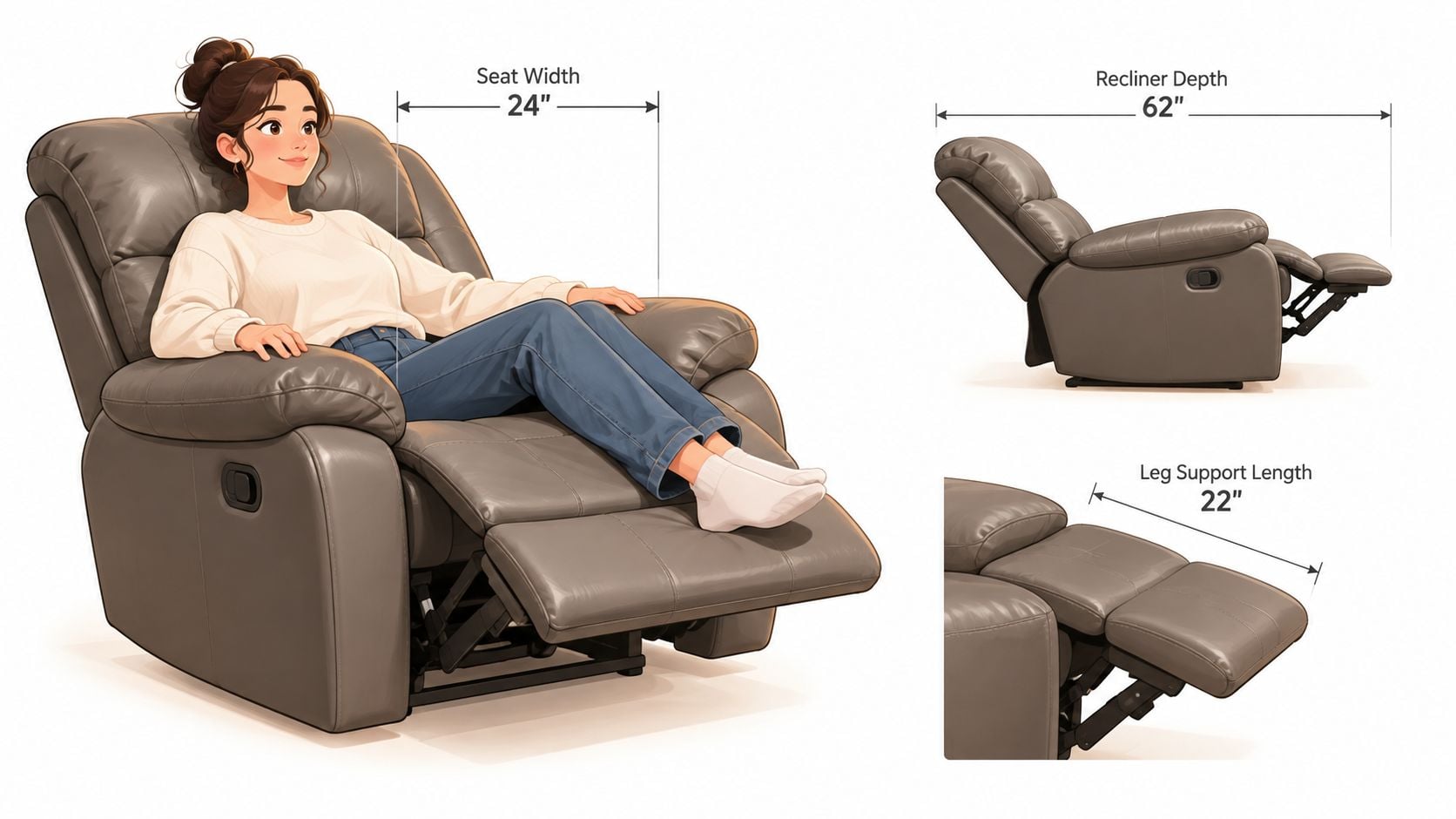
Product specifications also use terms that describe how the chair behaves in a room. Closed depth means the front-to-back measurement when the chair is upright. Reclined depth or reclined length describes the expanded footprint with the back and footrest open. Seat-to-floor height helps shoppers compare the chair with the user's leg length and ease of standing.
That vocabulary turns a vague search into a useful conversation. Instead of asking only for the biggest chair available, a shopper can ask about inside seat width, closed depth, wall clearance, and the fully open footprint.
Sizing Up the Footprint
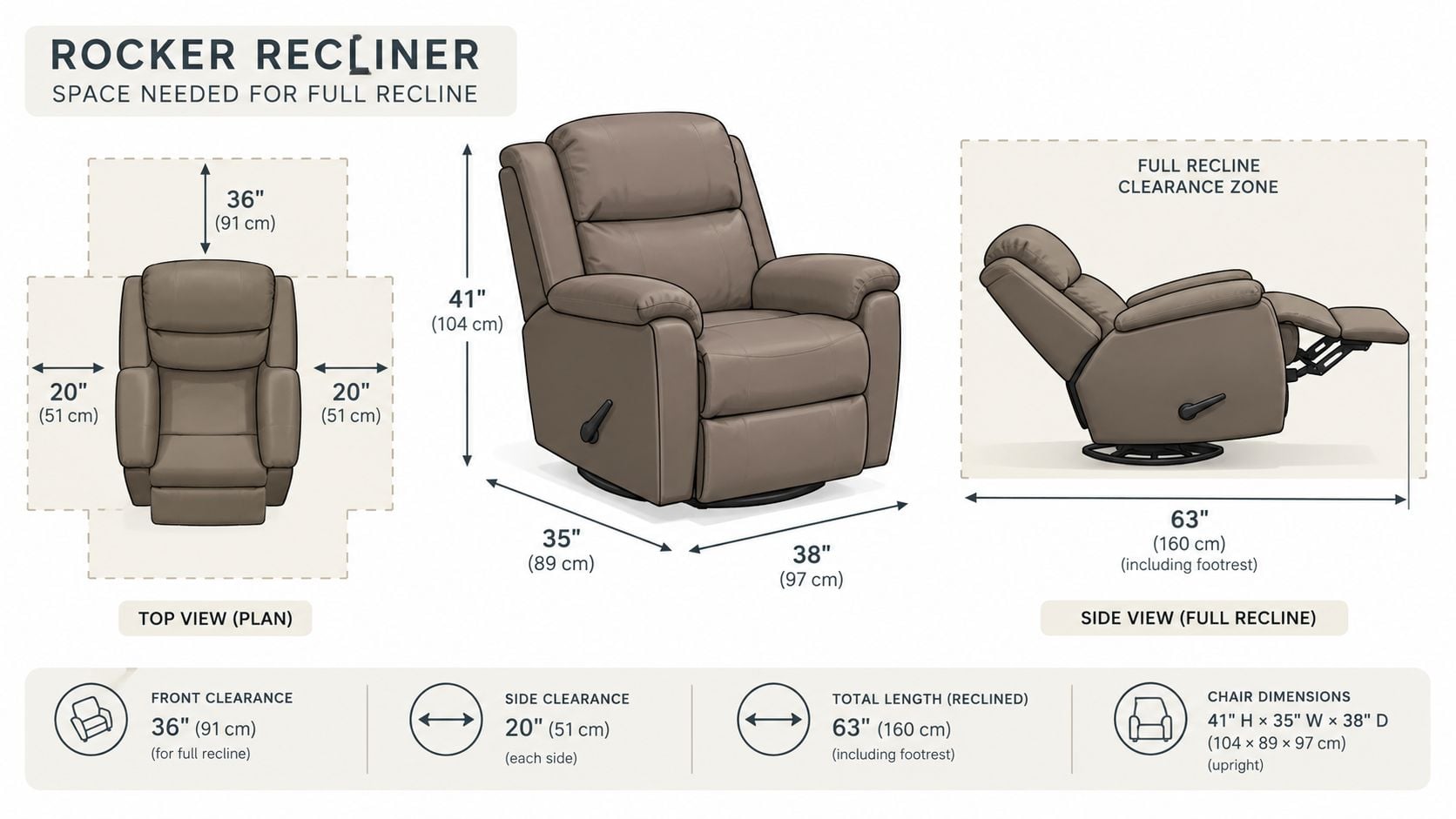
A wide rocker recliner needs a room plan before it needs a fabric choice. Available recliner dimensions place overall chair width between 30 and 42 inches and closed depth between 34 and 41 inches, according to this recliner buying guide. A chair near the wider end of that range may occupy close to 12 square feet before clearance is added.
Those figures describe the outside frame, not the space available to the sitter. That distinction causes many buying mistakes. A chair can be 42 inches wide overall and still provide a narrower seat than expected because the arms and side structure use part of that width.
Measure the room in three positions
The chair needs space in more than its parked position. A standard reclining mechanism generally needs 12 to 18 inches behind the chair, while a wall-hugger design may reduce that requirement to roughly 4 to 6 inches, depending on the model. Some larger mechanisms extend 20 to 30 inches beyond their upright depth when fully reclined, as explained in this recliner clearance guide.
Measure these positions before ordering:
- Upright: Record the chair's width and closed depth.
- Fully reclined: Mark the furthest point reached by the back and footrest.
- Rocking: Leave room for movement around the base and preserve a clear walking path.
A coffee table may be safely away from the chair when upright yet sit directly in the footrest's path when the chair opens. A nearby wall may look harmless until the back requires more clearance.
For a room-by-room approach, use this furniture measuring guide before visiting a showroom. Record the wall length, doorway width, nearby furniture, and the chair's intended position. The aim isn't to make the room feel empty. It's to make sure the recliner can operate without striking furniture or blocking circulation.
Matching the Chair to the Person
The body notices inside dimensions more quickly than the eye notices outside dimensions. A chair may have a broad frame but still feel restrictive if the arms leave too little room. Conversely, an overly wide or deep seat can reduce support by allowing the sitter to slide forward or lose contact with the back.
Recliner interiors commonly measure 20 to 22 inches, while shoppers who need more lateral room should look for at least 24 inches between the arms, based on anthropometric furniture guidance. Seat width should accommodate the user's seated hip breadth with room for clothing and natural movement. Seat depth should support the thigh without pressing behind the knees.
Use the body as the measuring guide
A shopper can take a simple set of measurements at home:
- Hip breadth: Measure across the hips while seated in ordinary clothing.
- Seated depth: Measure from the back of the hips toward the knees.
- Popliteal height: Measure from the floor to the underside of the knee.
- Arm spacing: Compare the usable distance between the chair's arms with the body's natural sitting position.
The relationship matters more than any single number. A deeper seat may suit a taller user, while a shorter user may need a shallower seat to keep the lower back supported. A seat that sits too high can increase foot pressure and make standing more difficult, especially for seniors or people with limited mobility.
Quick Fit Targets for Wide Rocker Recliners
| User Profile | Target Seat Width | Target Seat Depth | Target Seat Height |
|---|---|---|---|
| Average adult | Room for seated hip breadth and movement | Thigh supported without knee pressure | Feet rest naturally |
| Wider adult | At least 24 inches between the arms when needed | Enough depth to shift without sliding | Stable foot contact |
| Taller adult | Width that avoids arm pressure | More thigh support may be appropriate | Knees remain comfortable |
| Shorter adult | Width that allows posture changes | Avoid excess depth | Compare with popliteal height |
| Senior or caregiver-supported user | Easy lateral access without excessive gaps | Back and legs remain supported | Compare closely with popliteal height for transfers |
In the showroom, the test should include upright sitting, gentle rocking, full reclining, and standing. The arms should help the sitter push up without forcing the shoulders into an awkward position. A shopper comparing larger seating can also review recliner options for plus-size comfort while keeping the focus on actual inside measurements.
Power, Lift, and Upholstery Options
A wide rocker recliner can share the same outer size with another chair and still feel completely different to use once the mechanism changes. That is why this decision is about daily function, not just width on paper.
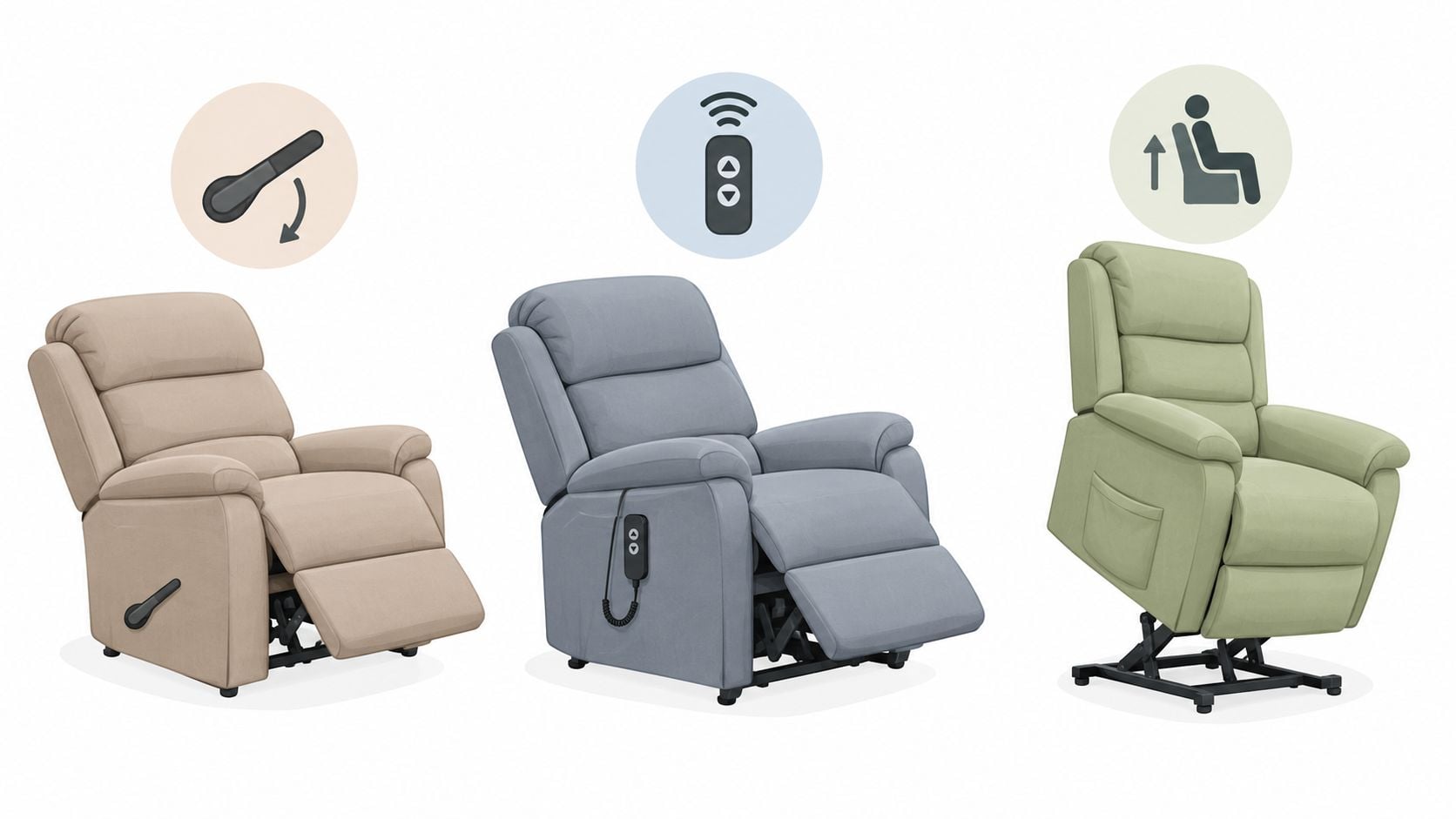
A manual recliner opens with a handle or by shifting body weight. For households that want fewer electronics and no nearby outlet, that simplicity can be appealing. A power recliner trades that hand-and-body effort for buttons or a remote, letting the user stop at a more exact position instead of moving from upright to fully open in one motion. Families comparing control styles can review different types of power reclining seating and then try the buttons, pace, and legrest movement in person.
A power lift recliner serves a more specific job. The seat rises and tilts forward to help with sitting down and standing up, so it belongs in the mobility-support category as much as the comfort category. Shoppers also need to separate terms carefully. A power recliner does not automatically include lift assistance, and a lift chair may change the base design enough that it behaves differently from a standard rocker.
Compare function, movement, and space
| Choice | Useful for | Planning consideration |
|---|---|---|
| Manual rocker recliner | Simple rocking and reclining | The sitter supplies the operating effort |
| Power rocker recliner | Gradual positioning and easier adjustments | The cord needs protected routing |
| Power lift recliner | Assistance with standing and sitting | The lift path needs open space in front |
| Wall-hugger | Rooms with limited rear clearance | The exact mechanism requirements vary |
| Standard rocker base | Gentle movement while upright | Rocking travel must stay clear of nearby furniture |
Lift models deserve one extra check before purchase. The chair needs clear floor area in front of it as the seat tilts up, so the lift path should be confirmed on the model's specification sheet rather than guessed from the upright footprint alone.
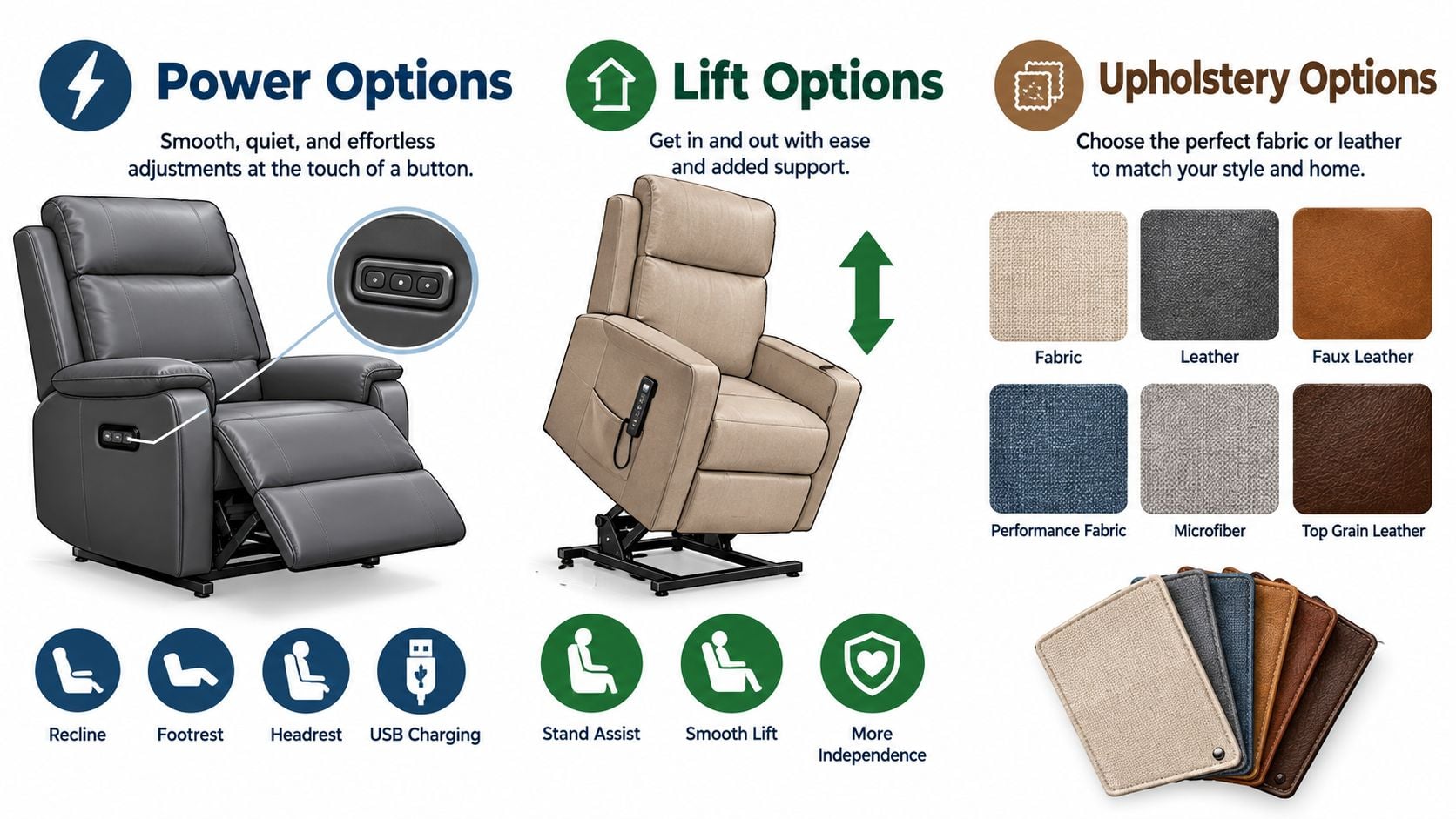
Upholstery matters just as much as the mechanism because the cover changes how the chair lives in the room. Performance fabric can make everyday spills and frequent use easier to manage. Leather gives a distinct hand feel and a surface many households like for quick wipe-downs. Microfiber feels softer and more casual. The best match depends on pets, children, snacks, sunlight, and how often someone will sit there every day.
In Wisconsin, power lift recliners are exempt from sales tax, which can reduce the cost of mobility support for eligible purchases. A helpful associate should explain those differences clearly and help the shopper choose the simplest option that fits the person, the room, and the routine.
Doorways, Hallways, and Rocking Clearance
A wide rocker recliner can look perfect on the sales floor and still stall at the first tight turn into the house. That usually happens when shoppers focus on the sitting space and forget the chair also has to travel through doors, around corners, and into position before anyone can enjoy it.
Start with the full path, not just the room where the chair will live. Measure the narrowest doorway, hallway width, stair turns, elevator openings, and any corner where the recliner must pivot. Then compare those numbers with the chair's outside dimensions, packaged dimensions if available, and the space it needs once assembled. Our guide to furniture for narrow doorways covers how to measure doorways, stair turns, and the fully open footprint before ordering.
Treat movement as part of the footprint
A rocker recliner needs more than a parking spot. It also needs room to move. The base travels as the chair rocks, and the footrest changes how far the recliner reaches into the room when open. That is why outside dimensions and inside seat measurements answer different questions. Seat width tells you how the chair fits the person. The moving footprint tells you how the chair fits the home.
A simple in-home test can prevent surprises. Use painter's tape or folded blankets to map the chair on the floor:
- Mark the upright footprint.
- Extend the outline to the fully reclined position.
- Add space for the rocking arc.
- Walk through the area the way the household normally would.
- Check that a walker, caregiver, pet, or child still has a clear route.
Ask about come-apart construction
Some recliners are easier to deliver because major parts separate. A removable back or a base that comes apart can help a wider chair pass through a narrow doorway or turn on a staircase. It does not fix every layout problem, but it can make delivery possible in older homes, condos, and tighter entries where a fully assembled chair would be difficult to manage.
Clearance matters after delivery too. Keep cords along protected edges, not under moving parts or across walking paths. Blankets, toys, and pet beds should stay away from the footrest and joints. Children should not play under reclining furniture, and the chair should return to its closed position when no one is using it.
Keeping the Chair Feeling New
A wide rocker recliner often becomes a daily-use chair, so care should fit naturally into household routines. One family may vacuum the upholstery while cleaning the living room. Another may wipe the arms after movie night and check the footrest area before closing the chair.
Fabric benefits from regular vacuuming with an upholstery attachment. Spills should be blotted quickly instead of rubbed into the fibers. If the design includes removable or reversible cushions, rotating or fluffing them can help distribute ordinary wear. A household should always follow the upholstery maker's care code rather than applying a random cleaner.
Match care to the cover
Leather needs products intended for leather and occasional conditioning suited to the specific finish. Fabric may need spot treatment, gentle vacuuming, and protection from excess moisture. Microfiber can require a different cleaning method from woven performance fabric, so the care label matters.
A family preparing a new chair can keep a small routine:
- Weekly: Remove crumbs and pet hair from seams and under the footrest.
- After spills: Blot promptly and use the recommended cleaning method.
- Every so often: Inspect visible hardware and listen for unusual movement.
- Before closing the room: Remove cords, blankets, and toys from the mechanism.
A moving joint may benefit from a light spray of silicone lubricant when the manufacturer permits it. Lubricant should never be sprayed indiscriminately around upholstery, electrical components, or areas where children and pets can reach it. For broader fabric and leather guidance, use these upholstery cleaning tips.
Returning the chair upright and closed when it isn't being used protects the footrest area and leaves the walkway open. Small habits won't eliminate normal wear, but they help preserve the chair's support, appearance, and everyday ease.
Your Next Step Toward a Comfortable Chair
A successful wide rocker recliner purchase comes down to five checks:
- Measure the user: Compare hip breadth, seated depth, and popliteal height with the inside seat.
- Measure the room: Mark upright, reclined, footrest, and rocking positions.
- Measure delivery access: Check doors, halls, stair turns, and elevator openings.
- Choose the mechanism: Decide whether manual, power, wall-hugger, or lift operation suits daily needs.
- Choose practical upholstery: Match the cover to children, pets, food, cleaning habits, and room style.
BILTRITE has served the Metro Milwaukee community as a fourth-generation, family-owned business since 1928. The store offers affordable, better-quality furniture, including USA-made, Amish-made, and solid-wood pieces, along with small-scale choices for apartments and senior living and heavy-duty options for families. The showroom also includes a mattress department with over 60 models. The team's sales associates bring over 400 years of combined experience, giving shoppers a knowledgeable, no-pressure place to compare comfort.
BILTRITE doesn't sell online, and the showroom is closed on Sundays so the staff can spend time with their families. That family-first approach makes an in-store visit useful for shoppers who want to sit in several chairs, ask about power lift options, compare fabrics, and discuss delivery access before making a decision.
A wide rocker recliner should feel generous without swallowing the room. When its inside measurements fit the user and its moving parts fit the home, it becomes more than a large chair. It becomes a dependable place for reading, resting, visiting, and enjoying time together.
BILTRITE Furniture-Leather-Mattresses offers hands-on access to wide rocker recliners, power lift seating, USA-made and Amish-made furniture, and practical choices for Metro Milwaukee homes. Visit BILTRITE Furniture-Leather-Mattresses in Greenfield to test the chairs without pressure, ask the experienced team about fit and delivery, and find a comfortable option for the way the household lives.