Yellow Swivel Accent Chair Guide for Milwaukee Homes


A living room can have good bones, comfortable seating, and plenty of daylight, yet still feel a little flat. A yellow swivel accent chair can add the missing spark without committing the whole room to a bold color scheme. In a Bay View apartment, it might give a reading corner a cheerful focal point. In a Whitefish Bay family room, it can bring warmth to a quiet window seat while turning easily toward the sofa when guests arrive.
The useful question isn't only whether the chair looks inviting. It's whether the shade works with the room, the scale leaves enough breathing room, and the swivel base can handle the way the household really uses it. Those details separate a chair that photographs well from one that earns its place every day.
Table of Contents
- Why a Yellow Swivel Accent Chair Brightens Your Space
- The Fun Benefits of a Swivel Seat
- Choosing the Right Shade and Fabric
- Getting the Scale Just Right
- Styling and Caring for Your Chair
- Visit Us at Our Greenfield Showroom
Why a Yellow Swivel Accent Chair Brightens Your Space
A Milwaukee family settling in after a long winter might notice the difference immediately. The sofa is neutral, the flooring is warm wood, and the windows bring in changing daylight. A yellow swivel accent chair near the window adds a lively point of contrast, but its rotating seat also lets the user face the room, look outside, or turn toward the television without dragging furniture across the floor.
That combination makes yellow more than a decorative choice. The color creates attention, while the swivel mechanism gives that attention a practical purpose. The chair can welcome a visitor during conversation, support a quiet reading session, or provide a comfortable place to keep an eye on children playing nearby.
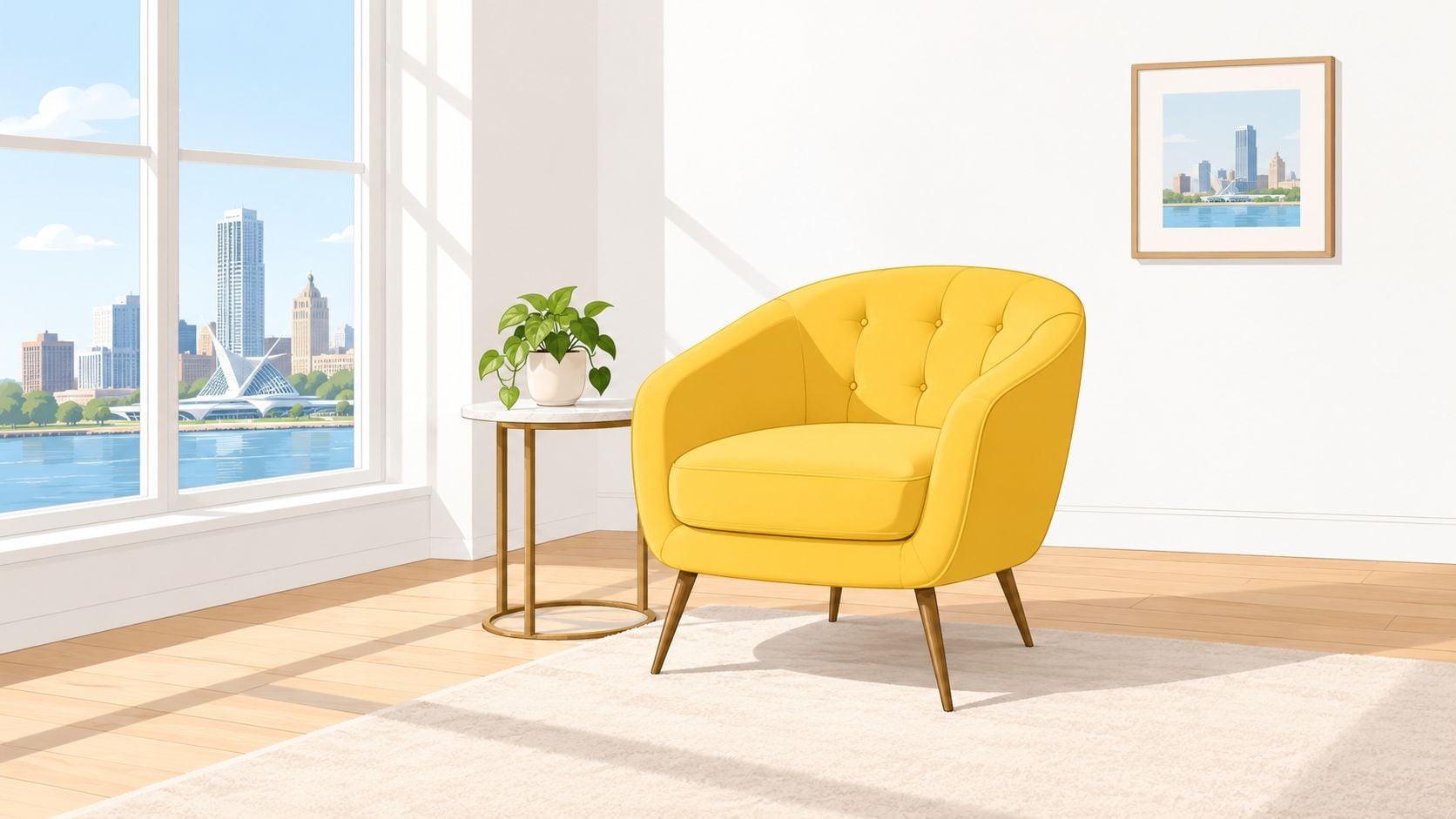
A focal point that still feels useful
Yellow works especially well when the surrounding furniture stays calm. A neutral sofa, simple rug, and restrained wood tones give the chair room to stand out without making the entire space feel busy. Readers looking for more ways to introduce color can also explore practical ideas for adding color without painting.
The chair's visibility from multiple angles matters, too. A stationary accent chair may show its front most of the time, but a swivel chair reveals its upholstery, arms, back, and base as people use it. That makes fabric quality and finish important parts of the room's visual story.
A long history of flexible seating
Swivel seating has a much longer design history than the modern accent chair. A documented early concept appears in a 1505 German manuscript by Martin Löffelholz von Kolberg, showing a chair designed to twist and adjust height. Thomas Jefferson created an early American swivel chair in 1775 by modifying a Windsor chair with upper and lower sections joined by a central iron spindle. The chair could rotate and move on casters, and it has remained in the American Philosophical Society's collection in Philadelphia since 1836. The history of swivel chairs shows how rotation moved from mechanical novelty into everyday furniture.
That lineage helps explain why a yellow swivel accent chair can feel both familiar and fresh. It combines an established movement feature with a welcoming color, giving Milwaukee homes a piece that contributes to conversation, comfort, and character.
The Fun Benefits of a Swivel Seat
A swivel base solves a simple household problem: people rarely use one room for only one activity. A chair may face the television in the evening, turn toward a guest during conversation, and point toward a window during a morning coffee. Rotation keeps those changes easy.
Think of the chair as a small room connector
The mechanism works like a turntable under the seat. Instead of lifting, dragging, or angling the entire chair, the user rotates the seating position while the base stays in place. That's especially useful in smaller rooms, where furniture movement can block a walkway or crowd a nearby table.
A practical routine looks like this:
- Set the chair where people naturally gather. Place it near the edge of the conversation area rather than forcing it into a corner that limits rotation.
- Test every direction. Turn toward the sofa, television, window, and entry path. Each position should feel natural, with no arm striking a table or wall.
- Check the return movement. Some bases rotate freely, while others may feel more centered. The user should know how the chair behaves before choosing its final location.
- Listen while turning. A smooth mechanism should not produce unexpected scraping, clicking, or wobbling during ordinary movement.
Practical rule: A swivel chair needs usable clearance around its moving parts, not just enough floor space for its stationary footprint.
The feature can also improve visibility. A caregiver may want to stay seated while checking on someone nearby. A parent can turn toward children without standing up. A guest can follow a conversation more easily when the chair doesn't force the body to face one direction.
Comfort depends on the whole base
A smooth turn isn't enough if the seat feels unstable or the mounting hardware loosens over time. Buyers should ask whether the base, fasteners, bearing, and frame were tested together, and whether the stated weight capacity applies to static seating, reclining, or rotation. A useful product discussion should distinguish a decorative occasional chair from office-chair-level durability.
For a broader look at how rotating mechanisms are used in seating, shoppers can review information about swivel bases for recliners. The same principle applies here: the mechanism should match the expected frequency and style of use.
Choosing the Right Shade and Fabric
Yellow isn't one color. Butter yellow, mustard, ochre, jewel yellow, and green-tinged yellow can create very different moods, especially when the chair is visible from several directions.
Match the undertone to the room
Butter yellow can behave like a warm neutral. It tends to sit comfortably beside soft beige, light wood, cream, and gentle gray, making it a friendly choice for a room that needs brightness without a dramatic contrast.
Mustard and ochre bring more depth. They can work beautifully with cool gray walls, navy accents, and restrained upholstery, but mustard may compete with orange-toned oak if both colors are strong. Walnut and darker wood can provide a richer backdrop for a deeper yellow, though the room may need lighter textiles to keep the composition balanced.
Jewel yellow has more visual intensity. It can anchor a room with quiet surrounding colors, but pairing it with several saturated accents may make the space feel crowded. A simple rug, neutral sofa, and limited accessory palette usually give this shade enough support.
Recent design coverage points in more than one direction. A 2025 designer survey placed butter yellow among leading colors at 12%, while another survey found preferences for dark yellow and mustard declining from 20% to 15% year over year. The survey coverage also reflects interest in both lighter yellows and richer tones. The practical lesson is clear: choose the undertone that works with the home, not only the shade receiving attention.
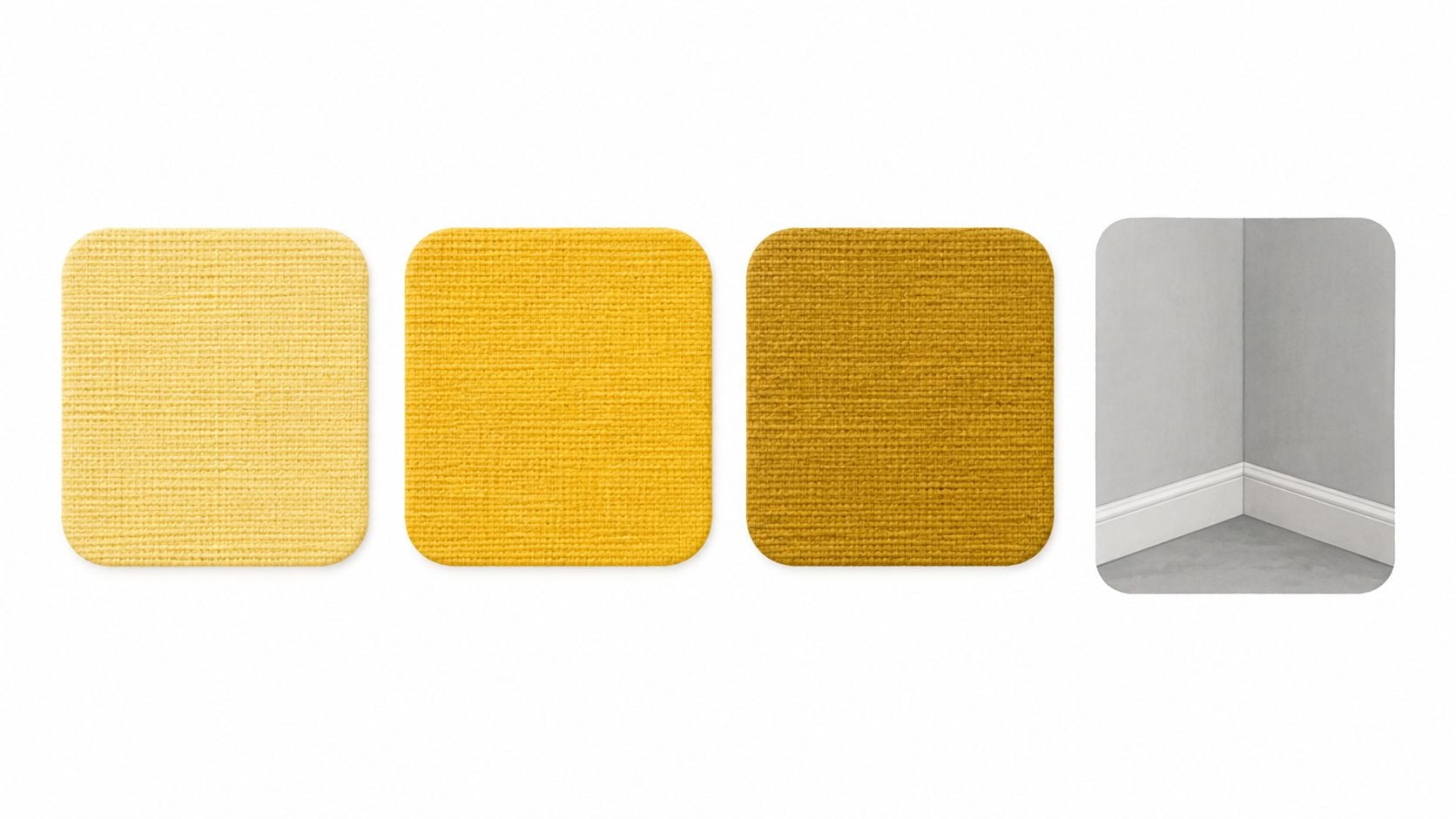
Compare fabric by household demands
A reading corner may favor a soft upholstery with a relaxed hand, while a busy family room may need a fabric that tolerates frequent contact and routine cleaning. Bright upholstery can make crumbs, marks, and wear easier to notice, so the cleaning code, weave, and care instructions deserve attention before the color wins the decision.
A useful comparison looks like this:
| Room situation | Fabric priority | Color approach |
|---|---|---|
| Quiet reading area | Hand feel and comfort | Butter or soft golden yellow |
| Family conversation room | Cleanability and wear resistance | Mid-tone yellow with visual texture |
| Formal sitting room | Surface appearance and tailored finish | Ochre or jewel yellow |
| Small apartment | Light visual weight | Pale yellow with simple surrounding colors |
A showroom swatch should be viewed beside the actual flooring, wall paint, and nearby wood. Daylight and evening lamps can change the way yellow reads, so a shade that looks balanced at midday may appear more orange or green later. BILTRITE's fabric selection guidance can help shoppers organize those questions before comparing chairs in person.
Getting the Scale Just Right
A chair can be attractive and still be too large for the room. Scale starts with measurements, but it ends with movement, sightlines, and comfort.
Measure the intended location, then note the distance to the sofa, coffee table, wall, doorway, and heating or cooling vents. Mark the chair's approximate footprint on the floor with painter's tape. Rotate within that marked area and check whether the arms would meet a table, whether the back would crowd a walkway, and whether the user could get in and out without squeezing past another seat.
Check the usable seat, not only the frame
Seat geometry strongly affects comfort. Anthropometric guidance gives adult seated depth ranges of approximately 16.9 to 20.4 inches for one population group and 17.7 to 21.1 inches for another, while a clinical anthropometric study reported an ideal seat height near 33 cm, or 13 inches, for its sampled users. The anthropometric reference illustrates why outside dimensions don't tell the whole story.
The sitter's back should meet the backrest while the cushion leaves a small clearance behind the knees. Excessive depth can encourage a shorter user to slouch, while insufficient depth can reduce thigh support. Finished seat height also matters because a swivel base may raise the seat and change how stable the chair feels.
Use the room's rhythm as a guide
A compact chair can suit an apartment, condo, smaller home, or senior living space when the seat and base remain proportional to the room. A larger upholstered chair may anchor a spacious family room, but it shouldn't block the route between the sofa and kitchen.
Before ordering, shoppers should confirm:
- Finished seat height: Compare it with the user's footwear and nearby tables.
- Usable seat depth: Measure the cushion area rather than the outer frame.
- Base diameter: Allow room for rotation and foot placement.
- Doorway access: Check the delivery path, not only the final location.
The furniture measuring guide offers a useful starting point. In a showroom, sitting down matters just as much as measuring. A chair can look compact from across the room but feel too deep, too low, or difficult to turn once occupied.
Styling and Caring for Your Chair
A yellow swivel accent chair works best when the rest of the room supports it without trying to compete. A beige sofa, white throw, natural wood table, or quiet patterned rug can give the chair a clear role. A pillow in blue, cream, gray, or a muted green can connect the yellow to existing décor without repeating the exact shade everywhere.
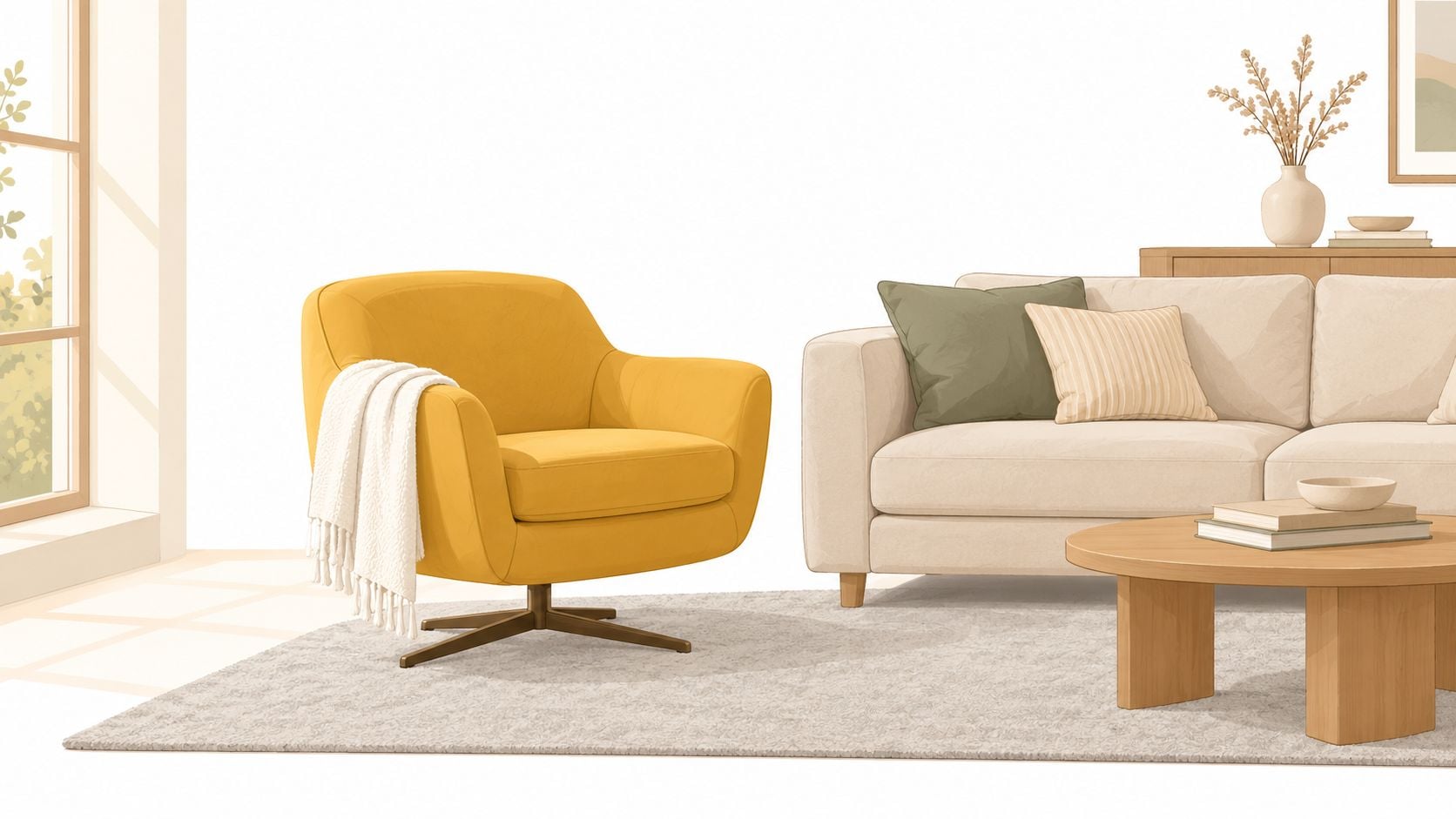
Keep the styling flexible
Because the chair turns, its back and side profile remain part of the room. A neat finish on every visible surface matters, particularly when the chair sits near a window or separates two areas. A small table should leave enough room for the seat to move, and a floor lamp should illuminate the reading position without becoming an obstacle.
Ideas for using an accent chair can help homeowners decide whether the chair belongs beside a sofa, in a bedroom corner, near a bookcase, or in a home office.
Protect the upholstery and mechanism
Care begins with the manufacturer's cleaning instructions. Spills should be addressed according to the fabric's care code rather than treated with an improvised cleaner. Regularly removing surface dust and avoiding harsh scrubbing can help preserve the upholstery's color and texture.
The rotating base deserves its own inspection. Turn the chair slowly and listen for changes in sound. Check for wobble, loose fasteners, or a mounting plate that shifts under ordinary seating. Buyers seeking long-term value should ask whether the swivel hardware is replaceable or serviceable, whether the warranty covers mechanism failure, and whether the upholstery can be repaired or replaced.
Durability has become a meaningful purchasing priority. In a survey of German consumers, 95.5% rated durability important or very important, while 65.3% rated sustainability important or very important. A European study found that 77% wanted to repair products before replacing them, while 64% did so. The furniture durability discussion supports a straightforward buying habit: ask how the chair can be maintained before assuming a durable-looking fabric tells the whole story.
For shoppers comparing local construction, BILTRITE Furniture-Leather-Mattresses identifies USA-made pieces with a store icon and separately marks solid-wood furniture, so country of origin and material construction can be checked as distinct details. Amish-made options provide another craftsmanship category to discuss with showroom staff.
Visit Us at Our Greenfield Showroom
BILTRITE has served the Metro Milwaukee community since 1928. Irwin Kerns opened BILTRITE Upholstery in Milwaukee that year, making and selling custom sofas from a small storefront on Third Street and Garfield. The business expanded its inventory in the same year and became BILTRITE Furniture. Mort Komisar took over in 1964, his son Marty began working there as a teenager, and Marty assumed leadership in 1970. The family moved to the current Layton Avenue location in Greenfield in 2006, where the showroom covers 45,000 square feet. The business celebrated 96 years in operation in 2024 and remains active as a four-generation family business. BILTRITE's family history is part of what makes the local showroom experience different from choosing furniture by photograph alone.
At 5430 West Layton Avenue in Greenfield, shoppers can sit in swivel chairs, test the rotation, compare seat heights, and place fabric colors beside real room settings. The sales associates bring over 400 years of combined experience, and their role is to answer questions without pressure. The showroom includes small-scale choices for apartments and senior living spaces, heavier-duty furniture for families, USA-made and Amish-made categories, and a mattress department with over 60 models.
Wisconsin shoppers may also want to know that all power lift recliners are exempt from sales tax in Wisconsin, which can make mobility-focused seating more affordable. Power lift recliners don't swivel, so they should be evaluated separately from an accent chair, with attention to support, lift function, and transfer needs.
BILTRITE is closed on Sundays to be with family, and the showroom experience is hands-on by design. Shoppers can ask about a chair's capacity, base construction, cleaning code, warranty, origin, and repair options before making a decision. Location details and showroom information can help plan a visit.
BILTRITE Furniture-Leather-Mattresses offers affordable, better-quality furniture, leather seating, Amish and USA-made pieces, and mattresses for Metro Milwaukee homes. Visit BILTRITE Furniture-Leather-Mattresses in Greenfield for a no-pressure chance to test a yellow swivel accent chair, compare fabrics, and ask the team what will fit your room and daily life.