What Is the Best Reclining Sofa to Buy


A Milwaukee family usually starts shopping for a reclining sofa after the old couch has stopped keeping up. One person wants a comfortable place for movie nights, someone else needs stronger back support, and the room still has to leave space for toys, pets, coffee tables, and a clear path to the kitchen. Then two sofas look almost alike, but one feels supportive while the other feels soft and saggy after a few minutes.
So, what is the best reclining sofa to buy? The answer isn't the sofa with the longest feature list or the lowest ticket price. It's the one that fits the household's bodies, room, delivery route, daily habits, and expectations for long-term use. The right showroom test reveals more than a product photo ever can.
| Shopper priority | Strong starting point | What matters most |
|---|---|---|
| Small room or apartment | Wall-hugger or compact motion sofa | Rear clearance, open footprint, delivery access |
| Easy everyday operation | Power reclining sofa | Control reach, smooth motion, cord placement |
| Traditional simplicity | Manual reclining sofa | Lever feel, body effort, mechanism stability |
| Mobility assistance | Power lift recliner | Transfer safety, seat height, firm arms, reachable controls |
| Busy family room | Durable reclining sofa or sectional | Frame, upholstery, serviceability, warranty |
| Different body sizes | Independently adjustable power seating | Lumbar, headrest, footrest, and seat geometry |
Table of Contents
- Finding the Right Reclining Sofa for Your Home
- Reclining Sofa Types and Mechanisms Explained
- Seat Geometry Pressure Distribution and Real Comfort
- Durability Frame Construction and Mechanism Cycles
- Reclining Sofas for Older Shoppers and Caregivers
- Room Fit Wall Clearance and Delivery Path Planning
- Matching Reclining Sofa Styles to Real Milwaukee Homes
Finding the Right Reclining Sofa for Your Home
A Milwaukee couple recently stood between two reclining sofas in the BILTRITE showroom, both attractive, both comfortable at first glance, and both large enough for their living room. One had more visible features. The other felt steadier beneath the lower back and allowed the taller shopper's heels to rest fully on the footrest. After sitting upright, reclining, and returning to a seated position several times, the decision became much easier.
That is the showroom advantage. A reclining sofa isn't just a color, fabric, or silhouette. It changes position, supports a body in different ways, and occupies more floor space when open. The sofa that looks best across the room may not be the sofa that feels best during a full movie or supports a family member who has trouble standing.
Start with the people who will use it
The household's routine should lead the search. Daily lounging, occasional guests, children, pets, reading, television, afternoon naps, and mobility concerns all point toward different priorities. A family that shares every seat needs consistent support and sturdy motion hardware. A smaller household may care more about a compact footprint, quiet operation, and a clean profile.
Shoppers can begin with BILTRITE's reclining sofa and loveseat selection for a sense of the available formats, then test the actual pieces in person. The important question isn't whether a sofa has every possible feature. It's whether the features improve the way the household already lives.
Showroom advice: A sofa should feel supportive in at least three positions, not merely comfortable during a quick upright sit.
BILTRITE has served the Metro Milwaukee community since 1928 as a fourth-generation, family-owned business. That history shapes the shopping experience. The team focuses on helping families compare comfort, construction, size, and value without turning a furniture decision into a high-pressure event.
Price is only one part of value
A cheaper sofa can become an expensive choice if its mechanism, cushions, or upholstery can't handle the household's routine. A better comparison includes repair access, warranty coverage, construction, delivery fit, and whether the sofa can be serviced instead of discarded.
BILTRITE's approach is straightforward. The store offers affordable, better-quality furniture, including USA-made, Amish-made, and solid-wood pieces, alongside small-scale options for apartments and heavier-duty choices for demanding households. The sales associates bring more than 400 years of combined experience, so shoppers can ask practical questions and receive guidance rather than a feature recital.
Reclining Sofa Types and Mechanisms Explained
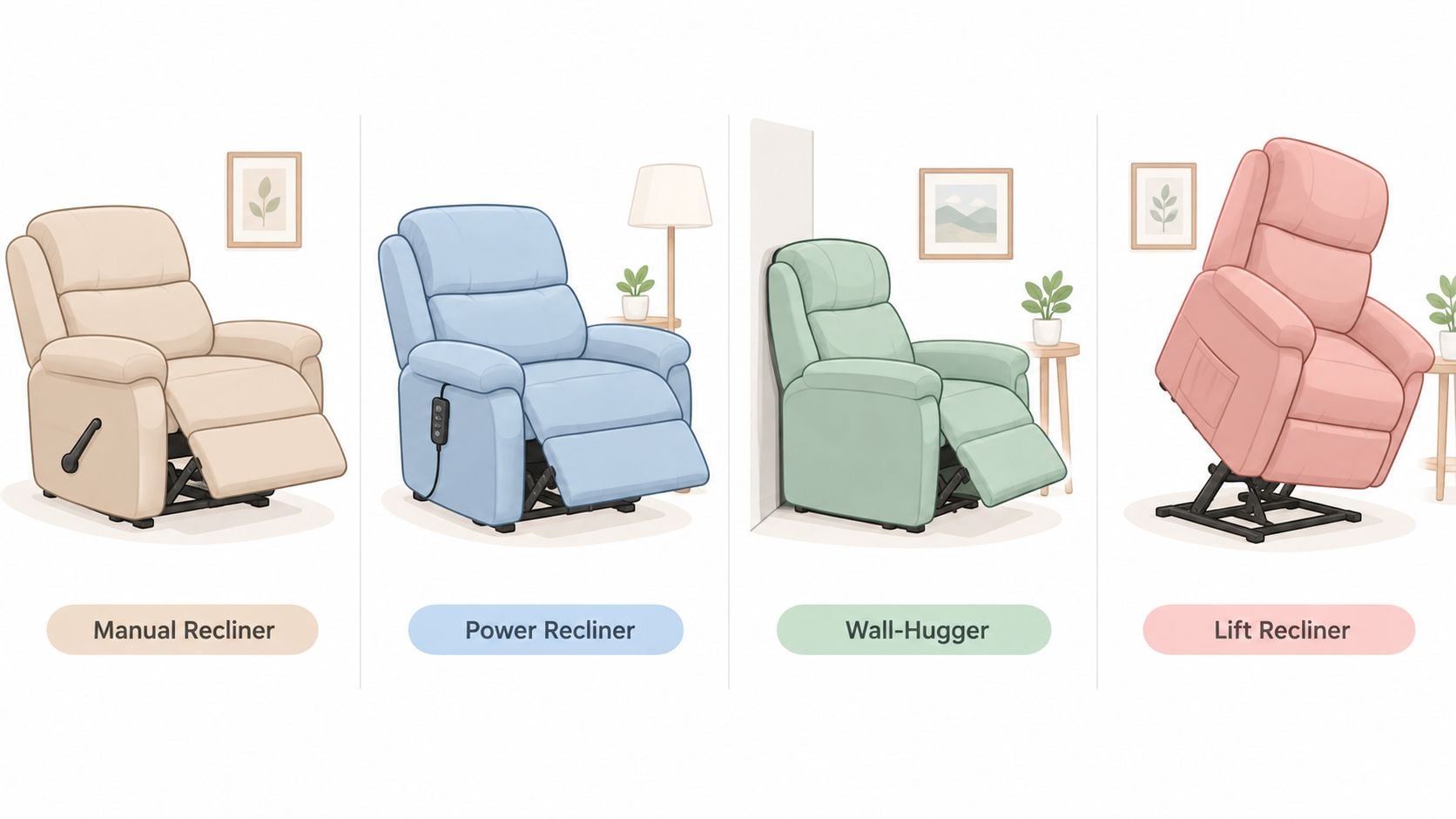
The main reclining sofa categories are easier to understand when each is tied to a real household need. Manual models rely on a lever or body movement. Power models use an electric motor. Wall-hugger designs reduce rear travel, while lift recliners help a person move between sitting and standing. Sectional recliners combine motion seating with a larger room layout.
Manual and power mechanisms
A manual reclining sofa suits shoppers who prefer a simpler operation and don't want to position the sofa around a power outlet. The lever should feel easy to reach and operate, and the footrest should open without excessive leg effort. Manual is a strong choice when the users can comfortably control the mechanism and prefer fewer electrical components.
A power reclining sofa uses buttons and motors to move the back and footrest. It can be especially useful for someone with back, knee, or mobility concerns because the user doesn't need to push hard against a lever. A power model does require thoughtful cord placement, accessible controls, and enough room for the mechanism to operate safely.
BILTRITE's power reclining sofa options give shoppers a useful starting point for comparing powered layouts in person. Independent headrest and footrest controls can help people with different heights find a better viewing position, but only if those controls are easy to reach and understand.
Wall-hugger and zero-wall designs
Wall-hugger and zero-wall mechanisms move the seat forward as the back reclines, reducing rear movement. They don't mean the sofa can sit flush against the wall. Planning guides recommend roughly 3 to 8 inches of rear clearance for many wall-hugger designs, while the manufacturer's specification should control the final placement, as explained in this wall-hugger space planning guide.
These models work well in compact rooms, but the forward movement still needs testing. A wall-hugger can save wall space while extending farther into a walkway.
Sectional and lift formats
A reclining sectional creates several seating positions and can anchor a larger family room. Its trade-off is scale. The shopper must measure the full layout, open seats, corners, and delivery path rather than measuring only one section.
A lift recliner belongs to a different category. It raises and tilts the chair to assist with standing, while a standard reclining sofa changes the sitting angle but doesn't lift the user. Caregivers should never assume that a regular power recliner provides the same transfer support as a lift model.
A standard reclining sofa helps the body recline. A lift recliner helps the user move between sitting and standing.
Seat Geometry Pressure Distribution and Real Comfort
Softness gets attention because it is easy to feel immediately. Pressure distribution matters more after the first few minutes. A cushion can feel plush in the showroom yet allow the pelvis to slide forward, separate the lower back from the support, or leave the feet dangling once the seat reclines.
Ergonomic pressure research indicates that upright sitting should concentrate peak pressure near the ischial tuberosities, commonly called the sitting bones. As the body reclines, meaningful support shifts toward the lumbar and thoracic regions away from the spine. A technically stronger sofa maintains lumbar contact as the back angle changes, supports the head without forcing the neck forward, and lets the feet rest fully on the footrest, as described in this research on pressure distribution.
The three-position showroom test
A useful test takes longer than a quick sit, but it prevents many disappointing purchases.
- Upright conversation position: Sit with both feet supported and notice whether the seat depth lets the lower back stay in contact without forcing the knees upward.
- TV position: Raise the footrest and recline moderately. Check whether the head stays level, the pelvis remains stable, and the lower back still feels supported.
- Full recline: Open the sofa completely. Confirm that the footrest supports the heels, the knees aren't pressed by a hard edge, and the headrest doesn't push the chin toward the chest.
Stay in each position for several minutes. The body often notices pressure hotspots only after the initial cushion softness stops being novel.
Body proportions change the answer
A shorter shopper may struggle with a seat that is too deep, while a taller shopper may find that the footrest ends before the heels. The correct seat geometry depends on leg length, torso length, shoulder height, and how each person naturally sits.
Households with different body sizes should pay close attention to independently adjustable power headrests and footrests. They offer more fit flexibility than one synchronized movement, especially when one family member needs stronger neck support and another needs a different leg angle.
For shoppers focused on lumbar comfort, BILTRITE's back-support recliner guidance can help frame the showroom conversation. The practical test remains physical: does the body stay supported through movement, or does the user need to keep shifting to get comfortable?
Don't confuse softness with support
The best reclining sofa isn't necessarily the softest model. Research on sofa pressure comfort found preferred seat-cushion firmness at 4.0 ± 1.35 and backrest firmness at 3.25 ± 1.07 on the study's measurement scale. Under the most comfortable condition, average seat pressure measured 0.43 ± 0.06 N/cm², while peak pressure measured 0.89 ± 0.37 N/cm², according to this study of sofa pressure comfort.
Those findings support a simple showroom rule. Choose balanced contact and sustained support over a cushion that feels dramatically soft for one minute.
Durability Frame Construction and Mechanism Cycles
A reclining sofa earns its keep in the joints, not in the sales tag. If the seat fits your body but the mechanism loosens, the frame twists, or a switch fails with no replacement path, comfort will not last. Start with one plain question. Can this sofa be serviced, or is it headed for the curb when one part wears out?
That question matters because people expect a sofa to stay in the home for years. A consumer survey found that more than 90% of buyers said quality and durability matter in home furnishings, and expected to keep a new sofa for about 10 years, according to this consumer research on furniture quality and ownership. A cheap price loses its appeal fast if the mechanism cannot be repaired or the maker cannot supply parts.
Ask for a measurable mechanism test
Sales language is easy. Test standards are better. The clearest benchmark is a documented cycle test for the reclining action itself, not just a claim that the sofa was built to last.
The U.S. General Services Administration method defines one full cycle as closed, to TV position, to full recline, and back to closed. The procedure runs for 25,000 cycles or until failure, as shown in the GSA upholstered furniture test method. If a retailer or manufacturer cites cycle testing, ask what was tested, what load was used, what counted as failure, and which parts the warranty covers. Frame coverage and mechanism coverage are not the same. Motor, wiring, switch, and upholstery terms may also differ.
For a busy family room, a result near or above 25,000 full-motion cycles is a useful line in the sand. So is a warranty that covers the pieces most likely to need attention.
Examine the construction, not just the cover
Look underneath if you can. A better reclining sofa usually shows its quality in secure mechanism mounting, steady movement, and a frame that does not flex or rack under shifting weight. Cushions should feel supportive through the full motion of the seat, not puffy on first sit and hollow a minute later. Upholstery should also match real life. Pets, spills, jeans rivets, and daily use will test the cover long before a fabric card impresses anybody.
Serviceability is what separates a keeper from a disposable purchase. Ask whether motors, switches, power supplies, wiring, cushions, and upholstery panels can be replaced after years of use. Ask whether parts are still available after the warranty expires. That is the practical standard behind this guide to how long furniture should last.
Practical rule: buy the reclining sofa with documented testing, steady construction, and replaceable parts. Those details matter more than a long feature list.
Reclining Sofas for Older Shoppers and Caregivers
Older shoppers and people with limited mobility need more than a soft seat. They need a sofa that supports sitting down, repositioning, reclining, returning upright, and standing without strain. Seat height, seat depth, arm placement, back angle, base stability, and control reach all decide whether the furniture works in daily life.
A 2025 peer-reviewed seating study found that comfort for older users depended heavily on the combination of seat height and backrest inclination. The most favorable tested configuration used a 105° backrest angle, according to this study of seating comfort for older users. That number is a starting point, not a rule. Body proportions differ, so the true test happens in the showroom, with the actual user in the actual seat.
Test the transfer, not just the recline
A caregiver should watch how the intended user performs the complete movement:
- Can the person sit down without dropping heavily into the cushion?
- Do the feet stay stable on the floor while standing?
- Can the arms provide useful support without being too low or too soft?
- Does the pelvis slide forward during recline?
- Can the controls be reached without twisting?
- Does the footrest retract fully and leave a clear walking route?
A power button reduces effort, but it cannot fix poor seat geometry. A seat that is too deep forces a shorter user to slide forward. A seat that is too low makes standing harder. A firm, stable base and supportive arms matter more than decorative details, and no motor compensates for a seat that fights the user's body.
Standard recliner or lift recliner
A standard reclining sofa changes the back and footrest position. It does not lift the user to standing height. A power lift recliner raises and tilts the seat to assist with transfers, which makes it the right category for some mobility needs. If standing up unassisted is the hard part of the day, that is the category to test first.
BILTRITE's recliners with lift support should be tested by the actual user whenever possible. Wisconsin shoppers should also know that power lift recliners that qualify as mobility aids may be exempt from Wisconsin sales tax. Confirm current rules with the retailer or the Wisconsin Department of Revenue before purchase, since eligibility depends on how the unit is classified.
The control should be reachable with limited hand strength, and the user should understand each button before relying on it. A caregiver should assess stability in the upright position, footrest retraction, arm support, and the user's ability to transfer safely. Bring the user to the showroom. Ten minutes in the seat tells you more than any spec sheet.
Room Fit Wall Clearance and Delivery Path Planning
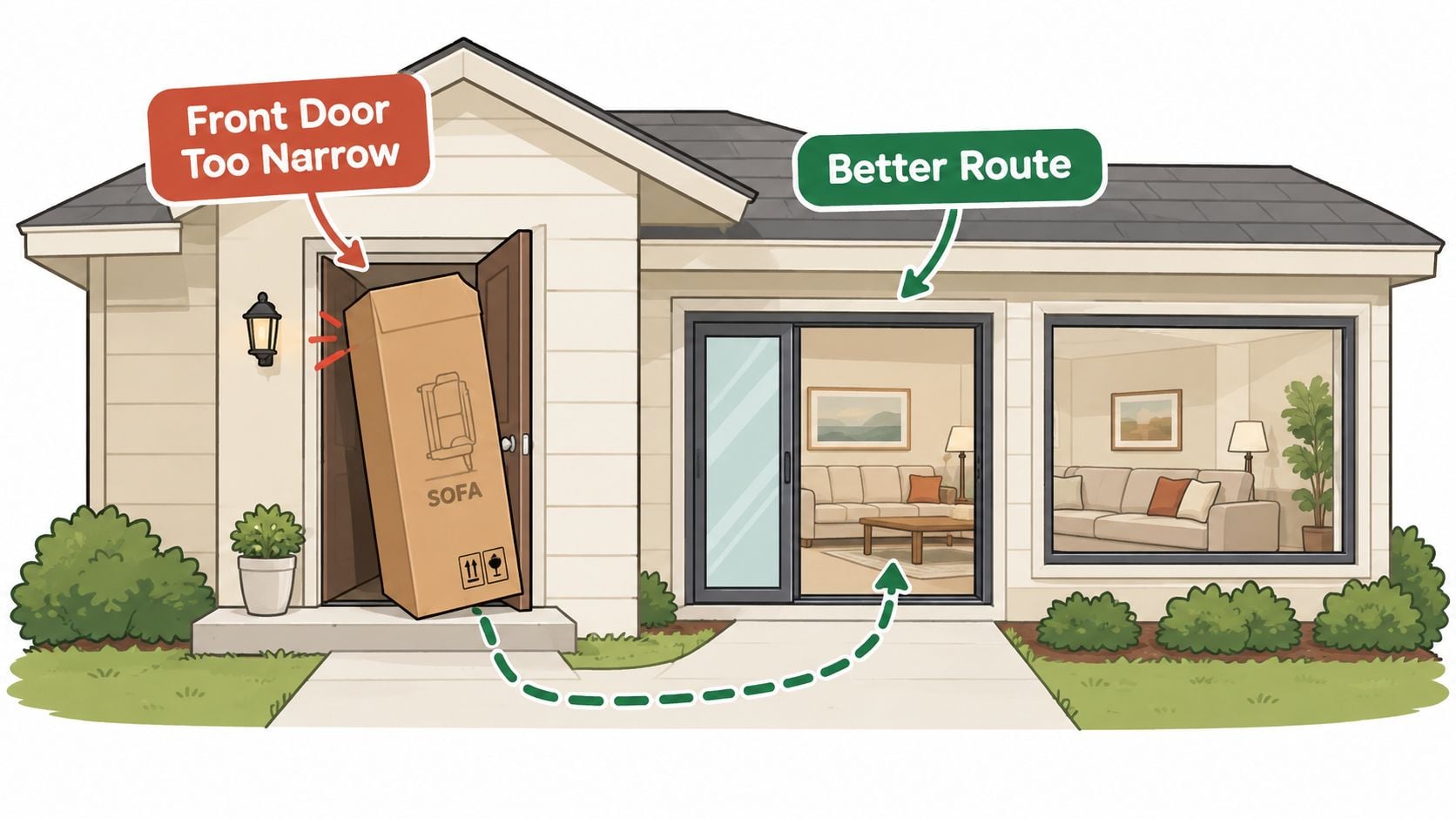
A reclining sofa can fit the living room and still fail at the front door. Delivery fit deserves its own measurement check because the sofa must pass through every narrow point before it reaches the room where it will live.
Capture the operating footprint
Measure the closed sofa, fully reclined depth, footrest extension, seat width, and nearby walking paths. Then use painter's tape to mark both the upright and open footprints on the floor. The test should show whether someone can still pass safely when the sofa is fully extended.
Typical rear clearance varies by mechanism. Manual rockers may need about 6 to 12 inches, standard power recliners about 5 to 12 inches, and zero-wall or wall-hugger models roughly 0 to 5 inches, according to this reclining sofa clearance guide. These are planning ranges, not universal rules. The exact manufacturer's specification controls because back travel, seat movement, and upholstery design differ.
| Measurement to capture | Typical range | Why it matters |
|---|---|---|
| Manual rocker rear clearance | About 6 to 12 inches | Allows the back to travel without striking the wall |
| Standard power recliner rear clearance | About 5 to 12 inches | Accounts for motorized back movement |
| Zero-wall or wall-hugger rear clearance | Roughly 0 to 5 inches | Reduces rear travel but still needs model-specific confirmation |
| Fully open footprint | Model-specific | Shows whether the footrest blocks a walkway |
| Primary room path | Layout-specific | Helps family members pass without hitting an open footrest |
Measure the delivery route completely
Record the narrowest clear opening at the front door, interior doors, hallways, stair turns, elevator openings, and tight corners. Include trim, hinges, handles, railings, and the space needed to turn the sofa before and after each opening.
Ask whether the back removes or whether the sofa separates into modules. A come-apart sofa or sectional can be a major practical advantage in an older Milwaukee home, apartment, condo, or senior living space. The final check should use the exact model's packaged or upright delivery dimensions, not a generic sofa size.
Delivery rule: The living room isn't the finish line. The narrowest doorway and tightest turn decide whether the sofa can arrive.
Matching Reclining Sofa Styles to Real Milwaukee Homes
The right reclining sofa depends on how your household uses the room. A small Greenfield apartment needs compact movement and an easy delivery route. A busy Bay View family room needs sturdy seating and simple service access. Brookfield senior living calls for stable transfers, while a Wauwatosa media room needs support through long viewing sessions.
| Milwaukee home scenario | Recommended direction | Showroom test |
|---|---|---|
| Small Greenfield apartment | Wall-hugger or compact power sofa | Mark the open footprint and confirm rear clearance |
| Busy Bay View family room | Durable power sofa or sectional | Test every seat, inspect the frame, ask about service parts |
| Brookfield senior living setup | Lift recliner or supportive power seating | Practice sitting, standing, control reach, and footrest retraction |
| Wauwatosa media room | Full-support power sofa or sectional | Check head, lumbar, heel, and viewing-angle support |
Small apartment living
For a Greenfield apartment, measure the wall, walkway, and complete delivery route before choosing a style. A wall-hugger can preserve floor space, but it still needs the manufacturer's stated clearance and room for the footrest to extend. Compact dimensions do not guarantee comfort. Sit in the sofa and check whether the seat depth, back angle, and arm height fit your body.
A come-apart design can solve a difficult entry hallway or stair turn. That route is the binding constraint when the room has plenty of space but the packaged sofa cannot make the turn.
Busy family rooms
A Bay View family room needs seating that handles frequent use, children moving around it, pets, snacks, and simultaneous reclining. Choose upholstery that suits the household's cleaning routine. Then inspect the frame, mechanism mounting points, and available service parts rather than judging the sofa by features alone.
For long-term value, construction and repair support deserve close attention. The furniture durability survey reinforces why shoppers should examine how a sofa is built and supported, not just how it feels during a short test.
For this scenario, ask whether the back removes and whether the sofa separates into manageable sections. A serviceable, come-apart design can make delivery easier and future repairs more practical.
Senior living and media rooms
Brookfield shoppers should test transfer stability, supportive arms, control reach, and the user's actual body dimensions. Wauwatosa media-room shoppers should sit upright, watch-TV, and fully reclined, checking head, lumbar, heel, and viewing-angle support in each position.
BILTRITE Furniture-Leather-Mattresses offers small-scale furniture, heavy-duty options, lift recliners, USA-made and Amish-made pieces, plus a mattress department with over 60 models. The family-owned Greenfield store lets shoppers compare fit in person with guidance from associates.
Visit BILTRITE Furniture-Leather-Mattresses for a hands-on, no-pressure test of reclining sofas and lift recliners. Bring your room measurements and delivery concerns, then compare comfort, access, and serviceability before choosing.