Lift Chairs Zero Gravity: Comfort and Health Guide


A long day can make a familiar recliner feel surprisingly unforgiving. An older adult may sit down to watch television, then shift repeatedly because the lower back stays tense, the knees don't feel supported, or the legs feel heavy after prolonged sitting. A caregiver may want to help, but choosing between a standard recliner and a powered lift chair can quickly become confusing.
Lift chairs zero gravity combine two functions in one piece of furniture. The lift mechanism helps a person move from sitting toward standing, while the reclining system aims to place the body in a NASA-inspired neutral posture. That doesn't make the chair a medical cure, but it can create a more supported way to rest at home.
The details matter. The right chair must fit the person, clear the walls and walkways, operate with ease, and make realistic claims about comfort. The following guide explains what zero gravity means, how the motors work, which benefits are reasonable to expect, and what families should check before bringing one into the living room.
Why Zero Gravity Lift Chairs Are Changing Living Rooms
A standard recliner usually gives a person two broad choices: sit upright or lean back with the footrest raised. That arrangement can feel comfortable for a while, but it may leave the body folded at the hips, with pressure concentrated around the seat, lower back, and tailbone. A zero-gravity lift chair approaches the problem differently by coordinating the backrest and legrest to support more of the body at once.
The lift function also addresses a practical challenge. Instead of forcing the user to push hard through the knees or pull against the armrests, the chair raises and tilts forward to assist the transition toward standing. For seniors and people with mobility limitations, that support can make a familiar daily movement feel more manageable.

A larger category with everyday demand
Lift chairs have moved well beyond a narrowly specialized product category. One market estimate places the global lift chair category at about USD 4.19 billion in 2024, with a projection of roughly USD 9.74 billion by 2034 and an 8.1% CAGR from 2025 to 2034. Another estimate places 2024 revenue at USD 4.3 billion and projects USD 6.2 billion by 2030, showing that research firms differ on exact values while still describing a large, expanding category. These figures come from lift chair market estimates.
That growth reflects practical needs, including aging populations, mobility limitations, and the desire to make home seating easier to use. Zero-gravity models sit inside that broader category, combining mobility assistance with a more adjustable resting position.
Comfort deserves a careful test
The phrase “zero gravity” can sound futuristic, but the useful question is simple: does the chair support the user's body without creating new pressure points? A chair that feels wonderful for one person may leave another person's head pushed forward or knees unsupported.
Practical rule: A lift chair should help with both major transitions, sitting to resting and resting to standing, without making either movement complicated.
Families should treat the purchase as a long-term furniture decision, not a quick gadget purchase. Room layout, body proportions, control design, service support, and safe load ratings all deserve attention before a chair comes home.
What the Zero Gravity Position Means
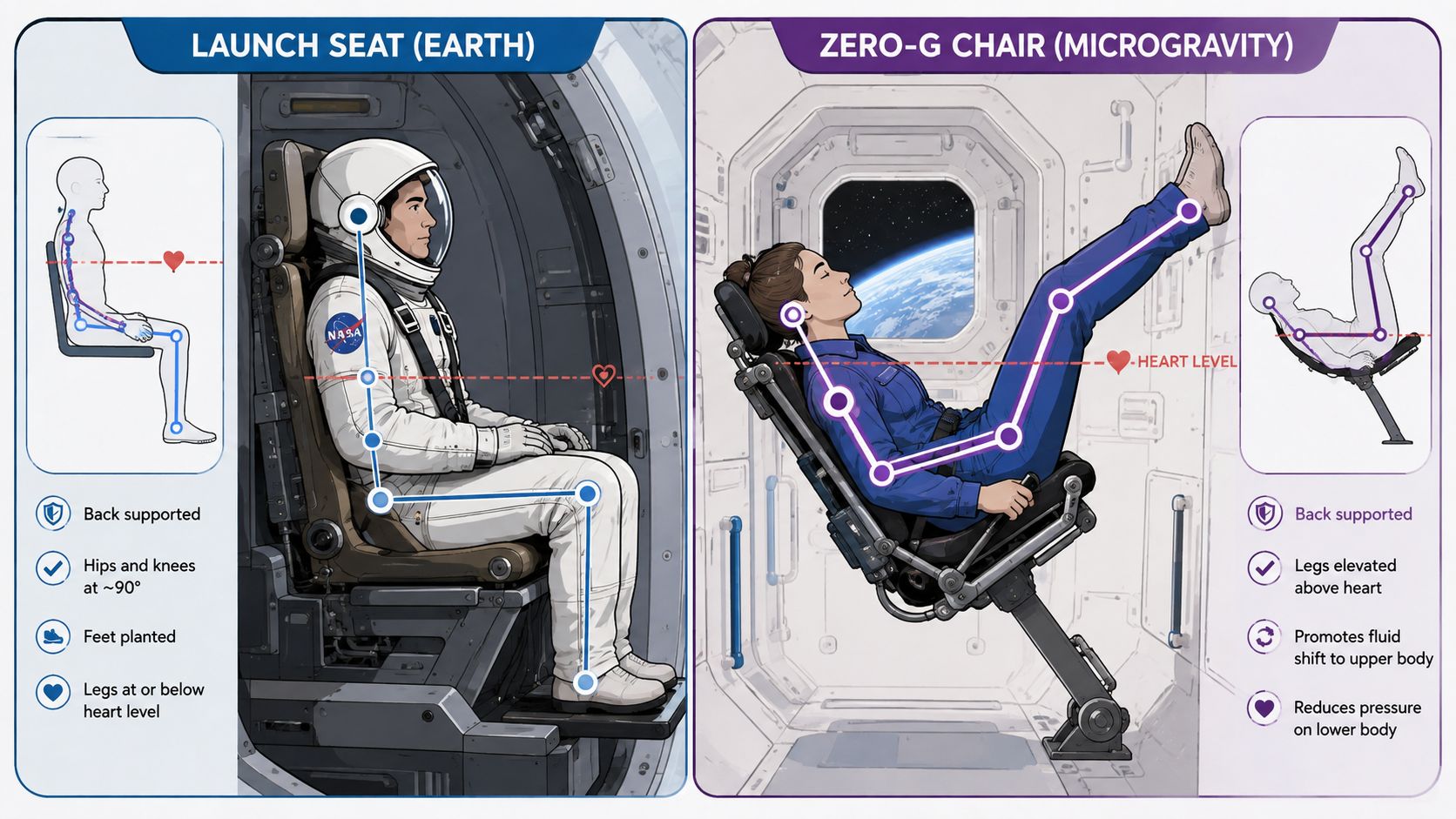
A zero-gravity lift chair places the body in neutral body posture, a position associated with NASA-derived ergonomics research. The torso reclines so it and the thighs form an angle of about 128 degrees. The legs rise until the knees are at or above heart level, while the hips stay lower than the upper body. The concept appears in this NASA-origin explanation of neutral body posture.
The sensation is similar to floating in water. Buoyancy does not remove every sensation, yet it reduces the feeling that one small area must carry the body's full load. A well-adjusted chair aims for broad support across the back, hips, and thighs, rather than leaving the lower back and seat to bear most of the pressure.
The position has a specific geometry
Zero gravity does not mean reclining as far as possible. A flat recline creates a different relationship among the torso, hips, and legs. Likewise, a standard footrest may raise the lower legs without placing the rest of the body in the intended posture. The chair coordinates several areas at once:
- The backrest reclines to support the torso.
- The hips remain low instead of sliding forward.
- The legrest raises the lower body.
- The knees reach a position at or above the heart.
- The head, neck, and spine stay supported without an awkward bend.
A detailed guide to zero-gravity recliner positioning can clarify the idea, but the label alone cannot confirm how a particular chair will fit your body. Seat depth, back height, legrest length, and cushion shape all affect the result.
Independent movement makes the difference
Many lift chairs with infinite-position or zero-gravity capability use two independent motors. One controls the backrest, while the other controls the footrest. This arrangement lets the user adjust each section separately instead of following one fixed movement sequence.
That flexibility can provide an upright position, a fully reclined position, or a zero-gravity setting with the upper body slightly higher than the hips and the legs raised. In a smaller room, however, the chair still needs enough clearance behind and in front to move safely. Measure the usable floor area before assuming the advertised position will work at home.
Terms such as “weightless” or “anti-gravity” describe an intended feel, not a guarantee. Check the actual movement range, support points, and fit in person. A showroom test reveals more than a dramatic label.
Real Health and Comfort Benefits You Can Feel
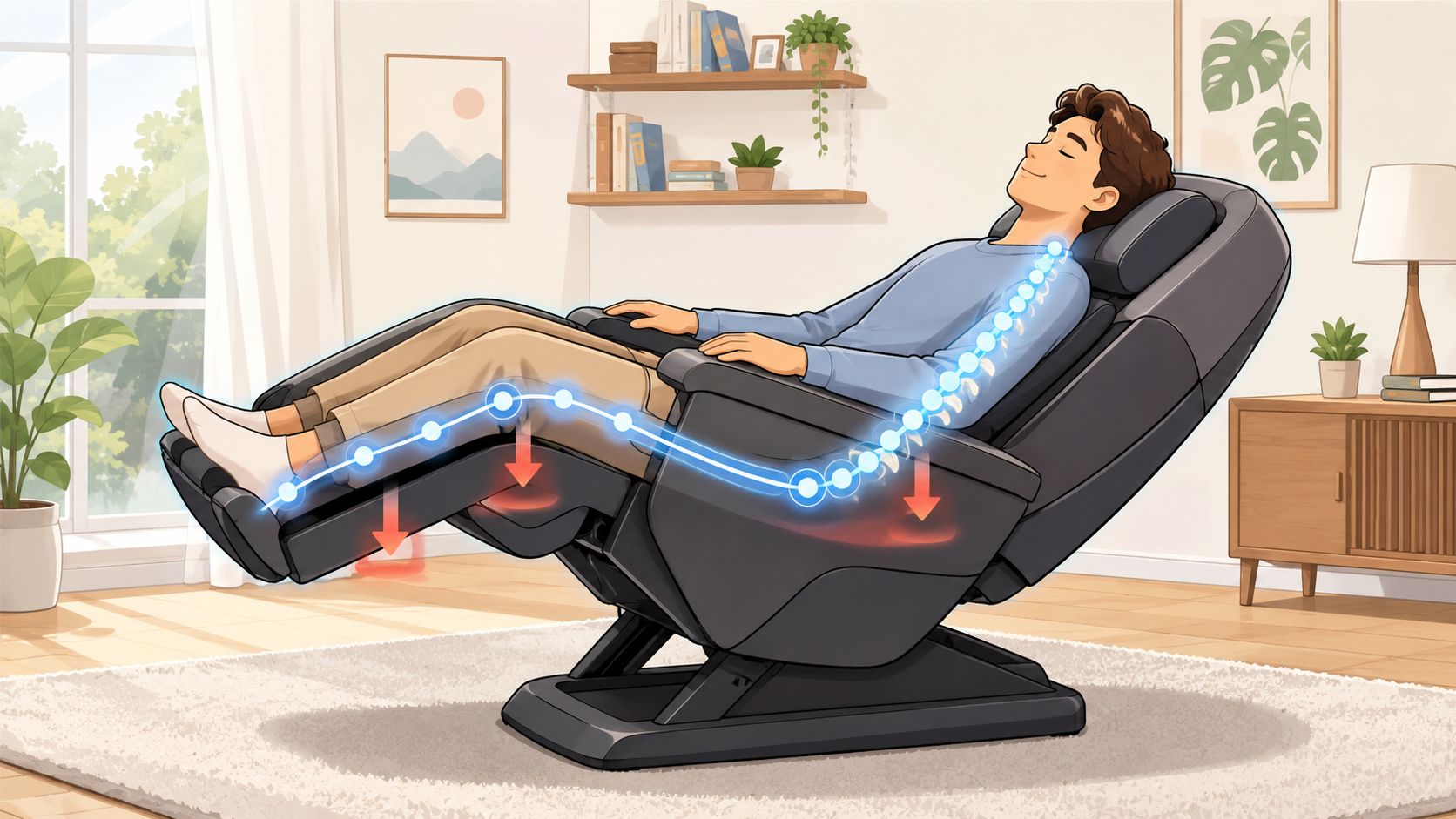
The most reasonable benefit to expect is pressure redistribution. Reclining the torso while raising the legs can change where the body bears weight, which some users find more comfortable than remaining upright. A discussion of NASA-inspired positioning cites a posture near 128 degrees and references a spine study reporting that reclining to about 125 to 130 degrees reduced disc pressure by as much as 40% compared with upright sitting. That mechanical claim appears in this zero-gravity posture discussion, but it shouldn't be treated as proof that every person will experience the same result.
A person with ordinary end-of-day soreness may notice fewer pressure points and less need to keep shifting. Someone with arthritis, spinal stenosis, persistent swelling, or cardiovascular concerns needs a more individualized conversation with a qualified clinician. A comfortable position can support daily living, but it isn't a treatment plan.
What users may notice during the day
Leg elevation can feel relieving after prolonged sitting, particularly when the lower legs and feet feel tired. Some people also prefer a supported recline after meals or during a rest period because the torso remains raised rather than lying fully flat. Those are comfort observations, not guarantees about circulation, digestion, or reflux.
A chair may also make short naps more comfortable. Some users report that a raised upper body helps them settle, while others find that a recliner changes their snoring or sleep experience. Neither outcome should be promised, and regular overnight sleeping in a lift chair deserves medical guidance when a person has a serious health condition.
Where claims need restraint
Clinical evidence around zero-gravity seating remains narrower and more nuanced than many product descriptions suggest. An NIH-hosted preliminary study found proof-of-concept correlations between a zero-gravity chair and a tilt-table test, not a broad medical endorsement. That distinction matters because “feels better” and “treats a condition” are very different claims.
Honest expectation: A zero-gravity lift chair may improve comfort, support pressure redistribution, and make resting easier. It can't cure arthritis, spinal stenosis, or cardiovascular disease.
The lift feature provides a separate practical benefit. It can reduce the effort required to rise from the chair, which may help preserve independence for someone who struggles with that movement. Medicare has historically covered part of the lift mechanism when eligibility and medical-necessity requirements are met, but not the entire chair. Consumer guidance says Medicare may cover up to 80% of the approved amount for the lift mechanism, while coverage information for lift chairs emphasizes that the chair itself isn't fully covered. Buyers should verify current rules with Medicare and the prescribing or supplying professionals involved.
How Dual Motors and Smart Controls Work Together
A single-motor lift chair links the backrest and footrest so they move through a coordinated pattern. That design can be straightforward and easy to operate, but it gives the user less freedom to position the upper and lower body independently. A dual-motor model uses separate actuators, allowing the backrest and legrest to respond to different commands.
That independent control is especially useful when a person wants the torso moderately reclined while the legs are more raised. It also allows the chair to approach the neutral posture discussed earlier instead of relying on one preset movement path. A practical overview of power recliner chair designs can help shoppers recognize the difference between coordinated movement and independent adjustment.
What the remote should make easy
Controls vary, but a useful remote commonly includes:
- Lift and lower buttons: These move the chair between a seated position and a raised position for standing.
- Backrest controls: The user can recline or return the upper section without guessing which button does what.
- Legrest controls: Separate operation lets the user adjust lower-body elevation more precisely.
- Preset positions: A dedicated zero-gravity or flat button can reduce daily adjustment.
- Memory settings: Some models let the user save a preferred position, which helps when several family members use the chair.
The best remote isn't necessarily the one with the longest feature list. Large, clearly labeled buttons and a logical layout often matter more for a user with limited dexterity or vision.
Extra features need practical scrutiny
Some powered chairs include battery backup so the mechanism can be lowered during a power outage. That feature can provide reassurance, but households should ask how the backup works and whether the battery requires maintenance. Newer models may also offer app or voice-assistant compatibility, though added electronics create more wiring and potential service points.
Safety deserves equal attention. FDA device rules require analysis and nonclinical testing showing that the device and armrests can withstand the rated load with a factor of safety, along with restraints or equivalent protections intended to prevent a user from falling. The relevant FDA device rule for lift-style seating is a useful reference when discussing load ratings and fall prevention.
Will It Fit Your Space and Your Body
A chair can feel comfortable in a showroom and still fail at home if the seat dimensions don't match the user or the reclined footprint blocks a walkway. Fit has two parts: the relationship between the person and the chair, and the relationship between the chair and the room.
Start with the user. Seat width should provide support without leaving the body loose inside the chair. Seat depth should allow the back to rest against the cushion while the knees remain supported. Backrest height should support the shoulders and head without pushing the neck forward.
A simple body-fit routine
A family member can help with a basic check at home:
- Sit against a wall with the feet resting naturally.
- Mark the approximate position of the knees and shoulders.
- Record the user's seated width and compare it with the product specification sheet.
- At the showroom, check whether the head, lumbar area, thighs, and feet remain supported in the intended position.
- Test the lift movement, because a comfortable recline doesn't guarantee a comfortable standing transition.
Product pages show why universal fit rules are unreliable. One lift recliner requires 21 inches from the wall and supports 285 pounds, while another lists a 330-pound capacity and a 71.4-inch reclined length. Those examples appear in the zero-gravity recliner product information. The figures describe individual models, not a universal standard.
Room planning deserves the same care
Measure the doorway, hallway turns, elevator or stair access, and the final placement area. Check where the power outlet sits, and avoid routing the cord across a walking path. A wall-hugger mechanism may reduce the gap needed behind the chair, but it still needs open space in front for the legrest and safe movement around the user.
| Measurement | Typical Range | Why It Matters |
|---|---|---|
| Wall clearance | Varies by model, including 21 inches for one example | Determines whether the back can recline without striking the wall |
| Reclined length | One example lists 71.4 inches | Shows how far the chair may extend into the room |
| Weight capacity | Examples include 285 pounds and 330 pounds | Supports safe model selection and may affect chair bulk |
| Seat and back dimensions | Vary by model | Determine whether the user's hips, knees, shoulders, and head receive support |
The lift chair weight capacity guide can help frame the capacity discussion, but the user's actual measurements and the manufacturer's specifications still control the decision. Higher-capacity construction may add bulk, so a heavier-duty chair must be measured just as carefully as a compact one.
Room test: Mark the chair's full footprint on the floor with painter's tape, then walk through the room as usual. A chair that fits the body but blocks the main walkway will become a daily frustration.
Testing and Choosing Your Chair at the Showroom
A showroom test is the most useful part of the decision because sitting reveals details that photographs and specifications can't. A person should spend enough time in the zero-gravity position to notice whether the lower back, neck, hips, and backs of the knees remain comfortable. The body often needs several minutes to reveal a pressure point that wasn't obvious during a quick sit.
A family member or caregiver can observe from the side. The user's head shouldn't be forced sharply forward, the knees shouldn't hang unsupported, and the feet should rest securely on the legrest. The test should include the lift function, not just the recline.
A practical showroom routine
- Begin upright: Check whether the seat height makes it easy to sit down without dropping into the cushion.
- Try the lift: Watch and feel whether the motion is smooth, stable, and understandable.
- Explore the recline: Use both preset and manual controls if the model offers them.
- Pause in the target position: Notice pressure behind the knees, support at the neck, and contact across the lower back.
- Practice the remote: The user should be able to identify the lift, lower, recline, and return buttons without constant assistance.
- Compare models side by side: Differences in cushioning, upholstery feel, motor responsiveness, and control layout become easier to notice when testing more than one option.
A retailer should also explain delivery timing, in-home setup, power requirements, and return or exchange policies before the purchase is finalized. Fees and conditions vary, and they can materially change the final cost. Families should ask whether the delivery team will remove packaging, position the chair, and demonstrate the controls.
The lift chairs for elderly shoppers category is a useful starting point for comparing support needs, but a showroom conversation can reveal whether a compact, standard, or heavy-duty design makes more sense. A reputable local store may also provide a fabric swatch so the household can check the color under its own lighting.
BILTRITE Furniture-Leather-Mattresses is a fourth-generation, family-owned showroom serving Greenfield and Metro Milwaukee since 1928. The store offers lift chairs, small-scale and heavy-duty furniture, USA-made and Amish-made pieces, and a mattress department with over 60 models, while its sales associates bring over 400 years of combined experience to in-store guidance.
Families comparing lift chairs zero gravity can visit BILTRITE Furniture-Leather-Mattresses at 5430 West Layton Avenue in Greenfield to sit in available models, check sizing, and discuss room planning with the team. Come on down to the showroom, bring the user's measurements, and see which chair feels supportive without pressure.