Most Comfortable Sofa for Seniors: A Buyer’s Guide


A sofa can look wonderfully soft in a showroom, yet become a daily obstacle once an older adult has to stand from it. A low cushion may leave the knees sharply bent, a deep seat can let the feet drift forward, and loose arms may offer nothing useful when the sitter needs to push off. For seniors and caregivers, the key question isn't just which sofa feels nicest while seated. It's which sofa supports comfortable sitting, steady transfers, and safe movement through the room.
The most comfortable sofa for seniors usually combines a higher loaded seat, moderate depth, firm cushioning, and sturdy arms. Those details support independence without making the living room feel institutional. BILTRITE Furniture has served the Metro Milwaukee community since 1928 as a fourth-generation, family-owned business, and that long perspective keeps the focus where it belongs, on how furniture works in everyday family life.
Table of Contents
- Why Sofa Choice Matters More as We Age
- The Critical Dimensions for Senior Comfort
- Comparing Sofa Types and Lift Options
- Safety and Layout Considerations
- Why Quality Construction Matters for Support
- Finding Your Fit at BILTRITE
Why Sofa Choice Matters More as We Age
An older adult may sit down comfortably, then struggle to stand without rocking forward, bracing against a table, or reaching for a caregiver. A sofa can look attractive and feel pleasant during lounging, yet its seat height, depth, and arm strength determine whether daily transfers feel controlled or uncertain.
Mobility limitations become more common with age. They affect about 35% of people aged 70 and the majority of people over 85, while difficulty rising from a chair affects up to 2 million people, or 8%, of noninstitutionalized adults aged 65 and older, according to independent aging-and-seating research. Deep cushions and low seats demand more knee bending and forward leaning, turning an ordinary transfer into a tiring task.
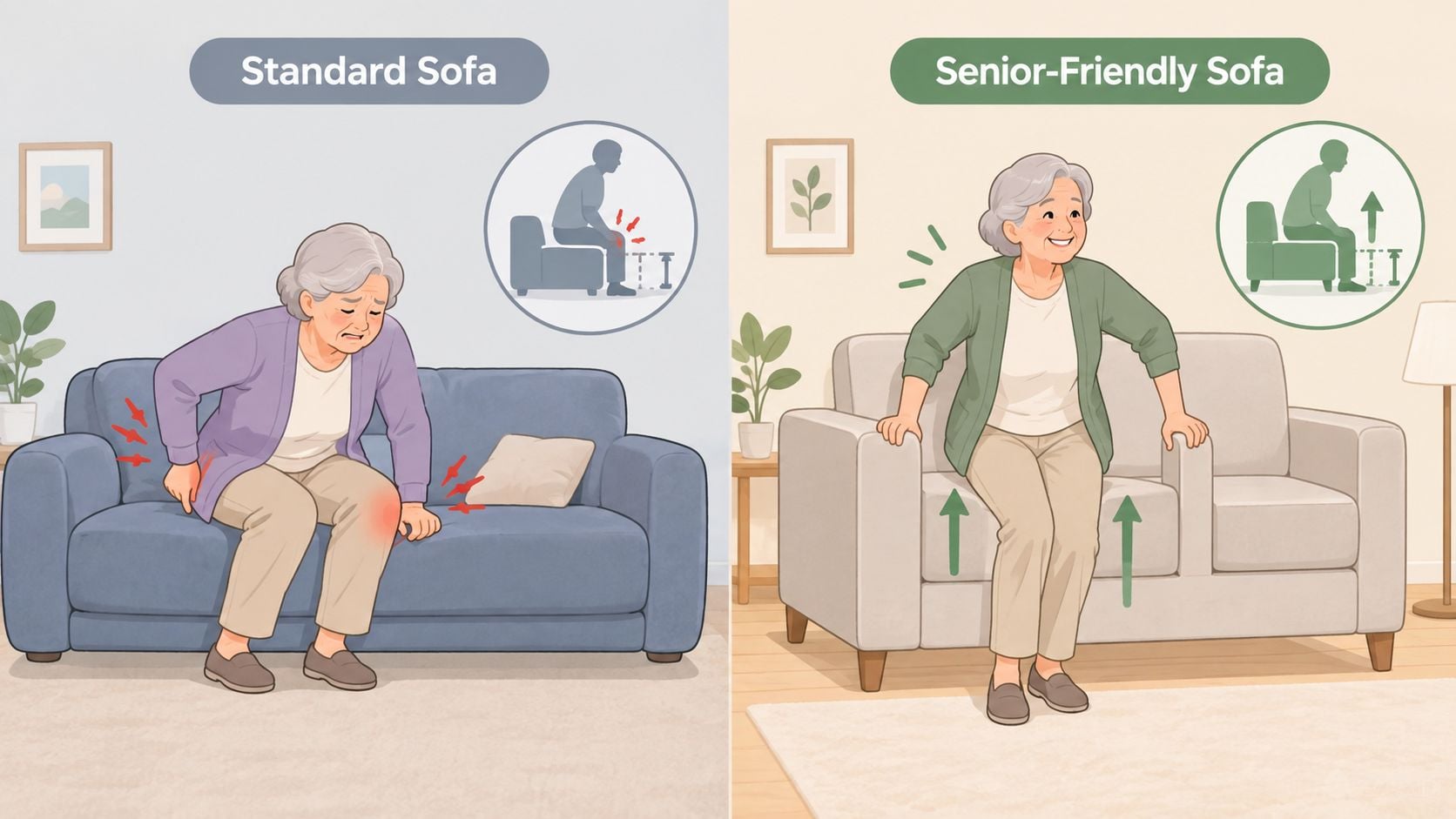
Comfort has a job to do
Soft upholstery alone is not enough. Supportive softness lets the sitter settle into the cushion while keeping the pelvis stable, the thighs supported, and both feet planted. The right sofa should feel comfortable after sitting, but also provide useful support during the movement into and out of the seat.
Armrests matter because they give the sitter a firm point for controlled push-off. A 2024 comparative study found that 76% of adults aged 60 and older said standing up and sitting down was easier with armrests. More than 90% of seniors in Denmark and Lithuania also reported that armrests helped with chair use, according to the comparative study of senior-friendly furniture.
The practical test: A senior sofa should feel comfortable during the transfer, not only after the sitter is fully settled.
Families can use BILTRITE's senior living furniture and mattresses selection to review supportive seating and mobility-conscious options. In the showroom, have the older adult sit, turn, place both feet, grip the arms, and rise. That real movement reveals more than a few minutes of ordinary lounging.
The Critical Dimensions for Senior Comfort
A sofa's measurements tell you more than a general promise of comfort. For many older adults, focus first on loaded seat height, usable seat depth, and arm strength. Loaded height means the distance from the floor to the top of the cushion while someone is sitting, not the uncompressed measurement shown in a showroom.
Seat height changes the transfer
Start with a loaded seat height of about 18 to 20 inches, supported by senior seating guidance on sofa geometry. Standard sofa seats commonly measure around 17 to 19 inches, while senior-friendly guidance generally places the seat somewhat higher, at roughly 18 to 20 inches, according to sofa-sizing guidance.
A higher seat reduces the knee bend required before standing and helps prevent the hips from dropping far below the knees. For someone with hip or knee limitations, a seat above the usual range may feel easier to use. Leg length and mobility still determine the final fit, so test the sofa with the actual sitter rather than choosing by measurement alone.
Depth should support the legs
A moderate seat depth around 20 to 23 inches works well for many seniors. It leaves room to support the thighs while helping the sitter keep both feet flat and the pelvis back against the cushion. Excessive depth can push the body backward, place the feet too far forward, and encourage sliding or leaning during the rise.
Body scale matters. An aged-care seating study recorded a mean buttock-popliteal length of 440 millimeters for an older Australian female, matching the Australian Standard recommendation for fixed-height chair seat depth. In lounge chairs, observed seat depths ranged from 470 to 530 millimeters, as described in the aged-care seating research. A sofa can suit a taller user yet leave another sitter unsupported.
Check the BILTRITE sofa dimensions guide before visiting, then test the actual cushion. Padding and compression change the usable depth.
Arms must carry weight
Arms should be firm, stable, and easy to grasp or push against. Decorative rails, loose pillow arms, and very low padded shapes offer little help during a transfer. Furniture sizing references commonly place arm heights in the low-to-mid 20-inch range, but the arm's construction and usable shape matter more than style measurements.
Use this quick showroom test:
- Sit fully back: Confirm that the lower back feels supported without forcing a slouch.
- Plant both feet: Both feet should rest flat, with the knees near a right angle.
- Rise naturally: Stand without repeated rocking or pulling on a caregiver.
- Use the arms: Push against a stable arm rather than gripping a loose cushion.
A sofa that passes these tests deserves closer consideration. Plush upholstery is not enough if the depth, height, or arms make standing awkward. Choose the model that supports the sitter through the entire transfer, not only after they are settled.
Comparing Sofa Types and Lift Options
Different seating categories solve different problems. A stationary sofa can serve as the household's shared gathering spot, a compact sofa can protect circulation in a smaller home, and a lift recliner can change the mechanics of standing altogether. The best choice depends on the sitter's mobility, the room's footprint, and how much independent assistance is needed.
| Feature | Standard Sofa | Small-Scale Sofa | Lift Recliner |
|---|---|---|---|
| Best use | Shared everyday seating | Apartments, condos, and compact rooms | Significant difficulty with standing |
| Main strength | Flexible seating for family members | Easier room planning | Power-assisted sit-to-stand movement |
| What to seek | Higher seat, moderate depth, firm arms | The same support in a smaller footprint | Stable arms, simple controls, safe cord placement |
| Main caution | Some models are too low or deep | Smaller size doesn't guarantee proper geometry | Needs power and space for movement |
Standard sofas
A firm, higher-seated stationary sofa is the strongest general recommendation for a senior who can stand independently but wants less strain. It offers shared seating without requiring the whole room to revolve around a specialized chair. Choose a model with a defined seat edge, supportive arms, and a cushion that doesn't collapse under normal body weight.
Deep lounge sofas are the least suitable when standing is already difficult. They may feel cozy for reading or watching television, but the combination of low height, soft padding, and extra depth can make the sitter feel buried.
Small-scale sofas
Small-scale furniture isn't only for appearance. It can preserve more open floor space for a walker, cane, caregiver, or direct path to another room. BILTRITE carries small-scale options for apartments, condos, smaller homes, and senior living communities, but compact dimensions still need to be checked against the sitter's body.
A smaller sofa becomes a good option when it keeps the room usable while still meeting the height, depth, firmness, and arm-support requirements. A petite sofa with the wrong seat geometry remains difficult to use.
Lift recliners
A lift recliner belongs in its own category. Its powered mechanism tilts the seat forward to help bring the user toward standing, reducing the demand placed on the knees, hips, and back. That is a functional change in the transfer, not merely a softer cushion, as explained in guidance on lift recliners for seniors.
For someone whose balance, leg strength, or joint pain makes rising unstable, a lift chair may be more appropriate than asking a standard sofa to do a job it wasn't designed to perform. The trade-offs include power-cord planning, additional space requirements, and the need to keep the lift and recline path clear. Families can review BILTRITE's lift chair guidance before comparing models in person.
Safety and Layout Considerations
A senior-friendly sofa can still create trouble if the surrounding room is crowded. Walkers need a direct approach, canes need room to turn, and caregivers need space to stand beside the sitter. A beautiful sofa that blocks the route to the kitchen, bathroom, or hallway isn't a safe choice.
Start with the movement path
Before shopping, identify the main route the older adult takes through the room. Measure from the sofa's front edge to the coffee table, wall, or other furniture, then check the path from the preferred seat to the next destination. Don't measure only the sofa wall. A piece can fit neatly along one wall while narrowing the route in front of it.
BILTRITE's sofa and television placement guidance can help families think through the full arrangement rather than choosing a sofa in isolation.
Use this showroom checklist
- Bring room measurements: Include the wall, doorway, and intended walking route.
- Mark the preferred seat: Decide which position offers the easiest exit and clearest approach.
- Test with mobility aids: If possible, bring the walker or cane used at home, or recreate the approach carefully.
- Inspect the front zone: Keep tables, stools, baskets, and footrests from creating a maze.
- Plan power safely: Lift recliners need cords routed beside the furniture, never across the main walking lane.
- Check the delivery route: Narrow doors and turns may require a sofa or sectional that comes apart.
A safe layout gives the senior room to turn, approach, sit, and stand without weaving around obstacles.
Lighting and flooring deserve attention too. A dim corner can hide a furniture edge, while a loose cord or small object can become a trip hazard. Caregivers should watch the full movement sequence, including reaching for the arm, standing, turning, and beginning the walk. That sequence reveals problems a seated comfort test can miss.
Why Quality Construction Matters for Support
A sofa can feel comfortable in the showroom and become difficult to use after months of daily sitting. As cushions soften and sag, the effective seat height drops and the front edge offers less help during standing. A flexible frame can also shift under pressure, making the arms feel unreliable when a senior pushes through the forearms.
Construction quality protects usable geometry. A sturdy frame helps the sofa hold its seat height and depth. Resilient seat materials limit the deep hammock effect that pulls the body backward and makes rising harder. Solid wood construction can provide a dependable base in homes where the sofa is an older adult's primary seat.
Look beneath the upholstery
Ask practical questions instead of judging the sofa by its appearance:
- Frame: What material forms the structure, and does it stay stable when the sitter shifts weight?
- Seat support: Does the cushion rebound without collapsing beneath the hips?
- Arm attachment: Do the arms remain solid when someone presses down through the forearms?
- Repairability: Can cushions, covers, or other serviceable parts be addressed later?
- Daily load: Is the piece suited to the household's regular use?
A well-built sofa should keep its key contact points dependable. Seat height, cushion firmness, and arm strength all affect how easily someone can sit down and stand up. Those details matter more than decorative styling when the sofa supports daily transfers.
Choose durability with purpose
BILTRITE specializes in USA-made, Amish-made, and solid wood furniture, including options designed for strong everyday performance. Better construction does not mean chasing the highest price. It means selecting a piece whose frame, arms, and cushions are built to remain useful as the household's needs change.
The store also offers small-scale furniture, heavy-duty options, come-apart sofas and sectionals, and custom choices in fabric, leather, wood, finish, and hardware. That range helps families address room size, body support, and delivery constraints while keeping a warm residential look.
Durability should match the job. A lightly used sitting room may need different construction from a sofa used for every meal, television session, and transfer. Test the arms, sit near the front edge, and check whether the cushion returns to shape after repeated movement.
The same practical approach applies beyond sofas. BILTRITE's mattress department includes over 60 models, giving families another place to discuss comfort, mobility, and support during a larger aging-in-place update. Choose furniture that keeps daily movement predictable and reduces the need for another replacement project.
Finding Your Fit at BILTRITE
The strongest recommendation for most seniors is a firm, supportive sofa with a loaded seat height around 18 to 20 inches, moderate depth around 20 to 23 inches, and sturdy arms. A small-scale version can work well when floor space is tight. A lift recliner deserves serious consideration when standing is unstable or requires substantial assistance.
Families shouldn't have to guess at those details from a product photo. A visit to the Greenfield showroom lets the older adult sit, stand, reach, turn, and compare several cushion feels in one trip. The sales associates bring over 400 years of combined experience, and their role is to help match furniture to the person's height, mobility, room, and daily habits without pressure.
BILTRITE has served Metro Milwaukee since 1928 as a fourth-generation, family-owned business. The store is committed to buy local, offers affordable better-quality furniture, and doesn't sell online, so the in-store test is central to the experience. Families can also review how to buy a sofa before measuring the room and planning the visit.
BILTRITE is closed on Sundays and Mondays to support family time. That family-first approach fits the decision itself, because the best sofa choice often comes from a senior, caregiver, and furniture professional testing the piece together.
Come on down to the BILTRITE showroom at 5430 West Layton Avenue in Greenfield, Wisconsin, bring the room measurements, and test the sofa the way it will be used at home. The goal isn't the softest seat in the building. It's the seat that helps the older adult rest comfortably, rise steadily, and move through the living room with confidence.
BILTRITE Furniture-Leather-Mattresses offers supportive sofas, small-scale furniture, lift chairs, USA-made and Amish-made pieces, and a large mattress selection for families planning comfortable living spaces. Visit BILTRITE Furniture-Leather-Mattresses in Greenfield to test senior-friendly seat heights, depths, cushions, and arms with the local team.