Pub Dining Tables: Sizes, Seating, and Buying Tips

A family can spend half the morning deciding whether breakfast belongs at the kitchen island, the dining table, or the rec-room counter. A taller table often sounds like the answer, especially when the space needs to handle quick meals, homework, card games, and Saturday snacks without feeling crowded. Pub dining tables offer a compact footprint, a casual perch, and social sightlines that help people stay connected while they eat or play.
The catch is that “pub height” isn't a style label. Table height, stool height, knee clearance, tabletop depth, room flow, and the people using the table all affect whether it feels inviting or awkward. A good choice should fit the family's habits as comfortably as it fits the room.
BILTRITE has helped Metro Milwaukee families make those choices since 1928. The showroom includes small-scale furniture for tighter homes, American-made and Amish-made options, and guidance from sales associates with more than 400 years of combined experience. The reasons to consider bar-height dining can help shoppers think through the lifestyle benefits before measuring a specific table.
Table of Contents
- Why a Pub Height Table Might Be the Upgrade Your Home Needs
- How Pubs Turned Dining Into Part of the Experience
- Getting the Heights and Spacing Just Right
- Shapes, Materials, and Footprints That Fit Real Homes
- Who Actually Loves Sitting at Pub Height
- Small Scale and Amish Made Options Worth Considering
- Styling, Placement, and Care Habits That Make It Last
- Your Buying Checklist and a Warm Invitation to Visit
Why a Pub Height Table Might Be the Upgrade Your Home Needs
Consider a household with a narrow kitchen nook and a finished basement that does double duty. The children need a place for homework, adults want somewhere to enjoy coffee, and friends gather for games without anyone wanting a formal dining setup. A pub-height table can give that household a defined dining spot while using vertical space to create a lighter, more casual feel.
The everyday appeal
A taller surface works especially well for:
- Quick breakfasts: A stool makes it easy to sit down for cereal, coffee, or a snack without setting a formal dining room.
- Homework and hobbies: The raised surface can create a useful workstation for older children and teens.
- Game nights: Players get clear sightlines across the tabletop, and the arrangement encourages conversation.
- Casual entertaining: Guests can sit, stand, or move around the table without the room feeling fixed in place.
The height can also help separate zones in an open room. A pub table beside a kitchen island can signal “eat here” without adding the visual weight of a full dining set. In an apartment or condo, that distinction matters because one compact piece may need to support several routines.
Taller doesn't mean better for everyone
A pub-height table creates a more upright perch than standard dining furniture. That relaxed feeling suits adults and older children who like informal meals, but young children may find taller stools harder to climb onto and less stable. Anyone who prefers to linger over a long dinner may also appreciate the support and knee position of a conventional table.
Practical rule: The right table is the one that matches the household's most frequent users, not simply the one that looks most distinctive.
Shoppers can compare stool backs, footrests, tabletop depth, and the space around the table before making a decision. The goal isn't to make every room feel like a bar. It's to create a comfortable, useful gathering spot that supports how the family lives.
How Pubs Turned Dining Into Part of the Experience
British pubs were historically associated primarily with drinking. Over time, many evolved into food-and-social venues where guests could share meals, meet friends, watch activities, and stay longer. That change gave pub furniture a broader job than holding a glass.
One table, several uses
A pub dining table may need to support casual dining, shared plates, drinks, conversation, and longer visits during the same day. Raised surfaces help create visual separation in a busy room, while stools and high chairs make a space feel informal and flexible. The furniture becomes part of the experience because it helps shape how people gather.
That history connects with the modern foodservice economy. In 2024, total United Kingdom foodservice food-and-drink sales reached approximately $71.3 billion, nearly $5 billion higher than in 2023, according to the United Kingdom foodservice market analysis. Pubs, clubs, and bars represented 28.6% of overall sector sales, making them the largest foodservice profit sector in that cited analysis.
What homeowners can borrow from hospitality
A home doesn't need commercial traffic to benefit from the same thinking. A useful pub table should make it easy to:
- Approach the surface: People shouldn't have to squeeze between legs, walls, or neighboring furniture.
- Set down a meal: Plates, glasses, utensils, and shared dishes need enough usable surface.
- Talk across the table: Raised furniture can give people clear sightlines, especially in an open kitchen or basement.
- Shift between activities: The table may serve breakfast in the morning, homework later, and cards at night.
That hybrid role explains why pub-height settings remain popular beyond restaurants. They combine dining with social time and make a room feel ready for activity rather than reserved for formal meals.
The commercial lesson is practical for homeowners: a pub table isn't just a decorative accent. Its durability, stability, spacing, and surface area determine whether it can handle the many ways a family gathers.
Getting the Heights and Spacing Just Right
Height is the first measurement to verify, because a table and stool work as a pair. Pub or high-top tables typically measure 40 to 42 inches from the floor to the tabletop, with matching stool or chair seats around 28 to 30 inches, as explained in this pub table and chair measurement guide. The resulting table-to-seat difference is roughly 10 to 14 inches, which supports a raised but usable sitting position.
Counter-height tables generally measure 34 to 36 inches, while standard dining tables usually measure 28 to 30 inches. A typical dining chair seat measures 18 to 19 inches, creating a lower seating relationship for longer meals.
A quick comparison
| Table type | Tabletop height | Matching seat height | Best for |
|---|---|---|---|
| Standard dining | 28 to 30 inches | 18 to 19 inches | Full meals, families, and longer sitting |
| Counter height | 34 to 36 inches | Counter-height seating | Kitchen areas and casual dining |
| Pub height | 40 to 42 inches | 28 to 30 inches | Game rooms, home bars, quick meals, and social spaces |
The figures above are practical starting points, not substitutes for measuring the actual pieces. A finished tabletop may sit higher than the frame suggests, and stool cushions can change the usable seat height.
Give each diner room to breathe
For comfortable full-service dining, allow approximately 24 inches of linear table edge per diner, based on this restaurant table sizing guidance. A four-person rectangular arrangement therefore needs about 96 to 112 inches of usable perimeter space, depending on the configuration.
Table depth matters, too. About 14 to 16 inches from the edge inward per diner gives each person room for a plate, glassware, and utensils. A deeper shared center can hold serving dishes and condiments, but too much depth may force diners to lean forward.
Before visiting a showroom, measure the floor-to-tabletop distance, the stool seat from floor to cushion, and the available room around the furniture. The guide to dining table heights can help shoppers compare labels with actual dimensions.
Showroom habit: Measure the finished tabletop and the actual stool seat. Don't rely only on “pub,” “counter,” or “bar” in the product name.
Shapes, Materials, and Footprints That Fit Real Homes
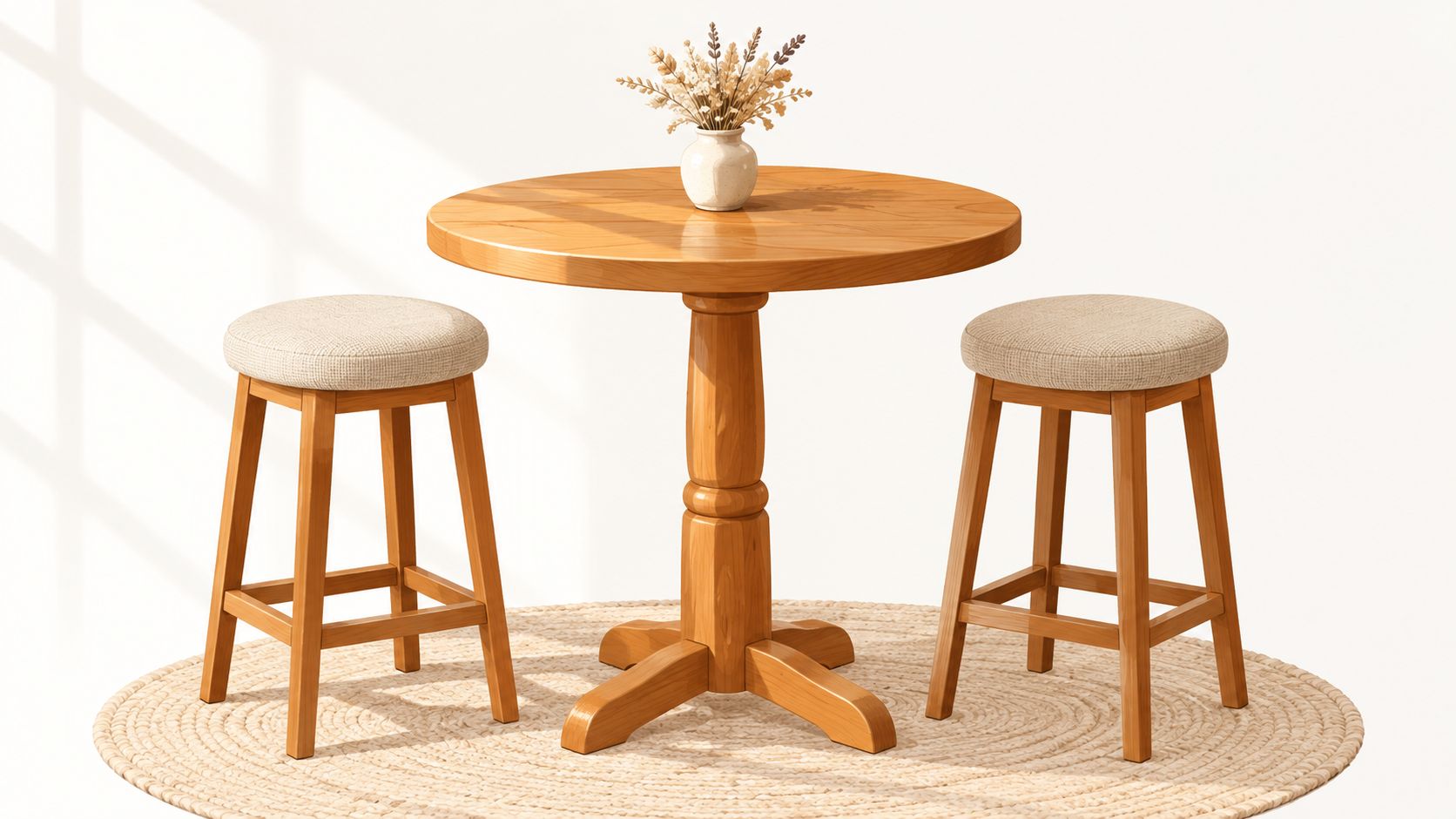
Once the height works, the table's shape determines how people move around it. A small round table can make a breakfast nook feel friendly because nobody sits at a sharp corner. A square top creates a balanced game-night arrangement, while a rectangle often uses a narrow wall or a longer room more efficiently.
Match the shape to the room
- Round tables: Encourage conversation and smooth traffic flow. They can work well in compact corners where a square corner would interrupt movement.
- Square tables: Offer a clear, symmetrical footprint for two or four diners and can double as a game surface.
- Rectangular tables: Suit longer walls and can seat people along defined sides, but they need attention to corner clearance.
- Bar-top formats: Create the strongest raised social feel and may suit a basement or entertaining zone, provided the room has enough circulation space.
A guide to table shapes and seating arrangements can help families compare how each footprint affects movement and conversation.
Read the construction from the underside
Solid wood brings warmth and can support a substantial family table, while veneer can offer a different balance of appearance, weight, and price. Metal bases may create a visually open look, but the base shape still determines where feet and knees can go. The useful question isn't which material looks attractive. It's whether the construction suits the room, the household, and the expected wear.
Aprons, foot rails, and crossbars can add stability, but they may reduce legroom. A central pedestal can make it easier to place chairs around a table, while four legs may provide familiar support and a straightforward visual profile. Either design can work well if the base leaves enough room for the people using it.
Small-scale furniture deserves special attention in apartments, condos, senior living communities, and finished basements. A compact top, a lighter visual profile, and a piece that can come apart for delivery may make the difference between a table that fits and one that never reaches its intended room.
Who Actually Loves Sitting at Pub Height
Taller furniture has a strong personality. Teens may enjoy a pub table for homework, adults may like the quick perch for coffee, and game-night hosts may appreciate the higher view across the room. Casual entertainers can also use the height to create a social station where guests sit or stand.
That doesn't make pub height comfortable for every person or every meal. Young children may need more help climbing onto a tall stool, and people with mobility limitations may find a raised seat difficult to approach. Guests who enjoy a slow, full dinner often prefer standard-height furniture with a familiar chair position.
Accessibility starts below the tabletop
Under the U.S. Access Board's ADA criteria, an accessible dining surface should be 28 to 34 inches above the finished floor. At least one usable seating position should provide 27 inches of knee clearance, 30 inches of width, and 19 inches of depth, according to the ADA dining surface criteria.
Those measurements change the conversation. A table can sit at an acceptable height and still be difficult to use if an apron, pedestal, trestle, or foot rail blocks the approach. The underside deserves as much attention as the tabletop.
A clear floor area matters as well. Guidance for accessible seating identifies a 30-by-48-inch clear floor area for each accessible position, while Massachusetts outdoor dining guidance says accessible seating must be movable and that at least one table, or 5% of dining tables, whichever is greater, must be accessible. The Massachusetts accessibility standards provide that additional planning context.
Ask who needs the easiest seat
A multigenerational home may need one lower, open-knee position even if other family members enjoy a higher table. A conventional table with open knee space may serve more people independently than a taller table with a blocked base.
A table's height is only one accessibility measurement. The approach zone, knee space, seat mobility, and underside design decide whether someone can use it comfortably.
Small Scale and Amish Made Options Worth Considering
Two buying paths often make sense for Metro Milwaukee households. Small-scale pub tables help apartments, condos, smaller homes, and senior living communities use a dining area without overwhelming it. Amish-made and USA-made tables appeal to shoppers who place a higher value on solid wood, craftsmanship, and long-term use.
Start with the doorway and the room
A compact table isn't useful if it can't pass through the entryway or leave enough room for people to pull out stools. Shoppers should measure doorways, turns, stairways, and the final footprint before choosing a top. Come-apart construction can simplify delivery when a home has narrow doors or tight hallways.
Small scale doesn't have to mean flimsy. It means the dimensions are adapted to the space. A lighter profile may suit a breakfast nook, while a heavier-duty construction may better serve a busy family or a household that expects the furniture to handle regular games, meals, and guests.

Compare craftsmanship with real-life priorities
Amish-made and USA-made furniture commonly attracts buyers who want solid wood, careful joinery, and finish choices that coordinate with the rest of the home. The meaning of Amish furniture is worth exploring before a showroom visit because construction details can vary from one piece to another.
Mass-produced furniture may appeal to shoppers focused on immediate price or a quick visual update. A locally selected, American-made piece may make more sense for a family that wants a durable surface, repairable construction, or a finish chosen to work with existing furniture. Neither path should be chosen by label alone. The table needs to match the room, budget, use, and expectations.
BILTRITE Furniture-Leather-Mattresses offers small-scale, USA-made, Amish-made, solid-wood, and heavy-duty furniture categories in its Greenfield showroom. The store's approach is affordable, better-quality furniture, not the lowest price, with associates available to explain construction and help shoppers compare pieces without pressure.
Styling, Placement, and Care Habits That Make It Last
Placement decides whether a pub table feels intentional or squeezed into an unused corner. A table near the kitchen can extend the casual breakfast zone, while one beside a window can create a bright morning spot. In a finished basement, it can anchor cards, snacks, and family games without taking over the room.
A narrow dining nook may work best with the table close to a wall, as long as diners can still pull out their stools. A rug can visually define the area, and a pendant or nearby light can make the surface feel like a destination rather than an obstacle.
Make the seating suit the routine
Stools with backs generally support longer sits more comfortably than backless versions. Families should also consider footrests, cushion firmness, and whether children can climb on and off safely. A finish that coordinates with existing wood can make a compact table feel connected to the room, while a surface with character may disguise the small marks of everyday family life.
For cleaning, use the simple habits in this wood furniture cleaning guide. Wipe spills promptly, use coasters for drinks, and place heat protection beneath hot dishes. Water rings and heat damage are easier to prevent than repair.
Let solid wood respond to the seasons
Solid wood is hygroscopic, which means it absorbs moisture when humidity rises and releases moisture when humidity falls. Most dimensional change happens across the grain, so wide tops need construction that allows movement instead of locking every board rigidly in place.
Indoor relative humidity around 40% to 60% is commonly recommended for solid-wood furniture, according to this solid-wood durability guidance. Keep the table away from sustained water exposure, heating vents, radiators, and damp exterior walls. These habits help reduce the risk of seasonal warping, buckling, or cracking while protecting the finish.
Your Buying Checklist and a Warm Invitation to Visit
A pub dining table should pass a practical test before it passes a style test. The following checklist keeps the decision grounded in the way a household will use the furniture:
- Verify the finished tabletop height: Confirm whether the table is standard, counter, or pub height.
- Match the stool seat: Measure from the floor to the actual cushion, not just the top of the stool frame.
- Measure the route: Check doorways, turns, stairs, and the final floor area.
- Choose the scale: Decide whether a small-scale table gives enough surface without crowding the room.
- Inspect the underside: Look for knee clearance, foot rails, aprons, crossbars, and pedestal placement.
- Plan for the users: Consider young children, older adults, mobility needs, and anyone who prefers longer meals.
- Select the material thoughtfully: Match solid wood, veneer, or other construction choices to the household's care habits and expectations.
- Test the seating: Sit at the table with both feet supported and check whether elbows, knees, and shoulders feel relaxed.
A showroom visit adds information that a product photo can't provide. Families can compare pub and counter heights side by side, test stool backs, inspect the underside, and see how a small-scale table feels in person. BILTRITE's team can also discuss USA-made and Amish-made furniture, custom options, heavy-duty pieces, and practical choices for tighter Metro Milwaukee homes.
The store has served the community as a fourth-generation, family-owned business since 1928. Its selection extends beyond dining furniture to living room, bedroom, home office, and a mattress department with over 60 models, giving families a place to consider several rooms during one visit.
BILTRITE Furniture-Leather-Mattresses offers pub-height, counter-height, small-scale, USA-made, Amish-made, and solid-wood furniture in its Greenfield showroom. Visit BILTRITE Furniture-Leather-Mattresses for a no-pressure, hands-on chance to test tables and stools, ask questions, and find a comfortable fit for the way the family gathers.