Loveseat Recliner with Chaise: A Comfort Guide


Movie night is about to begin. The snacks are ready, the lights are low, and two people want to stretch out without turning the living room into a maze of separate chairs. A loveseat recliner with chaise can bring those pieces together, but its comfort comes with a planning detail many shoppers miss: the furniture takes up more room when it's open than it does when it's sitting upright.
That trade-off deserves a closer look. The right model should support the legs, fit the room, suit the household's daily habits, and keep working reliably over time. Since 1928, BILTRITE has helped Metro Milwaukee families sort through those choices with practical advice, quality furniture, and a friendly showroom experience.
Table of Contents
- Introduction to the Loveseat Recliner With Chaise
- Understanding Recline Mechanisms and Chaise Functions
- Planning Your Space and Measuring for the Right Fit
- Prioritizing Comfort and Accessibility for Seniors
- Choosing Fabrics and Custom Options at BILTRITE
- Finding Your Favorite Piece in Our Greenfield Showroom
Introduction to the Loveseat Recliner With Chaise
After a long day, two people may want to sit together while each keeps enough room to stretch out. A loveseat recliner with chaise combines two-person seating, adjustable backs, and extended leg support in one connected piece. The chaise lets the lower legs rest along a longer surface than a short footrest, which can make reading, watching television, or taking a quiet break more comfortable.
The basic chaise idea has roots in ancient reclining daybeds and later became associated with luxury furniture in Europe. Modern versions bring that full-body lounging position into everyday homes, pairing a shared seat with space for the legs.
From luxury furniture to everyday comfort
The extended support changes both comfort and floor planning. A short footrest ends near the feet, while a chaise continues beneath the calves and heels. That longer contact area can reduce pressure at the knees, but it also creates a larger open footprint when the seat reclines. A room that fits the loveseat upright may feel crowded once the chaise is extended.
The closed shape can hide this trade-off. Leave enough clearance for the footrest to open fully, and keep walkways, tables, doors, and nearby seating usable at the same time. In a compact apartment, condo, or smaller home, a chaise loveseat can provide two seats and a lounging position without the width of a full sectional. Its advantage depends on arranging the room around the open position, not only measuring the furniture while closed.
Mechanism durability matters as well. Each reclining cycle places movement and load on the frame, hinges, and footrest assembly. A model that feels comfortable in the showroom still needs a stable structure and operating method suited to daily use. Power controls may offer precise positioning, while manual designs can have fewer electrical components. The right choice depends on who will use the loveseat, how often it will recline, and whether the household can keep the moving areas clear.
The chaise form has become a familiar furniture category, with retail assortments offering multiple configurations, upholstery choices, and reclining layouts. Those options can make comparison useful, but the most attractive arrangement is not automatically the best fit. Check seat depth, leg support, access to controls, and the fully open footprint before focusing on appearance.
A well-chosen loveseat recliner with chaise should feel supportive without turning the room into an obstacle course. Comfort is the starting point, while clearances, daily habits, and long-term mechanical use determine whether that comfort remains practical.
Understanding Recline Mechanisms and Chaise Functions
A short footrest supports the feet at the end of a limited extension. The calves may remain unsupported, leaving a noticeable bend near the knees. A chaise extension continues beneath the calves and heels, creating a longer line from the seat to the feet. That difference explains why a chaise can feel more like a lounge than a standard reclining seat.
The longer surface also changes how the body's weight is spread. On many models, the fully extended length approaches 64 to 65 inches, so the legs can rest along the seat and footrest instead of folding sharply at the knees. Taller users may notice the benefit most when a short footrest leaves their heels suspended. In a smaller room, however, that added comfort uses more floor area once the mechanism opens, so the closed footprint does not tell the whole story. A reclining loveseat size reference illustrates the dimensions shoppers should consider.
Manual, power, and zero-gravity choices
A manual mechanism commonly uses a side handle or exterior release. Pulling the handle raises the footrest, then leaning back moves the back into its reclining position. This direct sequence may suit households that prefer fewer electrical components. It still requires enough room to operate the handle and keep the moving assembly clear.
Power reclining uses a button to adjust the back and footrest gradually. That control can help someone find a comfortable position without pushing firmly against the mechanism. Some power models also provide zero-gravity positioning and multiple reclining positions at the touch of a button. Review power reclining seating options to understand how power layouts differ.
Questions to ask in a showroom
A quick sit rarely reveals how a recliner will feel during a full evening. Test the upright, partly reclined, and fully open positions. Check whether the lumbar area, head, arms, calves, and heels remain supported as the body changes position.
Ask these practical questions:
- How does it open? A handle and a power button create different daily routines.
- Where does the mechanism move? Watch for smooth operation and keep feet, toys, and pets away from moving parts.
- Can both seats adjust independently? Separate controls let each person choose a suitable position.
- Does the chaise support the whole lower leg? A long extension helps only when the calves and heels rest comfortably.
Durability depends on repeated movement through the frame, hinges, and footrest assembly. Choose the mechanism that fits the household's habits and expected use. Someone who changes positions often may value gradual power adjustment, while a household seeking a straightforward movie-night seat may prefer manual operation. Either way, an in-person test shows whether the comfort lasts beyond the first impression.
Planning Your Space and Measuring for the Right Fit
A chaise loveseat can feel wonderfully open when you stretch out, yet its extended footrest may turn a clear walkway into an obstacle. Plan for the chair in both positions, not only as it appears closed. Measure width, closed depth, fully extended depth, and traffic clearance. A two-person reclining loveseat may measure 55 to 79 inches wide, about 36 to 43 inches deep when closed, and roughly 64 to 65 inches deep when fully open. Use the selected model's specifications rather than relying on these general ranges.
Use the open footprint, not the showroom footprint
Follow this measuring routine:
- Measure the wall. Record the usable width, including trim, doors, and nearby furniture.
- Measure the closed depth. This shows how far the loveseat projects while upright.
- Measure the extended depth. Mark the farthest point reached when the chaise and back are fully open.
- Map the walking route. Leave space between the loveseat, doors, tables, and other seats.
- Check delivery access. Measure doorways, hallways, stair turns, and elevators. A frame that comes apart may help with a tight entrance.
Painter's tape gives you a clear test. Mark the closed and fully extended footprints on the floor, then walk around them. A chaise that fits the wall can still crowd a coffee table or force people to pass too close to the footrest.
A standard reclining loveseat moves the back and leg rest into the room. A wall-hugger loveseat shifts that motion forward, so it can sit closer to the wall. These models typically need only 3 to 6 inches of wall clearance to recline fully. Confirm the requirement for the exact model, because the mechanism and frame design affect the usable space.
Space planning dimensions
| Model Type | Closed Depth | Fully Extended Depth | Required Wall Clearance |
|---|---|---|---|
| Standard reclining loveseat | 36 to 43 inches | About 64 to 65 inches | Depends on the recline path |
| Wall-hugger reclining loveseat | Varies by model | About 60 to 65 inches | About 3 to 6 inches |
| Typical loveseat recliner range | Varies by model | About 60 to 65 inches | Measure the selected piece |
Some loveseat recliners measure 52 to 72 inches wide, while fully open reclining models can reach 60 to 65 inches deep. Those ranges show why a product label is only a starting point. Compare your room against the selected model's specifications in BILTRITE's sofa dimensions guide in inches. Leave enough room for the chaise to open without striking furniture, blocking a doorway, or placing repeated stress on the mechanism.
Prioritizing Comfort and Accessibility for Seniors
A senior returning home after an appointment may use a recliner several times before dinner. Each transfer should feel steady, and each position change should require as little reaching and twisting as possible. A chaise extension supports the calves and heels along a longer, continuous surface, which can feel better than leaving the lower legs suspended over a short footrest. The trade-off is spatial: that extra support creates a longer open footprint, so comfort must be checked against walking paths and nearby furniture.
Seat height also affects independence. Reclining loveseats commonly list seat heights around 20 to 21.5 inches, with arm heights around 25.5 to 26 inches. These figures are useful reference points, not universal prescriptions, because body proportions, mobility, and cushion firmness differ from person to person.
Test the movements that happen every day
A senior or caregiver should test the chair in several positions, not only when fully reclined:
- Is the seat easy to enter? Feet should rest securely on the floor before standing.
- Can the user reach the handle or control? Operation should not require twisting, stretching, or leaning across the arm.
- Does the back support the upper body? A long footrest cannot compensate for weak lumbar or neck support.
- Can the user return upright without strain? The closing movement should feel predictable and controlled.
- Does the chaise remain clear of walkways? A comfortable leg position can become a trip hazard if the extended section reaches into a common path.
A lift chair may suit someone who needs active assistance rising from the seat. Families can compare that category with a regular loveseat by reviewing BILTRITE's information on a recliner with lift support for elderly users.
Plan for service as well as comfort
For seniors, serviceability deserves a specific check. Ask whether controls can be reached without moving the loveseat, whether replacement handsets are available locally, and whether BILTRITE provides in-home service for power mechanisms during 5 to 10 years of daily use. These answers matter when a heavy chaise loveseat cannot be moved easily for repair.
Daily care protects both the upholstery and moving parts. Keep blankets, toys, pet items, and other objects away from the base. Vacuum reachable gaps, follow the cover-care instructions, and ask which replacement components can be ordered before purchase. A durable seat should remain practical to operate, maintain, and service throughout its ownership.
Choosing Fabrics and Custom Options at BILTRITE
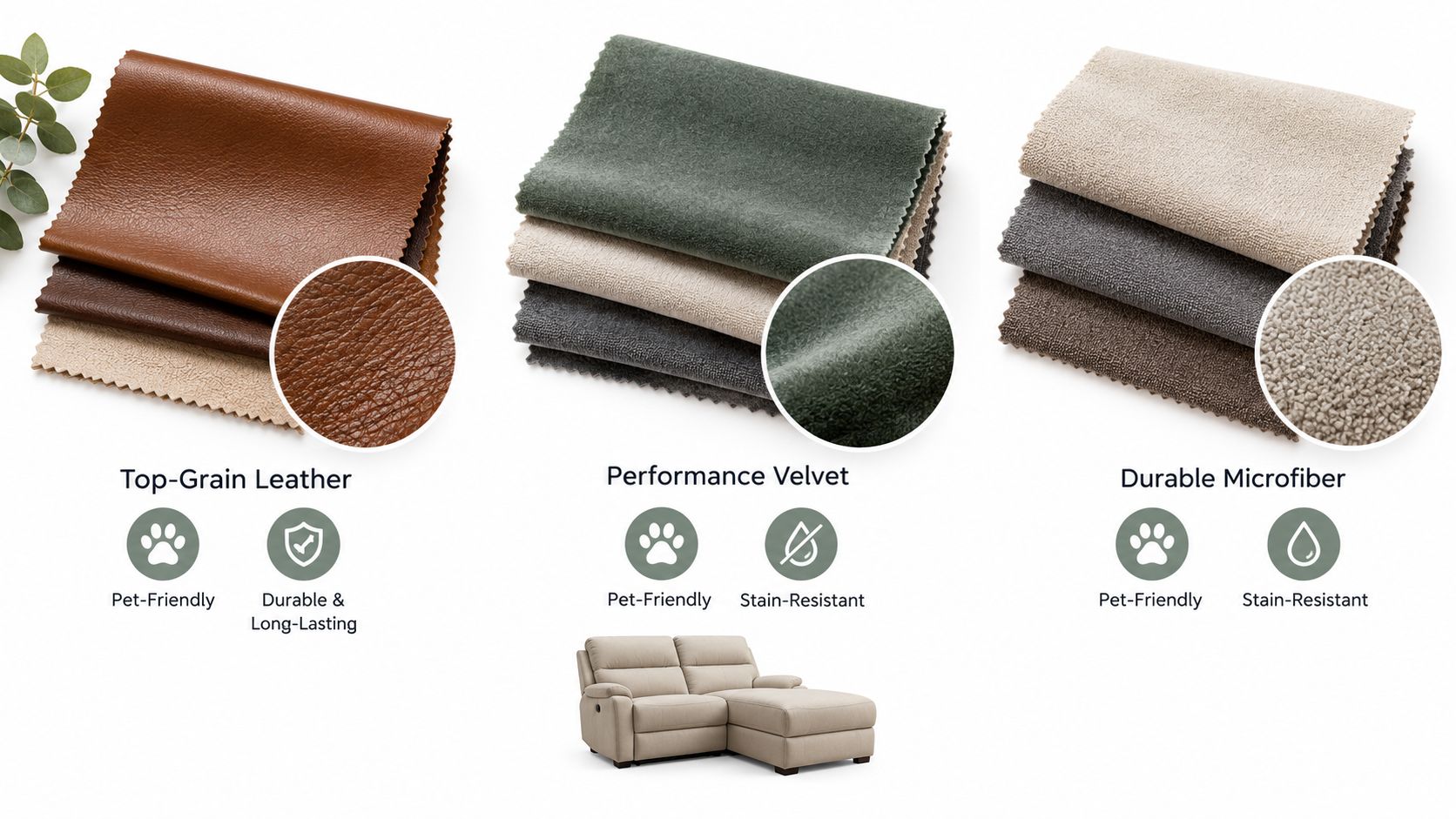
Upholstery should match the household, not just the paint color. A busy family may need a fabric that feels welcoming and handles frequent use, while an adult household may prioritize the smooth feel and easy wipe-down of leather. A small apartment might call for a lighter visual scale, while a larger family room may benefit from heavier padding and more substantial proportions.
BILTRITE offers affordable custom options with choices of fabric, leather, wood, finish, and hardware. That approach lets shoppers evaluate the tactile experience in person instead of guessing from a small screen image. Material samples can look different under showroom lighting than they do beside a home's rug, flooring, and natural light.

Match the cover to the routine
Performance-oriented fabrics can suit households with children, pets, or frequent visitors because they're selected with daily wear in mind. Leather offers a distinctive hand and can be practical for households that prefer a surface that can be wiped clean, but it still needs appropriate care. Microfiber may appeal to shoppers who want a soft, casual feel, while more textured fabrics can add warmth and visual interest.
The useful comparison is not just “fabric versus leather.” It's whether the material fits the household's cleaning habits, climate, pets, clothing, and preferred feel. A family that eats snacks during every movie should inspect seams, cushion edges, and reachable surfaces rather than choosing solely by color.
BILTRITE's fabric selection guide offers another starting point for comparing upholstery characteristics before a showroom visit.
Look closely at construction and mechanism access
Upholstery is only one part of long-term value. A well-used loveseat recliner also depends on frame construction, cushion recovery, stitching, and the quality of its moving system. Shoppers should ask how the base is built, whether the seating is available in USA-made or Amish-made construction where appropriate, and how service questions are handled after delivery.
A family-owned store can also help match scale to the room. BILTRITE carries small-scale furniture for apartments, condos, smaller homes, and senior living communities, along with heavy-duty options for households that need added resilience. The store also has a large mattress department with over 60 models, which can help families address comfort throughout the home rather than treating the living room as an isolated project.
The strongest custom choice is the one that balances appearance, touch, daily maintenance, and expected use. A beautiful cover won't feel like a good value if the mechanism is wrong for the household or the open footprint blocks the room.
Finding Your Favorite Piece in Our Greenfield Showroom
A loveseat recliner with chaise can look comfortable in a photograph, but photographs can't show whether the seat supports a particular person's knees, whether the arms feel too wide, or whether the controls are easy to reach. In a showroom, each shopper can sit upright, recline gradually, extend the chaise, and notice how the body responds after more than a quick test.
BILTRITE Furniture-Leather-Mattresses is a fourth-generation, family-owned business serving the Metro Milwaukee community since 1928. The Greenfield showroom gives homeowners, seniors, caregivers, and interior designers a place to compare small-scale seating, heavy-duty furniture, USA-made pieces, Amish-made options, and custom upholstery in person.
A pressure-free visit has practical value
The sales associates bring over 400 years of combined experience, and their role is to help shoppers ask better questions rather than push a particular choice. A useful visit can include:
- Testing the open position. Check leg support, head support, lumbar feel, and ease of returning upright.
- Comparing mechanisms. Try manual and power options if both suit the room and budget.
- Reviewing upholstery samples. Hold fabrics and leather beside clothing, bags, or a color sample from home.
- Checking scale. Compare the loveseat's proportions with the room's walking paths and nearby tables.
- Discussing delivery access. Ask whether a come-apart design could help with narrow doors or tight turns.
BILTRITE doesn't sell online, so the showroom experience is central to the process. The business is also closed on Sundays and Mondays to make time for family, a choice that reflects its local, family-first approach. Location details are available through the Greenfield showroom information.
The goal isn't to choose the most complicated chair or the largest piece in the room. It's to find seating that fits the home, supports the people who use it, and remains practical after the first movie night. Come on down, take a seat, and let the furniture answer the questions that photographs can't.
BILTRITE Furniture-Leather-Mattresses offers affordable, better-quality furniture, USA-made and Amish-made options, custom upholstery, supportive recliners, and a mattress department with over 60 models. Visit BILTRITE Furniture-Leather-Mattresses in Greenfield to test a loveseat recliner with chaise, compare fabrics and mechanisms, and get friendly guidance for the room and household.