Gel Foam Mattress Guide: What It Is and Who It Suits

Think the word gel on a tag means the bed will stay cool until morning? That is the gap most shoppers fall into. A gel foam mattress is one piece of a sleep system, not a cooling promise. Gel can change how pressure spreads and how heat moves in the first stretch of the night. It does not, on its own, guarantee deep sleep, all-night cooling, or a safer mattress. The useful questions are where the gel sits, how thick that layer is, what holds the body up underneath, and what the cover lets through.
Table of Contents
- What a Gel Foam Mattress Is and How It Is Built
- Gel Foam Versus Other Mattress Types at a Glance
- Does Gel Foam Really Sleep Cooler?
- Who Gel Foam Suits Best and Who Should Think Twice
- Reading Gel Foam Specs Before You Buy
- Safety, Smell and Care for Your Gel Foam Mattress
- Come Test Gel Foam for Yourself in Greenfield
What a Gel Foam Mattress Is and How It Is Built
Three beds on one showroom row can all carry the word gel and still be built three different ways. In the first, tiny gel beads are blended through the memory foam itself. In the second, a separate gel pad sits over conventional foam, a layer you can point to. In the third, a dense gel sheet rests directly under the cover and does most of the contact work. Same word on the tag. Three very different nights.
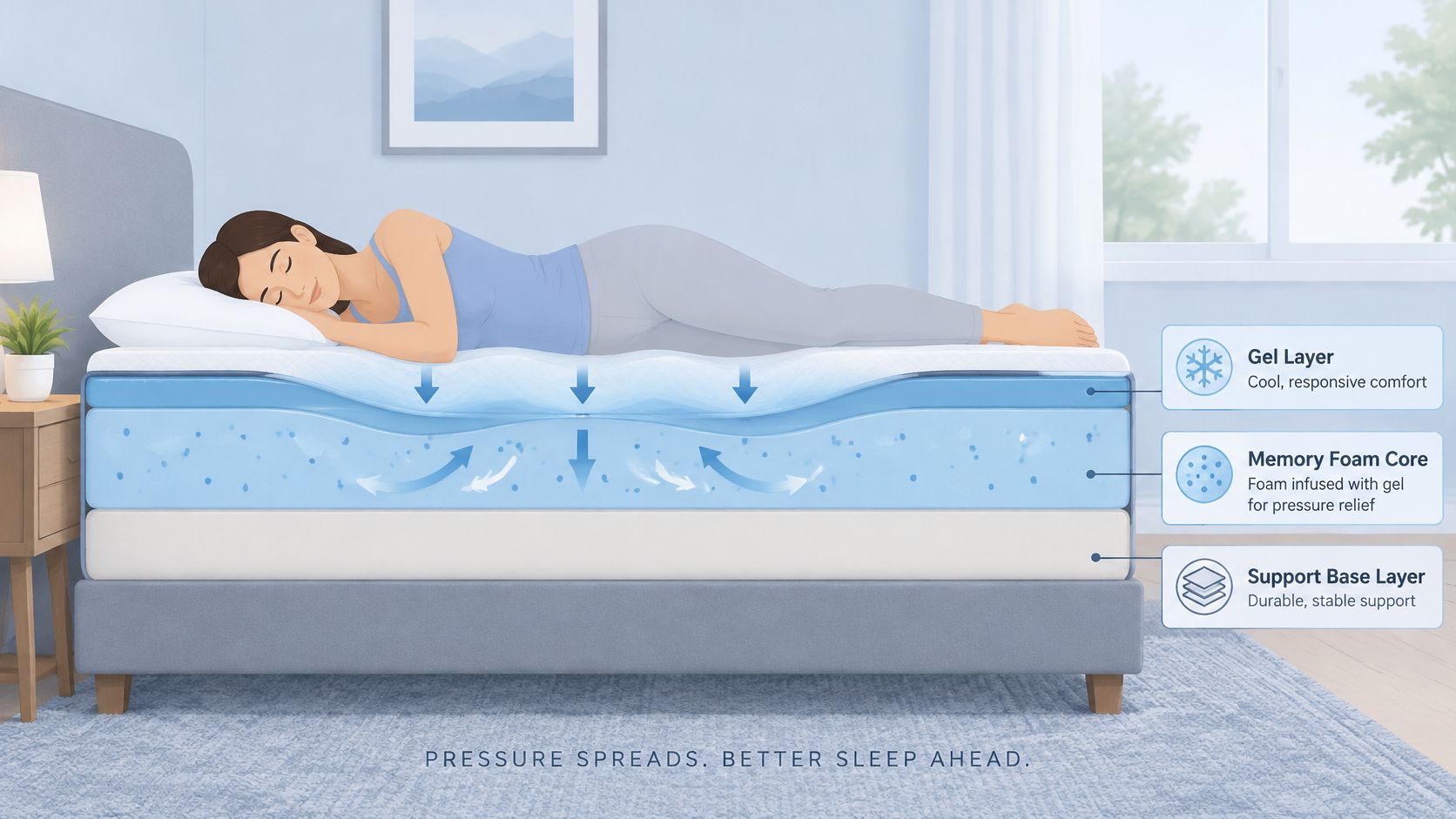
A gel foam mattress is a polyurethane memory-foam mattress in which gel is mixed into the foam, layered over it, or placed right beside it so pressure and heat behave differently. Sleepiverse's look at gel memory foam makes the shopper point clearly. Gel-infused foam, a distinct gel slab, and a dense gel surface are separate constructions, and they can perform in materially different ways.
How the stack usually sits
From the skin down, a typical bed has three jobs.
- Comfort layer: the soft top where the shoulder and hip meet first. Gel usually lives here, either blended in or laid on as its own sheet.
- Transition layer: a firmer foam that stops the body from dropping straight into the base.
- Support core: dense foam, or coils, that carry weight for the whole night.
The layer positions matter because the same gel material behaves differently depending on where it sits. A sheet under the cover touches the body all night. Beads dispersed through foam share the work with everything around them.
One controlled sleep study makes that distinction easy to see. Researchers compared a mattress that paired a foam core with a high-heat-capacity gel surface against conventional memory foam, and the gel-surface bed was associated with a little more deep, slow-wave sleep, a larger drop in core temperature and a lower heart rate through the night. That surface was a dedicated gel sheet, a different construction from gel particles stirred into foam, so the result describes that specific build rather than every mattress with gel on the label.
Practical rule: Ask for gel thickness, where the layer sits in the stack, and the foam density beneath it before comparing two models. Those three answers describe the actual construction.
Gel Foam Versus Other Mattress Types at a Glance
Two mattresses can both wear the word "gel" on the tag and behave like different beds all night. A feature-by-feature chart separates them faster than any product description can. Read each row as a prediction of how a night usually goes, then match it to the sleeper's habits.
| Feature | Gel foam | Plain memory foam | Hybrid | Latex |
|---|---|---|---|---|
| Cooling | Good early in the night, fades as gel warms | Holds heat through the night | Good, coil air space aids airflow | Good, open cell structure breathes |
| Pressure relief | Strong, gel spreads pressure across contours | Strong, deep contouring | Moderate to strong, set by the comfort layer | Moderate, responsive contouring |
| Support under heavier bodies | Needs a high-density core beneath the gel | Needs dense foam through the base | Strong, coil core supports weight | Strong, dense latex options |
| Motion isolation | Strong | Strong | Moderate | Moderate |
| Bounce | Low to moderate | Low | Moderate to high | High |
| Typical feel | Cushioned, hugging, slightly cool to the touch | Deep hug, slower response | Balanced, with a springy edge | Responsive, buoyant |
The rows group into pairs
Gel foam and plain memory foam travel together on pressure relief and motion isolation. Both contour around a shoulder or hip and give it a pocket instead of a hard point, and both absorb the wave a partner sends across the bed by turning over. Their shared demand sits underneath: each one needs a dense base so a heavier sleeper does not sink through the comfort layer.
Hybrids and latex form the second pair. Coil cores and dense latex carry weight more readily and push back sooner, which is why the bounce and support rows lean their way. A hybrid's pressure relief lands in the middle because it is set by the thickness and softness of the comfort layer above the coils, and that layer varies far more than the springs do.
The cooling row earns its own look because it is the one shoppers misread. Gel foam usually feels cooler at lights-out, since the gel has not caught up to body temperature yet, and that early edge fades as it warms. Plain memory foam holds heat through the night. Hybrids draw airflow from the open volume between coils, and latex breathes through an open cell structure, so overnight temperature rides on the whole build, foam density, air paths, and cover included.
Match the row to the night
Pick the row that decides your comfort first, then check which layers deliver it. Side sleepers after a cradled shoulder and hip will find that pocket in the gel foam or memory foam columns. Combination sleepers who dislike feeling stuck fit better with latex's quick response or a hybrid's springy edge. Anyone who wakes at every shift from a partner should lean on the motion row, where the foam beds keep their advantage.
Lying on a wider range of mattress types in person makes these tradeoffs easier to feel. When two finalists seem tied, the tiebreaker usually hides below the comfort layer, in what the support core is made of.
The table is a starting map for a hands-on test. The verdict comes from lying down.
Does Gel Foam Really Sleep Cooler?
Walk a mattress aisle and the pitch sounds settled: add gel, and the bed stops holding heat. The honest answer is narrower. Gel foam changes how heat moves through the layers, and that change has a ceiling.
Gel particles, beads, or phase-change materials raise the surface's thermal mass. They can pull heat off pressure zones such as the shoulders, hips, and back. An ice pack set on a warm plate works the same way. The plate feels cooler at first. Then the pack warms until both sit at nearly the same temperature, and the cool feeling is gone. The Sleep Foundation's guide to gel memory foam describes that same limit: once the gel nears thermal equilibrium with the sleeper, the short-term heat-sink effect fades.
That is the essential task gel performs. It manages the transfer of heat early in the night, while the rest of the mattress determines what happens during the other seven hours.
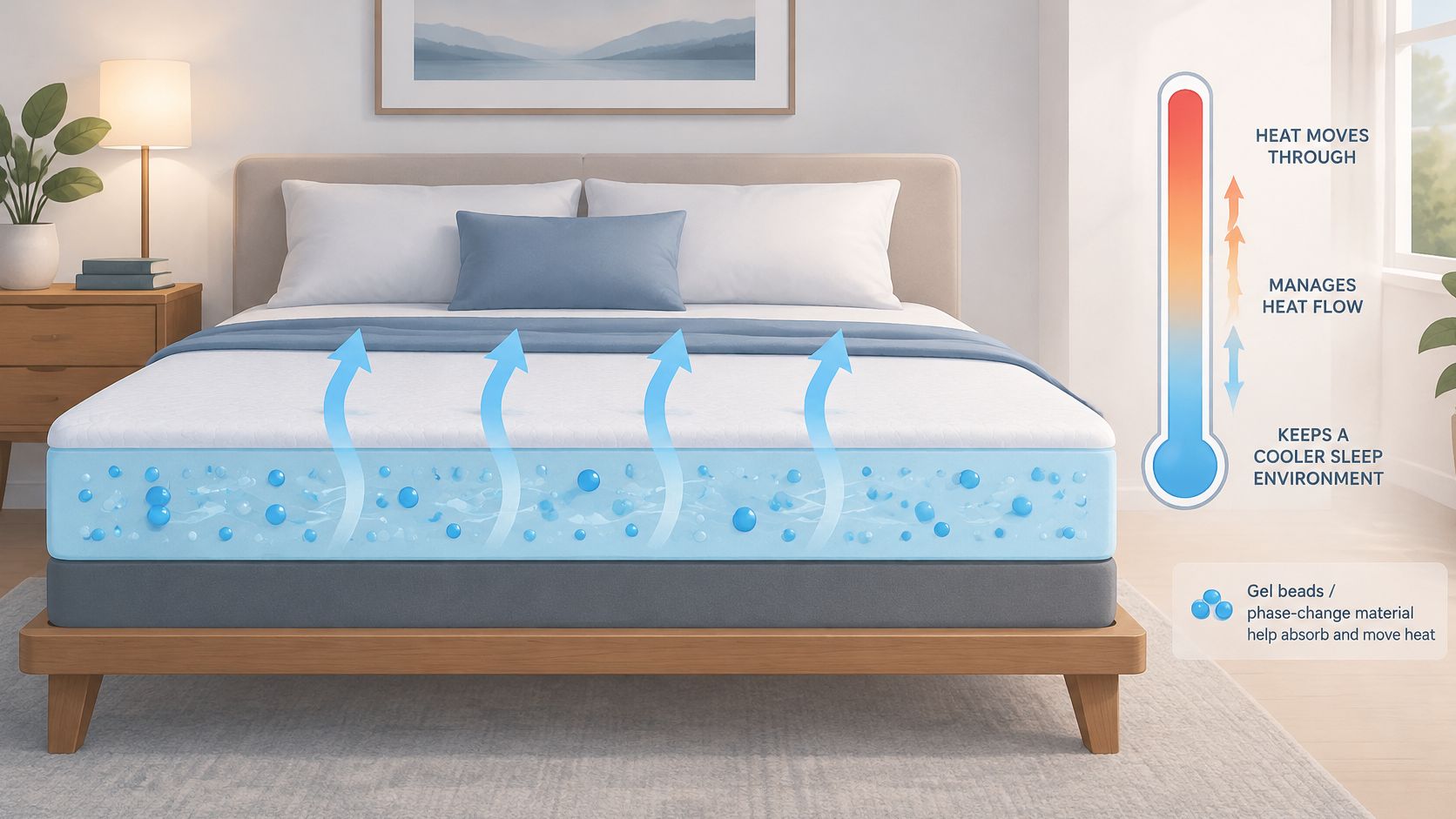
What actually holds temperature overnight
All-night comfort comes from the whole build, and the gel badge is only one line in that build.
- Foam density: tighter foam stores more heat against the body.
- Open cells: pathways inside the foam let warm air escape.
- Cover: a tight knit can trap what the gel tried to move, while a breathable cover lets it go. A cooling mattress cover adds that breathability on top of the build.
- Air channels and a ventilated core: coils, or channeled foam, give heat somewhere to travel.
In broad type-by-type comparisons, all-foam gel models tend to land mid-pack on temperature neutrality. Hybrid and innerspring designs usually run cooler because coil cores supply air volume and convective pathways. A gel layer may delay the first warm-up, and that head start is real during the first stretch of sleep. By 3 a.m., though, the surface has typically settled to body temperature. A specialized gel panel that performs well in a lab comparison still says little about how a particular gel-infused mattress will sleep in your bedroom.
A fair in-store check
Lie still for 10 to 15 minutes, long enough for the surface to meet your body heat. Notice whether the cool feel is still there or whether the hug has warmed. Then press the cover with a hand and ask whether the core is solid foam or a design with air paths. Those few quiet minutes on the bed tell you more than the word on the label.
Who Gel Foam Suits Best and Who Should Think Twice
Gel foam keeps the mechanical habits of viscoelastic foam. It conforms, it spreads pressure, and it isolates motion. A technical mattress-construction disclosure notes that gel can distribute pressure more evenly because it deforms in more than one direction under load, and that gel generally conducts heat better than foam, though fillers change that result. Deeper conformity increases contact area and can lower peak pressure at the hips, shoulders, and other prominent spots. That same wrap reduces free air around the body, so the surface can feel warmer even while pressure drops. Relief and warmth tend to arrive together, and the layer design decides which one wins overnight.
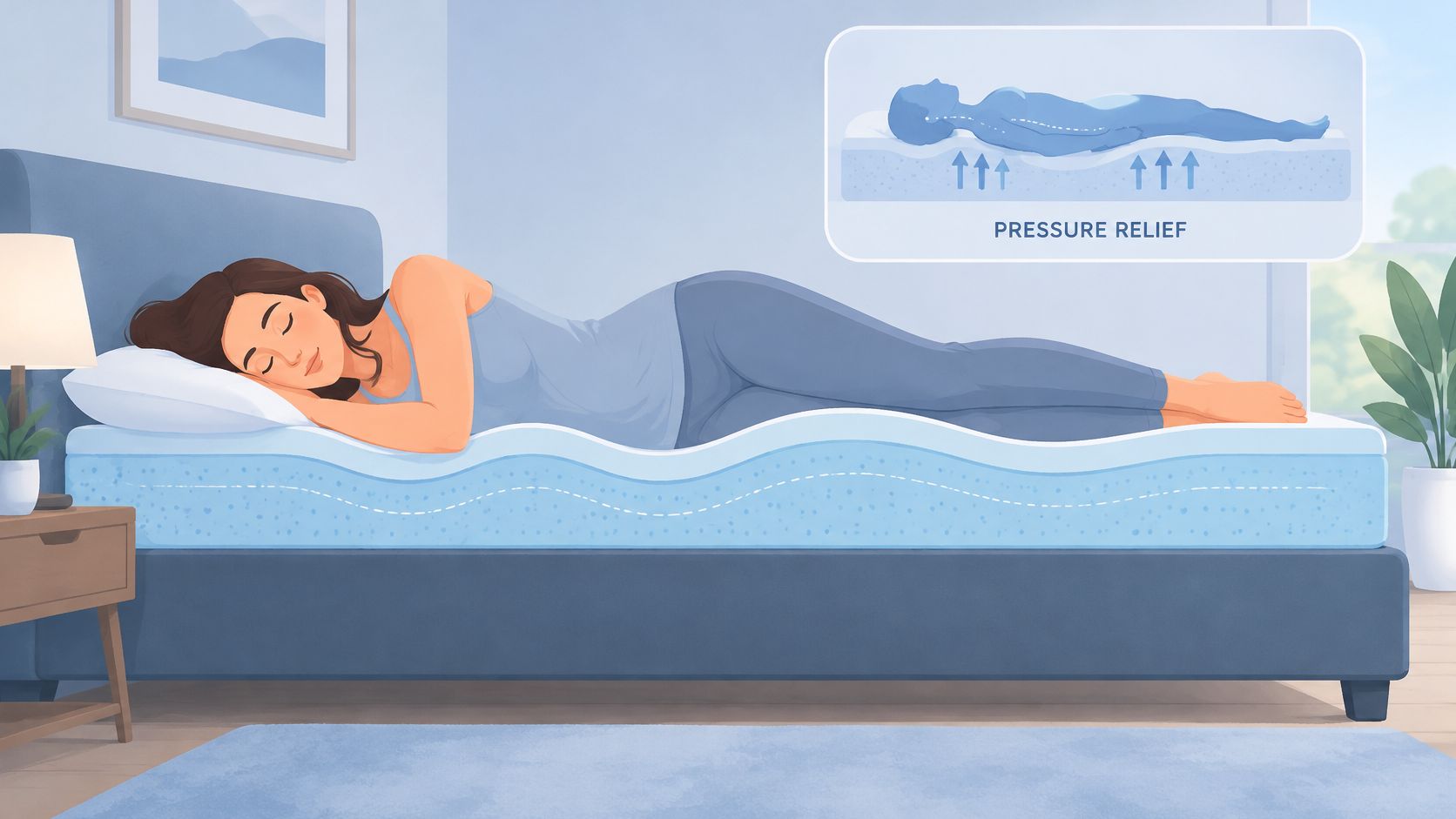
Who usually settles in
Side sleepers who want the hip and shoulder to sink a little, people with joint or pressure sensitivity, and anyone who likes a contoured hug tend to feel at home. The surface follows the body's outline and holds it, which is the source of both the comfort and the tradeoff. The better a bed cradles a shoulder, the less open air sits around that shoulder.
Heavier sleepers should look past the gel label. Comfort and durability cannot be read off gel content alone. Check foam density, comfort-layer thickness and firmness, the transition layer, and the support system. A high-density core under the gel foam keeps the body from sinking through to the hard layers below. Shoppers who run warm can use the type comparison above as a filter before deciding what to test.
A three-position self-check
- Lie on the side and wait. Pressure at the hip should ease without a stuck, trapped feeling in the shoulder.
- Roll to the back. The spine should look straight from the side, not hammocked in the middle or arched at the low back.
- If a partner shares the bed, have that person sit down near the edge. Motion should stay local. Different body weights sometimes need a firmer option from a mattress firmness guide so one sleeper is not parked in a hole.
Couples rarely share one sleep style, so a single showroom verdict rarely fits two bodies. Test two or three models side by side, with one partner lying on each, then switch and compare notes. The bed that passes both lists is the one worth bringing home.
Reading Gel Foam Specs Before You Buy
A gel label tells you only part of the story. To compare two mattresses, follow the layers from the surface down and ask what each one contributes.
- Where does the gel sit, and how thick is the layer? Gel particles mixed into foam and a separate gel layer are different constructions. Ask where the gel appears in the stack and how thick that layer is.
- What is the density of the comfort foam and core? Density helps describe how much material is packed into the foam, and gives useful context when comparing constructions. The foam density ratings guide explains how to read those figures.
- What is beneath the comfort layer? A solid foam core and a coil core have different constructions. Ask whether the cover and core include features intended to support airflow.
- How does the transition layer connect the soft top to the support core? A plush surface can feel comfortable at first, but the layers beneath it shape how the mattress supports the body.
- Which foam layers carry CertiPUR-US certification? The RTINGS guide to mattress certifications describes the certification benchmark for qualifying foam, including emissions criteria. Ask which layers are covered; certification of foam does not automatically apply to every mattress component.
- What testing and comfort-trial terms can the maker explain? Ask what independent temperature or comfort results are available, and clarify the exchange or trial policy before buying.
Four builds and the check that fits each
| Construction | How it is made | What to check |
|---|---|---|
| Gel-infused foam | Gel particles or beads blended into the foam | How the gel is incorporated and what foam density information is available |
| Distinct gel layer | A separate gel layer placed above the foam | Its position in the stack and how the layers beneath it are constructed |
| Gel surface over foam | A gel layer above a foam support core | The transition between the surface and core, and what testing is available |
| Gel comfort layer over coils | Gel foam above a coil support core | How the comfort foam and coil core work together, and whether airflow features are described |
The most useful comparison is about the whole build, not the gel label alone. Ask the same construction questions about each mattress, then compare the answers layer by layer.
Safety, Smell and Care for Your Gel Foam Mattress
Fire safety comes from the finished mattress meeting federal standards, not from the gel layer. Under the Consumer Product Safety Commission's mattress FAQ and 16 C.F.R. Part 1632, a tested mattress or pad must not produce a char length exceeding 2 inches (5.1 centimeters) in any direction from the nearest point of the cigarette.
Open-flame performance has a separate requirement. Under 16 CFR Part 1633, mattresses manufactured, imported, or renovated for sale are tested with propane burners and oxygen-consumption calorimetry. The peak heat-release rate cannot exceed 200 kilowatts during the 30-minute test, and total heat release cannot exceed 15 megajoules in the first 10 minutes. A mattress sold with a foundation is tested as a set; a mattress sold alone is tested by itself. Check the mattress label and ask the retailer or manufacturer for compliance documentation.
What a new-mattress smell does and does not mean
A new foam mattress may have an odor that fades as it airs out. In an EPA-indexed chamber study of two new memory-foam mattresses, VOC emissions peaked on the first day and declined over the following 31 days of a 32-day test. The EPA HERO record of the study reports modeled one-year average total VOC concentrations of about 2.7 and 4.2 micrograms per cubic meter. Those findings describe the two mattresses tested, not every gel foam mattress or a set number of days for every household.
Odor sensitivity varies, and a smell alone does not establish exposure. Fresh air helps disperse odors:
- Unwrap the mattress in a room with a window open rather than leaving it sealed in a closed bedroom.
- Keep air moving during the first few days. For more practical tips, see this guide to removing smells from a mattress.
- If someone in the household has asthma, is an infant, or has chemical sensitivities, ask about product-specific certifications, ingredient disclosures, and the return policy.
Foam-emissions certification and flammability rules address different properties, so one does not replace the other.
A care schedule that protects the build
| Care task | How often | Why it matters |
|---|---|---|
| Rotate the mattress head to foot (flip only two-sided models) | Every 3 to 6 months | Spreads wear so the comfort layer keeps its shape |
| Vacuum the surface | Every 1 to 3 months | Removes dust and skin cells that build up over time |
| Wash the mattress protector | Every 1 to 2 months | Keeps moisture and allergens away from the foam |
| Blot spills right away | As they happen | Liquid can soak into foam and cause mold or odor |
| Check for sagging | Every season | A dip deeper than about 1 inch can signal lost support |
Rotation shares the load across the surface. Vacuuming removes grit from the cover, while a clean protector helps keep moisture away from the foam. Blot spills promptly, and check for sagging each season to see whether the support core is still holding its shape.
Come Test Gel Foam for Yourself in Greenfield
Does a gel foam mattress feel different from other beds when you lie down? Comparing models in person can help you judge the whole sleep system, since gel is only one layer and does not guarantee a cooler night. BILTRITE Furniture-Leather-Mattresses has over 60 mattress models on sale in its Greenfield showroom, including hybrid, innerspring, memory foam, adjustable base, flip-able, heavy-duty, latex and semi-heavy-duty options.
Use the checklist in the specs section to guide your questions, then focus on how each mattress feels under your body. Does the support suit your preferred sleeping position? Does the surface feel comfortable? If you share a bed, notice how movement affects your side.
BILTRITE is a fourth-generation, family-owned business serving Metro Milwaukee since 1928. The showroom is closed Sundays and Mondays. On mattress-only purchases of $999 or more, free white glove delivery is offered; select model sets include a free mattress protector or a free heavy-duty bed frame.
Come down to the showroom and take your time. You do not have to decide after one lie-down.
Visit BILTRITE Furniture-Leather-Mattresses to compare mattresses in Greenfield and see which construction feels right for you.