Who Makes Two Sided Mattresses in 2026

How often do shoppers assume two-sided mattresses have disappeared? They're still made, though true flip-able beds now come from a smaller specialty and craft segment rather than the biggest mass-market factories. The industry shifted toward one-sided designs around 2000, as production costs and manufacturing choices changed.
A mattress only earns the “two-sided” label if both faces are finished for sleeping. That distinction matters: flipping can spread wear across both surfaces, but only if someone at home can safely turn the mattress over. Before choosing one, check that both sides are intended for use and consider whether its weight makes flipping practical.
Table of Contents
- Who Still Makes Two Sided Mattresses
- How Two Sleep Surfaces Differ From One
- Specs That Show Both Sides Are Real
- When Flipping Is Too Heavy to Do Alone
- How Often to Flip and Rotate
- Try a Flipable Mattress in Greenfield
Who Still Makes Two Sided Mattresses
Who still makes a mattress with two usable sleep surfaces? True two-sided beds remain available from specialty and craft-oriented makers, including American-made lines. The category is smaller than it once was, so shoppers should check the model's specifications and confirm that both faces are intended for sleeping.
Why the big factories walked away
One-sided designs became more common as manufacturers sought simpler production and finishing. A manufacturing history of flippable mattresses describes the shift and discusses factors behind it, including cost and the federal flammability standard 16 CFR Part 1633.
A useful question for any salesperson: does the underside have a finished sleep surface, and does the care label say to flip the mattress? A bed that can be rotated is not necessarily designed to be turned over.
Flipping can spread wear between two sleep surfaces, but the benefit depends on turning the mattress. Its weight matters, too: if nobody can safely flip it, the second surface may go unused.
| Maker type | What they may offer | What to check |
|---|---|---|
| Specialty and regional makers | Flippable models with two intended sleep surfaces | Product specifications and care instructions |
| Craft-oriented USA-made shops | Beds made for use on both sides | Confirmation that each face is a sleep surface |
| Makers with two firmness choices | Reversible models with a different feel on each face | Written firmness details for both sides |
| One-sided mattress lines | A designated sleep surface | Whether the model is designed to flip or only rotate |
| Greenfield floor | BILTRITE offers over 60 mattress models on sale, including 36 flip-able styles, and has over 500 mattresses in stock | Ask which floor models are intended to flip and whether you can safely turn one |
For a wider look at domestically made options, browse American-made mattress brands. BILTRITE's Mattress Center in Greenfield has an expanded gallery of flip-able, two-sided, and heavy-duty mattresses. All mattresses are USA made, 100% handmade, brand new, and factory fresh.
How Two Sleep Surfaces Differ From One
A two-sided mattress has cushioning on both sides of its central support structure. The support core is often an innerspring unit or dense foam, while padding, quilting, and comfort foam form a sleep surface above and below it. A one-sided mattress places its comfort layers on top, with a base underneath that is not meant for sleeping.
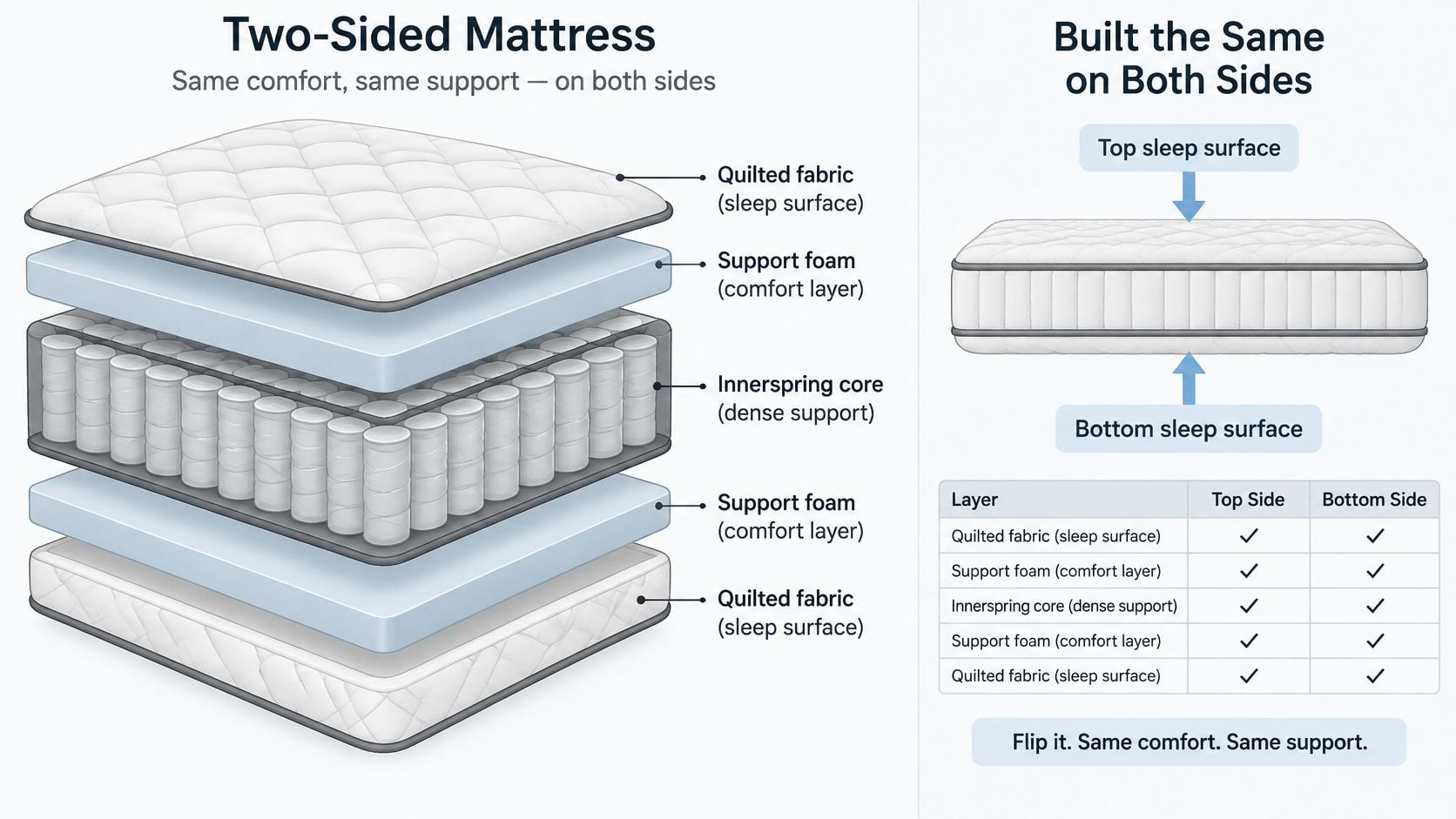
That construction creates two usable faces, but the feel can vary. Some reversible models have the same firmness on both sides; others offer a softer face and a firmer one. The Sleep Foundation describes these two-sided firmness options in its guide to flipping and rotating a mattress.
One feel on both faces or two different feels
A dual-firmness mattress might offer one side rated 4 out of 10 and the other 6 out of 10, while a same-feel model keeps the firmness consistent on both faces. Those ratings help describe the choice, though personal comfort is still subjective.
The distinction is practical. A same-feel model lets you alternate surfaces to spread wear. A dual-firmness model also gives you a way to change the feel, which may suit couples with different preferences. Neither design is automatically better; each meets a different need.
What a flip actually does to a comfort stack
Flipping a true two-sided mattress places a fresh comfort surface under the sleeper. The side that has carried pressure can rest, while the other takes its turn. That wear benefit depends on being able to flip the mattress safely and following its care instructions.
A mattress should only be flipped if its label or product documentation says both sides are made for sleeping. The label is more reliable than appearance alone. One-sided designs, including many with a pillow-top or zoned support, may have a specific top surface and an underside not built for sleep. Extra upholstery on both sides can also make a two-sided mattress heavier to handle.
| Question | True two-sided, same feel | Dual-firmness reversible | Typical one-sided |
|---|---|---|---|
| Sleep surfaces | Two matched faces | Two usable faces with different feels | One comfort side only |
| Comfort stack | Cushioning above and below the core | Cushioning on both faces, tuned differently | Soft layers on top, support underneath |
| Flip allowed | Yes, when the label says so | Yes, to change firmness and share wear | No |
| Example feel | Same firmness both sides | About 4 out of 10 and 6 out of 10 | One designated top |
| Wear plan | Flip plus rotate | Flip plus rotate | Rotate head to foot only, if allowed |
| Handling | Often heavier | Often heavier | Usually lighter |
| If flipped by mistake | Intended use | Feel changes on purpose | Comfort or support can be lost |
For a closer comparison of how the designs affect wear, edge support, and handling, see two-sided mattresses versus one-sided beds.
Specs That Show Both Sides Are Real
A mattress with two usable faces needs sleep-supporting layers on each side of its core. The details help you understand how those layers work together and whether the two faces are built alike.
Read the construction details
A two-sided innerspring may pair a coil core with insulation, padding, and foam on both faces. The coil system supports the mattress, while the layers above and below it cushion the sleeper. Some models use matching materials on each side; others tune the faces for different feels.
Each part has a job:
- Coils support the core. Their arrangement helps the mattress hold its shape under load.
- Edge reinforcement supports the perimeter. It can help the sides feel more stable when someone sits near the edge.
- Padding and foam shape the feel. Layers on both faces make each side usable for sleep.
- Insulation separates padding from the coils. It helps keep fibers from settling into the coil system.
Ask to see the construction details and care instructions. Look for an explanation of what sits above and below the core, whether the faces are matched or designed to feel different, and whether the maker allows flipping.
Dual-firmness models are a deliberate design choice. Each face may offer a different comfort feel, so check which side suits you and what the care instructions say about flipping. Warranty terms can also clarify how the maker treats flipping and body impressions.
A two-sided build gives wear another surface to spread across, provided the mattress is flipped as directed. Its lifespan still depends on factors such as the sleeper, the foundation, and the materials. The construction can support more even wear, but it does not promise a particular service life.
When Flipping Is Too Heavy to Do Alone
The wear-sharing payoff of two usable surfaces only shows up if someone turns the mattress. That's the part most care advice skips. Coverage of flippable beds acknowledges they can be awkward to handle, yet says little about safe handling, clearance, or when to call for help, as a closer look at two-sided mattress ownership points out. The risk lands hardest on older adults, people with injuries, couples with very different strength levels, and homes with narrow stairs or a tight bedroom.
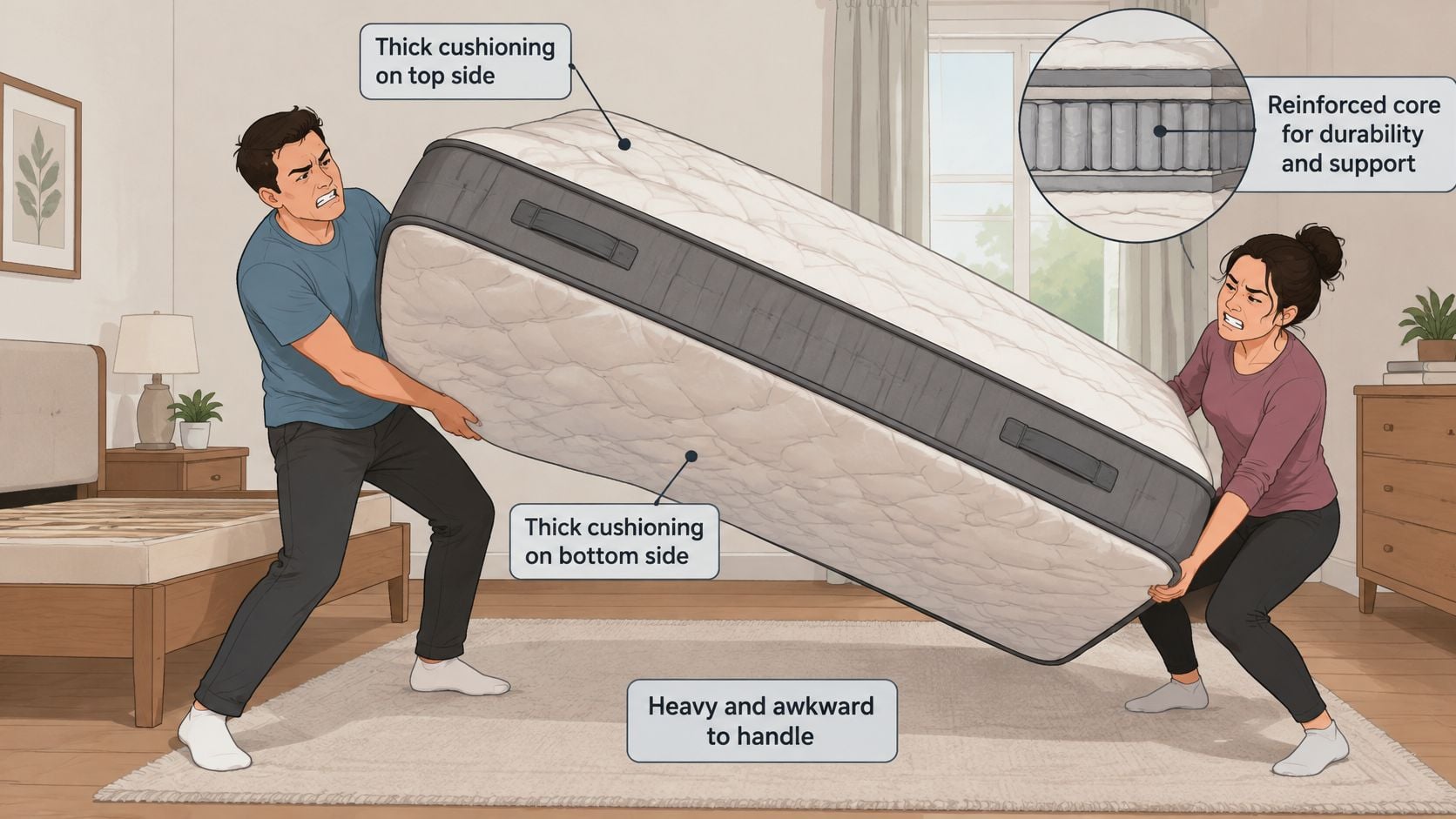
Do the homework before the bed arrives, in this order.
- Get the weight and thickness for the exact size you need, because a king and a twin are different jobs entirely.
- Measure the path, meaning doorways, stair turns, hallway width, and the floor space beside the bed where two people need to stand and pivot.
- Ask whether the handles are structural lifting handles or light carrying grips. One is built to take a mattress's weight mid-turn and the other isn't.
- Be honest about backs, shoulders, and age, and about whether one partner would end up doing it alone every time.
- Ask if delivery help can include a later flip, not just the drop-off day.
For senior households and caregivers, a durable bed is a poor match if the upkeep is unsafe. Compare the chore against the benefit. A home that can flip about twice a year, or that can schedule help, gets the full point of two surfaces. A home that can't should look hard at a well-made one-sided bed that only needs a rotate, or line up help in advance. Our guide to flipping a mattress safely walks through the physical steps if you want the mechanics.
How Often to Flip and Rotate
Flipping turns the other sleep surface up. Rotating turns the mattress 180 degrees, so the head and foot switch places. The two moves spread wear across different areas, much like shifting where you sit on a cushion.
Use the mattress label's guidance for the model you own. For a general schedule, rotate memory-foam and latex mattresses, when their design allows, one to two times a year. Newer innersprings have the same typical rotation schedule; older innersprings may need rotating two to five times a year. Flip only mattresses made for two-sided use.
| Mattress type | How often | Rotate | Flip |
|---|---|---|---|
| Memory foam or latex, if the design allows | 1 to 2 times a year | Yes | Only if designed to flip |
| Newer innerspring | 1 to 2 times a year | Yes | Only if double-sided |
| Older innerspring | 2 to 5 times a year | Yes | Only if built to flip |
| Bed designed to flip and rotate | About every 6 months | Yes, during the same care session | Yes, during the same care session |
The Sleep Foundation's mattress rotation guidance gives these typical ranges for memory-foam, latex, and innerspring mattresses. For a bed designed to be flipped and rotated, use about every six months as a practical routine.
A habit that actually sticks
Choose two reminders each year, such as the first weekend in March and September. Strip the bedding, flip the mattress if it is designed for two-sided use, then rotate it. Check that the foundation matches the manufacturer's directions.
Tie the reminder to a seasonal chore you already remember, like changing furnace filters. For a step-by-step refresher, see our guide to how often you should flip a mattress.
Try a Flipable Mattress in Greenfield
How can you tell whether a two-sided mattress suits you? Lie on both faces if the model is available to try, and notice how each feels at your shoulders and hips. A showroom visit can also help you check the mattress's handles and care label.
BILTRITE is a fourth-generation, family-owned showroom serving Greenfield and Metro Milwaukee since 1928. Its Mattress Center, updated in 2025, has an expanded gallery of flip-able, two-sided, and heavy-duty mattresses. Ask whether a specific model is on the floor and whether both sides are designed for sleeping.
Bring practical questions: How heavy is the mattress? Are its handles intended for lifting? What does the warranty say about flipping and body impressions? You can also learn how to test a mattress in a showroom before your visit.
BILTRITE offers a selection of flip-able, two-sided mattresses. Trying one in Greenfield gives you a chance to assess its feel and discuss whether you can safely turn it at home. Bring your room measurements and, if you share the bed, invite your sleep partner to compare comfort. Visit BILTRITE Furniture-Leather-Mattresses at 5430 West Layton Avenue in Greenfield.