Cooling Mattress Cover Guide for Better Milwaukee Sleep

A Milwaukee summer night can turn bedtime into a small negotiation. The pillow gets flipped to its cool side for the third time, the blanket lands in a heap on the floor, and the sheets seem to be hugging back a little too tightly. By three in the morning, a sleeper may be wondering whether the mattress is holding onto more heat than the bedroom itself.
That frustration is real, especially for people who naturally sleep warm or share a bed with someone who prefers a different temperature. BILTRITE has helped Metro Milwaukee families choose furniture and mattresses since 1928, and as a fourth-generation, family-owned business, the advice is simple: a cooling mattress cover can improve the feel of a bed, but it isn't a magic refrigerator for the whole mattress.
The useful questions are more practical. How does a cooling cover work? What does the research support? Will it fit the mattress, protector, sheets, and comforter already in the bedroom? And how can shoppers test comfort in person instead of buying blind online?
Table of Contents
- Why Hot Sleepers Keep Waking Up at 3 A.M.
- What a Cooling Mattress Cover Actually Does
- Cooling Technologies Compared
- What the Research Really Says About Cooling and Sleep
- Choosing the Right Cover for Your Bed and Bedroom
- Caring for Your Cover and Testing One in Person
Why Hot Sleepers Keep Waking Up at 3 A.M.
A warm bedroom can make a bed feel warmer still. The sleeper's body, pajamas, sheets, blanket, mattress, and protector all interact in the small space between skin and mattress. If that space holds onto heat or moisture, a person may wake up sticky, throw off the covers, and then pull them back on when the room feels cool again.
Humidity adds another wrinkle. Sweat cools the skin when it evaporates, but evaporation works less comfortably when moisture stays trapped near the body. A sheet can feel soft and clean while still creating a stuffy sleep surface if the fabric, quilting, protector, or mattress underneath limits airflow.
The mattress may not be the only suspect
A sleeper who blames the mattress may be reacting to the whole setup. A dense comfort layer can retain warmth, while a waterproof protector may limit moisture-vapor movement. Thick sheets and a heavy duvet can overwhelm a breathable top layer, much like putting a winter coat over a light summer shirt.
Position matters, too. A side sleeper has different contact points from a back sleeper, and the shoulders, hips, legs, and torso may not experience the same surface temperature. Research on bedding combinations found that local skin temperature changed according to which body parts touched or were covered by bedding, even when overall insulation stayed the same. The study tested 84 combinations across 18.6°C, 22.6°C, and 26.4°C, with different postures, clothing levels, quilts, and coverage rates (bedding combination research).
A useful starting point: Before replacing the mattress, look at the entire sleep system. The cover is one layer, not the whole weather forecast.
BILTRITE's team has spent generations helping local families sort through those details without making bedtime sound like an engineering exam. The goal isn't to chase the coldest possible surface. It's to find a setup that feels comfortably dry and temperature-balanced for the sleeper, the bedroom, and the mattress underneath.
What a Cooling Mattress Cover Actually Does
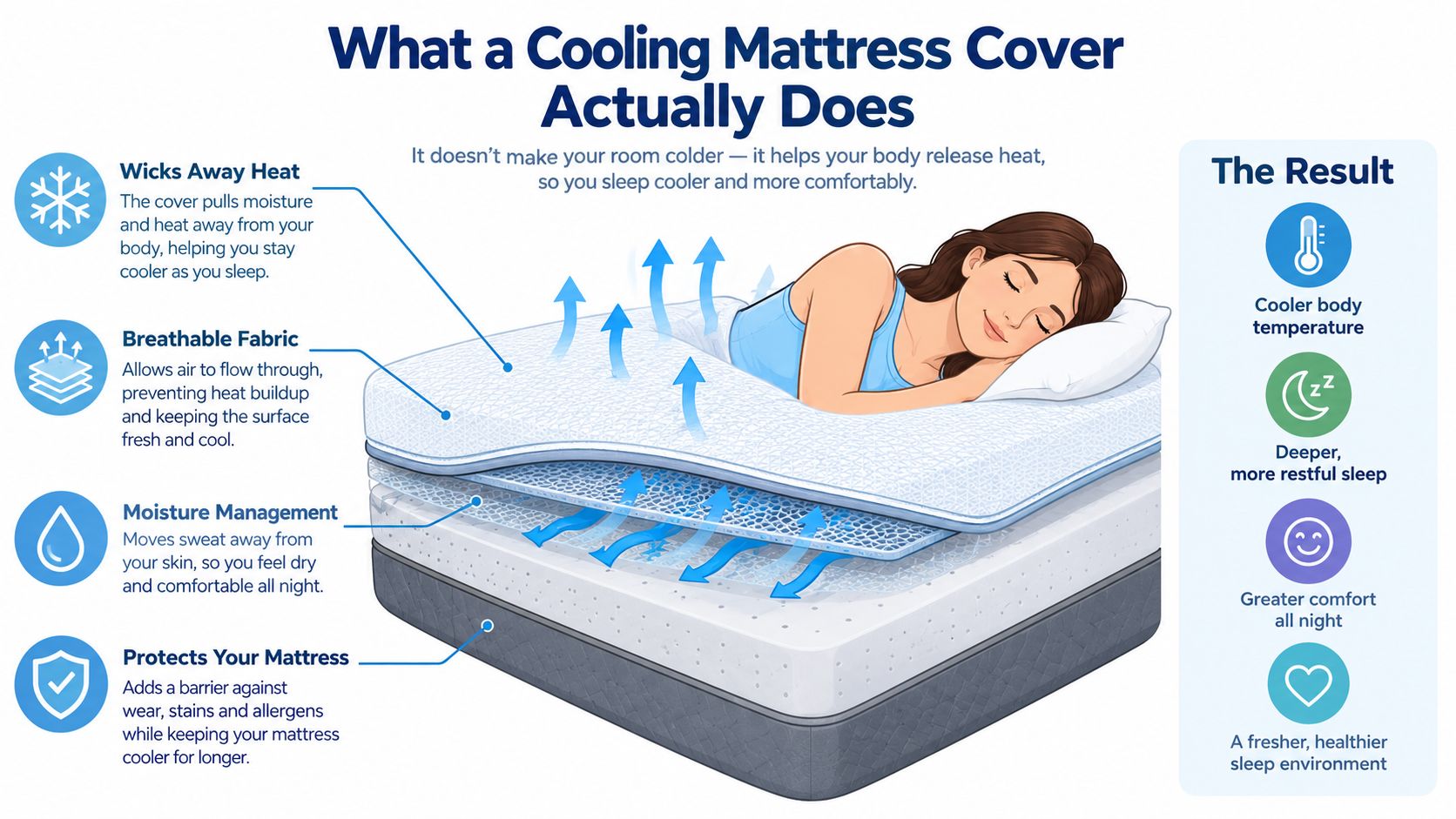
A cooling mattress cover works by managing the sleeper-to-bed microclimate, the narrow zone where the body meets the sheets and mattress. It doesn't usually make the entire mattress cold. A better comparison is a stuffy attic: opening vents can move heat and moisture out of the space, but the roof, insulation, and outside weather still affect the result.
Most covers sit directly on top of the mattress, usually beneath the fitted sheet. Their performance depends on several physical characteristics:
- Thermal conductivity: Materials that move heat away from the skin can reduce the sensation of warmth at the contact surface.
- Thickness: A thicker quilted layer may add comfort, but it can also add insulation.
- Air permeability: A fabric that allows air to move can feel less trapped than a dense, tightly sealed layer.
- Moisture-vapor resistance: If moisture can't move through the cover, sweat may remain near the skin.
- Fabric construction: Fiber type, yarn structure, and thickness all affect how the cover handles heat and perspiration.
Bedding fibers with high water-vapor permeability let sweat evaporate more readily. Evaporation removes latent heat and helps keep the skin interface drier. Research comparing bedding systems also reported lower humidity near the body with lyocell-based bedding than with a conventional cotton/polyester system under comparable temperature conditions (research on bedding moisture and microclimate).
The whole stack still matters
A breathable cover can help, but it can't fully overcome a heat-retentive foam comfort layer or an impermeable mattress protector. That doesn't make the cover useless. It means shoppers should assess the complete bed, including the mattress, protector, sheets, blanket, and room conditions.
A moisture-managing option such as BILTRITE's Dri-Tec mattress cover belongs in that conversation because the relevant question is how the layer handles trapped heat and moisture, not whether the word “cooling” appears on the label.
A showroom test can reveal useful details that a product description may skip. Hand-feel, fabric stretch, quilting thickness, and airflow through the textile all matter. A cover that feels cool for a few seconds may not move much heat after the sleeper settles in, while a less dramatic fabric may manage moisture better over the course of a night.
Waterproof backing deserves special attention. It can protect the mattress from spills, but it may also reduce vapor transmission. Shoppers should check care instructions, construction, and compatibility rather than assuming every protective layer will breathe equally well.
Cooling Technologies Compared
“Cooling” describes several different approaches, and they shouldn't be treated as interchangeable. One cover may focus on airflow and moisture handling. Another may use materials intended to absorb or conduct heat. An active system may adjust the bed's temperature with conditioned air or fluid.
Three broad categories
Passive breathable covers use moisture-managing textiles and open-feeling constructions. They don't require power, and they're often the simplest choice for sleepers who feel clammy rather than intensely overheated. Their performance depends on the fabric, quilting, protector, sheets, room humidity, and mattress below.
Phase-change and conductive materials are designed to absorb or move heat at the sleep surface. They may provide a more noticeable cool sensation than ordinary bedding, although shoppers still need to ask how long that sensation lasts and whether the material actually changes the bed's temperature.
Active temperature-controlled systems circulate conditioned air or fluid. They offer measurable adjustment rather than relying only on a fabric finish. In return, shoppers need to consider power, controls, possible noise, maintenance, washability, and the added equipment that comes with the system.
| Cover Type | How It Works | Best For | Trade-Offs |
|---|---|---|---|
| Passive breathable cover | Uses airflow and moisture-managing textiles | Sleepers who feel warm or damp | Can't actively lower temperature and depends heavily on the rest of the bed |
| Phase-change or conductive cover | Absorbs or moves heat at the surface | Shoppers seeking a stronger cool-touch or heat-transfer effect | Performance can vary by construction and may not provide continuous adjustment |
| Active temperature-controlled system | Circulates conditioned air or fluid | People who want adjustable temperature control | Requires power and may involve more equipment, care, noise, and expense |
A cool-touch finish can feel refreshing when a hand first lands on the fabric, but that doesn't prove sustained heat removal. Shoppers should ask whether the product offers measurable temperature adjustment, passive phase-change or conductive materials, or only an initial surface sensation (temperature-controlled cover study).
Match the technology to the complaint
A person who wakes up sweaty may need better moisture movement more than a dramatically colder surface. Someone whose mattress feels warm even in a comfortable room may want stronger conductive or active temperature management. Couples can also have different needs, especially when one person wants a lighter bed and the other prefers more warmth.
Mattress construction matters here. Dense foam can retain heat differently from other materials, so shoppers comparing gel memory foam and memory foam should think beyond the label and consider the cover, protector, sheets, and bedroom together.
Power and maintenance aren't minor details. An active system may need an outlet near the bed, and a passive cover may be easier to wash and replace. The most suitable choice is the one that addresses the actual discomfort without adding features that won't be used.
What the Research Really Says About Cooling and Sleep
You climb into bed already tired, then wake up a few hours later feeling too warm and wondering whether a cooling cover would fix anything. The honest answer is more modest than many product pages make it sound.
Research suggests cooling can improve perceived comfort and reported sleep quality, but that does not automatically mean better results on every objective sleep measure. In a randomized crossover study of 34 healthy adults, a temperature-controlled mattress cover used for 14 nights improved perceived sleep quality with a large effect size, d = 0.92, p = 0.001, and improved reported thermal sensation and comfort. The same study found no significant changes in objective sleep parameters or biometric indices. Participants slept in environments averaging approximately 21 ± 3°C and 60 ± 7% relative humidity (controlled temperature-cover study). For a broader look at how lighting, temperature, mattress, and bedding work together, see our guide to creating a sleep sanctuary with the right room and bed setup.
That difference trips people up. Feeling cooler can make the night feel better, and that matters. But a cooler-feeling bed surface is not the same thing as proof that sleep stages, total sleep time, or other biometric readings will improve.
The researchers also noted that expectancy or placebo effects may partly shape how people rate their sleep. That does not make the comfort benefit fake. If you usually wake up because your bed feels stuffy, relief is still relief.
The evidence has limits
The bigger body of research is still pretty thin. A systematic review screened 3,454 articles and found only nine qualifying randomized controlled trials in healthy adults. The review rated the certainty of evidence from very low to low, and cooling bedding generally did not show clear differences in sleep-onset latency, sleep efficiency, time awake after sleep onset, total sleep time, or the proportions of light, deep, and REM sleep (systematic review of cooling bedding).
Another study looked at the bed's immediate climate rather than broad product claims. In a controlled mattress-microclimate study, surfaces were maintained at 28°C, 30°C, and 32°C while room conditions stayed constant. Participants reported lower sleep satisfaction at 32°C than at 28°C, and subjective sleep latency was longer at 32°C than at 30°C (mattress microclimate temperature study).
The honest takeaway: a cooling cover can make the sleep surface feel more comfortable, especially for hot sleepers, but it is not a guaranteed fix for insomnia and not a promise of better sleep stages. Shop with the whole bed in mind. Room air, sheets, duvet, protector, and mattress all shape the bed's microclimate, so a cover works best when the rest of the setup is not trapping heat.
Choosing the Right Cover for Your Bed and Bedroom
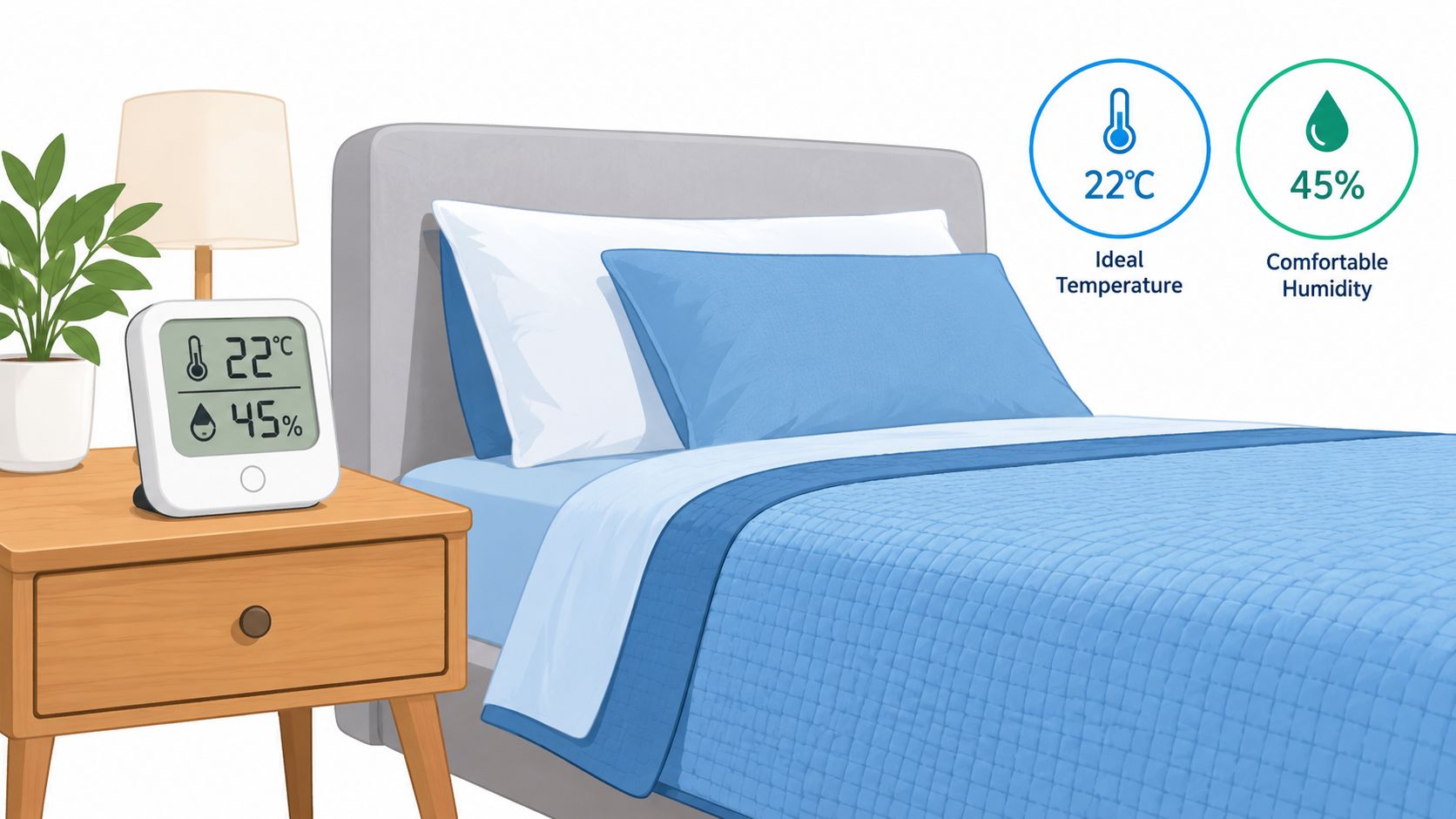
Choosing well starts with the whole bed, not the label on one product. If your bedroom feels sticky in July, a cover that breathes and handles moisture usually makes more sense than one that only feels cool for the first minute. If the room runs cool, that same airy cover can feel a little too brisk with light sheets. The goal is not the coldest bed. The goal is a bed that stays comfortable through the night.
That is why microclimate matters.
Your cover sits in the middle of a small weather system made up of room air, sheets, pajamas, duvet, protector, and mattress. Change one piece, and the feel can change more than shoppers expect. A heavy duvet can trap warmth over a cooling layer like a winter coat over a T-shirt. Warm sleepwear does the same thing. Sleep position changes the feel too, because side sleepers press shoulders and hips farther into the bed than back sleepers do.
Start with the bedroom setup
A practical match often looks like this:
- Warm and humid room: Focus on airflow and moisture handling. A passive breathable cover is often a sensible place to start.
- Warm-feeling mattress: Look at the comfort layers and the protector too. A cover cannot do much if heat is building underneath you.
- Heavy duvet user: Test the cover with the bedding you use. A lighter-feeling cover may still sleep warm under a thick comforter.
- Cool bedroom: The most breathable option is not always the most comfortable all year. A moderate design may feel more balanced.
- Different-temperature couple: Consider whether both sleepers really want the same surface feel, or whether each side needs a different solution.
As noted earlier, research on bedding combinations found that posture, clothing, quilts, and which body areas were covered all changed local skin temperature, even when total insulation stayed similar. That is a useful reminder for shoppers. A cooling cover is one layer in the system, not a magic override for everything above and below it.
Check fit before buying
Fit affects comfort more than many people realize. Measure mattress depth with any topper already on the bed. A cover that is too tight can pull at the corners and change how the surface feels. One that is too loose can bunch under the fitted sheet, which gets annoying fast.
Material pairing matters too. Check whether the cover is meant for your mattress type, and pay attention to what sits underneath it. Some mattress protectors use waterproof backings that can reduce vapor movement. That does not make them bad. It just means the protector and cover need to work together.
BILTRITE's Mattress Center includes over 60 models, including flip-able and two-sided mattresses. That helps because a cover should be judged on the actual bed beneath it, not on a fabric swatch by itself.
Before you choose, ask a few plain questions:
- Is the main issue heat, sweat, or both?
- Is the bedroom warm, humid, cool, or inconsistent?
- What sheets, duvet, pajamas, and protector are already in the mix?
- Does the cover fit the full mattress depth?
- Is it washable, and does any backing slow vapor movement?
- Does it manage heat over time, or mainly give a cool first touch?
Caring for Your Cover and Testing One in Person
A breathable cover needs sensible care. Shoppers should check whether it's machine washable, follow the water temperature and drying directions, and avoid assuming that every quilted or temperature-managing material can handle the same treatment. Clean bedding helps preserve the fabric's feel, while incorrect washing can damage coatings, backing, or internal materials.
The mattress care guide for staying cool and clean offers a useful starting point for keeping the broader sleep system fresh. Regularly checking the protector, sheets, and cover together also makes it easier to spot the layer that is trapping heat or moisture.
Since BILTRITE doesn't sell online, shoppers can test comfort in the Greenfield showroom instead of guessing from a screen. The hands-on checklist is straightforward:
- Feel the fabric: Notice whether it feels cool, smooth, slick, or breathable.
- Stretch the cover: See whether the material moves naturally over the mattress.
- Inspect quilting thickness: A lofty layer may feel comfortable but can insulate differently.
- Ask about airflow: Staff can explain construction, care, and compatibility.
- Test the mattress beneath it: The cover should make sense with the support and comfort layers already under the sleeper.
BILTRITE's sales associates bring over 400 years of combined experience, and the Mattress Center carries over 60 models with 500+ mattresses in stock. Qualifying purchases may include free white-glove delivery, and select sets may include old mattress removal in donatable condition or a complimentary protector or heavy-duty frame. The showroom is at 5430 West Layton Avenue in Greenfield, and the family-owned store is closed Sundays and Mondays for family time.
BILTRITE Furniture-Leather-Mattresses offers hands-on mattress guidance, cooling-cover options, and a broad selection of USA-made, Amish-made, solid-wood, small-scale, and heavy-duty furniture for Metro Milwaukee homes. Visit BILTRITE Furniture-Leather-Mattresses in Greenfield to test comfort without pressure, ask practical questions, and find a sleep setup that fits the bedroom.