


Non Toxic Furniture Finish: A Buyer’s Guide


Most of the advice about a non toxic furniture finish comes down to one instruction: buy water-based, check the VOC number, move on. That advice isn't wrong so much as incomplete. A finish is the thinnest layer of a piece. Underneath it sit the wood, the glue in the joints, the plywood or particleboard core, the stain and the sealer. What you breathe in a bedroom has as much to do with that underside as with the can the topcoat came from.
No U.S. agency defines "non-toxic" as a finish category. It's a word on a label, not a measurement. What can be measured are the emissions: volatile organic compounds and formaldehyde. Volatile organic compounds, or VOCs, are chemicals that evaporate out of a product into the air you breathe. Some smell strong. Some don't smell at all. Formaldehyde is a separate gas with its own rules and its own health limits, and it comes mostly from the adhesives that hold panels together rather than from the coat on top.
The goal here is simple: give you the vocabulary to look at a dining table or a nursery dresser and know what to ask, what a label can prove, and what it can't.
Table of Contents
- What Non-Toxic Really Means for Furniture Finish
- Wax, Water-Based Polyurethane and Oil Compared
- Why Your Nose Cannot Tell You If a Piece Is Safe
- Certifications, Labels and Questions to Ask Before You Buy
- How to Apply and Cure a Low-Emission Finish at Home
- Pick Your Finish and Visit Our Greenfield Showroom
What Non-Toxic Really Means for Furniture Finish
A quick rule: a finish works like a lid on a jar. It slows the smell, and whatever is in the jar stays in the jar. That one image explains why two pieces that look identical on a showroom floor can measure very differently once they are sitting in a bedroom.
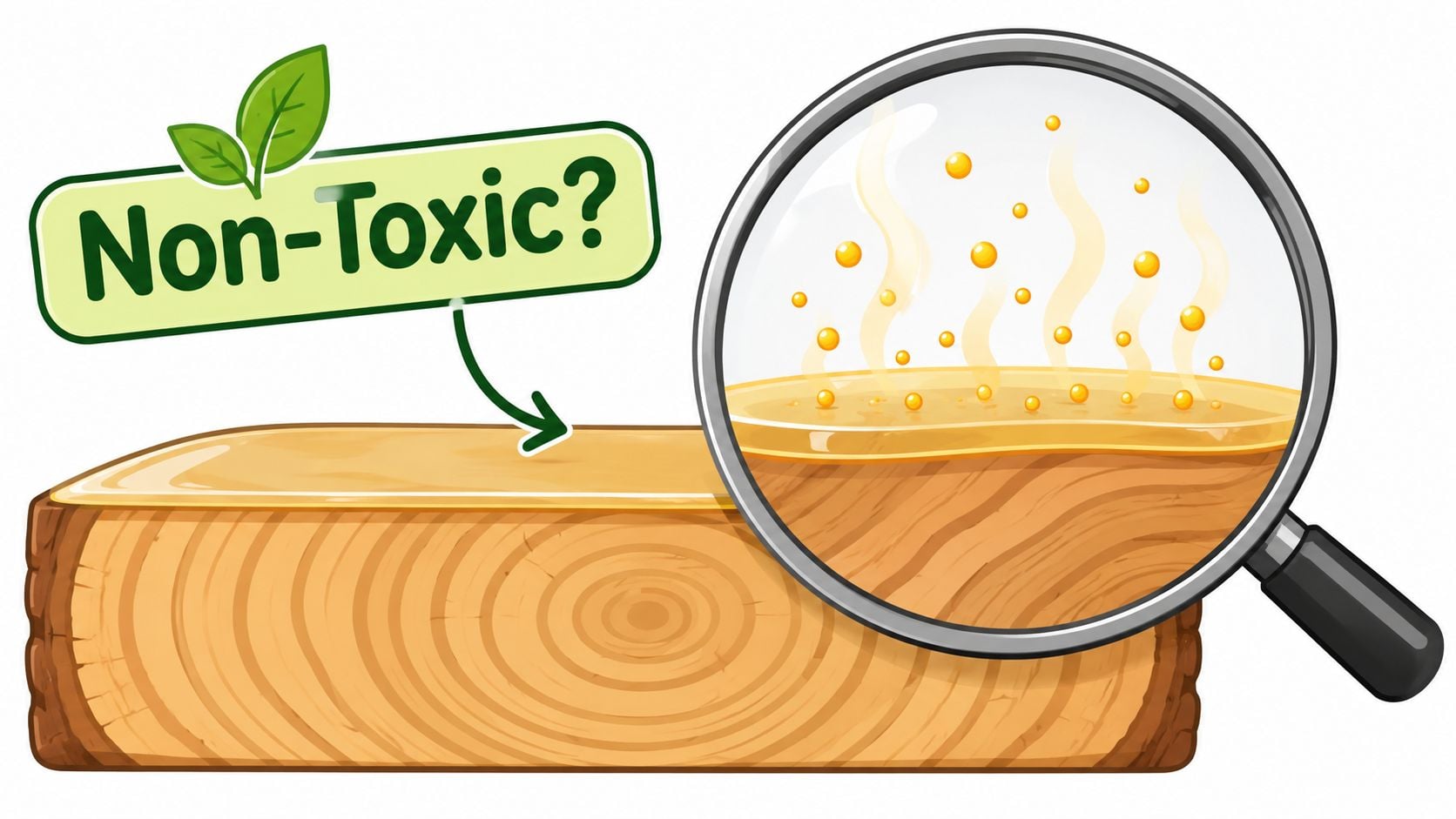
The Lid and the Jar
A jar of something pungent in the fridge has two parts, the lid and the contents, and the air in your kitchen depends on both. A tight lid over something mild is easy to live with. A loose lid over something sharp makes for a different evening. Furniture follows the same logic. The finish is the lid, and the wood, panels and glue underneath are the contents. Even a very good lid over a strong core lets some of that core through over time.
That is why the wording on a can of finish describes only the layer it names. The piece underneath keeps its own chemistry, so the honest question is what the whole assembly gives off, not what the topcoat promises on its own.
A 2020 peer-reviewed review of emissions from wood-based products found that VOC sources include resins, coatings and other finishes that can off-gas into indoor air, and that emissions shift with wood species, manufacturing conditions, drying, storage and the type of surface treatment. In a particleboard experiment covered there, a high-density polyethylene film sealed better than any other method tested, and the 2020 peer-reviewed review reports that total VOC emissions fell by 84.2% and formaldehyde emissions fell by 71.4%. The waterborne coating in that same experiment reduced total VOC emissions less effectively than the other treatments.
That detail is the one to carry into a showroom. A finish described as water-based, natural or eco-friendly still needs product-specific testing behind it, because the category name alone predicts very little about what reaches your air.
For solid-wood furniture, the questions that produce real answers cover four topics: finish chemistry, curing, indoor-air certifications and test results for VOCs and formaldehyde. Shoppers comparing eco-friendly furniture materials can use those four as a filter on any piece, from a crib to a dining table. When a seller answers with documents, you have a specification. When the answer is a label alone, you have a starting point for a few more questions.
Wax, Water-Based Polyurethane and Oil Compared
Four families of finish cover most furniture people buy. Here's how they line up.
| Finish | Emissions profile | Durability | Best for | Watch for |
|---|---|---|---|---|
| Paste wax | Usually low-VOC; check the carrier solvent | Soft; needs regular re-waxing | Decorative pieces with light use | Water and heat mark it easily |
| Water-based polyurethane | Lower than solvent-based; still needs full cure | Hard; good abrasion and moisture resistance | Tabletops, dressers, chairs | Needs ventilation and full cure before heavy use |
| Hardwax or penetrating oil | Often low solvent; check driers and biocides | Moderate; spot-repairs easily | Solid wood with a hand-rubbed look | Longer cure; read the full ingredient list |
| Solvent-based polyurethane or lacquer (comparison) | Highest VOC of the group | Very hard and durable | Heavy-use surfaces with strong ventilation | Strong odor and longer off-gassing |
Paste wax is the gentlest of the four. A waxed hall table or a decorative chair that mostly gets looked at will do fine with it, and re-waxing twice a year is a ten-minute job. Read the label for the carrier solvent, though, because a wax has to be softened with something so you can spread it, and that something is what evaporates first.
Water-based polyurethane earns its reputation as the workhorse. It builds a harder film than wax, stands up to spilled coffee and a damp cloth, and doesn't yellow the wood. A kitchen table, a dresser top and a chair seat are all reasonable homes for it. Two caveats: it needs airflow while it dries, and it needs the full cure time before a family starts leaning on it every night.
Hardwax and penetrating oils soak in rather than sitting on top, which gives solid wood that low-sheen, hand-rubbed look people drive to a showroom to find. The repair story is the main selling point. Scratch a wax-oil finish and a fresh spot coat blends in without stripping the whole surface. The trade-off is cure time and chemistry. Oils and hardwaxes can carry driers and biocides, so the "natural" word on the front of the tin doesn't settle anything.
Solvent-based polyurethane and lacquer sit at the opposite end. They build the toughest film of the four, which is why commercial bars and heavy-use counters still use them, and they also carry the highest VOC content and the sharpest smell. In a shop with proper spray ventilation, that's a manageable trade. In a spare bedroom, it isn't.
What Low VOC Actually Measures
"Low VOC" is a measured content value, not a promise of zero emissions. The U.S. Environmental Protection Agency's coating category materials express limits as weight of VOC per volume, listing a general one-component metal-furniture coating at 0.40 kilograms per liter, or about 3.3 pounds per gallon. Those are industrial thresholds, not a household safety cutoff, but they show why the phrase belongs on a technical data sheet rather than a front label. Water-based products are mainstream rather than niche: a 2024 Market.us analysis reported water-dispersible coatings held a 34.3% or greater share of the global water-based coatings market in 2023.
Finish selection really comes down to how hard the piece will work. A dining tabletop wants a film finish with abrasion and moisture resistance. A decorative shelf wants a wax or oil. Matching the finish to the job, then checking protective coatings for the full chemistry, beats choosing by the word "natural" alone every time.
Why Your Nose Cannot Tell You If a Piece Is Safe
Leave a brand-new dresser in a closed bedroom for a week, then open the door. The smell reaches you before the furniture does. Sharp, sweet, unmistakably chemical. It's easy to read that smell as proof the piece is dangerous, and to read a scent-free piece as proof it's safe. Both readings fail, for the same reason: your nose detects one thing at a time, while a piece of furniture releases many things at once.
California's Air Resources Board explains in its consumer guidance that odors may come from varnish, lacquer, paint or other decorative finishes, while composite-wood resins are a separate potential formaldehyde source. Your nose can't separate those two streams. A topcoat can smell strong while the panels underneath stay quiet, and a fully cured, scentless finish can sit on particleboard that is still releasing formaldehyde on its own schedule.
Smell reports that something is leaving the piece. It can't say what the compound is or how much of it there is.
The same guidance notes that ventilation accelerates the removal of both finish odors and formaldehyde, while higher temperature and humidity can increase formaldehyde emissions. That's why the closed spare bedroom in July smells stronger than the same dresser would in an air-conditioned living room. The piece didn't change. The conditions did.
Zero VOC claims deserve the same skepticism, because they may exclude other ingredients or emissions entirely. A label describes the topcoat alone, while the wood, panels and glue underneath do their own emitting. Three checks cover most of it:
- Air it out. Open windows, run a fan, and let a new piece spend time in a ventilated room before it moves into a bedroom.
- Keep the room moderate. Lower heat and humidity mean less formaldehyde release from any panels inside.
- Ask about the core. Whether the underlying MDF, particleboard or plywood meets CARB or TSCA Title VI requirements matters more than the topcoat story.
A finish can be cured to the touch and completely scentless while the panel underneath keeps working. Treat the smell as your first question about the whole assembly, then let the finish label and the core materials give you a clearer answer.
Certifications, Labels and Questions to Ask Before You Buy
A "non-toxic" or "zero VOC" label works like the sticker on a jar of sauce. It describes the coating on top. It does not describe the noodles, and on a chair or a dresser the noodles are the wood, the panels, and the glue. Emissions come from that whole assembly. A one-minute label check shows which part of the piece was measured.
| Standard or rule | What it measures | Benchmark or threshold | Where it applies |
|---|---|---|---|
| GREENGUARD building-product criteria | Chamber-tested total VOC and formaldehyde | Total VOC 0.50 mg/m³; formaldehyde 50 ppb (61.3 µg/m³) | Voluntary third-party certification of finished products |
| CARB composite-wood rules (Phase 2) | Formaldehyde from MDF, particleboard and hardwood plywood | Phase 2 limits plus third-party lab certification and labeling | Composite-wood furniture and finished goods |
| Formaldehyde Standards for Composite Wood Products (40 CFR Part 770) | Formaldehyde from composite wood | Effective June 1, 2018 | Regulated composite-wood panels used in furniture |
| EU restriction on formaldehyde | Emissions from furniture and wood articles | 0.062 mg/m³ for furniture | EU-wide, furniture, applying from August 6, 2026 |
Reading a Label in Under a Minute
Chamber testing puts a finished piece in a closed room and measures what leaves it. The GREENGUARD criteria cap predicted total VOC concentration at 0.50 mg/m³ and formaldehyde at 50 ppb (61.3 µg/m³). A certificate that names those thresholds, and that names the finished product rather than a raw board, means someone measured the assembly you would bring home.
Composite wood is a separate document. California's Air Resources Board requires furniture that uses these panels to meet its formaldehyde standards, to use a board-approved third-party laboratory, and to carry a clear label. Per CARB's announcement of the standard, the rule began with Phase 1 in 2009, and products must now meet the stricter Phase 2 standards.
The federal Formaldehyde Standards for Composite Wood Products, 40 CFR Part 770, began taking effect on June 1, 2018. Those limits follow California's emission standards and cover regulated composite-wood panels used in furniture. Europe later set its own cap for furniture and wood-based articles. The last row of the table is that furniture limit, and the date it is scheduled to apply across the EU. Same family of rules, different paperwork.
A panel certificate answers the core. A coating certificate answers the film on the surface. Ask for both, because each one covers only its own part of the piece. A low-VOC topcoat still sits on whatever board, veneer, and adhesive the factory chose.
Questions Worth Asking at the Showroom
Start with the hidden parts, then the paper.
What's under the finish? Solid wood, composite panels, or a mix in the same piece. A hardwood frame with a particleboard back is common, and only the panel side of that mix is what CARB and the federal rule cover.
Can you show the finish paperwork? The safety data sheet, the VOC content, the cure requirements, and any independent chamber certificate. Ask whether that certificate covers the finished piece or only the liquid in the can.
Is the sealing complete? Edges, drilled holes, drawer interiors, and undersides, not just the face you see in the showroom. Laminates, finishes, veneers, and other coverings shrink the raw panel area that can release formaldehyde. A factory-sealed drawer box behaves differently from an open core with one coat on the front.
The EPA's formaldehyde assessment identifies furniture, wood flooring, paint, finishes, and foam cushions as contributors to indoor concentrations, and notes it can be hard to tell how much comes from any single source. Changing the topcoat is one lever. The panels and the glue are the others.
Households with an infant, asthma, or a senior who is sensitive to air quality can ask for those two documents before the piece goes into a bedroom, plus the written care sheet that should come with the wood. Amish furniture made to order often starts from solid wood, which uses far less adhesive than a panel core, and the finish can be chosen before the piece is built. Match the paperwork to that exact piece, including any interior panels, so the woodworking and the indoor-air story describe the same furniture.
How to Apply and Cure a Low-Emission Finish at Home
Refinishing an inherited dresser is a realistic weekend project, and the routine below keeps emissions low without sacrificing durability. The USDA's Wood Handbook chapter on finishes notes that penetrating paraffin-oil finishes are commonly formulated without volatile solvents. The same principle holds across coating types: a product carrying more solid material and less solvent releases less into your air, because less of it has to evaporate. Keep one limit in mind before you start, though. A low-emission label governs only the coat you brush on, so if the dresser underneath is built on a composite core, the panels and glue still count.
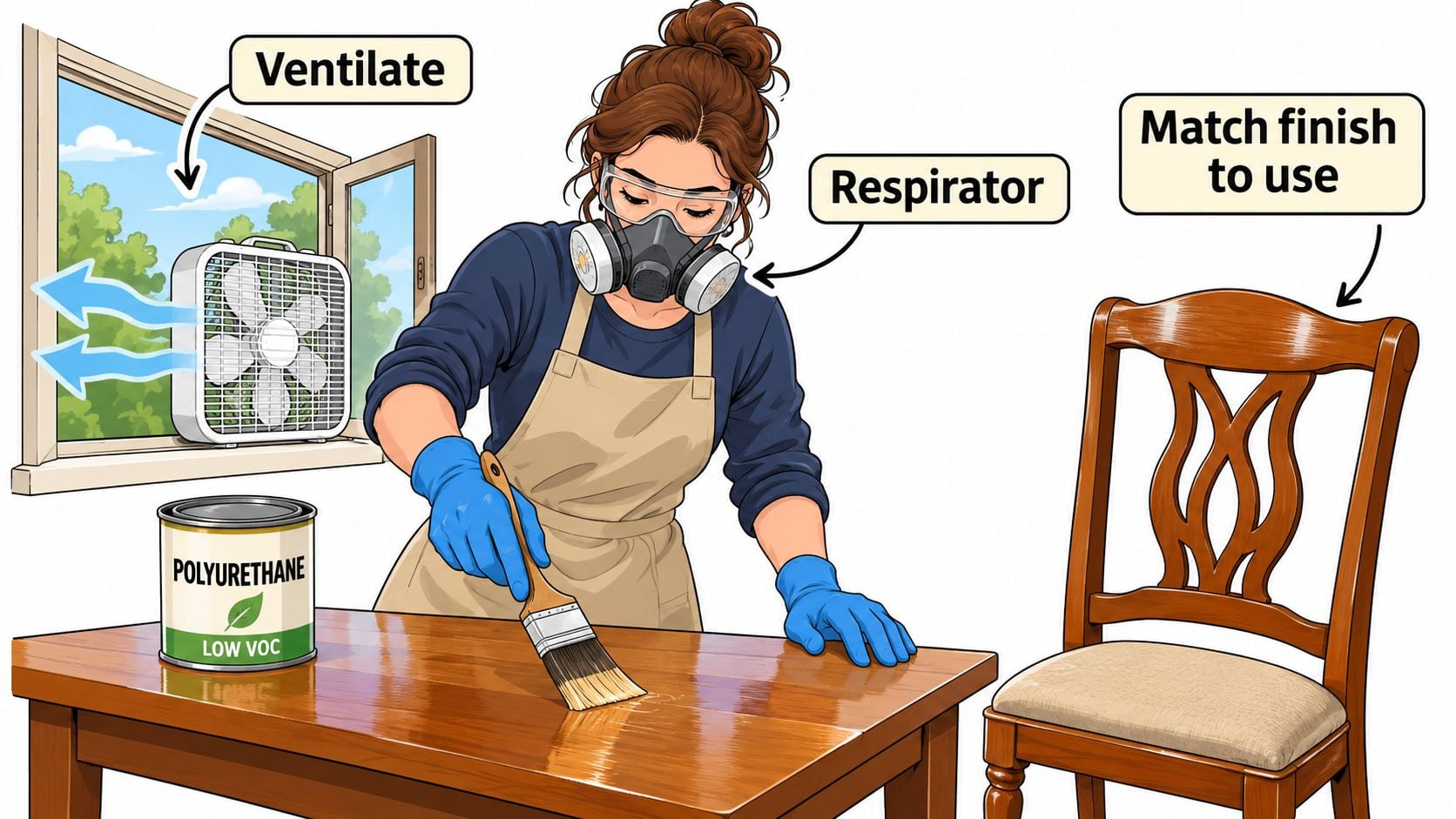
- Match the finish to the workload. Polyurethane for a tabletop that takes daily abuse, oil for a decorative chair that mostly gets admired. A senior living piece or a heavily handled arm needs real abrasion and moisture resistance ahead of the lowest VOC number on the shelf.
- Set up airflow before you open the can. Two fans pushing air out a window, a door cracked open, and a respirator rated for organic vapors. A dust mask does nothing against solvent vapor, and a closed garage in January is the worst possible workspace.
- Clean and scuff the surface. Wipe off grease and wax, then sand with the grain using about 100 grit on a worn finish and 220 grit between coats. Wipe the dust away with a damp cloth and let it dry completely.
- Apply thin coats. Brush, roll or use a high-efficiency spray setup. HVLP, airless, electrostatic and roller methods reduce overspray and emissions compared with inefficient spraying, and the right choice depends on the shape of the piece and the thickness of the coating. Thin coats level better and dry more evenly than one heavy pass.
- Follow the label's recoat window. If the label says four hours, don't test it at two. Solvent still flashing off under a fresh coat gets trapped and clouds the film.
- Wait for the full cure. A finish cures the way concrete sets: it feels hard quickly and keeps gaining strength for days. Water-based polyurethane may feel dry in an hour and still be soft enough to print a palm after a day, so give tabletops a week before heavy daily use.
- Keep the curing space ventilated. A finish keeps releasing vapor after the surface dries, so the piece belongs in a room with moving air for its first stretch indoors, using the same fan setup from step 2. And as the sniff-test section explains, a fading odor is a weak gauge of what's left in the air, so time and airflow do the work.
One warning that costs people real money: aftermarket sprays and treatments void a manufacturer's warranty on upholstered fabric. Those protectors and deodorizing sprays can also degrade the durability and resiliency of the fabric itself, so ask before treating anything new. If your project is bigger than a single coat, this guide to refinishing wood furniture walks through the order of operations.
A finish that cured correctly looks even under a raking light, feels dry rather than tacky to a warm hand, and stays put when you drag a damp cloth across it. If it fails any of those three checks, it needs more time, not more product.
Pick Your Finish and Visit Our Greenfield Showroom
A finish label describes only the top layer. The rest of the piece, the wood, the panels, the glue and the upholstery, decides what your home lives with. That is why the last step in choosing a low-emission piece happens in front of the furniture, with your hands and your questions.
BILTRITE Furniture-Leather-Mattresses has been family-owned and operated since 1928, serving Metro Milwaukee from its Greenfield showroom. The focus is USA-made and Amish-made solid wood furniture, and most pieces can be customized with a choice of wood, finish, fabric, leather and hardware. In the store, the USA Made, Amish made and solid wood icons mark exactly the categories this guide keeps coming back to.
A showroom visit also gives you something a product page cannot. Run a hand across a hand-rubbed oil top, then a water-based polyurethane top, then a waxed surface, and the difference shows up in seconds. Ask what sits under that finish, which panels went into the build and how the piece was assembled. Every customer leaves with written care information for their wood, fabric or leather furniture and mattresses, so the answers go home with the piece.
The showroom is closed on Sundays and Mondays. On open days, bring the questions from this guide and take your time.
If you are weighing a solid maple piece for a nursery or a dining table that will see years of family dinners, stop in and ask what is under the finish before you decide. Visit BILTRITE Furniture-Leather-Mattresses in Greenfield and let the team walk you through the wood, the panels and the finish in person.