Extra Firm Memory Foam Mattress: Is It Right for You?

The hardest mattress in the room isn't automatically the most supportive one. That's the first thing worth unlearning before shopping for an extra firm memory foam mattress. A surface can feel like a board and still leave the spine out of line, press hard on a shoulder, or wear out faster than a softer model built with denser foam.
Table of Contents
- What Extra Firm Memory Foam Really Means
- Firmness Levels and What the Labels Really Tell You
- Who Extra Firm Memory Foam Suits and Who Should Look Elsewhere
- Durability Comes From Density and Care, Not the Label
- How to Test an Extra Firm Mattress in Our Showroom
- Take Your Shortlist to Our Greenfield Showroom
What Extra Firm Memory Foam Really Means
Extra firm and memory foam describe two different things, and mixing them up leads to most buying mistakes. Extra firm describes resistance, meaning how little the surface gives when weight is placed on it. Memory foam describes response, meaning the material slowly contours under pressure and slowly returns to shape after that pressure lifts.
That slow response wasn't designed for softness. In 1966, NASA contracted engineer Charles Yost and Stencel Aero Engineering Corporation to develop an energy-absorbing material for aircraft seating, as documented in NASA's report on the original temper foam research. The goal was protection against crash forces and vibration, plus better comfort in the seat.
Why the Origin Still Matters
The resulting foam was temperature-sensitive and viscoelastic. It flowed around pressure instead of bouncing straight back. That behavior later moved into medical cushioning and mattresses, which is why memory foam still sinks gradually and recovers slowly today.
A hard first impression tells a shopper how a mattress resists weight. It doesn't tell whether the pelvis, shoulders, and lower back stay in a neutral line all night.
Readers who want the basics first can start with a plain-language explanation of what a memory foam mattress is before comparing firmness labels. The short verdict is simple. Extra firm often suits many stomach sleepers and heavier sleepers who want a steady, level surface. For many back and side sleepers, medium-firm is the safer first mattress to test.
The sections ahead separate feel from support. They cover a firmness label comparison, a sleeper fit table, a density checklist for durability, and a step-by-step showroom test that takes minutes instead of seconds. Our sales associates bring over 400 years of combined experience to that process, and they're here to help shoppers test comfort, not to pressure anyone into a decision.
Firmness Levels and What the Labels Really Tell You
Labels are a starting point, not a verdict. One maker's firm can feel close to another maker's medium-firm, so the table below works best as a map for what to check in person.
| Firmness label | Typical feel | Main watch-out |
|---|---|---|
| Extra firm | Very little give, stays level under load | Can feel hard for side sleepers |
| Firm | Firm with light cushioning | Shoulders and hips may ache for side sleepers |
| Medium-firm | Balanced sink and support | Less hard, but still firm enough to limit sink |
| Medium | Noticeable sink with steady push-back | May sag sooner if the foam is low density |
| Soft | Deep sink, cradling feel | Often gives less support for back sleepers |
The Two Numbers Behind the Label
Firmness is commonly measured with indentation load deflection, often shortened to ILD. The test measures the pounds of force needed to press a standard disk one inch into a foam sample. A higher ILD generally means a firmer feel when someone first lies down.
Density measures something else entirely. It's the foam's mass per unit of volume, usually stated in pounds per cubic foot. As explained in this breakdown of firmness versus density in mattress foam, mattress firmness and foam density describe different properties, since firmness is the force required to compress foam while density is mass per unit volume.
A concrete example makes the split clear:
- A 5-pound foam: One cubic foot of that foam weighs 5 pounds, which describes density only.
- Its ILD could still be low: Chemistry and cell structure can make a denser foam compress more easily than a lighter foam.
- The label follows feel: Shoppers feel ILD and layer thickness first, not the weight of material inside.
How to Use a Label in Store
Treat extra firm as a description of the first few seconds, then ask harder questions. What's the ILD of the comfort layer? What's the density of each layer underneath it? How thick is each layer, and what does the support core do once the top foam compresses?
Shopping rule: A firmness label predicts initial feel. It doesn't predict service life, pressure relief, or spinal alignment.
Our mattress firmness guide for comparing feel levels gives shoppers a useful reference before a visit. In the showroom, though, the label should lose to evidence from the body. If the lower back feels suspended or a shoulder starts to ache, the word on the tag doesn't fix that.
For which sleepers each label tends to suit, the sleeper fit table in the next section is the practical place to start. It connects the label to body weight, sleep position, and pain history instead of treating firmness as a one-size answer.
Who Extra Firm Memory Foam Suits and Who Should Look Elsewhere
Fit depends on the body on the mattress, not the adjective on the tag. The same extra firm surface can keep one sleeper level and leave another with a sore shoulder by morning.
| Sleeper profile | Extra firm fit | Consider instead |
|---|---|---|
| Back sleeper, heavier body | Often a good fit when the lower back stays supported | Medium-firm if the lower back sags |
| Stomach sleeper | Often a good fit, keeps hips from sinking | Medium-firm for lighter stomach sleepers |
| Side sleeper | Risky if shoulders and hips get concentrated pressure | Medium or medium-firm with good contour |
| Lighter-weight sleeper | Often feels too hard | Medium or medium-firm |
| Combination sleeper | Depends on the position spent in most nights | Medium-firm |
| Chronic back pain | Mixed evidence, so check with a clinician first | Medium-firm, as one trial found |
Why the Evidence Doesn't Crown One Winner
A government evidence review reported that one randomized trial found a medium-firm mattress superior to a firm mattress for improvement in disability and pain on rising, with both outcomes reaching p=0.008, according to the plain-language evidence summary on beds and mattresses for back pain. That same review noted other studies favoring hard or firm beds for selected outcomes. A separate comparison found foam slightly better than firm mattresses for back symptoms, function, and sleep.
Mixed findings aren't a dead end. They're a reminder that body weight, height, and sleep position change what supportive feels like. A heavier back sleeper compresses foam more, so a surface that feels severe to a lighter shopper may feel balanced under greater load.
Side sleeping creates the sharpest trade-off. Shoulders and hips carry concentrated pressure, and an extra firm surface may not contour enough to spread that load. The result can feel supportive for two minutes and punishing after twenty.
Back sleeping creates a different risk. A very soft surface can let the pelvis drop below the torso, while a very hard surface can bridge under the body and leave gaps. Stomach sleepers usually have the clearest case for extra firm, because keeping the hips from sinking helps limit an exaggerated arch through the lower back.
Shoppers who want to match construction to build can review guidance on choosing a mattress for different body types before narrowing the list. Couples should test together, since the heavier partner and the lighter partner may feel as though they are describing two different mattresses while lying on the same one.
Do you need a firmer base, or do you simply dislike sinking? Those are different problems, and they don't always lead to the same mattress.
That question narrows the choice faster than any label. Someone who hates sink may be happy with a medium-firm model that has a thin, responsive comfort layer over a strong core. Someone whose pelvis drops on every softer model likely needs to start with firm or extra firm and test from there.
Durability Comes From Density and Care, Not the Label
A mattress can feel rock solid on day one and still be built from light foam that fatigues early. Density and firmness are independent variables, so manufacturers can produce high-density soft foam or low-density firm foam. Shoppers who only ask about firmness never learn which one they're buying.
| Density band | What it usually signals | Question to ask in store |
|---|---|---|
| Under 1.5 lb/ft³ (below 24 kg/m³) | Light foam, often softer over time | Why is this layer so light, and what is its warranty limit? |
| 1.5 to 2.0 lb/ft³ | Entry-level density for comfort layers | What is the height-loss limit in the warranty? |
| 2.0 lb/ft³ and up | Industry benchmark for conventional foam | Which layers are at this density, and how thick are they? |
| Up to 8 lb/ft³ (128 kg/m³) | Highest density reported for mattress foams | Which layer uses this density, and what does it cost in weight? |
How to Read Those Bands
Memory foam in mattresses is reported across a broad range, from less than 24 kilograms per cubic meter (1.5 pounds per cubic foot) to 128 kilograms per cubic meter (8 pounds per cubic foot), as summarized in a systematic review of mattress firmness and sleep quality. Commonly encountered standard memory foam spans roughly 16 to 80 kilograms per cubic meter (1 to 5 pounds per cubic foot) in that same review. The full range matters because two extra firm models can sit at opposite ends of it.
Industry technical guidance identifies conventional foam densities of at least 2.0 lb/ft³ as capable of achieving height loss below 5% under suitable conditions, according to Polyurethane Foam Association guidance on foam durability and density. Actual results depend on formulation, thickness, loading, temperature, and construction. Treat that figure as a screening benchmark, not a promise.
High-density memory foam generally lasts longer than low-density memory foam. Memory foam overall, though, is typically less durable than higher-quality polyfoam or latex. That's worth hearing plainly before paying extra for a thick memory foam build.
Layer by Layer, Not Mattress by Mattress
Heavier sleepers should compare three specs separately:
- Comfort layer density and thickness: This layer takes the first compression and shows wear first.
- Transition layer density: This layer decides whether the sleeper sinks gradually or drops onto the core.
- Support core density: This layer carries the long-term fight against sagging.
A very firm, thin memory foam comfort layer over a sturdy high-density core may resist sagging better than a thicker mattress built with low-density foam. The opposite problem exists too. A dense top layer can still feel too hard if there isn't enough conforming depth above the core.
Readers comparing expected service life can use our overview of how long foam mattresses last alongside the density figures gathered in store. Ask for the warranty's indentation limits in writing, because a warranty that only responds to deep visible sagging may not help when a mattress softens and stops supporting evenly.
Care habits protect whatever density a shopper buys. Rotate the mattress for even wear, and flip two-sided models if they're built for it. Use a protector from the first night, keep the mattress on a steady, supportive base, and avoid using the edges as a daily seat, since repeated edge loading breaks down foam where it's least supported.
How to Test an Extra Firm Mattress in Our Showroom
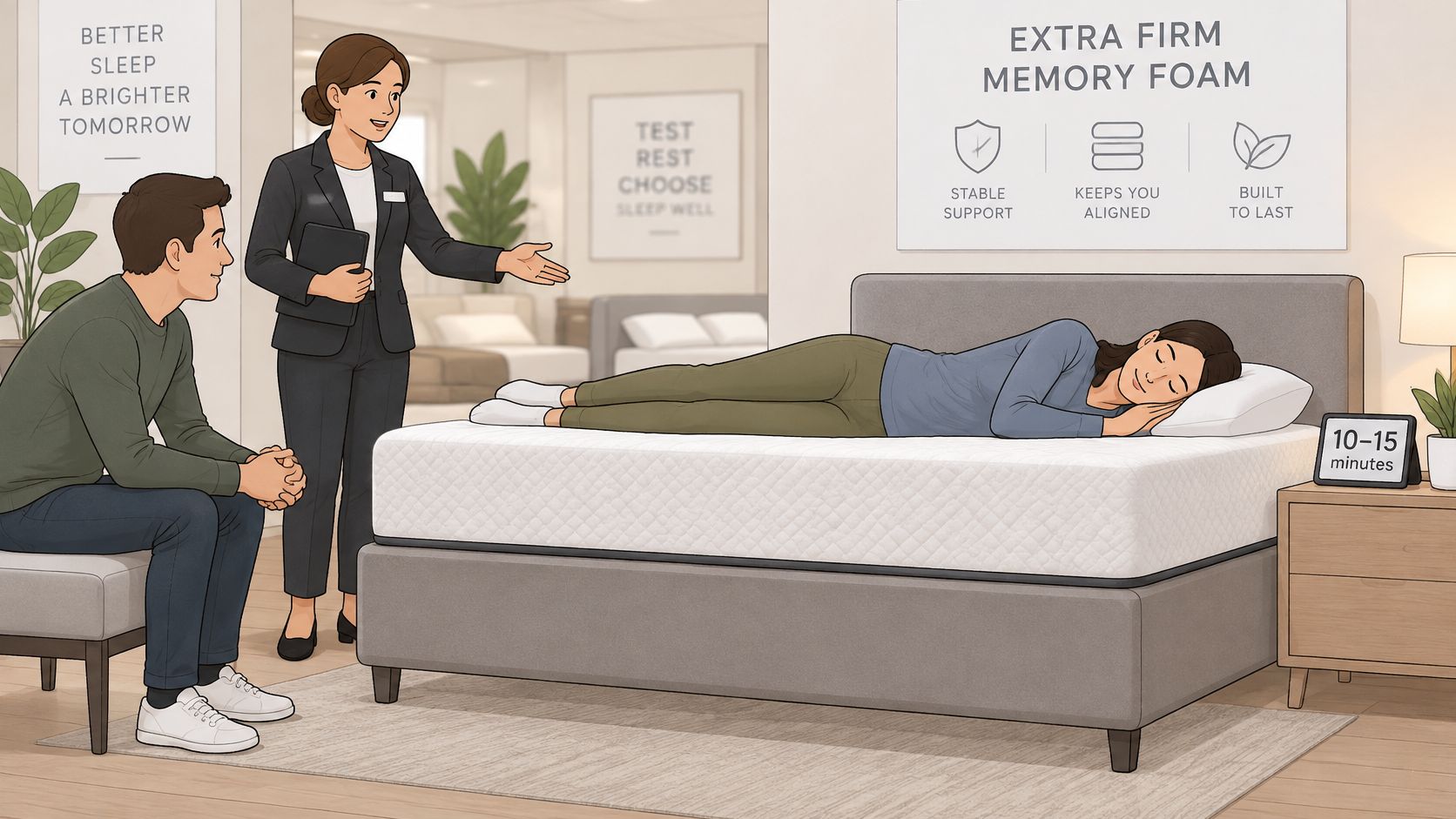
A thirty-second sit on the edge reveals almost nothing. Memory foam responds slowly, pressure builds slowly, and alignment problems show up after the body settles. This test takes a little longer and gives answers worth trusting.
The Nine-Step Test
Bring the usual setup. Shoppers should bring their usual pillow and, if they share a bed, their partner. A different pillow height can change neck and shoulder alignment enough to blame the wrong product.
Stay down for 10 to 15 minutes. That time in the preferred sleep position lets the foam contour fully and lets pressure points announce themselves. Anyone who feels rushed should say so, since our team would rather wait than guess.
Check pelvis position. The pelvis shouldn't sink below the torso. If the hips drop and the shoulders stay high, the spine is bending instead of resting in a neutral line.
Test the lower back on the back. Back sleepers can slide a hand under the lumbar area. Research on mattress stiffness explains that an excessively firm surface can leave the lower back without contact and contribute to abnormal kyphosis, or exaggerated rounding of the spine, as described in a study comparing mattress stiffness and spinal positioning. The lower back should feel supported, not suspended over a gap.
Test pressure on the side. Side sleepers should note pressure at the shoulder, hip, and knee, then roll slowly to the other side. Numbness, tingling, or a growing ache during a short test rarely improves over a full night.
Sit on the edge and press a corner. Edge support matters for getting dressed, getting up safely, and using the full width of the bed. A corner that collapses easily deserves a question about core construction.
Ask for numbers in writing. Request the density of each foam layer and the warranty indentation limit before discussing price. Verbal reassurance is hard to compare later at the kitchen table.
Compare against medium-firm on the same frame. Testing an extra firm memory foam mattress beside a medium-firm model on an identical base isolates the firmness difference. Changing the frame between tests muddies the result.
Record three findings. Write down pelvis position, pressure points, and how the body feels after standing up. Those three notes beat a vague memory of which mattress felt nice.
Shoppers who want to rehearse the process can read our step-by-step advice on how to test a mattress in store before visiting. Clothing can matter more than you might expect, too. Loose, comfortable clothes make it easier to settle into a real sleep position instead of perching politely on top of the bed.
A useful sign: The right mattress gets easier to ignore as the minutes pass. The wrong one keeps asking for attention at the shoulder, hip, or lower back.
Partners should take turns moving while the other person stays still. Memory foam usually limits motion transfer, but the actual model on the floor is the only proof that counts. Anyone managing ongoing back pain should bring notes from a clinician, since showroom comfort and medical guidance work better together than either does alone.
Take Your Shortlist to Our Greenfield Showroom
Start with the three findings from the test. Where did the pelvis sit? Where did pressure build? How did the body feel after getting up? Choose extra firm only if those answers and the sleeper's usual position point that way. Otherwise, a medium-firm model is the safer place to start, and there's no prize for buying the hardest bed in the building.
Our Greenfield showroom makes that comparison easy. We've been family-owned and operated since 1928, proudly serving Metro Milwaukee as a fourth-generation family business. Our mattress department carries over 60 models, so shoppers can try an extra-firm and a medium-firm option on the same frame and feel the difference without guessing from a screen.
What a Visit Looks Like
Our sales associates, with over 400 years of combined experience, can walk through layer construction, density figures, and warranty terms at whatever pace suits the shopper. They're here to help, not to pressure. Questions are welcome, second tests are normal, and taking notes is encouraged!
The showroom also features American-made, solid wood furniture, including Amish-made pieces, so shoppers can see how a bed frame and bedroom set fit together. We focus on affordable, better-quality furniture, not the cheapest option on the floor. From small-scale pieces for apartments to heavy-duty options for busy families, there's something for a wide range of homes. And as a friendly Wisconsin reminder, power lift recliners are exempt from sales tax in Wisconsin, which makes comfortable mobility help a little more affordable for families who need it.
We don't sell online, because mattresses and furniture need to be sat on, lain on, and opened and closed in person. We're closed on Sundays to be with our families, so plan a visit around our hours. Come on down to our showroom and see for yourself! We'd love to see you in our store, say hi, and help find the right piece for home.
Bring those three test findings, a pillow, and any questions about density or warranty terms, and our family team will help compare extra-firm and medium-firm models side by side with no pressure. Visit BILTRITE Furniture-Leather-Mattresses to plan a trip to our Greenfield showroom, where over 60 mattress models and USA-made and Amish-made furniture are ready to try in person.