Suede Microfiber Couch: Is It Right for Your Home?

A hangtag that says stain-resistant can feel like a promise. What if the rule for living with a suede microfiber couch is a tiny letter on the care label, not the fabric name printed above it?
Plenty of sofas share that soft, brushed look. They don't share the same cleaner, the same nap, or the same way a Saturday spill behaves. One cover welcomes a little water. Another rings the moment water touches it. A third should only meet a vacuum.
We've been helping Metro Milwaukee families pick furniture since 1928, and the question we like is simple. Which care code matches the way your household cleans? Answer that before you fall for the hand-feel, and the rest of the shopping gets a lot calmer.
Table of Contents
- Suede Microfiber Compared With Real Suede and Other Fabrics
- How Suede Microfiber Is Made and Why It Feels So Soft
- Durability for Families and Pet Owners
- Safety Labels and Questions to Ask Before You Buy
- Find Your Care Code and Clean a Spill Step by Step
- Visit Our Greenfield Showroom to Test a Suede Microfiber Couch
Suede Microfiber Compared With Real Suede and Other Fabrics
A suede microfiber couch is upholstery made from synthetic polyester fibers, with a soft brushed surface that looks and feels like suede without any animal hide. Real suede, top-grain leather, and a woven cotton or linen blend often land on the same shortlist, and they don't behave the same once juice, paws, and weeknight TV show up.
Suede microfiber compared with other couch fabrics
| Fabric | Stain handling | Pet and kid durability | Upkeep |
|---|---|---|---|
| Suede microfiber (polyester) | Surface spills sit on top briefly if blotted promptly | Strong when densely woven; nap can flatten under heavy use | Vacuum regularly and spot clean by care code |
| Real suede (animal hide) | Absorbs liquids and marks easily | Scratches and rubbed patches show | Professional cleaning and a protector recommended |
| Top-grain leather | Wipes clean | Resists scratches but can crack with age | Occasional conditioning |
| Woven cotton or linen blend | Stains soak in | Snags and fades over time | Follow care label; often professional cleaning |
Suede microfiber gives you a short window. Many everyday spills stay near the surface if someone blots them right away. A dense weave stands up to kids and pets, though the nap can flatten where a person, or a dog, always lands. Routine care is vacuuming plus spot cleaning that follows the code on the label.
Real suede is lovely, and it drinks liquid. Marks show. Scratches show. Rubbed patches show. Professional cleaning, plus a protector, is the usual plan, which is a lot of fuss for a family room.
Top-grain leather wipes clean and shrugs off plenty of scratching, then can crack as the years add up. A little conditioning keeps it supple. It isn't the no-thought choice people sometimes expect.
Cotton and linen blends breathe, which feels good on a warm afternoon. Stains soak in, threads snag, and color can fade. The care label often points toward a professional cleaner.
A Saturday juice test
Say two kids and a dog share the sofa, and juice tips over before breakfast. On microfiber, that splash can sit on top long enough to blot. On real suede, the same splash can leave a ring before anyone finds a cloth.
Suede microfiber suits busy households that want the look without the hide, as long as they follow the care code. If hide and cloth are both still in the running, our leather versus fabric upholstery guide lays out that choice in plain terms.
A soft hand-feel is not a cleaning plan. The letter on the label is.
How Suede Microfiber Is Made and Why It Feels So Soft
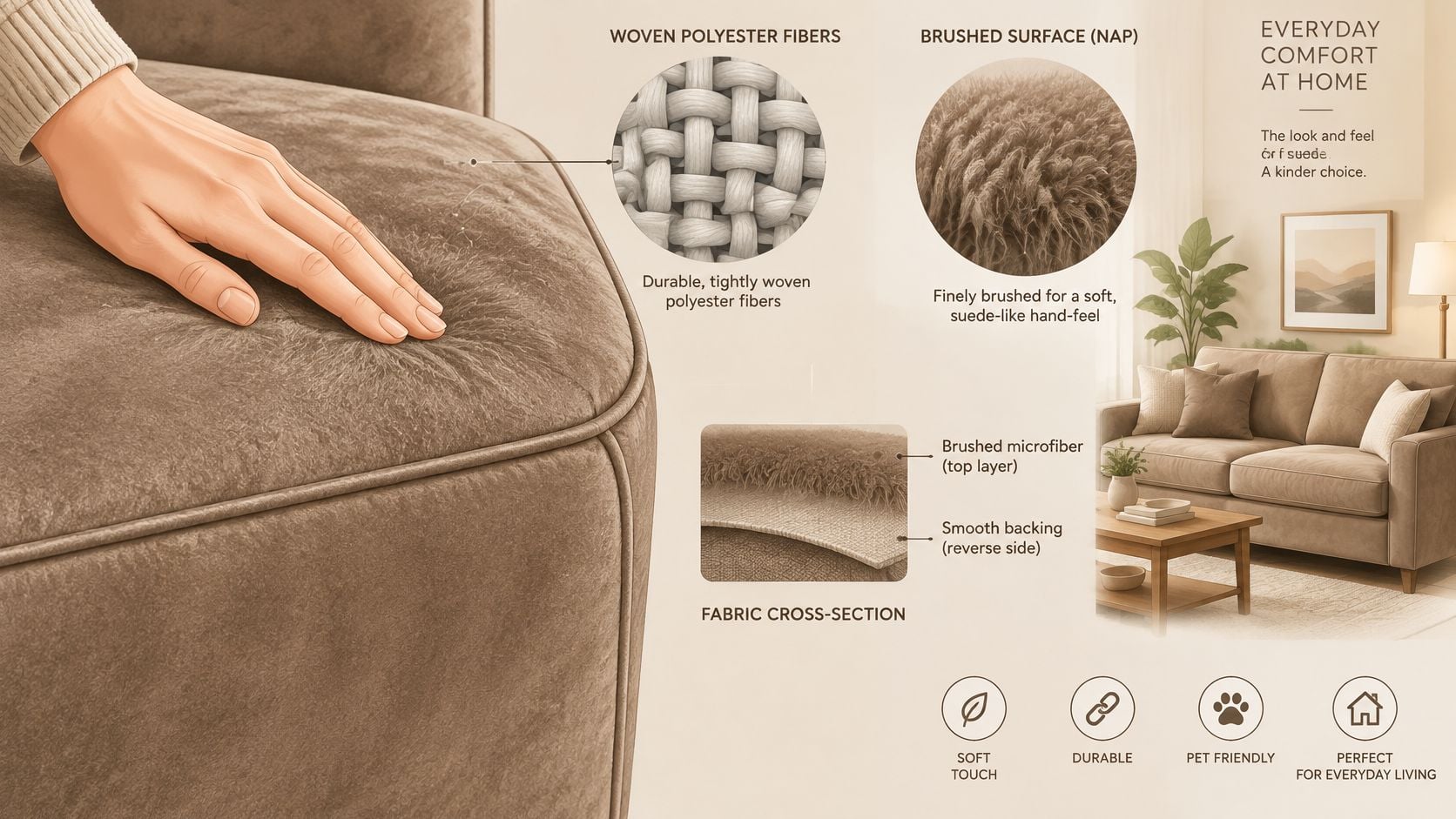
Fine polyester filaments create the fabric's soft, brushed surface.
That softness comes from how the material is built, not just how it looks.
Three ideas that explain the hand
The filaments are finer than ordinary polyester. Textile Tuts' overview of polyester fabric notes that microfiber polyester uses filaments measuring approximately 0.5 to 1.0 denier per filament, compared with about 1.5 to 3.0 denier for conventional polyester. Finer filaments create more contact points across the surface, contributing to the soft feel.
The short pile changes appearance with brushing. Brush the nap one way and the color can look lighter. Brush it the other way and it looks deeper, because the tiny fibers reflect light differently. It's like a dense lawn of short grass beside a few tall stalks.
The fabric may include a backing layer. Cimmino's upholstery fabric notes describe microfiber as extremely fine polyester, sometimes blended with polyamide, and cite a suede-finish example made from 100% polyester microfiber with a backing. That backing supports the fabric, while the polyester construction absorbs little water and can dry relatively quickly. The exact fiber content and backing depend on the fabric.
Durability for Families and Pet Owners
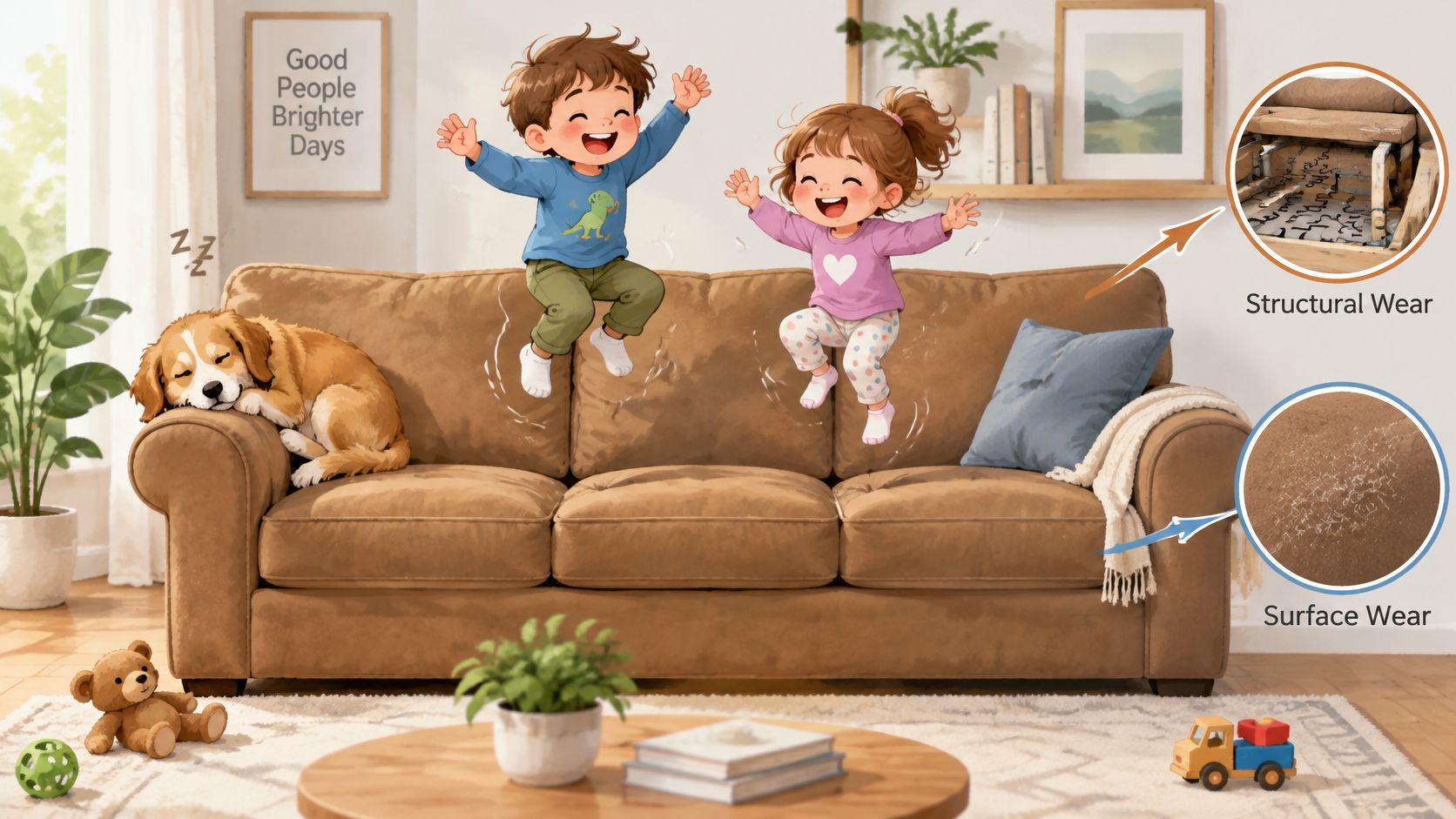
A dog naps on one arm every afternoon. Two kids treat the seat cushions like a trampoline. That's a normal week for a lot of Greenfield living rooms, and it's the week a suede microfiber couch has to survive.
Two kinds of wear
Structural wear asks whether the sofa is still sound. Seams hold, the backing stays put, and the cushions haven't collapsed.
Appearance wear is what owners notice first. Shiny traffic lanes on the arms, a flattened nap, darkening along the seams, or a patch of texture that no longer matches the rest. The sofa can still be sturdy while it stops looking like the one from the showroom.
Fiber fineness helps the soft hand, the shape, and resistance to wrinkles and pills. It does not, by itself, decide how the cloth wears under rubbing.
Why one spec can beat another
Yarn, weave or knit, pile, backing, and finish all change the result. A university-authored upholstery study of polyester microfiber chenille found a clear split. The 576-fiber construction with a 1.5-mm float length reached the highest tensile strength and elongation. The 288-fiber construction with a 2.6-mm float length reached the highest abrasion resistance. A denser cloth can feel softer, and a different weave can still win under rubbing.
Martindale and Wyzenbeek numbers are screening tools, not a promise of years. The two tests don't swap into each other, and a lab rub can't copy grit in a seat front or a kid climbing an arm.
Before you decide, ask for these, then sit down for a few minutes:
- Abrasion result: the test name, the number, and what counted as failure.
- Colorfastness and seam strength: written, not guessed from the swatch.
- Build you can feel: seat-edge compression, seam stitching, and whether the face is cut pile or flat.
- A written cleaning code: so the cloth matches the way you'll care for it.
Our performance fabric furniture page is a useful companion when you're comparing those specs on the floor. A high abrasion number doesn't predict comfort, safety, or a showroom look five years later. Sitting on the cushion still tells you something a sheet can't.
Safety Labels and Questions to Ask Before You Buy
Which label should you check before choosing a suede microfiber couch? Start with the federal flammability compliance label. Upholstered furniture manufactured, imported, or reupholstered under the federal rule must comply with California Technical Bulletin 117-2013. The U.S. Consumer Product Safety Commission's upholstered-furniture guidance explains that the test evaluates smolder resistance across the cover, barrier, filling, and decking. It considers outcomes such as char length, continued smoldering, and transition to open flaming. A finished sofa passes only when its tested construction meets the standard.
A five-question check on the floor
- Does this exact model carry a TB 117-2013 compliance label? Check the sofa itself.
- Is the listed cover the fabric on this model, rather than a similar swatch?
- Does the care sheet match the upholstery on the piece?
- Can the team provide abrasion, colorfastness, and seam data for that cover?
- Does the care warranty fit a home with children or pets, including its terms for spill-related damage?
For a household with a toddler and a cat, matching model, cover, and test information makes comparisons more useful than judging softness alone. Check the written warranty terms too, especially any exclusions for cleaning products or spill treatment.
Before you leave the showroom, write down the model, cover name, care instructions, compliance-label details, and warranty limits. The fabric selection guide can help you compare fabric options; keep the care code and warranty details with your notes.
Find Your Care Code and Clean a Spill Step by Step
The care code, not the word microfiber, controls how you clean the couch. The same liquid can be right for one suede microfiber couch and leave a permanent mark on another.
Care codes and what each one allows
| Care code | What it means | What you can use | What to avoid |
|---|---|---|---|
| W | Water-based cleaning allowed | Small amount of clear dish soap in distilled water | Soaking and solvents |
| S | Solvent-based cleaning only | Rubbing alcohol on a white cloth, spot treatment only | Water-based cleaners and soaking |
| WS | Water or solvent, if the maker permits | Either method, tested first in a hidden spot | Harsh brushing and saturation |
| X | Vacuuming or brushing only | Upholstery attachment or soft brush | Any liquid cleaner |
Broom Book's microfiber cleaning guidance is clear on the split. W takes a water-based cleaner. S takes a water-free solvent. WS (sometimes written S/W) allows either when the maker permits it. X stays at vacuuming or brushing. An S or WS spot may take rubbing alcohol on a white sponge, worked gently and left to evaporate. A W spot should get only a small amount of clear dish soap in distilled water, with no soaking. An X-coded couch should not get liquid cleaner at all.
Why soaking backfires
Polyester microfiber may adsorb more than seven times its weight in water, according to cleaning guidance summarized by Elle Decor. Incomplete extraction leaves residue, stiffness, or odor. That isn't a sign the cloth is "easy care." It's a sign the water stayed behind.
Spill steps, and why each one exists
- Blot right away with a dry white cloth. Press and lift. Rubbing drives the spill wider and flattens the nap.
- Read the sewn-in code before any bottle comes out. The letter overrides a tip you saw online.
- Test a hidden spot, such as a cushion underside, and let it dry before you judge color or texture.
- Work from the outside of the stain toward the center with a barely damp white cloth. Colored cloths can transfer dye.
- Keep liquid out of the cushion foam. A soaked core is how water rings start.
- Air dry fully, then brush the nap lightly in one direction so the patch doesn't flash a different shade.
Say grape juice hits a family sofa with a W label. Blot the puddle, mix a drop of clear dish soap into distilled water, and touch a hidden corner first. If that corner dries clean, dab the spot without soaking it, then let the cushion dry all the way before anyone sits.
Additional fabric protection applied by a store or a customer voids the manufacturer's warranty on upholstered furniture fabric. A spray that sounds helpful can erase that coverage, so check the warranty before any extra treatment. Each customer at BILTRITE Furniture-Leather-Mattresses receives written care information for wood, fabric, leather, and mattresses. If the sewn-in label is unclear, use that sheet, and don't clean until you have it. For a fuller routine on cloth sofas, see our notes on how to clean a fabric sofa naturally.
Visit Our Greenfield Showroom to Test a Suede Microfiber Couch
Would a suede microfiber couch feel comfortable in your home and suit the way you use it? A showroom visit lets you check the fabric's hand and see how the nap looks from different directions.
BILTRITE Furniture-Leather-Mattresses is a fourth-generation, family-owned furniture and mattress showroom serving Greenfield and Metro Milwaukee since 1928. Its floor includes small-scale pieces for apartments and smaller homes, as well as heavy-duty options. The store carries thousands of items in stock and 500 mattresses.
Custom furniture options let you choose fabric, leather, wood, finish, and hardware. BILTRITE also offers USA-made and Amish-made furniture, including solid wood pieces. Ask which models suit your space and preferences, then use the care-code and label guidance from the earlier sections to compare candidates.
The showroom is closed Sundays and Mondays, so plan your visit for another day. To prepare, read the guide to buying a sofa.
BILTRITE Furniture-Leather-Mattresses offers affordable, better-quality sofas in Greenfield. Visit the showroom at 5430 West Layton Avenue to explore the selection and discuss which options fit your home.