Gray Sectional Sofas: How to Choose Fabric, Fit and Style


Gray gets picked first, and that is the mistake. The color name is the easy part. What decides whether a gray sectional still looks right after years of kids, pets, and winter light is the cloth, the undertone, and the seat. Treat gray as a foundation, then judge the fabric's test result, the shade's undertone, and the fit before you fall for a swatch.
Table of Contents
- Fabrics and Finishes That Suit Gray Sectionals
- Picking a Gray Shade That Will Not Date
- Testing Upholstery Durability Before You Buy
- Finding a Seat Height and Depth That Fits You
- Room Layout and Delivery Clearances
- Keeping Gray Upholstery Looking Fresh
- Styling Your Gray Sectional Without Starting Over
- In-Stock or Custom for Every Budget
- Confirm Your Sectional Plan in Our Greenfield Showroom
Fabrics and Finishes That Suit Gray Sectionals
Pick the cloth before you commit to the gray. Gray is a foundation, and the fabric's test result decides whether that foundation still looks even after years of sitting, spills, and pets. Wood, metal, leather, and pattern sit beside it without a fight when the weave holds up.
A Fast Company look at sofa color describes a catalog analysis of 3,500 sofas from one major flat-pack retailer's catalogs published between 1960 and 2021, in which colors grew more neutral across those 61 years, and by 2013 gray or beige was generally the most common sofa color in that catalog, while a 2024 survey of 400 living-room shoppers in the same piece found 49% named gray their favorite sofa color, ahead of beige at 16%, white at 10%, blue at 9%, and brown at 7%. Catalog share and shopper preference measure different things. Both still explain why a solid gray sectional leaves room for other finishes.
The cloth has to earn that color. Use the comparison below as a lookup when you narrow finishes.
Gray upholstery fabrics compared
| Fabric | Cleaning | Pilling and wear | Pets and kids | Gray look |
|---|---|---|---|---|
| Performance woven polyester blend | Wipes clean, often with a cleaning code | Good when the test rating is high | Good for kids and pets | Crisp, even gray |
| Microfiber or microsuede | Spot clean, follow the code | Moderate, can pill | Fair, hair clings | Soft, slightly muted gray |
| Chenille | Vacuum and spot clean | Can snag | Fair, snags on claws | Textured, warm-looking gray |
| Linen-look blend | Usually spot clean only | Shows wrinkles and wear | Fair for low-traffic use | Airy, relaxed gray |
| Velvet | Vacuum, professional cleaning for stains | Crushes in high-use spots | Poor with pets | Rich, deep gray |
| Top-grain leather | Wipe with a leather cleaner | Scratches and patinas over time | Good, wipes off pet hair | Smooth gray with natural grain |
| Bonded leather | Wipe clean, avoid harsh cleaners | Peels or cracks under heavy use | Good for light use | Uniform, even gray |
Match the cloth to the household
Families with kids and pets do best with a performance woven blend or top-grain leather. Hair wipes off leather, and a tight weave hides the scuffs that collect on the seat front. Leave bonded leather for lighter use. It looks even on day one, then peels where people sit every night.
Formal living rooms can take velvet or chenille when the look matters more than daily traffic. Velvet gives a deep gray. Chenille reads warmer and softer, which shifts the undertone even when the color name stays gray. Both snag, and velvet crushes in the spot someone always uses.
Low-traffic guest rooms can use a linen-look blend. Wrinkles belong to that airy gray. Save that finish for rooms that see little sitting.
"Performance" is a claim to check. Ask for the test result before you trust the hangtag, and choose the fabric or leather for how your household sits.
A three-part showroom check
Sit on the fabric for a few minutes, brush the surface with your hand to see whether it snags, and look at the swatch under the lamps you use at night. Showroom glare runs brighter than most living rooms, so the gray you approve on the floor can read cooler at home.
Picking a Gray Shade That Will Not Date
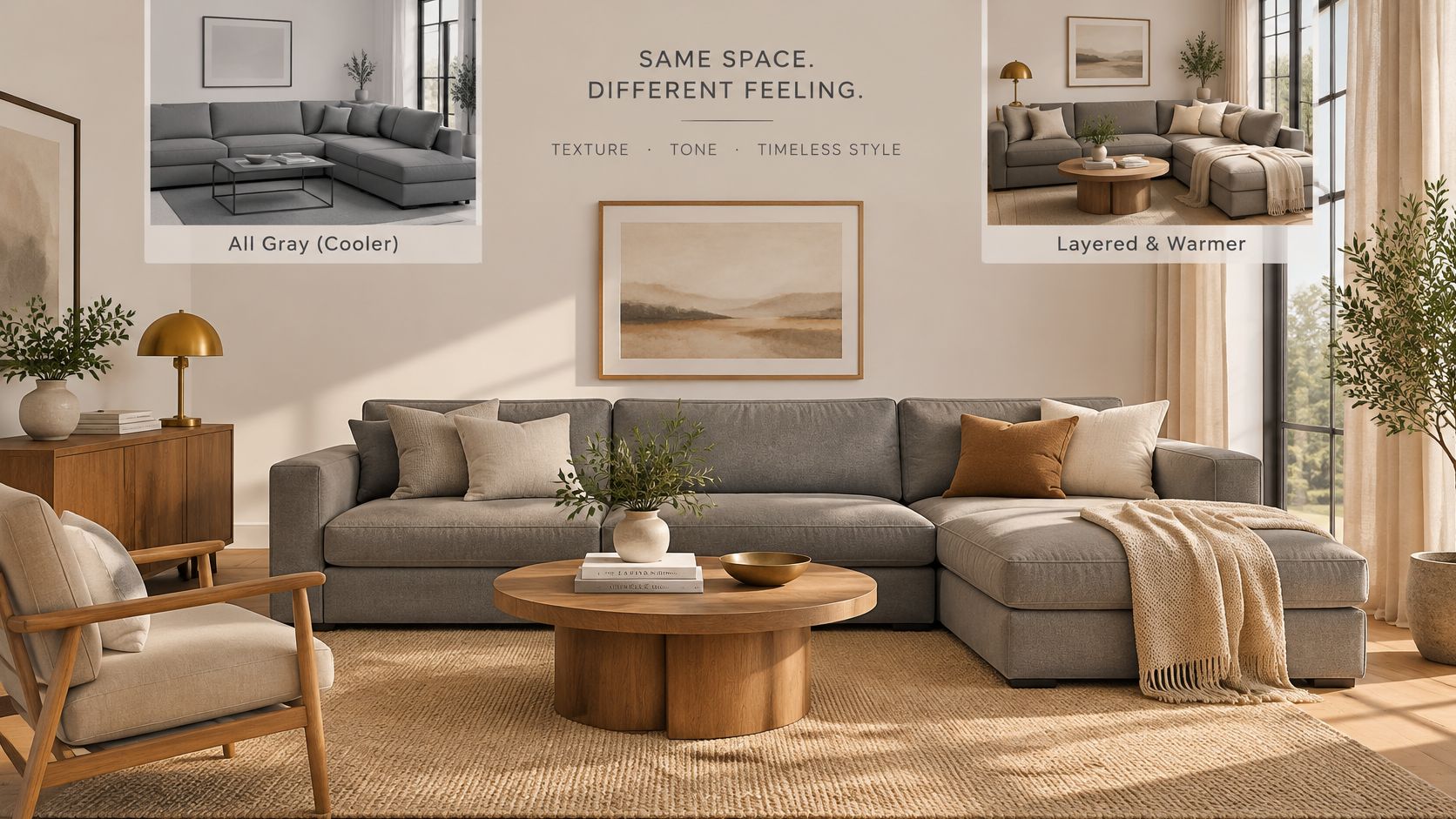
A gray sectional does not automatically look dated. An all-gray room ages faster than the same sofa set beside warm wood, cream textiles, and a rug with some color in it.
Gray is a foundation, not a finish. Judge the fabric's test results, the shade's undertone, and the sectional's fit before you commit to the color name. Those three decide how the sofa ages in a real home.
Furniture Today's 2025 consumer sentiment survey found that 43% of respondents most wanted a gray palette for upholstered furniture such as sofas, sectionals, and chairs, while beige and brown each reached 42%. Shoppers are splitting attention across cool gray and warm neutrals. Use seven to 15 years as a working life for the sofa. Construction and daily use move that span more than the color name does.
Shades and where they belong
Cool gray carries blue or green undertones. It belongs in a bright room with warm wood nearby. Blue-gray walls plus gray floors stack the chill, so break that stack with oak or a cream rug.
Charcoal is a deep, dramatic gray. Larger rooms and cream textiles give it air. Black metal on every lamp and table makes the same room heavy.
The middle shades need the same undertone check:
- Slate or blue-gray reads modern and slightly coastal beside white trim and a light rug. Orange-heavy paint fights the blue.
- Greige mixes gray with beige and holds up as a whole-house neutral, unless the flooring has a strong pink cast.
- Taupe-gray warms a family room without turning the sofa beige. Icy blue accents flatten it.
- Warm stone has a sandy cast that sits well with oak and cream. Cool fluorescent light washes that cast out.
Metro Milwaukee winters make the choice personal. Gray skies push cool grays colder. South- and west-facing windows warm the same swatch in the afternoon. Bring the swatch home, look at it in morning and evening light, and set it beside your flooring and paint. A short guide to neutral sofa colors helps while you compare undertones.
Keep the sectional in a flexible gray, and let pillows, throws, chairs, and rugs carry the warmer shift over those seven to 15 years.
Testing Upholstery Durability Before You Buy
Gray works as a foundation, not a finish. The color name comes last. Test results, the shade's undertone, and how the sectional fits decide how that sofa ages in a real home. A pretty swatch tells you nothing about the seat front.
Ask for the test method, then compare only numbers from that same method.
| Household use | Wyzenbeek double rubs | Martindale cycles | Notes |
|---|---|---|---|
| Light use, formal or guest room | 10,000-15,000 | Under 20,000 | Minimum for occasional sitting |
| Everyday family room | 15,000-30,000 | 20,000-30,000 | Screening range for residential sofas |
| Heavy use, pets or daily lounging | 30,000+ | 40,000+ | Target for busy households |
Treat those bands as general guidance, a practical rule of thumb, not a published standard.
In North America, the ASTM D4157 Wyzenbeek test rubs fabric with cotton duck in both directions. Martindale testing, in the style of ASTM D4966, uses a different motion and a different abradant. Herman Miller's textile quality standards make the practical point: the machines, abradants, pressure, and failure points differ, so the scores are not interchangeable.
Our rule of thumb for residential sofas is a screen of about 15,000-30,000 Wyzenbeek double rubs or 20,000-30,000 Martindale cycles. Heavier household use should target about 30,000+ double rubs or 40,000+ Martindale cycles. Our notes on fabric durability ratings walk through how to read those labels before you commit.
Gray often lands in family rooms because soil shows less than it does on cream. Seat fronts, corners, and chaise edges still shine and thin where legs and arms land every day.
A seven-step check
- Ask for the method and the number. "Performance fabric" is marketing. You want Wyzenbeek or Martindale, plus the result.
- Compare like with like. A 30,000 double-rub score is not the same claim as 30,000 Martindale cycles.
- Check fiber and weave at the seat front and arm edges. A tight weave pills less than a loose, fuzzy one.
- Read the cleaning code. W means water-based cleaner, S means solvent, WS means either, and X means vacuum only.
- Confirm seat foam. Guidance aimed at long-term sofas puts seat foam around 1.8 pounds per cubic foot or higher as the range that generally holds its shape longer.
- See whether cushions flip or rotate. Two usable sides spread the wear.
- Read the warranty exclusions for pets, snags, and fading before you assume the cloth is covered.
Practical rule: A high rub count measures one failure mode. It does not predict seam slippage, cushion compression, snagging, fading, or damage from pet claws and clothing hardware.
Use the number as one input. Then look at the swatch under showroom light and take the care sheet home.
Finding a Seat Height and Depth That Fits You
Gray can look right in the room and still sit wrong. Judge the sectional's fit before you commit to the color name. Cushion fluff will not fix a seat that is the wrong height or the wrong depth.
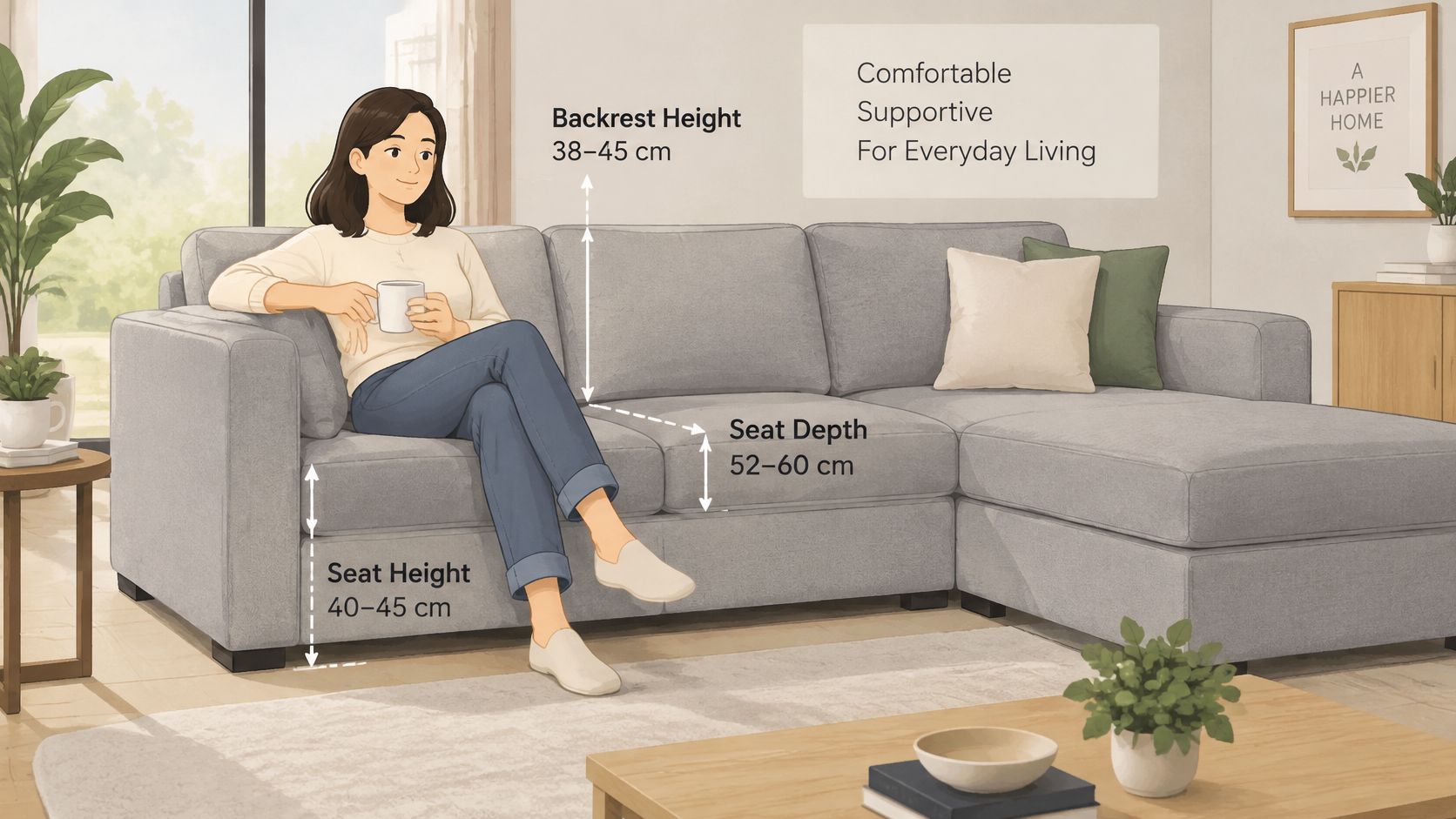
An ergonomics study of supportive seating identified about 37 cm seat height, 57 cm backrest height, 62 cm backrest width, a 105-degree seat-to-back angle, and a 5-degree seat slope as reference values. In everyday measure that seat height is roughly 14.5 inches, the backrest height about 22.5 inches, and the backrest width about 24.5 inches. Treat those numbers as a starting point. Your height, your mobility, how far the cushion compresses, and whether you recline all change the right fit.
Two fits that fail
A seat that sits too low forces more bend at the knees and hips when you stand. That is a real problem for older adults and anyone with stiff joints. A seat that is too deep leaves a shorter sitter slumped, with an empty gap behind the lower back and feet that barely reach the floor. Soft cushions hide both problems for the first minute and announce them by minute ten.
A lift recliner is a different chair from a sectional. It does not replace a seat-depth check on the sofa. If standing up is the hard part, you still have to sit the sectional the same way: feet down, back supported, no guessing from a quick perch.
The sit test
- Sit in your real posture for several minutes, not the perched pose you use when someone is watching.
- Plant your feet flat on the floor. If you cannot, the seat is too high or too deep for you.
- Check the lower back. Support should meet the lumbar area without shoving the shoulders forward.
- Try both ends. The chaise and the straight run often feel like two different seats.
When adults in the house are different heights, look for movable ottomans or more than one seat depth. A single fixed chaise only fits one leg length. The reference numbers build the shortlist. Your body makes the call.
Room Layout and Delivery Clearances
Will that gray sectional clear the doorway, or only look right on the showroom floor? The shade can wait. Footprint and delivery path decide whether the sofa you want can live in the house you have.
A large L can sit cleanly on one wall and still cut the route to the kitchen. Tape the floor first, then judge the gray. Use these clearances as your planning numbers.
| Measurement | Recommended | Why it matters |
|---|---|---|
| Walkway around the sectional | About 36 inches | Keeps paths clear for family and guests |
| Sofa to coffee table | About 18 inches | Comfortable reach without crowding |
| Sectional to nearest perpendicular wall or piece | About 36 inches | Room to walk past the corner |
| Typical sectional depth | 34-42 inches | Compare against the room depth you measured |
| Standard entry door opening | 32-36 inches | Check the clear width, not the trim |
| Extra room when angling furniture | 6-8 inches | Needed for turns through doorways |
Treat the table as a planning target, not a brand spec. Measure the room front to back and set sectional depth against that number. If the coffee table would have to crowd the seats, choose a shallower table or a shorter run. A blocked path stays blocked no matter how calm the fabric looks.
Measure the path, not just the room
The truck route is a separate job from the floor plan. Older Milwaukee houses often have narrow entries and steep stairs. The corner piece, not the long run, is usually what sticks.
- Measure the narrowest clear doorway with the door open, from the door face to the opposite jamb. Ignore trim and the nominal door size, then compare that opening with the door row above.
- Record hallway width, stair dimensions, the tightest turn, and the diagonal you have at the corner.
- Leave maneuvering room anywhere the piece has to tilt. The extra inches in the table cover that tilt, not the sofa once it is placed.
- Ask whether pieces separate and whether legs or arms come off. Our come-apart sofas and sectionals break into smaller pieces, which lowers the risk on a tight stair. Every connector, arm, and back still needs a verified opening.
- Tape the footprint and walk the path you use at night, including the route to the kitchen. If you have to sidestep the tape, the layout is too tight.
Take our walk-through on how to measure a sectional sofa home before you order. Fit the room and the doorway first. Then pick the gray.
Keeping Gray Upholstery Looking Fresh
Gray does not hide everything. Pale gray shows spills fast. Dark gray and blue-gray hide some soil, then broadcast lint and pet hair. The weekly habit matters more than the shade you picked.
Weekly care
- Vacuum with an upholstery tool once a week. Grit at the seat front and arms acts like sandpaper on the fibers.
- Lift pet hair with a rubber brush or a damp glove before it works into the weave.
- Blot spills immediately. Don't rub. Work from the outside of the spot inward so you don't spread it.
- Test any cleaner on a hidden seam, and use only what the cleaning code allows. Water on an S code can leave a ring.
- Rotate or flip reversible cushions every few months so one seat doesn't go flat first.
- Keep the sectional out of direct sun, or hang sheers. Sunlight fades dye slowly, and gray goes patchy before you notice the cause.
Stains that need more than a wipe
Dark denim can transfer blue dye onto pale gray. Treat that transfer the same day, while it is still on the surface. A set-in dye mark is a different job from a water spill.
Heavy stains, ink, and anything that has dried into velvet or chenille belong with a professional cleaner. Home scrubbing on those cloths crushes the pile or pulls a snag into a run.
Busy households should plan a professional deep clean about once a year. Before you spray on a fabric protector, read the warranty. Some exclusions start the moment an unapproved coating goes on the cloth.
Styling Your Gray Sectional Without Starting Over
The sectional stays. The accents move. That is how a gray foundation lasts while the room changes around it.
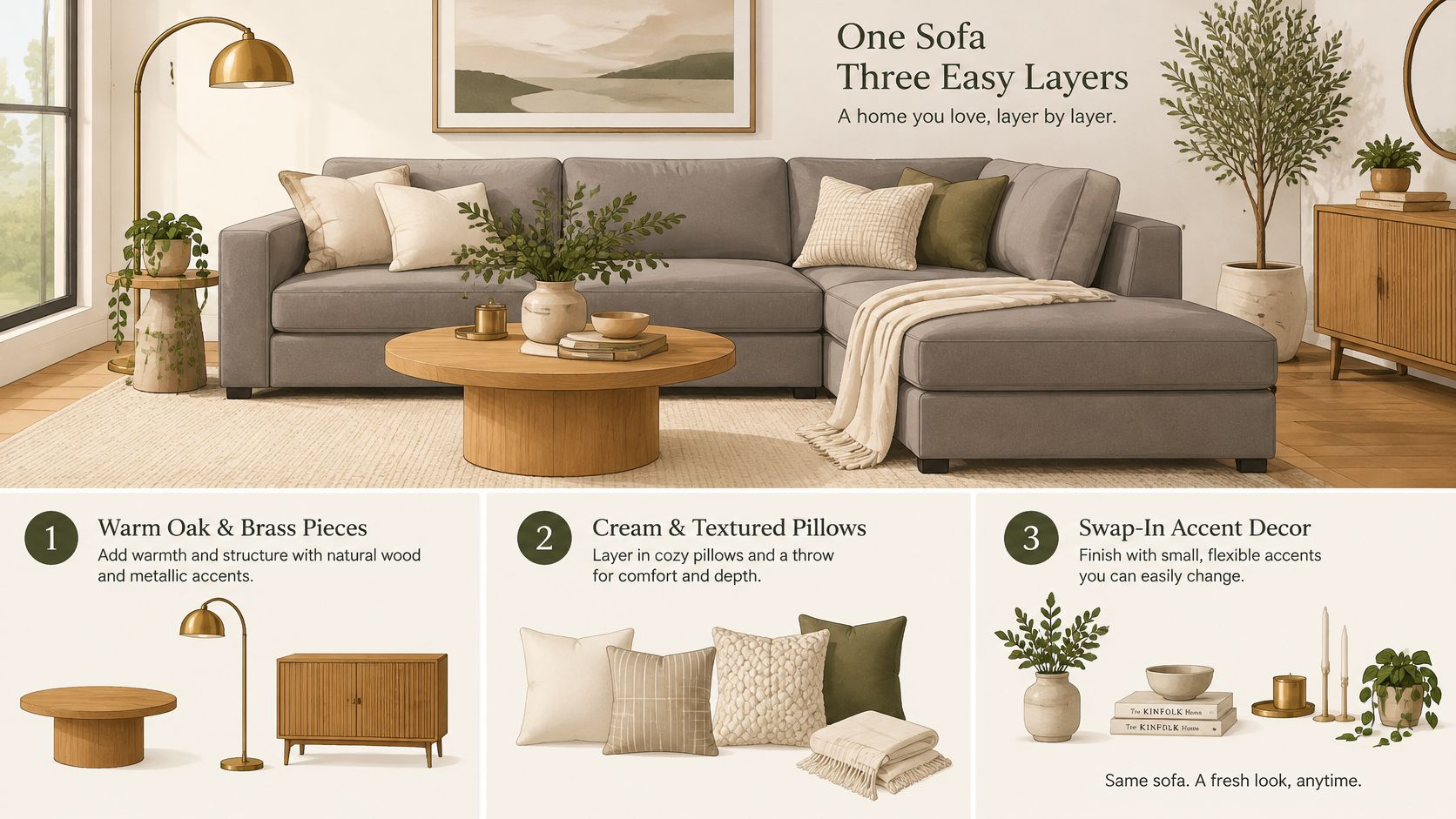
Three layers, biggest change first
Warm materials come first, because they are the pieces you will keep. Oak, brass, cream, and terracotta stop a gray room from feeling cold. A solid-wood coffee table in American-made or Amish-made construction does this job well. The grain is the warmth, and it balances cool upholstery without another gray surface in the mix.
Swap pieces come second. Pillows in rust, mustard, deep green, or navy, a wool or cotton throw, and a rug that tucks under the front legs. An accent chair in warm wood or a neutral cloth breaks the long line of the sectional. If you are stuck on pattern scale, start with what color rug goes with a grey couch and pick one field color before you add a second pattern.
Lighting comes third, and it is the easiest fix. Warm-white bulbs soften gray and take the edge off a cool undertone. Cool overhead bulbs do the opposite, especially on winter evenings.
A simple order works: pick one accent color, choose two warm materials, and add one large textile. Picture a gray sectional, an oak coffee table, a cream throw, and a terracotta pillow. Swap the pillow and throw with the seasons. The sofa stays put.
In-Stock or Custom for Every Budget
Treat gray as the foundation, not the finish. Judge the fabric's test results, the shade's undertone, and whether the sectional fits the room before you fall for a color name. That order keeps the sofa looking right years from now, and it decides whether you buy from the floor or special-order it.
In-stock pieces are on the floor today. Sit in one, set a pillow from home against the gray, and see whether the undertone stays friendly next to your rug and wood. When a cloth you already trust is ready now, an in-stock sectional is the simpler choice. You can plan the room around a size you have measured in person.
Custom orders let you match an odd room or an existing floor. You choose the fabric, leather, wood, finish, and hardware, so the gray lines up with the wall you already have. Our tips for special order furniture spell out how that conversation usually goes, from the first swatch to the build that fits the space.
Size the sectional to the household. A smaller sectional or a single chaise suits an apartment, condo, or tight family room, and small-scale furniture is built for those homes. A standard sectional suits a typical Metro Milwaukee living room. A longer run, with a chaise or extra seating, suits a busy house with pets and kids, especially in a heavy-duty build.
Solid-wood frames, including USA-made and Amish-made pieces, deserve the same attention as the gray cloth. Come-apart sofas and sectionals are the practical answer for narrow doorways and tight stairs. You still get the seating you want, and every sofa and sectional we sell is brand new.
Confirm Your Sectional Plan in Our Greenfield Showroom
Will the gray sectional fit your room, your routine, and the route into your home? Bring your measurements to our Greenfield showroom and try the seat in person. BILTRITE is a fourth-generation, family-owned business serving Metro Milwaukee since 1928.
Compare the gray in person, ask about upholstery details, and check how the sectional feels in your usual sitting position. We have thousands of items in stock, including 500 mattresses, and most furniture can be customized to suit your style and comfort.
Bring a tape measure, doorway and stair measurements, a photo of the room, and any swatches from home. We can help you review the plan before you choose.
BILTRITE Furniture-Leather-Mattresses offers sofas, sectionals, and solid-wood pieces, including USA-made and Amish-made options. Visit our Greenfield showroom to try a seat and talk through the fit. BILTRITE Furniture-Leather-Mattresses