Amish Furniture Quality: What Makes It Built to Last


A family standing around a dining table in a Milwaukee showroom may notice the weight first. The top feels substantial, the grain has character, and the price invites a practical question: does that heft mean the table is built to become an heirloom, or is it part of the sales story?
That's the right question. Amish furniture quality isn't based on nostalgia alone. It comes from choices that can be inspected, including the wood species, the joinery, the finish, the way the piece handles seasonal movement, and whether it can be repaired instead of discarded. A family with three children, two dogs, and a full calendar of holiday meals needs furniture that works as hard as the people gathered around it.
Table of Contents
- What Sets Amish Furniture Quality Apart
- A Short History of Amish Craftsmanship
- The Three Pillars of Authentic Amish Furniture Quality
- How to Spot Real Amish Construction in the Showroom
- Common Misconceptions Worth Clearing Up
- Longevity and Value Over a Lifetime
- Modern Amish Furniture for Today's Homes
- Experience the Craftsmanship in Greenfield
What Sets Amish Furniture Quality Apart
The Kowalski family's showroom question is one many shoppers share: how can someone separate genuine craftsmanship from a convincing label? A useful inspection begins with four simple questions. What wood is used? Which joints carry the load? What finish protects the surface? Can the piece be maintained years from now?
Authentic Amish furniture is commonly associated with solid North American hardwoods, including oak, cherry, brown maple, and walnut. Independent guidance describes authentic pieces as using solid hardwood throughout rather than particle board or engineered wood, with traditional dovetail and mortise-and-tenon joinery supporting drawers and frames. This overview of Amish furniture quality offers helpful background for shoppers who want to understand the category before visiting a showroom.
The wood matters because solid lumber can be maintained over time. A tabletop may eventually need care, a drawer may need adjustment, or a chair joint may need attention, but solid wood gives a skilled professional something substantial to work with. A thin decorative surface over a weak core offers fewer options when everyday wear appears.
The questions that reveal quality
A shopper doesn't need to be a woodworker to ask useful questions:
- Material: Is the piece solid hardwood throughout, and which species was used?
- Construction: Are the drawers dovetailed, and are the frames joined with mortise and tenon?
- Movement: How does the design allow wide panels to expand and contract?
- Finish: What protects the wood, and can the surface be repaired or renewed?
- Care: What maintenance does the maker recommend?
The answers should be specific. A knowledgeable associate can explain where the wood came from, how the joints work, and what care the finish requires. That kind of conversation turns a large purchase into an informed decision.
A Short History of Amish Craftsmanship
Amish furniture grew from practical needs rather than a plan to create a luxury category. The craft traces back to Amish communities in Pennsylvania in the late 18th century, where furniture-making became part of the self-sufficient household. Families needed chairs, tables, chests, and beds, so local woodworking developed around useful forms, durable connections, and materials that could serve daily life. A history of Amish furniture places that tradition in the broader story of how the craft developed.
The style favored restraint. Instead of covering a piece with ornament, builders emphasized proportion, clean lines, and strong joinery. That approach suited households where furniture had to earn its place every day. A dining chair needed to support repeated use, and a storage chest needed to remain dependable through changing seasons.
From regional work to national recognition
The category gained wider attention in the 1920s, when early American folk art was “discovered” and dealers and historians began valuing Amish pieces for their beauty and craftsmanship. That moment matters because it marked a change from a regional craft to a nationally recognized quality category. Collectors, dealers, and historians gave sustained attention to pieces that had already earned their reputation through use.
Amish communities later expanded into regions including Ohio, Indiana, and Lancaster County. Different areas developed their own woodworking identities, and customers began associating particular shops and communities with specific types of furniture. Those distinctions grew from generations of practice, not from a modern marketing campaign.
A useful historical lesson: the reputation came after the furniture had demonstrated its usefulness. The story is meaningful, but the construction still has to stand on its own.
Today's buyer doesn't need to recreate an 18th-century household to appreciate that heritage. The same principles remain relevant in a modern dining room or bedroom. Families still want drawers that stay square, tables that remain stable, and surfaces that can be cared for rather than quickly replaced.
The Three Pillars of Authentic Amish Furniture Quality
A well-built piece rests on three connected foundations: solid hardwood, mechanically strong joinery, and a protective finish. If one foundation is weak, the entire piece may struggle under daily use.
Solid hardwood gives the piece a future
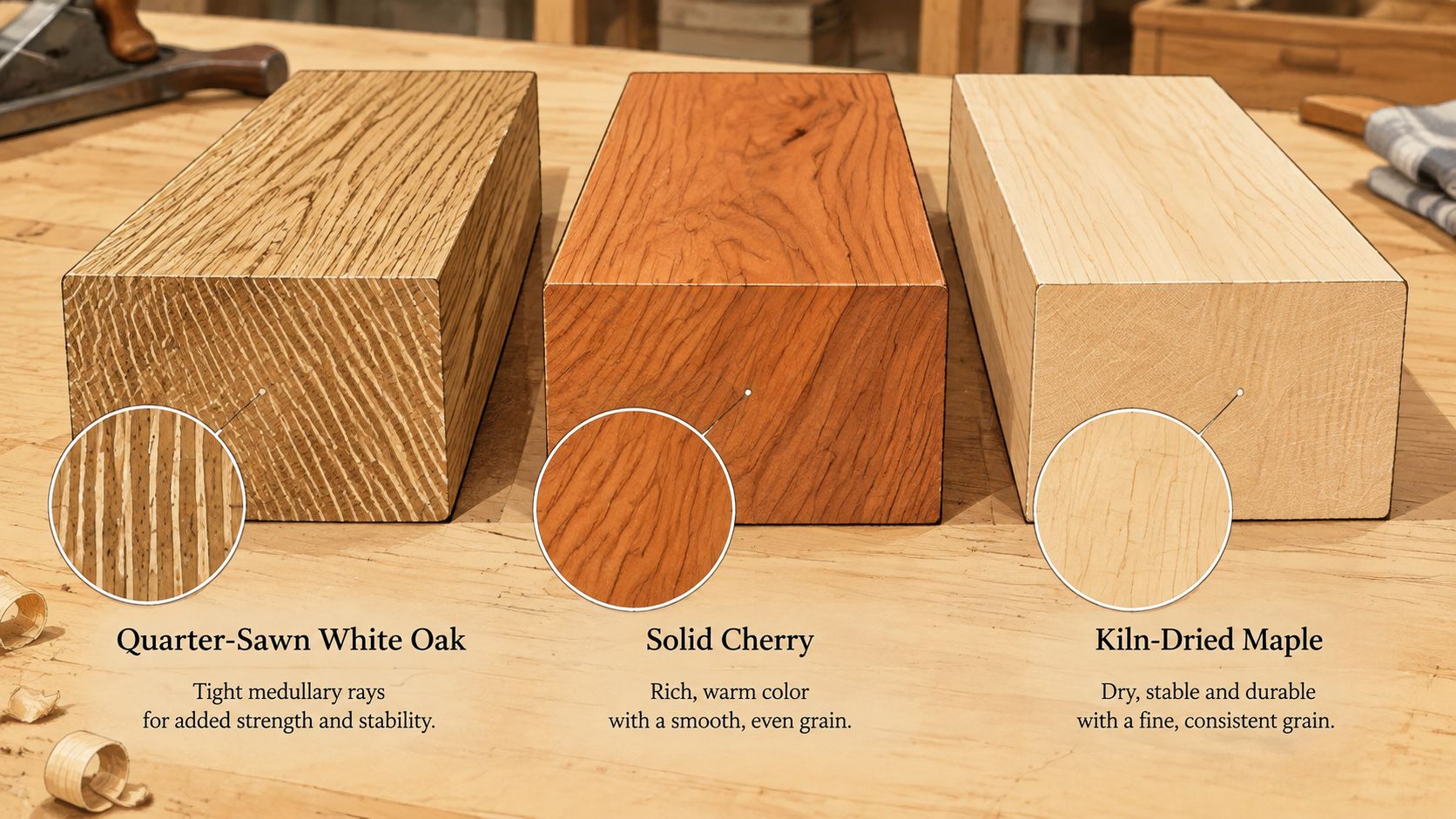
Authentic Amish furniture is commonly described as using 100% solid hardwood rather than particle board or engineered wood. Oak, cherry, brown maple, and walnut are frequent choices. Solid lumber has enough substance to be sanded, refinished, and repaired, which supports a longer service life than a thin surface over a composite core.
Buyers can learn more about why material choice matters in this guide to the benefits of solid wood furniture. The main idea is simple: a solid surface can be renewed. That doesn't mean every scratch disappears without work, but it does mean the furniture has a practical path forward after years of family use.
Joinery carries the forces
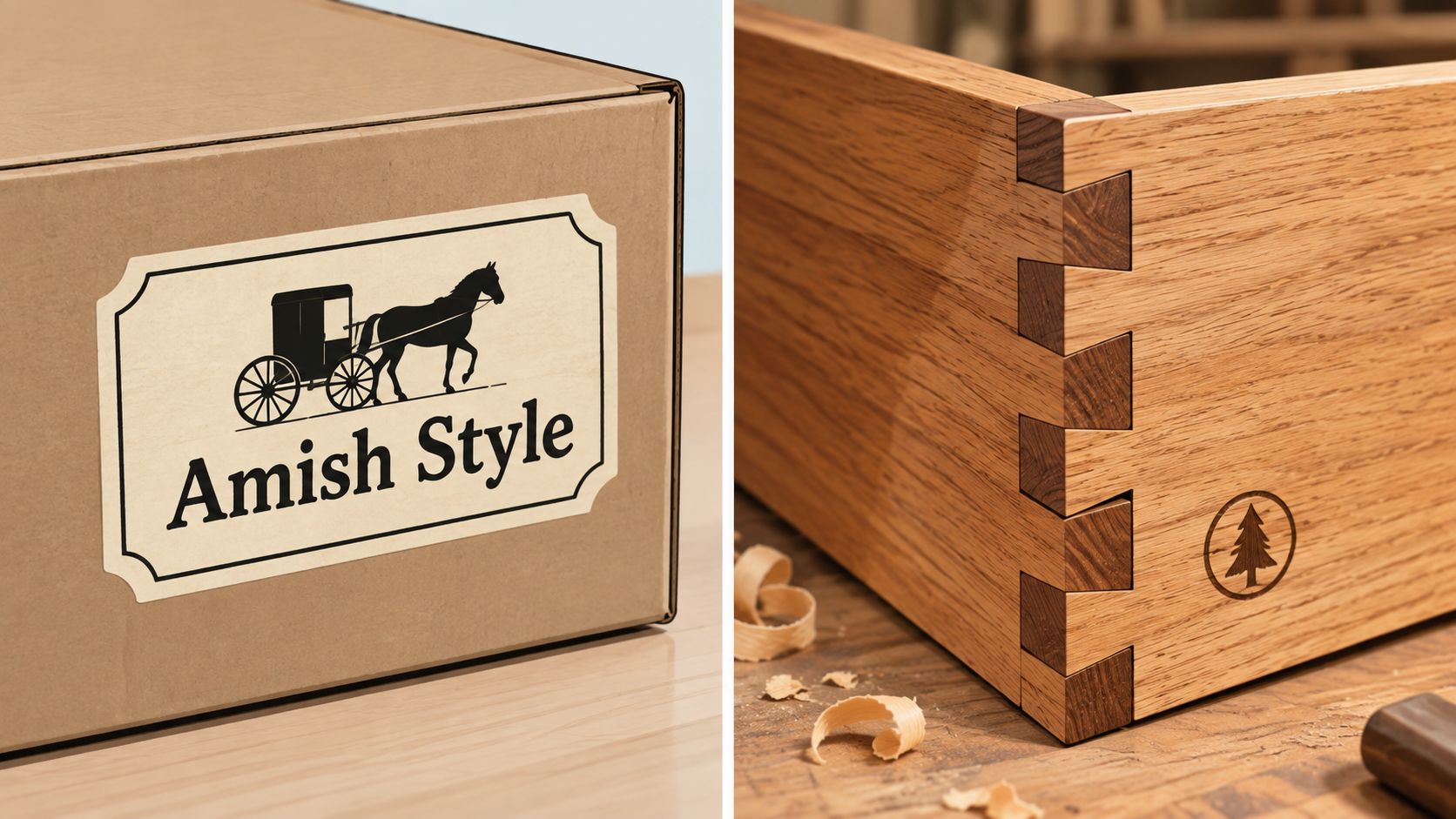
Dovetail joints use interlocking pins and tails, making them especially useful in drawers that are pulled open and closed repeatedly. Mortise-and-tenon joints place one wood member into a carefully fitted opening in another, creating a broad wood-to-wood connection for chair frames, tables, and beds.
These connections work like a wooden handshake that grips more firmly than a fastener alone. Guides on authentic construction identify dovetails and mortise-and-tenon joints as stronger quality signals than construction based mainly on staples, screws, or brackets.
Finishes defend the surface
The finish is more than color. It helps protect the wood from moisture, abrasion, and the small accidents that happen around a busy home. Some makers use durable catalyzed conversion varnishes, while others use hand-applied oil-based approaches. Shoppers should ask what finish was used and how it should be maintained.
Wood movement belongs in this same conversation. Guidance on seasonal movement estimates about 1/8 inch across 12 inches of width in moderate climates, with movement reaching 3/16 inch across 12 inches in more extreme climates. This explanation of wood movement shows why a quality maker uses floating panels, slotted holes, or other details that let the wood shift without cracking.
Think of those allowances as expansion joints on a bridge. The bridge isn't weak because it has room to move. It's designed to remain sound because the builder expected movement.
How to Spot Real Amish Construction in the Showroom
A showroom inspection should feel less like a test and more like getting acquainted with a piece. The hands and eyes can reveal a great deal, especially when a shopper knows where to look.
Start with the frame
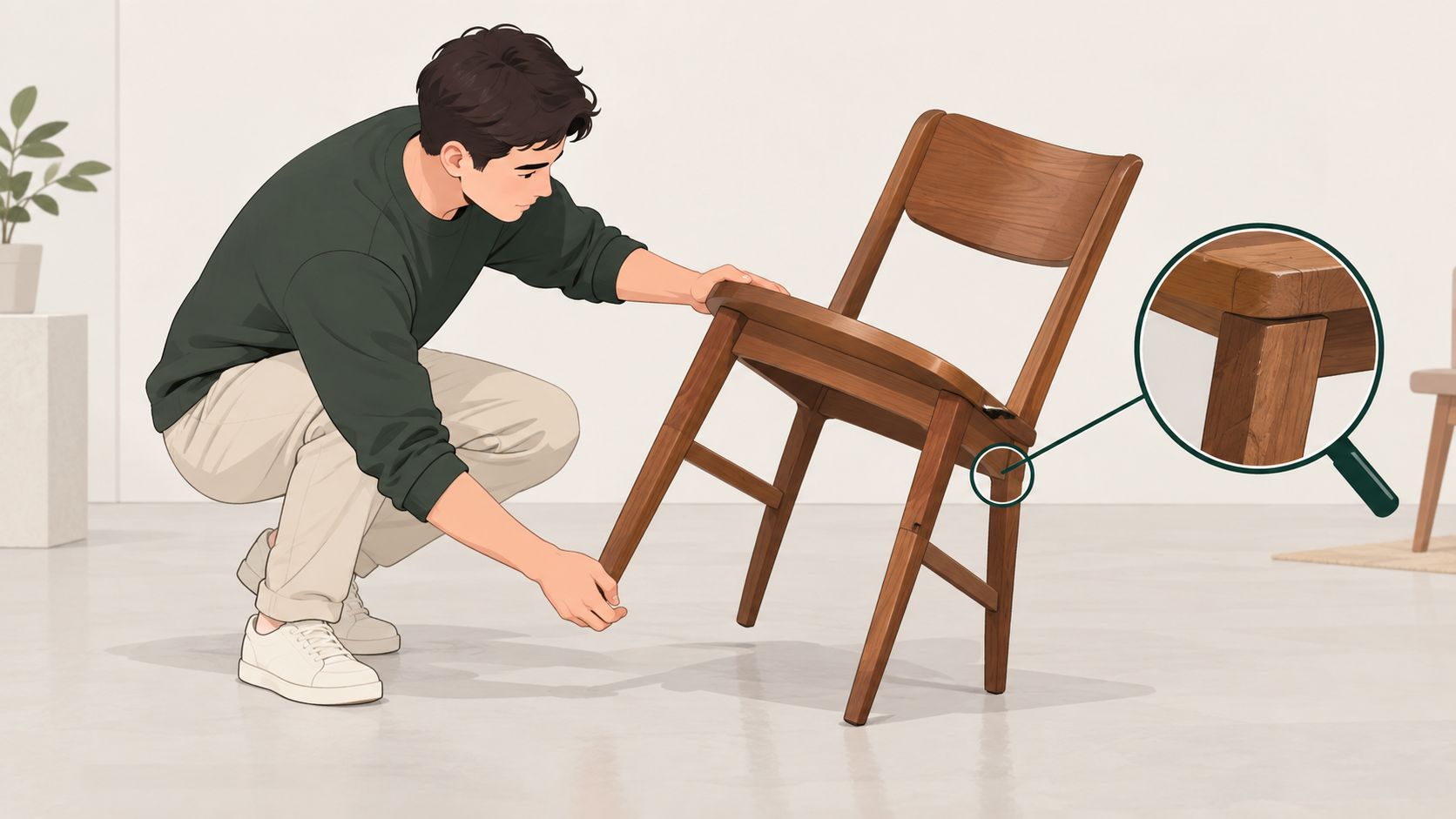
Ask permission before moving a display piece, then tip a chair back slightly and notice how the weight is distributed. A solid, balanced chair should feel substantial without feeling awkwardly assembled. Look at the underside of the seat and the inside of the legs for clean connections rather than decorative blocks added to hide a weak joint.
On a table, place a palm against the top and check for a consistent feel across the surface. A solid top should not feel hollow or unusually light for its size. Inspect the edges as well. A visible seam or abrupt change in material may indicate a surface applied over another core.
Open every drawer
Pull each drawer out and listen to the movement. The drawer should track smoothly and sit squarely in its opening. Look at the corners for interlocking dovetails, which are a visible sign that the maker designed the drawer to resist the pulling force created by daily use.
Run a fingernail along the back or underside of a case piece. The goal isn't to demand that every hidden part look decorative. The goal is to notice whether the materials and construction make sense throughout the piece. A dust panel or carefully finished interior suggests that the builder considered stability and function beyond the parts visible from across the room.
Ask before assuming
A label can start the conversation, but it shouldn't end it. Ask the associate to identify the wood, explain the joinery, describe the finish, and point out how wide panels accommodate movement. A shopper who wants a clearer explanation can review what a mortise-and-tenon joint is before coming in.
Practical showroom habit: take photographs of the joinery details, underside, drawer corners, and finish sample before ordering. The images make it easier to compare pieces later and help the household remember what made one design stand out.
Common Misconceptions Worth Clearing Up
The word “Amish” can attract attention, but the label alone doesn't prove construction quality. Some furniture is described as Amish-style or Amish-inspired without using the materials and joinery shoppers expect. The reliable approach is to verify the wood, the joints, the finish, and the place of construction instead of relying on a name.
A higher price doesn't automatically create better value either. A shopper should consider whether the piece can be repaired, refinished, and cared for over time. Those qualities may matter more than the initial price because they influence how long the furniture remains useful.
Natural wood isn't factory-perfect
Solid wood can contain mineral streaks, close grain, subtle color variation, and other signs of natural lumber. Seasonal expansion and contraction can also occur. Those characteristics aren't automatically defects. A quality builder anticipates movement and designs the piece so the wood can respond without creating unnecessary stress.
That doesn't mean every irregularity should be accepted without a question. A crack, loose joint, or uneven surface deserves an explanation. The difference is between natural variation that belongs to the material and poor workmanship that compromises function.
Traditional doesn't mean inconvenient
Amish-made furniture can use traditional construction while offering modern comfort. Today's shoppers may find upholstered seating, performance fabrics, soft-close hardware, and contemporary silhouettes alongside familiar hardwood tables and case pieces. Modern needs don't cancel the heritage. They give builders more ways to apply it.
The best questions remain direct:
- Origin: Where was the piece built?
- Wood: Is the lumber solid, and which species was selected?
- Joinery: What holds the frame and drawer boxes together?
- Finish: How does the finish handle ordinary household use?
- Care: What can be repaired or renewed later?
Longevity and Value Over a Lifetime
The financial case for Amish furniture begins with service life, but it doesn't end there. One craft-focused source describes mass-produced furniture as typically lasting 3 to 7 years, while quality Amish pieces regularly last 30 to 50 or more years with normal use. That durability comparison helps explain why a solid-wood piece can make sense even when the starting price is higher.
Another independent guide places solid hardwood furniture at roughly 30 to 100 or more years of typical usefulness, compared with 5 to 25 years for engineered-wood furniture, while an industry analysis describes Amish pieces as lasting 50 to 100 years and mass-produced pieces as lasting 10 to 20 years. The material and lifespan comparison should be treated as a way to understand the durability gap, not as a promise for every individual piece.
A practical comparison
The table below uses the cited lifespan ranges and illustrates how annualized cost can change when furniture remains useful longer. The annualized figures are calculations based on the example prices and durations shown, not guarantees about any particular purchase.
| Furniture Type | Amish-Built Lifespan | Annualized Cost, Amish | Mass-Produced Lifespan | Annualized Cost, Mass-Produced |
|---|---|---|---|---|
| Example dining set | 30 years | $2,200 ÷ 30, about $73 per year | 10 years | $900 ÷ 10, $90 per year |
The example doesn't account for delivery, maintenance, repair, replacement shopping, or the inconvenience of removing an unwanted set. It shows why a lower sticker price may not remain lower across the years.
Repairability protects the original purchase
A solid hardwood table can often be sanded and refinished when its surface becomes tired. A chair joint may be re-glued by a qualified professional. A drawer with traditional joinery can sometimes be adjusted or repaired instead of replaced entirely.
That flexibility is a quiet form of value. Families keep the original proportions, memories, and familiar marks of the piece while restoring its usefulness. Independent guidance also recommends asking about repairability, refinishability, and future care, because those factors shape total cost of ownership more clearly than the label alone. This discussion of Amish furniture value also notes that tracked online sales for Amish Furniture and Handmade Craft were about $25 million in 2025, down 10 to 20% year over year, suggesting that shoppers are asking harder questions about long-term value.
Modern Amish Furniture for Today's Homes
Traditional construction fits modern homes best when it responds to real household needs. A family in a downtown apartment may need a smaller dining table, while a household in a larger open-plan home may need a sectional with carefully considered proportions. Quality doesn't require every room to look formal or old-fashioned.
A 2025 retailer trend report described growing interest in upholstered seating, performance fabrics, and mix-and-match styles, while rustic cherry and brown maple remained popular. That discussion of Amish furniture trends reflects a broader shift toward comfort, stain resistance, lower-maintenance surfaces, minimalist silhouettes, sustainability, health, and heritage woods.
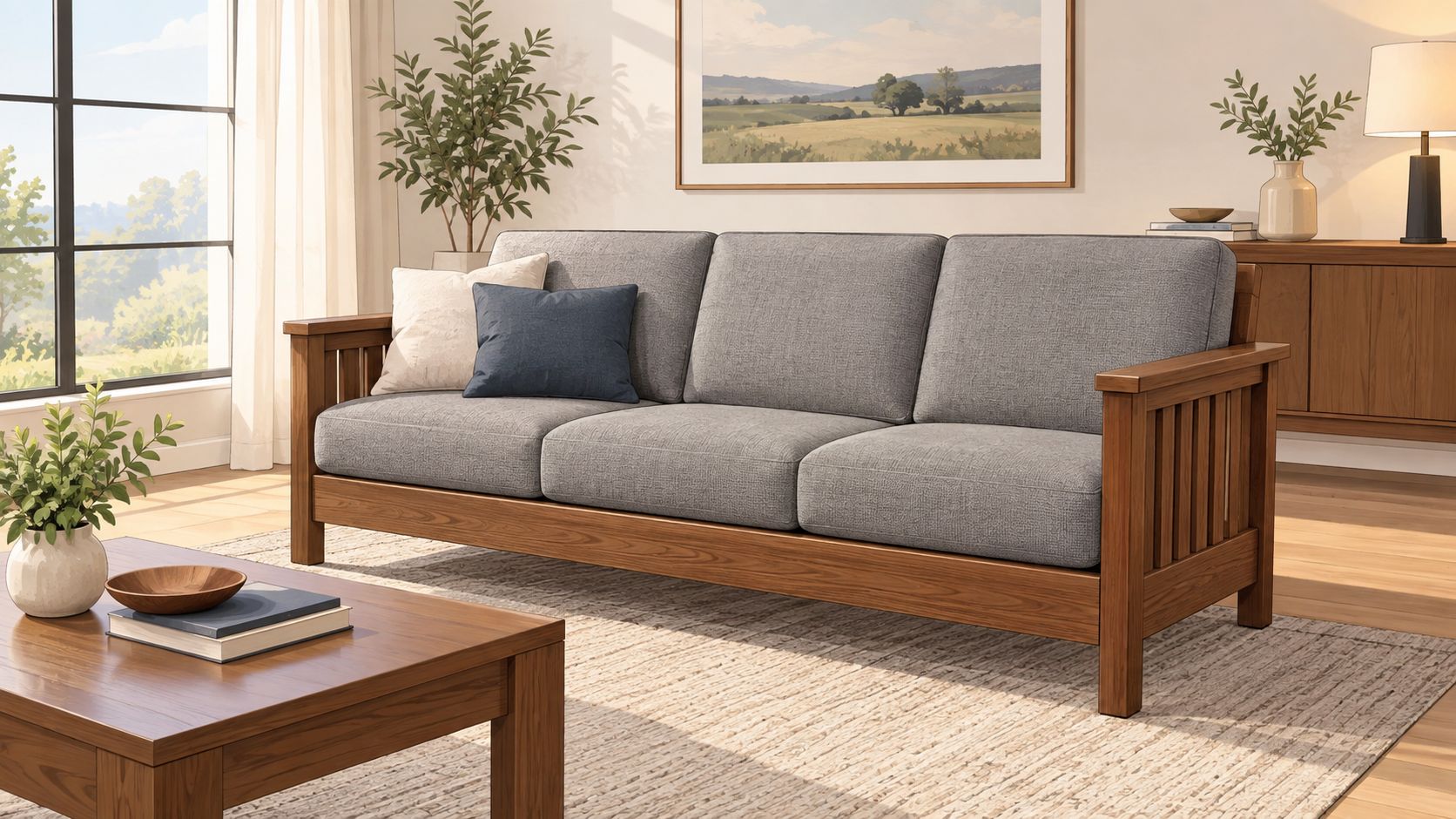
Craftsmanship can follow the floor plan
Modern Amish furniture may include:
- Smaller proportions: Useful dimensions for apartments, condos, senior living spaces, and compact dining areas.
- Flexible storage: Configurations that combine drawers, doors, and open shelving around the household's routines.
- Updated comfort: Upholstery and cushioning designed for relaxed sitting rather than display-only rooms.
- Personal choices: Wood species, stains, hardware, fabric, leather, and other finish selections.
- Useful features: Charging access, extension leaves, and pieces designed to move through narrow doorways.
A hardwood frame paired with resilient cushioning and performance textiles can bridge old-world construction with contemporary comfort. The point isn't to make a modern piece look traditional. It's to preserve sound building practices while giving the family a piece that fits how the room is used.
BILTRITE Furniture-Leather-Mattresses has a Greenfield showroom where shoppers can compare traditional and modern proportions in person, including American-made, Amish-made, solid-wood, small-scale, heavy-duty, and upholstered options. The store's team can discuss construction details without turning the visit into a pressure-filled decision.
Experience the Craftsmanship in Greenfield
Amish furniture quality makes the most sense when shoppers can touch the evidence. A solid oak chair has a different balance in the hands than a lightweight substitute. A well-fitted drawer has a smooth, controlled glide. Under showroom lighting, natural grain patterns and finish depth become easier to evaluate than they are in a small image on a screen.
A Greenfield showroom visit gives families room to test the furniture together. They can bring room measurements, compare chair heights, open doors and drawers, examine table leaves, and ask how a finish should be cared for. They can also ask whether a wide panel includes an allowance for seasonal movement, an important concern in a Wisconsin home.
A helpful visit starts with questions
Shoppers may want to bring a short list:
- Room details: Measurements, doorway widths, stairway limits, and preferred traffic paths.
- Material questions: Wood species, solid components, finish options, and natural variation.
- Construction questions: Drawer joinery, frame connections, hardware, and repair options.
- Lifestyle needs: Children, pets, frequent meals, mobility concerns, or limited space.
- Style preferences: Traditional, transitional, minimalist, upholstered, or mixed materials.
BILTRITE has served the Metro Milwaukee community as a fourth-generation, family-owned business since 1928. Its associates bring over 400 years of combined experience, and the store remains focused on helping shoppers understand their options. The broader showroom also includes more than furniture, with a mattress department offering over 60 models for households making several home-comfort decisions during one visit.
The store is located at 5430 West Layton Avenue in Greenfield, Wisconsin. Since BILTRITE doesn't sell online, the in-store experience matters. Families can see the Amish furniture selection near Milwaukee, ask questions face to face, and decide whether the construction feels right for their home.
A piece of furniture doesn't become valuable because someone calls it heirloom quality. The value grows from solid materials, purposeful joinery, a protective finish, thoughtful movement allowances, and the ability to remain useful through changes in family life. Those are the details worth checking before the purchase.
Ready to examine Amish furniture quality in person? Visit BILTRITE Furniture-Leather-Mattresses in Greenfield to explore USA-made, Amish-made, and solid-wood furniture, along with small-scale, heavy-duty, and custom options. Bring room measurements, test the drawers and chairs, and let the BILTRITE team help find a durable piece suited to the household's everyday life.