Solid Wood Table with Metal Legs Buying Guide


Could a heavier steel base make a wood table more likely to crack? That's the detail shoppers can miss when they concentrate on the grain, finish, and leg shape. A solid wood table with metal legs needs more than attractive materials. The connection between those materials matters just as much.
For Metro Milwaukee families, a dining table might host breakfast, homework, holiday meals, and an unfinished puzzle. Choosing one starts underneath the top, continues with a room measurement, and ends with a practical plan for keeping it looking good.
Table of Contents
- How a Solid Top Moves on a Steel Base
- Table Length Height and Walkway Clearance
- Styles from Farmhouse to Everyday Family Dining
- Strength Tradeoffs and What Lasts in Real Homes
- Care Refinishing and Protecting Your Floors
- See USA-Made and Amish Tables in Greenfield
How a Solid Top Moves on a Steel Base
Think of a wooden cutting board that feels slightly different after a change in the weather. A solid tabletop responds to moisture in much the same way: it takes moisture from humid air and releases moisture when the air becomes dry. The wood remains responsive after it becomes furniture.
Steel legs don't respond to indoor humidity the same way. That difference makes the wood-to-metal joint an important part of the table's construction, not only a place to drive screws.

Why the top needs room to move
Wood movement happens mainly across the grain, rather than along its length. On a typical rectangular top with grain running lengthwise, the important seasonal change is across its width. A broad tabletop therefore needs more movement allowance than a narrow wooden component.
The USDA Forest Products Laboratory's wood handbook explains moisture-related dimensional movement and reports that hardwood lumber intended for furniture is typically dried to approximately 6–8% moisture content. Proper drying prepares lumber for indoor use, but it doesn't make the finished top immune to changes in the room.
The U.S. Forest Service's guidance on moisture control describes seasonal moisture-content fluctuations of roughly 6–7% for interior woodwork across most of the continental United States. In Metro Milwaukee, heated winter interiors and humid summer conditions make seasonal changes a practical furniture consideration.
That isn't a reason to avoid solid wood. It's a reason to choose a table whose builder planned for it.
A finish slows the exchange of moisture, but it doesn't stop it. Finishing the underside and edges matters, too, because a tabletop has more exposed surfaces than the face that holds the dinner plates.
Secure doesn't mean locked in place
A sound attachment holds the top firmly while allowing limited cross-grain travel. Elongated mounting holes, tabletop clips, figure-eight fasteners, and suitable movement-tolerant brackets are ways a builder can provide that allowance.
An elongated hole gives a properly installed fastener room to shift relative to the bracket. A tabletop clip or figure-eight fastener works differently, but the purpose is similar: support the wood without forcing it to remain the same width through every season.
By contrast, rigidly fastening a broad top across its grain can concentrate stress around screws and mounting plates. The results can include splitting, cupping, finish damage, or loosened hardware. Adding more steel doesn't solve that mismatch.
Showroom rule: A secure top shouldn't wobble, but its attachment should still accommodate the wood's seasonal movement.
A visible slot alone isn't proof that the connection works. Its direction, the fastener placement, and the mounting arrangement need to suit the grain direction. A sales associate should be able to explain the connection or obtain the construction details.
A practical showroom inspection
The most useful inspection follows a simple sequence: confirm the material, understand the drying and joint, inspect the frame, examine the feet, and check floor contact. Looking underneath is just as worthwhile as admiring the top.
Showroom checks for a solid wood top on metal legs
| Check | What good looks like | Red flag |
|---|---|---|
| Top material | Solid wood through the thickness that can be sanded and refinished | Thin veneer or a printed face over a panel |
| Drying | Kiln-dried for indoor rooms, commonly about 6–8% moisture content | Lumber not prepared for indoor humidity |
| Wood-to-metal joint | Elongated holes, clips, or figure-eight fasteners that allow cross-grain movement | Screws that lock the top rigidly to steel |
| Frame | Bracing that resists racking without clamping the boards | A heavy frame with no allowance for movement |
| Feet | Replaceable glides or adjustable levelers | Bare metal feet on hard flooring |
| Stability | Every foot down and no rock under ordinary pressure | Loose bolts, a narrow stance, or a wobble |
Start with the top material. Solid wood can consist of boards glued together; it doesn't have to be a single slab. The distinction is whether the wood continues through the thickness, rather than being a thin decorative face over a different core.
A veneer surface isn't automatically poor furniture, but it isn't the same construction. The U.S. Forest Service's wood-properties guidance helps explain why material structure and grain direction matter when evaluating movement and the connection to a base.
Next, ask about drying and attachment together. A useful question is whether the lumber was prepared for indoor rooms and how the mounting system accommodates width changes. An answer limited to the top's thickness leaves the most important joint unexplained.
Then inspect bracing, feet, and floor contact. Bracing should resist sideways distortion, often called racking, without immobilizing the tabletop. Replaceable glides or levelers should be accessible, and gentle pressure at a corner shouldn't produce an unexplained rock.
A table that passes those checks still needs to fit the home. That calls for a tape measure, not a guess based on how open the base looks.
Table Length Height and Walkway Clearance
Will the table fit the room once chairs are pulled out? Start with the table's footprint, then account for chairs and the route people need to walk through.
As a planning guideline, a table about 59–71 inches long can suit four to six diners, while one about 71–94 inches long can suit six to eight. Allow roughly 43–47 inches from the table edge to an obstacle for pulling out chairs, and about 51–59 inches where people need to walk behind seated diners. BILTRITE's dining table size guide offers another starting point. Treat these ranges as estimates; chair style and leg placement affect usable space.
Match the height before counting chairs
Everyday dining tables generally pair with dining chairs. Counter-height tables call for stools of a matching height. If people at home have different ages or mobility needs, try sitting down and standing up at the intended height before choosing.
Dining size and clearance planning
| Plan | Measurement | Who it fits | Clearance to add |
|---|---|---|---|
| Everyday dining height | 28–30 inches | Most dining chairs and mixed ages | About 43–47 inches for chair pullout |
| Counter height | About 34–36 inches | Stools in a casual kitchen spot | Allow space for chairs or stools and the walkway |
| Four to six diners | 59–71 inches long (150–180 cm) | Family meals | About 43–47 inches for chair pullout; 51–59 inches for a walkway behind seated diners |
| Six to eight diners | 71–94 inches long (180–240 cm) | Guest meals | Use the same clearances on sides where people sit or pass |
| Extendable top | Smaller for daily use, longer with leaves | Busy family rooms | Tape both the closed and open footprints |
Check the underside as well as the tabletop. An apron or steel rail can crowd thighs or chair arms, even when the table height seems right. Pull a chair fully in, rest both feet, and check that there's room beneath the frame.
Use painter's tape to test the room
A room's usable area includes the space needed for a sideboard, an open doorway, and the route to the kitchen. Mark the furniture footprint before deciding where it belongs.
- Measure fixed obstacles. Note the distance between walls and furniture that will stay, including the space needed to open cabinet doors.
- Mark the tabletop. Use painter's tape to outline its actual length and width on the floor.
- Add chair and walking space. Place existing chairs around the outline, then pull them out as people would during dinner.
- Test the expanded arrangement. For an extendable table, mark both footprints and check the route past the end seats.
A smaller top can suit an apartment, while an extendable rectangle can serve a family that hosts occasionally. The tape outline shows how much room the table and pulled-out chairs take, even when the metal base looks open.
Styles from Farmhouse to Everyday Family Dining
A wood top and metal base don't have to produce an industrial-looking room. The same materials can feel relaxed, farmhouse-inspired, spare, or contemporary depending on the base shape, finish, and chairs.
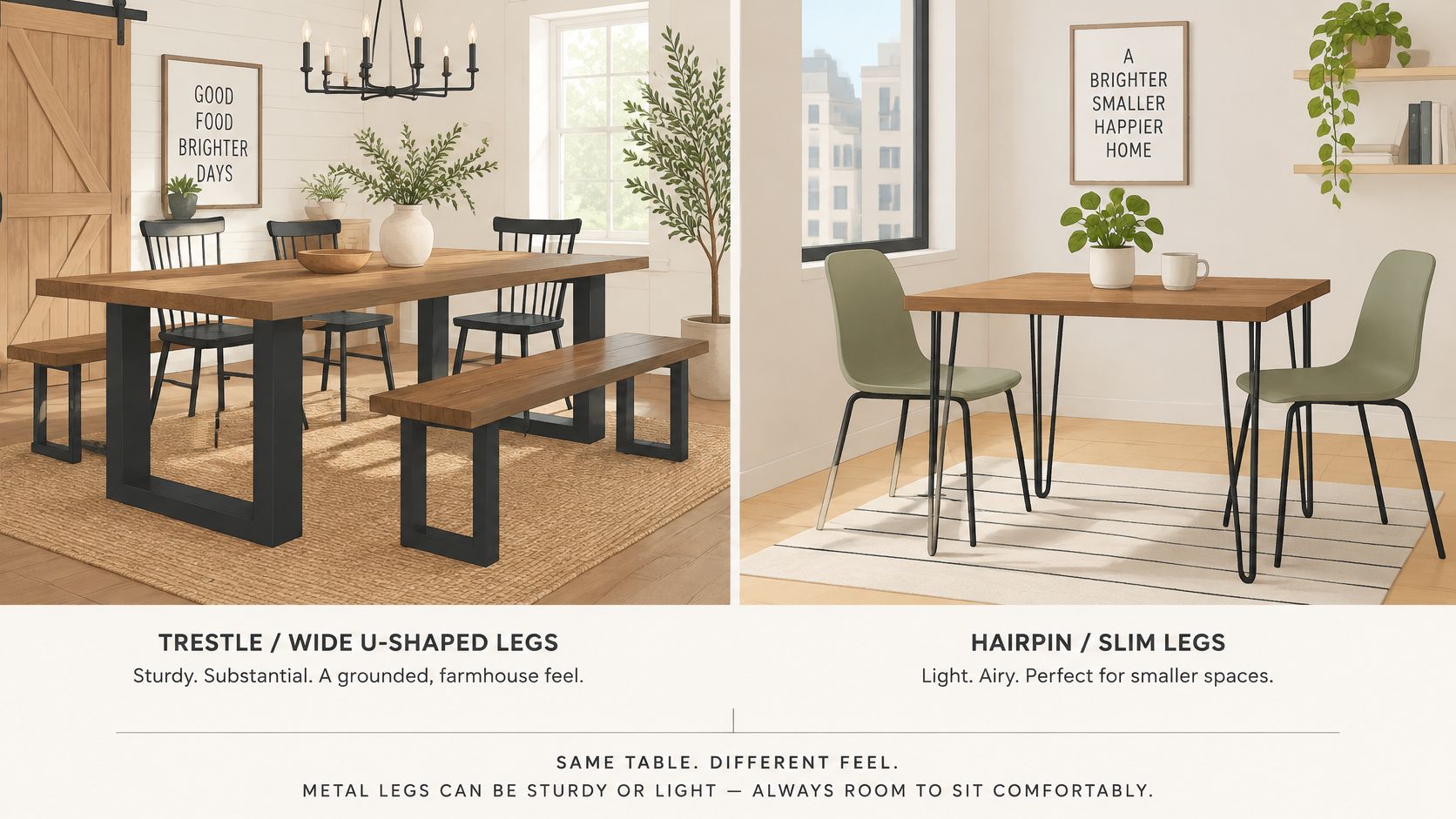
Consider a family dining room with painted cabinets and warm wood flooring. A rectangular top on a trestle or broad U-shaped base can suit the room without making it feel formal. The important comfort question is where that base lands relative to knees and feet.
Different rooms call for different silhouettes
In a compact apartment, slim straight legs or a hairpin-style base can leave more of the floor visible. That gives the room a less crowded appearance, although the chair arrangement still needs a real fit test. Splayed legs also deserve attention because their feet may extend farther than expected.
For a square breakfast area, a round top on a pedestal-style metal base can soften the layout. Diners can face one another without designated end seats, and a central support can simplify chair placement. The pedestal's footprint still needs checking for comfortable foot placement.
A longer room often suits a rectangle, especially when extra seating is occasional rather than daily. An extendable design should be judged both as an everyday table and as a larger gathering place.
The most useful style choice is one that looks right while everyone is actually seated.
Let wood and finish set the mood
Natural oak or maple under a clear finish keeps grain visible. Dark steel paired with a stained top can lean industrial, while warmer wood tones and softer chair upholstery can make that same base feel inviting rather than stark.
BILTRITE's industrial and rustic furniture style comparison can help households distinguish the details they enjoy. A family doesn't need to furnish every room in a single named style.
- For condos and senior living: A small-scale top and easy-to-use seating can matter more than a dramatic base.
- For homework and projects: A well-supported surface, accessible seating, and a suitable finish deserve priority over visual heft.
- For casual kitchen conversation: Counter-height furniture can work when the stools suit the people using them.
At BILTRITE's Greenfield showroom, USA-made and Amish-made solid wood furniture provides a range of starting points, with custom choices available on eligible pieces. Wood, finish, and hardware options should be confirmed for the particular table rather than assumed from a photograph.
Strength Tradeoffs and What Lasts in Real Homes
Judge stability by the tabletop, support spacing, connections, and floor contact together. A substantial top can feel unsteady on a poorly proportioned base, while an uneven floor or loose joint can affect an otherwise well-built table. The U.S. Consumer Product Safety Commission's tip-over guidance notes that voluntary standards address particular furniture hazards, rather than setting a general federal stability regulation. Treat a metal base as one part of the design, not a guarantee of stability.
Real strengths and practical limits
Solid wood can be refinished or repaired, and steel can support a table without bulky legs. The quality of either material depends on how it is prepared and joined to the rest of the table. A wide support stance can help resist ordinary movement; narrow supports, loose connections, and uneven floors can work against it. Climbing or sitting on the tabletop adds loads the furniture may not be designed to carry.
| Potential strength | Limit to evaluate |
|---|---|
| Steel supports can provide a visually open base | Narrow or poorly positioned supports can compromise stability |
| Bolted connections may be serviceable | Inaccessible hardware makes maintenance harder |
| Solid wood offers restoration options | A suitable repair depends on the damage and finish |
| Separate top and base components may simplify service | Confirm replacement parts and maker support |
At setup, follow the maker's bolt-tightening instructions, then check that every foot meets the floor. Repeated wobbling calls for an adjustment or a closer look at the connections, not a shrug.
Durability has a waste consequence
The U.S. Environmental Protection Agency's durable-goods figures estimate that furniture and furnishings generated 12.1 million tons of municipal solid waste in 2018, with 80.1% landfilled. The agency identifies wood as the largest material category in furniture and furnishings, followed by ferrous metals. These figures describe waste, not the lifespan of a particular table. They help explain why it is useful to check whether a maker can service the connections or supply replacement parts.
Steel may enter scrap-recycling channels, depending on local acceptance and preparation requirements. Keeping a useful table in service also depends on practical details: whether a connection can be reached, a glide replaced, or a damaged finish addressed.
Craftsmanship shows in the details of construction, not appearance alone. BILTRITE's guide to Amish furniture quality offers points to consider, including how carefully a piece is built. A durable table brings its parts together well: prepared wood, sound joints, a braced base, and feet that meet the floor.
Care Refinishing and Protecting Your Floors
How can a table stay ready for family meals without turning care into a chore? Wipe spills promptly, dust with a soft cloth, use coasters, and place a protective pad beneath hot serving dishes. These habits take minutes a day.
For sticky spots, start with a soft cloth lightly dampened with water, then dry the surface. Harsh abrasives, solvent-heavy cleaners, and unidentified polishes can harm an otherwise serviceable finish. Check the maker's care instructions before trying a new product.

Protect the top and the floor
Where a table sits affects its care. A spot beside a radiator or directly over a heat outlet can dry the wood unevenly. Choose a more balanced indoor location when possible.
Grit caught beneath a glide can scratch the floor, and a worn pad may expose the metal foot. Lift the table with suitable help when moving it, rather than dragging it.
- During routine cleaning: Clear debris from around the feet and inspect the floor-contact surfaces.
- After seasonal changes: Check accessible bolts and levelers according to the maker's directions. Avoid overtightening hardware designed to allow wood movement.
- When a coating chips: Keep exposed steel clean and dry, and ask about a compatible touch-up.
- When damage looks structural: Stop using a table with a split mounting area, failed weld, or persistent instability until it can be assessed.
Ask about restoration before it's needed
Solid wood can often be repaired and refinished, but the right method depends on the finish, construction, and type of damage. A small surface mark may need a targeted finish repair. Sanding the entire top without understanding its coating or edge details can turn a manageable repair into a larger job.
Long-term ownership question: Can the worn part be repaired or replaced while the useful parts stay in service?
Before buying, ask whether the top separates from the base for refinishing, whether individual legs or glides can be replaced, and which cleaners the maker approves. Keep the care instructions and finish information with your household records; they can help guide future service.
BILTRITE's wood furniture maintenance guide offers practical care guidance. A clear repair path can help families keep a solid wood table in use for years.
See USA-Made and Amish Tables in Greenfield
Could your chairs slide under the table, with enough room for everyone's feet? Seeing the chair and table together helps answer that question. At BILTRITE's Greenfield showroom, you can sit at the actual table, check how its base affects legroom, and inspect the wood grain and finish up close.
BILTRITE is a fourth-generation, family-owned business serving Greenfield and Metro Milwaukee since 1928. Bring room measurements, chair dimensions, and photos of nearby finishes to help narrow the options. For an extendable table, include measurements for both its everyday footprint and expanded arrangement.
- Match the scale to the room: Small-scale furniture can suit apartments, condos, and senior living spaces. A larger table may better fit a busy family dining area.
- Ask about available choices: Confirm which wood, finish, leg, and hardware options apply to the specific table.
- Check the designations: USA-made, Amish-made, and real solid wood labels can help you focus on a piece's origin and construction.
Families exploring Amish furniture near Metro Milwaukee can compare tables in person at the Greenfield showroom. BILTRITE doesn't sell online, and the showroom is closed Sundays and Mondays.
The showroom also has a mattress department with over 60 models and power lift recliners. Bring your measurements, take a seat, and ask questions at a comfortable pace.