Solid Wood for Furniture: A Friendly Buyer’s Guide


A dining table catches the eye from across the showroom. The grain has gentle variation, the surface feels substantial, and the legs stay steady when a shopper gives the table a careful nudge. Then the questions begin. Is the top solid wood? Will it hold up to family meals? What happens when Wisconsin's dry winter air gives way to a muggy summer?
Those are smart questions. Solid wood for furniture can bring warmth, repairability, and lasting character to a home, but the material also needs thoughtful construction and seasonal care. At BILTRITE, a fourth-generation family-owned furniture business serving Metro Milwaukee since 1928, shoppers can slow down, touch the surfaces, inspect the joinery, and talk with a knowledgeable associate before making a decision.
Table of Contents
- Understanding What Solid Wood Really Means
- Exploring Popular Wood Species for Your Home
- Comparing Solid Wood to Engineered Alternatives
- How to Spot True Solid Wood in the Showroom
- Caring for Your Wood Furniture Through the Seasons
- The Value of USA and Amish Craftsmanship
- Your Showroom Buyer's Checklist
Understanding What Solid Wood Really Means
A dresser can look like wood from ten feet away, yet its visible layer may be only a thin veneer over MDF or particleboard. Another dresser may use natural lumber through most of its visible and structural parts. The finish can make them appear similar, but their construction, movement through Midwest seasons, and repair options may differ.
Solid wood furniture uses natural wood as the primary material, rather than depending on particleboard, MDF, or a paper-wrapped composite for its main structure. That does not mean every board is one uninterrupted piece of timber. Amish and other USA furniture makers commonly join boards, strips, lamellas, and bars to build stable tops, panels, doors, and case parts. A German furniture quality reference explains that solid wood furniture uses one type of wood, with grown wood, lamellas, and bars among the forms used in production. The German Furniture Quality Association's explanation of solid wood furniture clarifies that “solid wood” describes the material and construction, not a single-piece carving.
Natural material with a repairable surface
Daily life leaves marks. A solid wood tabletop can often be sanded, touched up, or refinished as scratches and wear accumulate. That repairable surface is one reason families may keep a well-made piece in service as children grow, rooms change, and homes move.
The material also responds to the air around it. Dry Midwest winters and humid summers can cause wood to gain or lose moisture, leading to small seasonal changes in width or shape. Sound furniture construction allows for that movement rather than treating wood like a completely rigid sheet. In a showroom, ask how the maker accommodates seasonal movement and which parts are solid wood.
Consumer preference supports the appeal of the material. This furniture materials guide records that 62% of consumers considered solid wood important or very important in furniture purchases, while 33% were willing to pay up to 10% more when they knew a piece was solid wood.
Why the label deserves attention
“Real wood” can describe a veneer, trim, or selected component while another material forms the core. One industry-standard explanation states that, under solid-wood construction rules, the rear panel and drawer bottoms may be exceptions, while other parts must be solid wood for the label to apply. This construction guide to solid wood furniture gives shoppers a practical reason to ask which components use solid wood.
A helpful starting point for families is this plain-language guide to choosing wood furniture. In the showroom, connect the label to the details: honest materials, careful joinery, a suitable finish, and construction suited to seasonal Midwest living.
Exploring Popular Wood Species for Your Home
Wood species change the personality of a room. Oak can bring visible grain and a familiar, grounded look. Cherry often offers a warmer, more refined appearance. Walnut has a deeper, richer tone, while pine can create a lighter, more relaxed feeling. The right choice depends on the room, the finish, the household, and the amount of daily wear the piece will receive.
Hardness helps explain why some species suit busy dining rooms or heavily used storage better than others. The Janka hardness scale measures the force required to press a steel ball into wood. Across common woods, one 2026 furniture standards source reports a broad range of roughly 320 to 3,680 lbf, with density ranging from 0.32 to 1.10 g/cm³. The wood standards reference shows why “solid wood” alone doesn't tell the whole performance story. Species, density, grain, design, finish, and construction all matter.
A practical comparison
| Wood Species | Durability Level | Best Room or Use Case |
|---|---|---|
| Oak | Strong, dependable hardwood | Dining tables, bedroom furniture, storage, and busy family spaces |
| Maple | Dense hardwood with good resistance to everyday wear | Dressers, desks, dining furniture, and clean-lined interiors |
| Walnut | Durable hardwood with a rich visual character | Dining rooms, home offices, statement case pieces, and refined living spaces |
| Cherry | Durable hardwood with warm color and noticeable character | Dining rooms, bedrooms, and traditional or transitional furniture |
| Pine | Softer wood that can show use more readily | Casual rooms, lighter furnishings, and homes that welcome a relaxed, lived-in look |
The table offers a starting point, not a rulebook. A well-built piece of a moderately softer species may serve a household better than a poorly constructed piece made from a harder wood. A dining table needs a stable top, well-designed joints, and a finish suited to meals and gatherings. A bedroom nightstand may place more emphasis on drawer construction, proportions, and surface feel.
Matching the species to daily life
A family with frequent meals, crafts, homework, and gatherings may prefer a species that handles regular contact confidently. A quieter home office may allow more flexibility, especially if the main priority is color and grain. Softer wood isn't automatically a poor choice. It may develop dents and marks more easily, and some homeowners appreciate that relaxed patina.
Oak, maple, and walnut generally outperform softer or composite materials for longevity, according to the standards reference above. Dense hardwoods are often selected for high-wear pieces such as dining tables, bed frames, and storage furniture because resistance to dents and long service matter in those settings.
Showroom question: “Which wood species fits the way this room gets used?” often leads to a better decision than “Which wood is hardest?”
Color also deserves attention. Natural grain varies from board to board, and a finish can change how warm, light, or dramatic a species appears. A side-by-side visit to a showroom makes those differences easier to judge than a small color swatch. For a closer look at two especially popular choices, shoppers can read this comparison of walnut and oak furniture.
Comparing Solid Wood to Engineered Alternatives
Engineered wood describes several different materials, not one single product. Particleboard, MDF, and similar panels use wood fibers, particles, or strands formed into a manufactured core. Veneer is different again. It is a thin layer of natural wood placed over a core, so the surface can show genuine grain without the piece being solid wood throughout.
Each option can serve a sensible purpose. An engineered panel may lower cost, reduce weight, or provide a consistent surface for temporary furnishings. A well-made veneer can offer attractive grain and steady performance when its construction is clearly explained. The showroom question is simple: which parts are solid wood, which are veneered, and which use an engineered core?
Where solid wood stands apart
The clearest difference appears when a surface has to be renewed. Solid wood has material beneath the finish, so a craftsman can often remove a shallow mark and apply a new finish without exposing another layer. Veneer requires more restraint. Its natural wood face is thin, and aggressive sanding can cut through it into the core, leaving a patch that cannot be repaired like a solid board.
That limitation matters after a move, a spill, a chair scrape, or years of opening and closing drawers. A damaged MDF or particleboard edge presents a related problem because the exposed core does not respond like natural wood. A veneer piece may still be a good choice, but the owner should understand what future repairs can and cannot involve.
Midwestern homes add another consideration. Humid summers and dry, heated winters make wood respond to changes in moisture. Solid boards expand and contract, much like a row of neighboring houses adjusting to the seasons. Good furniture design allows for that movement. Engineered panels may change less in some conditions, but their edges, fasteners, and surface layers still depend on sound construction.
The value question
A lower initial price may suit a short-term apartment, guest room, or furnishing plan that will change soon. Solid wood may fit a family choosing a dining table, dresser, bed frame, or desk for long ownership. The decision depends on expected use, repair options, budget, and how long the piece is likely to remain in the home.
A simple calculation can clarify the choice:
Purchase price ÷ realistic years of use = starting cost-per-year comparison
This does not include resale value, refinishing, delivery, or the inconvenience of replacement. It does shift attention away from the price tag alone. A piece replaced after a short period may not remain the less expensive choice over its full ownership cycle.
Construction still matters
Solid wood does not excuse weak design. Wide panels need room for seasonal movement, especially in the Midwest. Drawers need sound joinery and supported bottoms. Tables need stable aprons, legs, and fasteners. Amish and USA furniture makers often place this practical construction knowledge at the center of their work, rather than treating material choice as the whole story.
For a side-by-side explanation, shoppers can review this guide to solid wood and engineered wood. In the showroom, evaluate the complete piece: material, joinery, finish, proportions, and the way it will serve your home through changing seasons.
How to Spot True Solid Wood in the Showroom
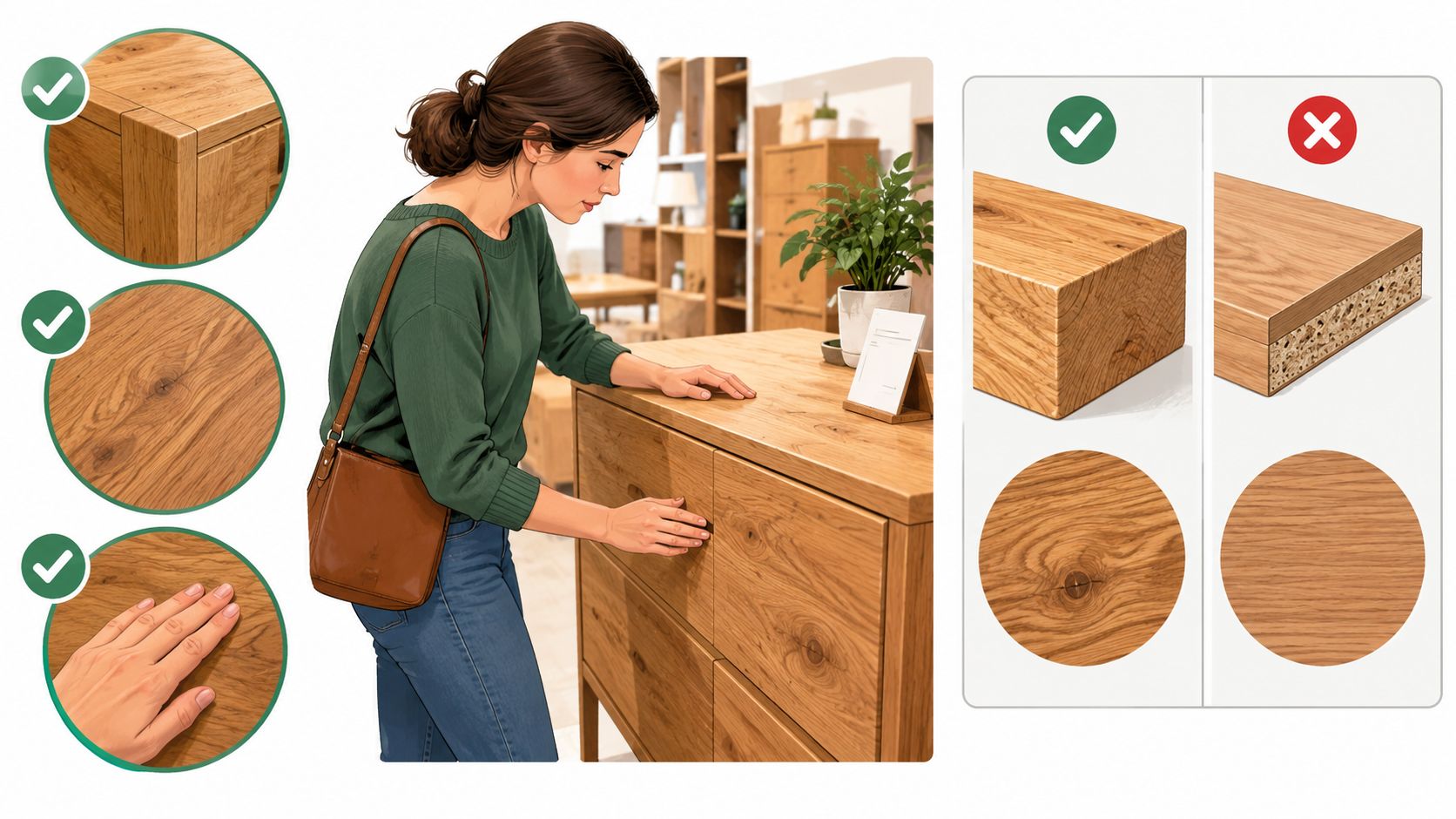
A shopper doesn't need a carpentry background to inspect furniture intelligently. A few calm checks can reveal a great deal, especially when the piece is available to see and touch in person.
Start where the display doesn't
The top and front usually receive the most attention, but the underside and interior can tell a more honest story.
- Inspect the underside. Look for natural grain, finished wood surfaces, and carefully fitted components. A flaky, compressed, or crumbly underside may indicate a manufactured core.
- Open every accessible drawer. Solid wood drawer sides, a bottom set into a groove, and smooth movement suggest thoughtful construction. A hollow feel, wobble, or stapled-on bottom deserves a question.
- Follow the grain. Natural boards show variation. Repeated patterns, printed designs, or a surface that wraps awkwardly around an edge may indicate a decorative layer rather than solid wood throughout.
- Examine the end grain. At an exposed edge or unfinished underside, end grain can help distinguish a natural board from a printed surface. It shouldn't look like a photograph applied over the edge.
- Feel the weight and temperature. Solid wood furniture often feels substantial and grounded. Weight isn't proof by itself, but an unexpectedly light large case piece may rely heavily on manufactured materials.
Look at the joints
Joinery reveals how a piece is expected to handle stress. Dovetail joints interlock drawer sides and resist the pulling force created with repeated use. Mortise-and-tenon construction fits one component into another, creating a strong frame connection when properly made. Reinforced corners and cleanly fitted parts can also signal careful workmanship.
A shopper can gently test a chair or table for wobble, run a hand along an edge, and check whether doors hang evenly. No single clue proves the entire construction, so the best approach combines material, joinery, finish, and feel.
Ask for precise language
The phrase “wood furniture” leaves room for confusion. A better question is, “Which parts are solid wood, and which parts use veneer or an engineered core?” Another useful question is, “What can be repaired or refinished if this surface receives heavy wear?”
The industry definition matters because solid wood is more specific than “real wood.” This practical guide to identifying real wood furniture can help shoppers prepare before visiting a showroom, but a conversation with a knowledgeable associate remains valuable. Clear answers should include the species, the construction, the finish, and the care requirements.
Caring for Your Wood Furniture Through the Seasons
A solid wood dining table can look unchanged through a Wisconsin winter, then show a slightly snug drawer or small gap when summer arrives. Indoor air becomes dry during heating season, while summer moisture creates the opposite response. Wood is hygroscopic, meaning it absorbs and releases moisture from the surrounding air.
That movement occurs much more across the grain than along it. Wide tops, doors, and panels need space to adjust. Technical guidance for wood furniture notes that interior components are often targeted to about 10% to 12% moisture content, bringing the material closer to its service environment. This technical brief on wood movement and furniture construction explains why floating panels, slotted fastener holes, and breadboard ends accommodate movement better than rigid cross-grain pinning. These details are easy to discuss in a showroom because they show how craftsmanship accounts for real Midwestern conditions.
Humidity matters more than many owners expect
Furniture care guidance commonly places indoor relative humidity around 35% to 55%, while other recommendations broaden the workable range to 30% to 60% or 45% to 65%. This solid wood care guide explains that conditions outside those ranges can contribute to shrinkage, swelling, loose joints, sticking drawers, and hairline cracks.
The precise reading matters less than avoiding sharp, repeated swings. Stable indoor conditions give wood time to adjust gradually. A basic humidity monitor can show whether a room becomes unusually dry or damp as the seasons change.
Small habits protect large pieces
- Keep furniture away from direct heat. Do not place solid wood directly beside a furnace vent, radiator, or strong heat source, where uneven drying can stress the material.
- Use coasters and placemats. They limit contact with moisture, heat, and spills on dining and occasional tables.
- Dust with a soft cloth. Abrasive particles can create fine surface wear when dragged across a finish.
- Clean gently. Follow the maker's care directions, and avoid harsh chemicals or silicone-heavy products unless the finish instructions allow them.
- Give drawers room to respond. A drawer that becomes slightly snug during a humid spell may need patience rather than force.
- Oil or refinish only when the finish and maker's instructions call for it. For a full seasonal care routine, see this wood furniture maintenance guide.
Seasonal habit: Stable indoor conditions usually serve solid wood better than dramatic attempts to correct one sticky drawer or small gap.
A small dry-season gap or snug humid-season door does not automatically mean the furniture has failed. Proper design anticipates movement. Careful construction, sensible placement, and consistent indoor conditions help keep that movement manageable for years.
The Value of USA and Amish Craftsmanship
A piece of furniture carries more than a finish color. It also reflects decisions about material selection, joinery, labor, repairability, and the distance between the maker and the household that uses it. USA-made and Amish-made furniture appeal to shoppers who want those decisions to be visible and understandable.
Amish craftsmanship is often associated with careful handwork, solid wood construction, and traditional joinery. Dovetail drawers and mortise-and-tenon frames are not decorations. They are construction methods that can help furniture resist the repeated stress of opening, closing, sitting, lifting, and moving. The value comes from the complete process, not from a label alone.
Material responsibility requires questions
Solid wood is often part of a sustainability conversation because a repairable piece can remain in service instead of being discarded when its surface becomes worn. Yet solid wood isn't automatically the greener choice in every circumstance. Species selection, forest management, kiln drying, transportation, finish chemistry, and the life of the finished piece all matter.
The global wood furniture market has been estimated at USD 415.16 billion in 2026, compared with USD 401.38 billion in 2025, in a market source's projection. The market overview behind those estimates also describes growing interest in responsibly sourced timber, reclaimed wood, and eco-certified practices. The same source reports that 63% of manufacturers use eco-certified timber sourcing practices.
Those figures don't make every wood product equally responsible. They do give shoppers a reason to ask where the wood comes from and whether the seller can explain its sourcing. Certifications can help, but transparency matters too.
Local values meet long service
Choosing American-made furniture can connect a household purchase with domestic craftsmanship and local retail support. It can also make the buying process more personal. A showroom associate can explain why one construction suits a busy family room, why another works better in a smaller apartment, or how a finish may look beside existing floors.
Cost pressure can affect this category. A 2025 industry report cited in the market discussion describes new U.S. tariffs on imported timber and finished furniture as increasing pressure on costs. That reality makes value more important than just chasing the lowest price. A well-built piece that fits the room, serves its purpose, and remains repairable may justify a higher initial investment without requiring every shopper to choose the most expensive option.
The family-owned tradition at the Greenfield showroom reflects that same long-view approach. Affordable, better-quality furniture can include small-scale pieces for apartments, heavy-duty choices for families, custom options, and American and Amish-made solid wood. The standard remains practical: the furniture should work well in the home and be explained plainly.
Your Showroom Buyer's Checklist
A showroom visit becomes easier when shoppers arrive with a few concrete questions. The goal isn't to memorize every furniture term. It is to identify the piece that suits the room, the household, and the expected length of use.
Material and construction
- Identify the wood. Ask whether the piece uses oak, maple, walnut, cherry, pine, or another species, and ask how that choice suits the room.
- Clarify the construction. Find out which components are solid wood, which may use veneer, and whether any engineered material appears in the piece.
- Inspect the hidden areas. Look beneath the top, inside drawers, behind doors, and along the back panel.
- Test the movement. Open drawers, operate doors, and check whether the piece feels stable rather than loose or wobbly.
- Study the joinery. Look for dovetails, mortise-and-tenon connections, fitted panels, and other signs of deliberate construction.
Ownership and care
- Ask about the finish. A finish should protect the surface while allowing the wood's grain and character to remain visible.
- Discuss room conditions. Share whether the home becomes especially dry in winter, humid in summer, or difficult to regulate.
- Measure the path. Doorways, stairways, elevators, and narrow hallways deserve attention before a large table, dresser, or bed frame is selected.
- Match the scale. Small-scale furniture can help an apartment or condo feel comfortable, while heavy-duty furniture may suit a larger family's daily demands.
- Consider the whole room. A wood piece should support the room's function, not merely fill an empty space.
The showroom team at BILTRITE has more than 400 years of combined experience, giving Metro Milwaukee shoppers a useful resource for questions about scale, materials, finishes, and comfort. The store has served the community since 1928, and its family-first schedule means the showroom is closed on Sundays and Mondays so staff can spend time with their families.
A visit also makes it easier to compare solid wood dining, bedroom, living room, and home office furniture in person. Shoppers can feel the grain, examine the underside, test the drawers, and discuss custom choices for wood, finish, stain, and hardware without making a rushed decision.
BILTRITE Furniture-Leather-Mattresses offers USA-made and Amish-made solid wood furniture, custom choices, small-scale and heavy-duty pieces, and a mattress department with over 60 models at the Greenfield showroom. Visit BILTRITE Furniture-Leather-Mattresses at 5430 West Layton Avenue in Greenfield, Wisconsin, and let the local team help match lasting furniture to the home, the room, and the way the family lives.