3 DAY MATTRESS SALE! THURSDAY - FRIDAY - SATURDAY!
98TH ANNIVERSARY SALE-A-BRATION ENDS SATURDAY, NOVEMBER 7TH AT 5PM!
NO CREDIT CARD FEES!
1000's of Items IN-STOCK + 500 Mattresses!
Largest selection of USA Made Furniture & Mattresses + Amish Made!
FREE In-Store Design Services!
BUY LOCAL & LOVE YOUR HOME!
Tuesday-Thursday 10am to 6pm | Friday 10am to 7pm | Saturday 10am to 5pm | Sunday Closed To Be With Family & Friends | Monday Showroom Closed
5430 West Layton Ave, Greenfield - Metro Milwaukee
Can a couple recline together, get up comfortably, and still leave a clear path to the kitchen? That's a better starting question than whether a loveseat has cupholders. The best loveseat recliner should fit the people, work in the room when it's open, and remain serviceable when everyday wear catches up with its moving parts.
A Bay View apartment can make the job plain. One person wants to stretch out after work; the other reads upright. The shared seat has to support both postures and still leave a clean route to the front door when the footrests are open.
A loveseat recliner is seating for two with one or both sides that move from upright sitting into supported reclining. A stationary loveseat asks only for floor space. A reclining loveseat also needs room for the back to tilt, the footrest to rise, and knees, walkers, pets, and laundry baskets to pass without a daily shuffle.
Shared furniture, individual comfort
Independent movement matters more than matching cushions. A shorter occupant may need a different headrest position, while limited hand strength can turn a stiff release handle into a reason to avoid a side that looked comfortable in the store. Seat height and armrest shape deserve the same attention: a person who pushes off to stand needs a stable edge and arms placed where the hands naturally land.
Lift help changes the answer. A power lift loveseat is not the standard arrangement, so many households do better with shared reclining seating plus a dedicated lift chair nearby, especially in senior living or caregiver settings.
Start with the household's hardest requirement: easy standing, limited floor space, daily family use, or a firm budget.
A Waukesha family room and a senior living apartment will not always reward the same build. Color and softness can narrow the final choice, but neither fixes an inaccessible control, a footrest parked across a doorway, or a frame that cannot turn the stair. Judge the piece by safe transfers, open footprint, delivery path, and whether worn parts can be serviced later.
BILTRITE Furniture-Leather-Mattresses is a fourth-generation, family-owned showroom serving Greenfield and Metro Milwaukee since 1928. The useful finish is an unhurried sit, with both people trying the side they will claim.
Quick Picks by Budget Space and Mobility
Start with the household job, then compare the furniture that can do it. These are starting categories, not named product recommendations or promises that every example includes every feature.
Best loveseat recliner starting pick by need
Need
Start with
Fit priority
Watch-out
Budget shared seating
Manual recline on a solid frame
Usable depth that lets each occupant sit fully back
A soft cushion that loses lumbar support
Small apartment or condo
Compact manual or power recline
Full open footrest plus a walking path
Upright size that blocks the room when open
Heavy daily family use
Reinforced heavy-duty frame
Firmer seat and tougher fabric or leather
A delicate fabric at the arms
Senior or caregiver help
Power lift loveseat where available, or a separate lift chair
Seat height and armrests suitable for pushing off
A deep recline that makes standing harder
Movie night for two
Independent power recline on each side
Lumbar contact in upright and open positions
One control that moves both people together
Tight doorway or stairs
Come-apart loveseat frame
Entry path, not just final wall space
A one-piece frame that cannot turn the stair
Where to put the furniture budget
For budget-conscious households, a straightforward manual mechanism can leave more room in the budget for supportive cushions and sound construction. The useful comparison isn't merely the lowest tag. It's whether the occupant can operate the seat comfortably and whether the seller can explain what supports the upholstery.
A firmer cushion isn't automatically better, either. It should hold the occupant without creating uncomfortable pressure at the thighs or forcing a perched position. Ask about the cushion construction and replacement options rather than trying to predict durability from a quick squeeze.
Small-space shoppers should resist choosing by outside width alone. Slim arms may create useful sitting room, but the furniture still needs to open, and delivery components still need to make the turn into the room.
When mobility changes the shortlist
For an older adult, standing difficulty deserves attention before entertainment extras. A shared loveseat can remain part of the room, while a separate lift chair provides a seating position suited to the person who needs assistance. The guide to lift chairs for seniors offers a useful starting point for that comparison.
BILTRITE Furniture-Leather-Mattresses carries 150 styles of recliners, alongside a living room category that includes sofas, sectionals, loveseats, chairs, lift chairs, and sleeper sofas. That breadth allows shoppers to compare different seating arrangements rather than forcing every household into a loveseat.
The store's emphasis is affordable, better-quality furniture, not being the cheapest. Its broader selection includes USA-made furniture, Amish-made craftsmanship, and solid-wood pieces. Those categories are worth exploring, but origin alone doesn't establish whether a particular reclining mechanism suits the occupant.
The table narrows the search. Actual measurements and a several-minute sit determine whether a starting pick belongs on the final shortlist.
Measure the Open Seat Not the Tag
Will the loveseat still fit when someone reclines, and can the person who needs it get in and out safely? Start with a tape measure, painter's tape, and a notepad. Mark the loveseat's closed position, then its full recline, including the space needed for the back and footrest.
A compact loveseat can sit neatly against a wall and still block a route through the room when opened. Include door swings, heating equipment, side tables, and the coffee table in your sketch. Space beneath an extended footrest is not clear walking space.
Clearance and seat checks for a loveseat recliner. ADA figures below come from the standard linked above.
Check
Number to use
What it tells you
Seat length reference
At least 42 inches, an ADA bench figure
A bench-scale reference. Measure the actual seat before deciding.
Seat depth band
20 to 24 inches
An ADA bench reference. Check how the person who will sit there fits.
Clear floor beside the seat
30 by 48 inches
An ADA reference area for transfers beside seating.
Clear floor in front
42 by 48 inches
An ADA front-clearance reference, separate from the deployed footrest.
Open footprint
Full recline, not the closed tag
Whether a route through the room stays clear.
Door and turn
Narrowest doorway and hallway turn
Whether the loveseat can get into the room.
Those clear-floor rectangles do not guarantee adequate circulation, and a footrest cannot occupy them while they are needed for access. A wheelchair user's transfer method, mobility equipment, and approach may call for a different layout.
Measure the person, too
Usable seat depth runs from the supporting back cushion to the front edge of the seat. It differs from the loveseat's exterior front-to-back measurement. The ergonomics and design reference guide hosted by Oregon State University explains how seat depth relates to back support and pressure behind the knees.
Check each side separately if two people will share the loveseat. Sitting upright, the person should be able to rest against the back, keep their feet supported, and avoid pressure behind the knee crease. A deep cushion may leave a shorter sitter sliding forward; a shallow seat may offer too little thigh support for a taller sitter.
The loveseat size guide helps separate overall dimensions from usable sitting space. Record doorway openings, hallway turns, stair landings, elevator dimensions, and where the coffee table will go when the footrest is open.
A loveseat that fits only while closed doesn't fit the room's everyday use.
Bring your measurements, a simple floor sketch, and photos of tight turns to the showroom.
Manual Power and Lift Side by Side
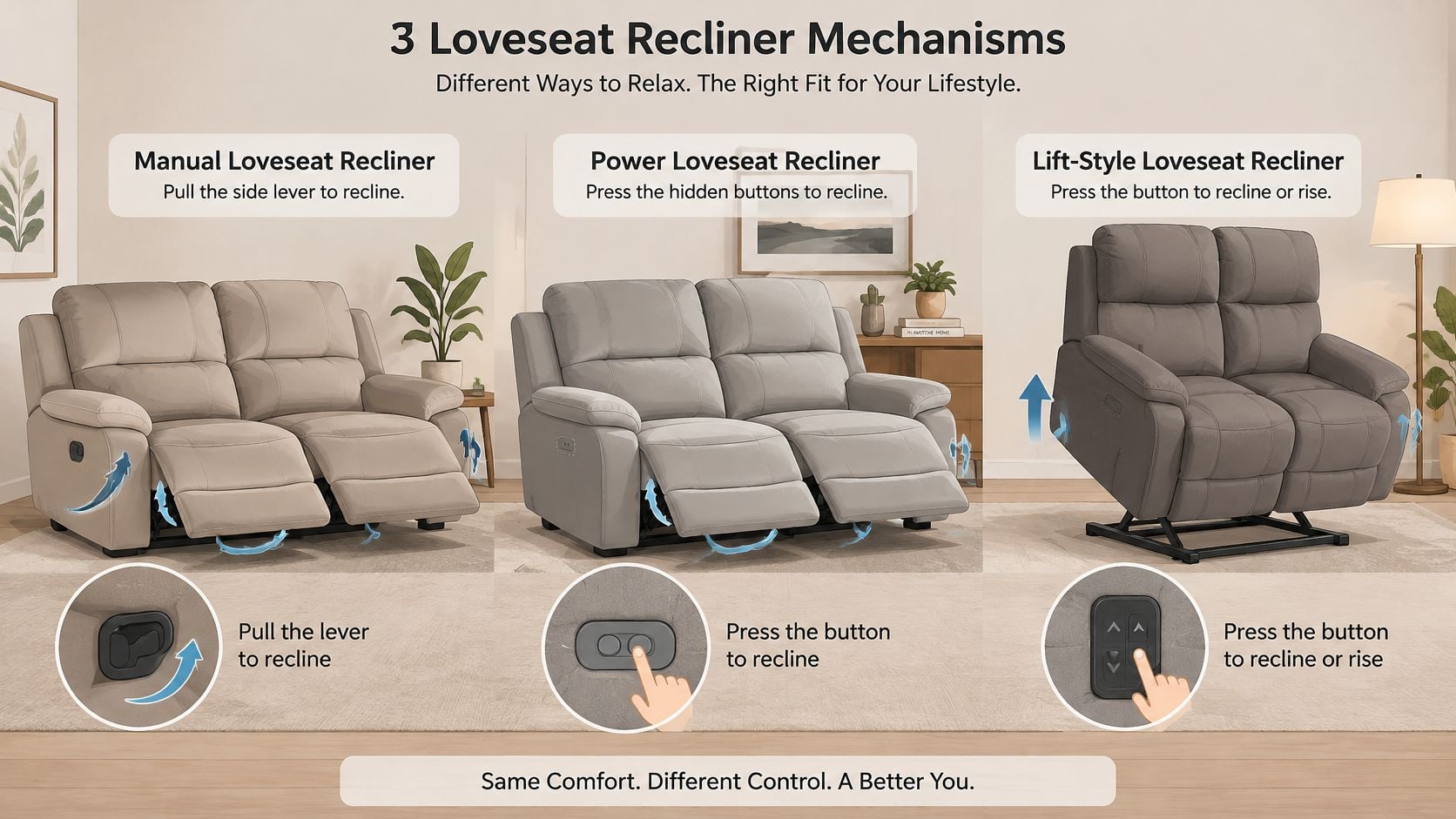
Three mechanisms can look nearly identical on a showroom floor and behave very differently at home. Manual recline runs on the occupant's effort and a release lever. Power recline uses a motor controlled by buttons or a wand. Power lift adds a forward tilting action that helps a sitter move toward standing.
Watching the controls and movement together makes the comparison clearer.
Manual, power, and power lift compared
Mechanism
Best for
How it moves
Standing help
Manual
Budget seats and fewer parts to service
Lever or handle on that side
The sitter supplies the push
Power recline
Movie nights and mixed positions
Button or wand, can stop partway
Motor returns the footrest
Power lift
Seniors and difficult standing
Power recline plus a forward lift
Raises and tilts to help the occupant up
Test effort, not just movement
Manual seating has fewer electrical components to service and usually costs less than comparable powered seating. The trade is that the occupant must release, reposition, and close the footrest. Test those actions while sitting fully back in the seat. Standing beside an empty loveseat tells you nothing about the effort involved.
A handle may pull easily while the footrest demands real leg force to close. Check that the mechanism latches without repeated kicks or an awkward forward lean, especially for a sitter whose knees or grip are already weaker.
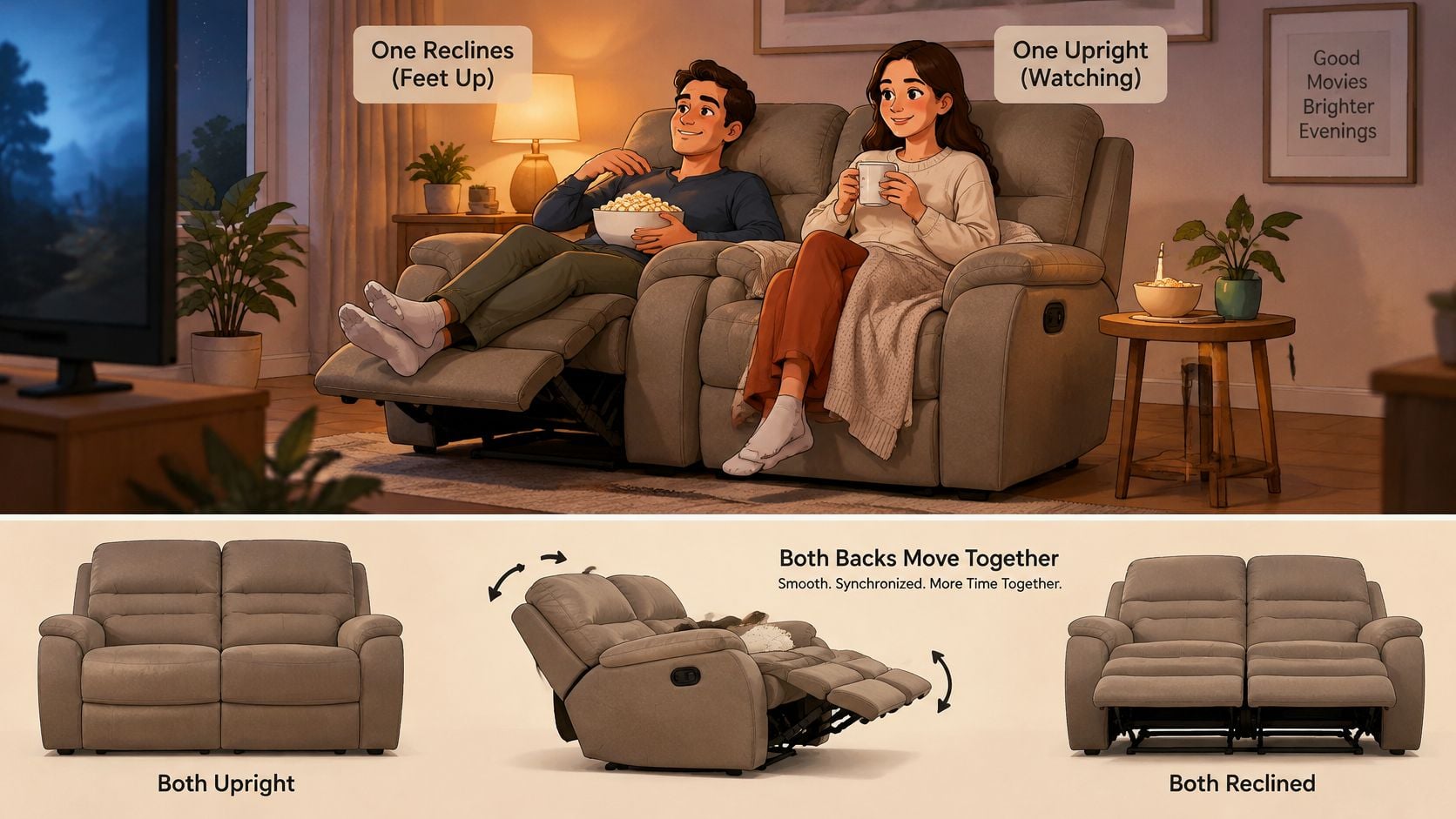
Power recline removes most of that effort and allows stops at intermediate positions. On independently controlled seating, one person stays upright while the other stretches out. The guide to types of power reclining seating explains the distinctions among powered adjustments. While testing, note where the footrest lands at full extension, because that stretch of open floor has to stay clear in daily use.
For extended sitting, a review of sitting biomechanics available through PubMed Central identifies supported backrest angles between 110° and 130° as associated with reduced lumbar-disc pressure and back-muscle activity compared with unsupported upright sitting. Treat that as a fit-testing reference rather than a push toward the deepest possible recline.
The backrest should keep contact with the lower back through its full travel. The footrest should carry the lower legs without pushing the pelvis forward. Adjustable headrests and lumbar zones help only when their range of adjustment matches the person sitting in them.
Lift assistance is a different job
A power lift recliner works like a steady hand under the elbow, raising and tilting the seat to help someone stand. Ordinary power recline does not provide that assistance, and lift recliners do not swivel.
The lift category also sits in its own class at checkout. Power lift recliners are treated differently from ordinary motorized reclining loveseats, so ask the showroom staff how current sales tax rules apply to the specific model you are considering.
BILTRITE carries 48 models of power lift chairs, so a senior or caregiver can compare dedicated assistance against shared seating side by side. Judge a lift chair by the individual's needs. It supports a transfer, and hands-on transfer guidance still matters when a caregiver provides it.
With any powered option, confirm the controls stay reachable without twisting. Listen for uneven movement, try the intermediate stops, and make sure the sitter can tell the buttons apart by touch.
Real Rooms and How Each Loveseat Gets Used
On movie night, one partner may want legs raised while the other sits upright with a snack. Independent controls accommodate that difference. If a shared control moves both occupants together, the arrangement may become frustrating even though both seats feel comfortable on their own.
Now place that loveseat in a narrow apartment. It may be the main seat for reading, visiting, and television, so its usefulness can't depend on moving the coffee table every evening. The guide to recliners for small spaces can help shoppers consider alternatives when shared reclining seating would crowd the room.
A family room has different demands
In a busy family room, daily naps, visitors, and frequent use of the arms change the upholstery decision. Consider a tighter weave or leather with an appropriate protective finish, then check the actual care requirements. Not every leather tolerates the same cleaning products, and fabric appearance alone doesn't establish wear resistance.
Children also change the operating routine. A reclining footrest isn't a climbing platform, and a soft landing spot isn't permission to jump onto a moving seat. Choose seating intended for the household's use, then establish clear rules about its moving parts.
Different-height partners shouldn't automatically move up to a larger loveseat. Greater overall size may deepen both seats without improving either person's support. Separately adjustable headrests or lumbar support can be more useful than extra bulk.
For caregivers, the stand-up test comes first
An older adult's comfort shouldn't be judged only by maximum recline. The ergonomics findings summarized alongside the European circular-furniture report describe better comfort and pressure distribution near a 105-degree backrest angle, while 135 degrees increased slipping and reduced postural security.
Those findings concern a particular older-adult seating context, while broader recline guidance addresses other supported-sitting conditions. Neither establishes a universal setting. The practical distinction is between relaxation while seated and stability during entry and exit.
Use this showroom sequence with the intended occupant:
Sit fully back. Check that the pelvis feels settled rather than perched.
Place both feet securely. Notice whether the seat height permits a stable starting position.
Operate the mechanism. Observe the knees and hips for unwanted shifting.
Return upright and stand. Use appropriate arm support, not the partner or powered footrest.
A caregiver should observe without pulling the occupant through the movement. Any usual mobility aid should be part of the evaluation, and difficulty transferring warrants individual advice from a qualified clinician.
The strongest reason to reject a seat may appear when its occupant tries to leave it.
The best choice handles the hardest recurring task in that room, not the most relaxed moment.
Repair Delivery and Lifetime Cost
A lower purchase price can become poor value if a failed control makes an otherwise usable loveseat impractical to repair. Before choosing upholstery, find out whether the mechanism, electrical components, and cushions can be serviced separately.
The environmental case for repair is substantial: CE Delft's assessment of damaged household furniture calculated that repairing sofa or chair stains had 24–33 times lower climate impact than replacement, while reupholstering damage had 3–4 times lower impact. Those comparisons concern climate impact, not guaranteed savings on a household repair bill.
Ask what happens after a part fails
A useful ownership conversation should establish:
Parts access. Can the motor, control, wiring, or mechanism be replaced without replacing the entire seat?
Warranty responsibilities. Which parts, labor, transport, and service visits are covered?
Upholstery options. Can a damaged panel or cushion be repaired or replaced?
Service access. Can a technician reach the working parts without unnecessarily dismantling the upholstery?
BILTRITE Furniture-Leather-Mattresses offers come apart sofas and sectionals. For a particular reclining loveseat, confirm exactly which components separate and whether disassembly serves delivery, servicing, or both. A removable back doesn't necessarily mean the entire frame divides.
Look for testing behind durability claims
A smooth showroom demonstration isn't a durability test. The U.S. General Services Administration upholstered-furniture test method moves a recliner through closed, television, fully reclined, and closed positions at 20 cycles per minute, with an initial 25,000-cycle stage and inspections every 2,000 cycles.
The EN 13759 reclining-mechanism test standard evaluates occupied and unoccupied operation using a hinged 100-kilogram test dummy. Ask whether the particular mechanism has documented testing, not whether the manufacturer has heard of a standard. Neither method translates directly into a promised household lifespan.
Safety deserves the same specificity. The EN 12520 domestic-seating standard addresses strength, stability, durability, and hazards including pinch points. Keep children and pets away from hinges, console gaps, and moving footrests, and close unoccupied seating according to its instructions.
USA-made and Amish-made craftsmanship can be useful starting interests, but inspect the actual construction and service provisions. The guide to how long furniture should last supports a longer-term comparison: purchase price, maintenance, repair access, and continued usefulness belong in the same decision.
Test It in Our Greenfield Showroom
What can a showroom visit tell you that a photo cannot? You can operate the recliner, see how much room it takes when open, and check whether the seat feels steady when getting in and out.
BILTRITE Furniture-Leather-Mattresses has served Greenfield and Metro Milwaukee since 1928 as a fourth-generation, family-owned showroom. Call 414-238-2020 before visiting to ask which loveseats or recliners are available to try.
Make the trip useful
If a caregiver helps with transfers, have them watch and try the process too. Check whether the controls are easy for the user to reach, and whether the footrest and back move without creating a difficult path in or out. A comfortable seat still needs to work for the people who will use and assist with it.
BILTRITE offers small-scale and heavy-duty furniture, as well as USA-made and Amish-made pieces. Ask which options include the reclining features you need; those categories do not automatically describe a particular mechanism. If you are comparing prices, BILTRITE refunds 110% of the difference when a lower price is found within 30 days after purchase.
A useful visit can end with a clear reason to rule out a model, even if you do not buy that day. BILTRITE offers loveseats, recliners, and lift chairs among its living-room furniture.