Extendable Dining Set Buying Guide


A weekday breakfast for three can turn into a Saturday dinner for eight before the grocery list is even finished. A fixed table may feel oversized every morning, while a small table can leave guests balancing plates when the whole family arrives. An extendable dining set solves that tension only when it remains comfortable, stable, and attractive in both positions.
The important question isn't whether a table opens. It's whether the closed table works for daily life, the expanded table supports real guests, and the chairs, finish, room layout, and hardware continue to make sense after repeated use. BILTRITE Furniture has helped Metro Milwaukee families make practical furniture choices since 1928, with USA-made, Amish-made, solid-wood, in-stock, and custom options worth examining in person.
What an Extendable Dining Set Needs to Do
A useful extendable dining set performs two jobs without feeling like two unrelated pieces of furniture. In the closed position, it should provide a steady surface for breakfast, homework, crafts, and ordinary dinners. In the open position, it should give every guest enough table space, legroom, and chair clearance to enjoy a meal without crowding the person beside them.
That sounds simple, but daily comfort depends on several moving parts. The top needs to stay level when closed, the extension should open without a struggle, and the added leaf should align cleanly with the original surface. The base must support the expanded span, while the finish needs to tolerate the familiar evidence of family life, including spills, chair movement, and occasional dropped utensils.
A family living in a compact dining area may keep the table closed most of the week, then open it for a birthday dinner. A household with a dedicated dining room may expand it more often, perhaps for weekend meals or holiday gatherings. Those homes need different proportions and mechanisms, even though both buyers are searching for an extendable dining set.
The everyday position matters most
The table's closed footprint controls how the room feels during the majority of meals. It should leave a clear path to the kitchen, allow chairs to pull out, and avoid making the room feel like a storage area for a larger table that rarely gets used.
The open footprint deserves the same attention. A table that technically fits when expanded may still block a doorway, pinch a walkway, or leave end chairs pressed against a wall. A practical starting point is the guide to picking a dining table, followed by measurements taken in both table positions.
A five-part performance test
Before comparing finishes or chair styles, shoppers can ask whether the table handles these responsibilities:
- Daily stability: Does the closed surface feel solid when someone writes, serves, or leans lightly against it?
- Repeatable movement: Can the table open and close smoothly without scraping, sticking, or requiring unusual force?
- Balanced seating: Do guests receive comparable elbow room and leg clearance in the expanded position?
- Family-friendly finish: Can the surface handle normal dining activity with sensible care?
- Room-friendly proportions: Does the set preserve circulation when it's closed and when it's fully opened?
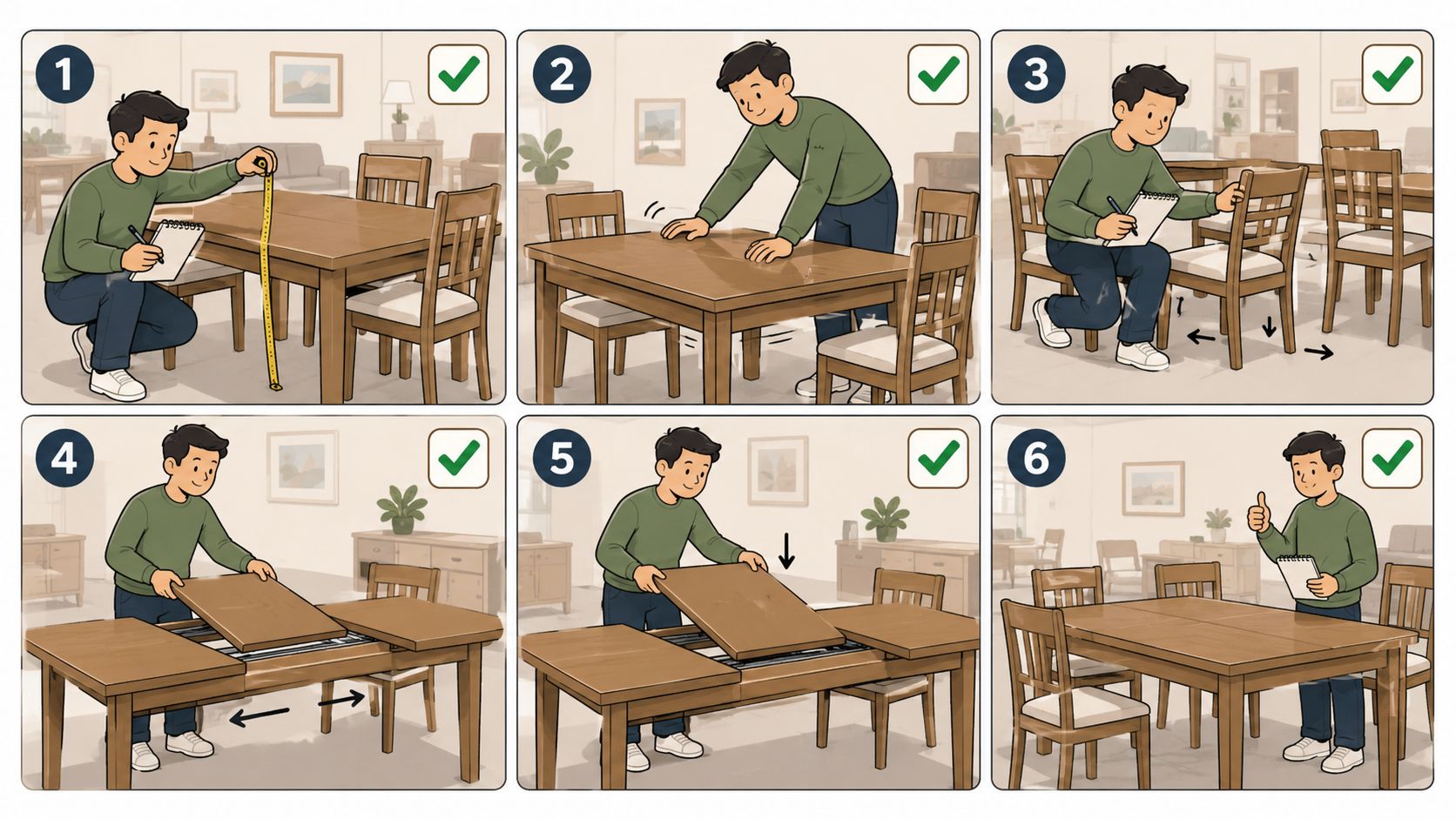
A good showroom test involves more than admiring the tabletop. Someone should open the table, insert or release the leaf, sit in the chairs, and walk around the complete arrangement. That small exercise reveals whether flexibility will feel convenient or become a chore.
Understanding Extension Mechanisms
Extension mechanisms make more sense when a table is treated like an expanding bridge. The two ends move apart, a stored or separate section fills the gap, and hardware underneath brings the surfaces back into alignment. The mechanism should feel controlled rather than loose, with support carrying the weight across the expanded span.
Center leaves and sliding systems
A common arrangement begins with a tabletop split near the center. The two halves slide apart on tracks or wooden runners, creating space for a leaf. The leaf is then placed between the halves, and alignment pins, latches, or locks help pull the surfaces flush.
Some leaves store inside the table. Others remain separate and need a closet, basement, or another protected storage area. Separate leaves can offer longer expansion, but they also demand more storage space and may require a second person during setup. The solid-wood table with a leaf guide helps shoppers focus on fit, construction, and the practical work involved.
Butterfly leaves and built-in storage
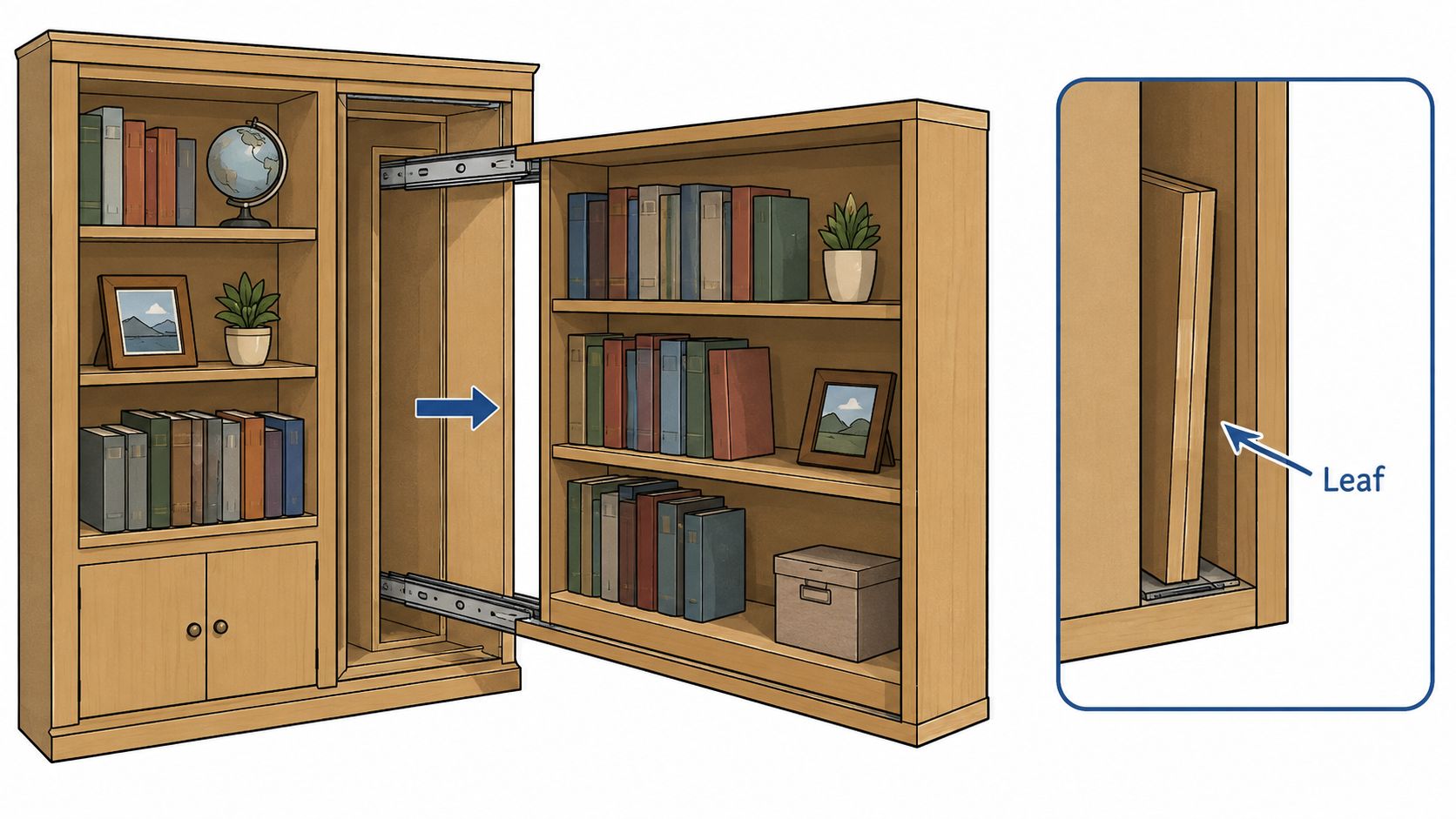
A butterfly leaf folds in half beneath the tabletop. When the table ends move apart, the folded section rises, unfolds, and locks into place between them. This design stores the extension inside the table, so the household doesn't need to find a separate leaf before guests arrive. The butterfly leaf explanation shows why built-in storage is a major mechanical distinction.
The key inspection point is the fold and lock. The leaf should unfold evenly, sit level with the tabletop, and remain secure after the table is closed again.
Other familiar formats
A drop-leaf table uses hinged sides that lower when compact and rise when more surface is needed. It can work well in a breakfast nook, though the supporting structure and chair placement deserve careful attention.
Gate-leg designs swing or slide supporting legs into position beneath the extended sections. Refectory-style tables typically pull apart along their length, with leaves added between the sections. Each format can work, but the right choice depends on storage, frequency of use, room clearance, and how much effort the household accepts on hosting days.
Practical rule: A self-storing leaf saves space and setup time, but buyers should still operate the table several times before choosing it.
Matching Table Shape to Your Space
Table shape changes the way people move, talk, serve food, and occupy chairs. A rectangular extendable dining set usually keeps a clear directional flow, while a round or oval design softens circulation and changes how guests face one another.
A rectangular table often feels natural in a long dining room or open-plan space beside a serving cabinet. In its closed state, it can serve a smaller household, then accept a linear leaf that adds seating along the long sides. The corners can accommodate end chairs, but armchairs need enough surrounding clearance to avoid interrupting traffic.
Round pedestal tables create a different experience. When extended, they commonly become oval, removing the sharp corners that can make tight rooms feel crowded. The pedestal also reduces the problem of chair legs meeting table legs, although the expanded perimeter may not provide identical seating at every position.
An oval table combines the softer ends of a round design with the directional capacity of a rectangle. It can improve movement through a room, but the curved footprint may require more floor area than shoppers expect. Rugs, door swings, and paths to nearby rooms should be checked with the full outline marked on the floor.
| Shape | Closed Seating | Open Seating | Best Room Type | Main Trade-off |
|---|---|---|---|---|
| Rectangular | Two to four, depending on size | Adds seats along a straight span | Long rooms and buffet-friendly layouts | Corners can crowd armchairs |
| Round | Compact everyday group | Opens toward an oval arrangement | Square rooms and conversational layouts | Capacity changes around the expanded perimeter |
| Oval | Flexible small-group seating | Larger group with softer ends | Rooms needing gentler circulation | Needs careful clearance around the curved footprint |
The table shapes and seating arrangements guide can help households compare flow before choosing a style. A host who walks from the kitchen along one side of the table should test that route with chairs pulled out, not only with the table pushed neatly beneath a chandelier.
Planning Size and Seating Capacity
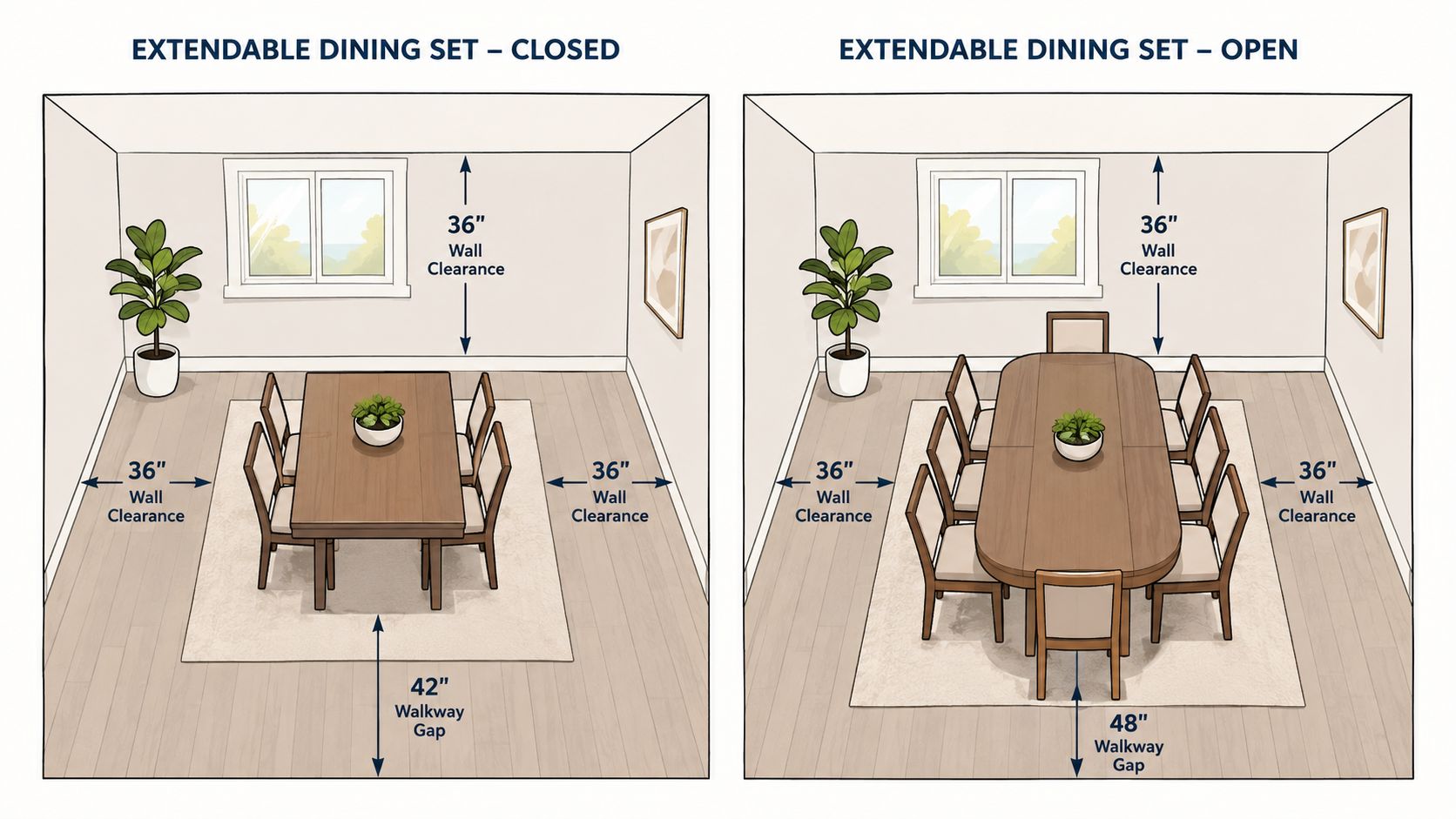
A dining set can fit neatly beside a wall on an ordinary weeknight, then crowd the same walkway when guests arrive. Plan around both positions. The fully opened table determines whether a cabinet remains accessible, whether an end chair clears the wall, and whether people can reach the kitchen without turning sideways.
Start with the room, then test the furniture in stages:
- Measure the room footprint. Record walls, doorways, nearby furniture, vents, and radiators.
- Trace traffic lanes. Follow the paths between the kitchen, hallway, living room, and exterior door.
- Mark the closed set. Include the tabletop, base, and chairs pulled out for sitting.
- Mark the open set. Add every intended leaf and repeat the chair check.
- Test the largest gathering. Check end chairs, armchairs, and serving routes while the table is fully extended.
A general sizing guide recommends at least 36 inches between the table edge and walls or doorways for comfortable movement and chair access. It places tables around 72 to 96 inches in a typical range for 6 to 8 people, while tables around 96 to 120 inches can accommodate 8 to 10 or more, depending on chair width and arrangement. Use the dining table size guide as a starting point, then test the actual BILTRITE set in your room. An in-stock option may simplify the decision when its closed and open measurements suit your space. A custom table can better match an unusual room, chair style, or preferred gathering size, but its dimensions still need the same floor test.
Turning length into usable seats
A rectangular table commonly allows about 24 inches of table edge per person, although broad chairs and armrests reduce usable capacity. Oval tables can make good use of curved ends. Round tables may offer less consistent seating after an extension leaf changes the original perimeter.
Chair clearance deserves equal attention. Armchairs need more room at the ends than narrow side chairs. A bench can add places along one side, while changing how guests enter and leave. Hardware should also open the table without forcing chairs into a narrow passage. A set that seats a stated number on paper may feel cramped if diners cannot pull out their chairs comfortably.
Room test: Mark the closed and open outlines with painter's tape, then place temporary chairs around both. The floor plan often exposes a clearance problem before delivery day.
Choosing Construction That Stays Stable
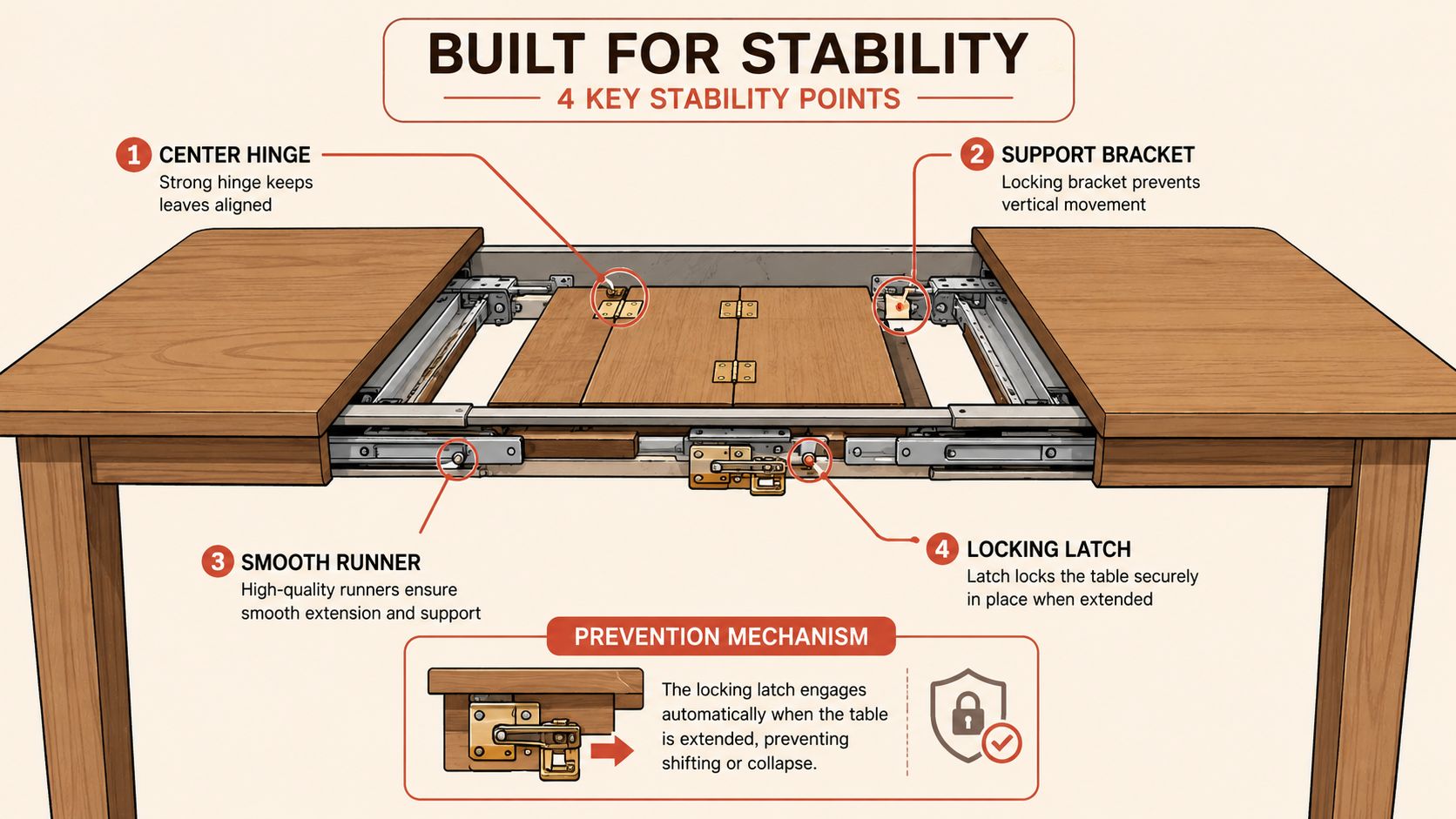
An extendable table contains more points that can loosen or misalign than a fixed table. Independent guidance identifies concerns such as center sag, leaf misalignment, loose tracks, weak locks, and uneven support, making long-term construction more important than a dramatic first opening. The comparison of extendable and fixed dining tables treats durability as a central buying question rather than a side note.
Four areas deserve close inspection
Extension hardware carries repeated movement. Metal center tracks generally offer greater durability than plastic tracks, while solid wood paired with a tight mechanism can help reduce wobble over time. A shopper should open the table slowly, listen for scraping, and check whether both sides move evenly.
Locks and alignment pins keep the added leaf flush with the original top. Loose latches can create a ridge or gap that catches crumbs and catches sleeves. The hardware should engage positively, without forcing the tabletop into position.
Center support becomes especially important after the table opens. A fitted center leg or strong supporting beam should carry weight at the expanded seam. If the design leaves the center span unsupported, even a well-made top may feel less secure when guests lean or serve from it.
Wood movement can change gaps and surface alignment. Low-density composite tops, including particle board, are more vulnerable to temperature-related expansion and contraction, which can increase hardware wear and shorten service life. Solid wood still needs thoughtful construction and care, but it offers a more substantial foundation.
BILTRITE's Amish-made solid-wood choices reflect a preference for furniture built for repeated household use, not just one impressive showroom demonstration. Buyers can ask whether the frame uses durable joinery, how the center support works, and what maintenance the finish requires. Those questions matter whether a table comes from an in-stock collection or a custom order.
Coordinating Chairs Finishes and Options
A dining set looks settled when the table and chairs share a visual language. That doesn't require every piece to be identical. Wood species, stain warmth, upholstery texture, hardware, and chair scale should relate closely enough that the room feels intentional.
A natural wood tabletop can pair with painted chairs for contrast, especially when the paint echoes another room detail. Matching wood species and finish creates a more traditional appearance, while leather or fabric upholstery can add softness to a substantial solid-wood table. Wood seats are easier to maintain visually, but upholstered seats may provide greater comfort during longer meals.
Seat height and back support should be tested in person. A chair can look attractive beside a table yet place knees too high, press against the apron, or prevent the chair from sliding fully underneath. The problem becomes more noticeable when the table is expanded and the available circulation narrows. The dining chair selection guide offers a useful starting point for comparing proportion and comfort.
In-stock or custom
BILTRITE's in-stock extendable dining sets suit households that want to see the actual pieces, confirm proportions, and take advantage of quicker availability. The selection may offer fewer choices in leaf count, wood, edge profile, or chair design, but the trade-off is a shorter path from decision to delivery.
Custom furniture gives the household more control. Buyers can specify table size, leaf count, wood, finish, edge profile, chair style, and coordinating details for an existing room or a particular family need. Custom work generally requires more planning and patience, but it can resolve awkward dimensions or match furniture already in the home.
| Decision Area | In-Stock Set | Custom Set |
|---|---|---|
| Availability | Usually available sooner | Requires production time |
| Sizing | Uses existing collection dimensions | Can be specified for the room |
| Finish | Limited displayed choices | Choice of wood and finish |
| Extension | Existing leaf configuration | Leaf count can be discussed |
| Chairs | Coordinated collection options | Chair style and upholstery can be selected |
| Budget planning | Easier to evaluate immediately | Depends on selected specifications |
The right choice depends on whether speed, certainty, and visible value matter more than exact customization. BILTRITE offers both paths, with associates available to explain the practical difference without pressuring shoppers.
Comparing Real-Life Dining Set Scenarios
Different homes need different forms of flexibility. The table below shows how shape, mechanism, seating, wood, and availability can work together.
| Household Profile | Table Shape & Mechanism | Seating Closed / Open | Wood & Finish | Best BILTRITE Option |
|---|---|---|---|---|
| Young couple in a compact condo | Round-to-oval table with a self-storing butterfly leaf | Two to four / Four to six | Solid wood with a light, durable finish | In-stock set for easier room testing and quicker availability |
| Family of five with a dining room | Rectangular table with two leaves and a sliding mechanism | Five / Eight or more | Solid hardwood with a warm stain | In-stock collection if the displayed dimensions fit, custom if chair and leaf needs differ |
| Multigenerational household | Extra-long rectangular custom table with a robust extension system | Six / Eight | Solid wood coordinated with existing living room furniture | Custom order for exact length, eight chairs, finish, and support details |
The condo couple values convenience. A self-storing leaf removes the need for separate storage, while the rounded open shape helps preserve movement around a compact room.
The family of five needs a table that works every night, not only during holidays. Two leaves add flexibility, but the set must still leave comfortable space for everyday chairs, armchairs, or a bench when the table is closed.
The multigenerational household has a different priority. Exact length, supportive seating, and a finish that relates to existing furniture may outweigh quick availability. A custom design can address those requirements more directly.
Each scenario balances convenience against flexibility. The best match comes from identifying how often the table expands, where the extra leaves live, and which seating positions family members use most.
Your BILTRITE Showroom Checklist
Preparation makes a showroom visit more useful. Before leaving home, the shopper should measure the dining room, nearby doorways, hallways, and the route from the delivery entrance to the final location. A photograph of the room, a rough floor plan, and the table's closed and open measurements can help the sales associate understand the full situation.
The household should also write down its normal and maximum diner counts. A family that usually eats together but hosts larger gatherings occasionally may need a different balance than a couple who entertains every weekend. Priorities should be ranked in plain language, such as daily comfort, hosting space, easy leaf storage, matching wood, fast availability, or custom sizing.
The in-store test
At BILTRITE's Greenfield showroom, shoppers can:
- Operate the table: Open and close each candidate instead of relying on appearance.
- Inspect storage: Confirm where the leaf lives and whether it can be handled comfortably.
- Sit in every chair: Check back support, seat height, arm clearance, and legroom.
- Test the expanded position: Look for center support, level seams, and chair clearance.
- Study finishes: Compare samples and surfaces under showroom lighting, then ask how they may appear in the home.
- Discuss timing: Ask about availability for in-stock furniture and expected lead times for custom work.
Questions worth asking: What does the warranty cover? How is delivery handled? What hardwood sourcing information is available? Which care products and habits protect the finish? How should the mechanism be maintained over time?
Solid wood benefits from simple care. Independent guidance recommends cleaning with a soft damp cloth, drying afterward, avoiding harsh chemical cleaners, and using coasters, placemats, or trivets to help prevent water rings and heat marks. The solid-wood dining table care guidance gives shoppers a practical maintenance reference.
BILTRITE's sales associates bring over 400 years of combined experience, and their role is to help families compare comfort, construction, and fit. The store carries small-scale furniture for apartments and condos, heavier-duty choices for demanding households, USA-made and Amish-made pieces, custom options, and a mattress department with over 60 models. The showroom is closed on Sundays so the family-owned business can protect family time, a value that remains part of its Metro Milwaukee identity.
BILTRITE Furniture-Leather-Mattresses offers in-stock and custom dining furniture, including USA-made, Amish-made, and solid-wood choices for everyday meals and larger gatherings. Visit BILTRITE Furniture-Leather-Mattresses in Greenfield with room measurements and seating needs, and let the showroom team help evaluate an extendable dining set in both closed and open positions.