Navy Storage Ottoman Guide: Sizes, Uses and Care


The blankets are piled on the sofa, the board games need a home, and someone always needs somewhere to put their feet. A navy storage ottoman can handle all of that without adding another large piece of furniture. The smart purchase isn't just the nicest shade of blue, though. It's the ottoman that fits the room, supports its intended users, and opens without a wrestling match.
Table of Contents
- Navy Storage Ottoman Sizes and How Much They Hold
- Navy Fabric and Frame Choices That Last
- Seating, Footrest and Lid Safety Checks
- Pairing Navy With Wood, Metals and Small Furniture
- Cleaning and Caring for a Navy Ottoman
- Confirm Your Size and Visit Our Greenfield Showroom
Navy Storage Ottoman Sizes and How Much They Hold
In a 12 x 14 ft living room with a sofa and one armchair, a medium ottoman around 17 inches high and 24 inches across can serve as a footrest without taking over the floor. Check the available space and how you'll use it before settling on a shape. A compact round model can suit a bedroom corner, while a longer bench may fit at an entryway or the foot of a bed.
Measure the space before choosing the shape. Round sides can help keep a narrow walkway clear. A square has a simple footprint beside a sofa, while a bench needs enough uninterrupted floor space to stay out of the traffic path.
Navy Ottoman Sizes and Approximate Storage
The dimensions below are examples for comparing shapes, not specifications for BILTRITE inventory or guaranteed usable capacities. The outside-volume figures are rough estimates based on those example dimensions. Seating comfort and capacity depend on the individual piece's construction and manufacturer rating.
| Size | Typical dimensions (H x W x D) | Approx. storage (outside volume) | Seating | Good fit |
|---|---|---|---|---|
| Small round | 16 x 18 x 18 in | About 2 cu ft | One adult, occasional | Studio, bedroom corner |
| Medium round | 17 x 24 x 24 in | About 3 to 4 cu ft | One adult, comfortable | Living room, reading nook |
| Square cube | 17 x 24 x 24 in | About 4 to 5 cu ft | One adult, footrest | Family room, under a window |
| Bench-length | 16 to 18 x 36 to 48 x 16 to 18 in | About 5 to 6 cu ft, depending on dimensions | Two people, short sits, if rated | Entryway, foot of the bed |
Outside volume is not storage capacity. Cushioning, the lid frame, hinges, interior walls, and storage floor all take up room. Ask for interior measurements; a familiar-looking shape can hold less than expected.
Measure what you plan to store, too. If blankets and board games need a home, check the largest game box against the compartment opening. For a bench meant for shoes and pillows, compare both the opening and the interior dimensions. A roomy compartment won't help if a rigid box can't fit through the top.
Practical rule: Measure the belongings that need a home, not just the floor space available for furniture.
Check the delivery route before you buy. Leave enough clearance for the lid to open fully, and measure doorways, stair turns, and the path into the room. BILTRITE's guide to measuring furniture helps organize those checks. Bring a tape measure to the showroom and compare ottoman height with the sofa.
Navy Fabric and Frame Choices That Last
A navy ottoman in a family room may serve as a footrest every evening, a spare seat when company visits, and a home for blankets between uses. Choose its fabric and frame for that daily wear. Pale lint and pet hair can show against navy, while rubbing and sunlight can change a fabric's appearance. Choose upholstery for your household first, then compare navy samples.
Navy Fabric Types Compared for Daily Use
| Fabric | Strengths | Watch for | Best for |
|---|---|---|---|
| Performance woven | Texture can disguise dust, and some constructions resist rubbing | Dye transfer is possible; ask for test results | Family rooms with daily use |
| Velvet or crushed velvet | Rich color and a noticeable surface texture | Pressure marks and changes in nap | Adults-only or formal spaces |
| Top-grain leather | Wipeable surface that develops an aged appearance | Scratches, fading, and finish-specific care | Busy households that appreciate patina |
| Textured linen blend | Soft look and lighter visual weight | Visible lint and uneven color change | Small rooms that need softness |
| Microfiber | Spot cleaning may be practical when the care label allows it | Friction-related pilling | Homes with pets and kids |
Fabric categories are a starting point, not a guarantee. Check the sample's construction and care instructions, and ask for documented test results before relying on a performance label.
Ask for the Test Method
For general contract use, commercial upholstery benchmarks cite 15,000 Wyzenbeek double rubs or 20,000 Martindale cycles; heavy-duty use benchmarks cite 30,000 double rubs or 40,000 cycles, as outlined in BILTRITE's fabric durability ratings guide. These figures help screen fabrics, but they do not predict a specific ottoman's lifespan. Compare results only within the same test method. For an ottoman used daily, favor documented heavy-duty abrasion performance when it fits your budget.
Ask about crocking, the transfer of dye through rubbing, and whether testing follows ISO 105-X12. For a spot near a window, request lightfastness information under ISO 105-B02. These details matter because navy can look uneven if rubbing or sunlight affects the color.
Check the frame alongside the upholstery. Ask what supports the lid, how the storage floor is attached, and how any solid wood was dried and prepared. Wood exchanges moisture with the air, so conditioning and construction affect dimensional stability. A sturdy-looking exterior alone won't answer those questions.
View fabric samples in daylight and lamplight. Navy that reads as soft blue by a showroom window may look nearly black under warm evening lighting, so check it in the kind of light your room gets.
Seating, Footrest and Lid Safety Checks
A navy storage ottoman may be a seat during a visit, a footrest on an ordinary evening, and a container between uses. Check each job separately before you buy. The lid, foam, and base all affect how well it handles daily use.
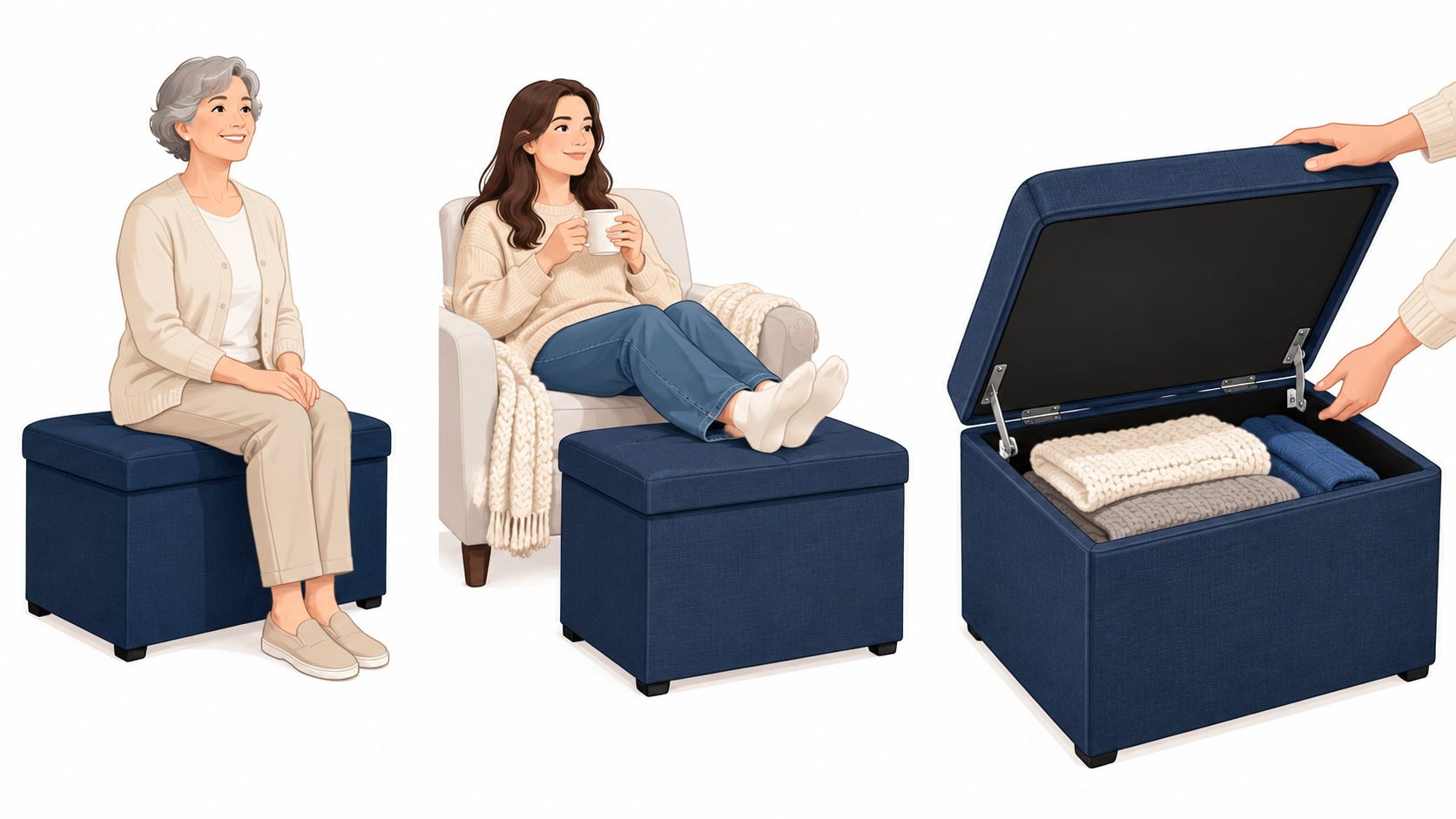
For seating, sit on the ottoman and check for steady support, excessive sinking, or lid movement. For footrest use, compare its height with your sofa or chair. A tray and coasters can make a stable lid useful for light coffee-table duty, but skip heavy stacks and check that the lid is intended for that use.
What the Foam Numbers Mean
Density, hardness, and compression set describe separate foam properties. One firm upholstery foam specification lists 37–41 kg/m³ density, 170–230 N nominal hardness, and 8% dry compression set in its technical foam data. Use those figures to understand the terms, not as a promise about how a particular ottoman will feel.
Density helps describe the foam material, while hardness relates to how it responds to pressure. Compression set measures lasting height loss after loading; a lower result means less residual compression under equivalent testing conditions. Ask for the density and test method, and compare figures only when the methods and conditioning temperatures match.
Foam cannot make up for a weak lid frame. Check the complete assembly, and ask what “heavy duty” means for that specific ottoman.
Run the Lid Check Before Taking It Home
- Controlled opening: Does the lid open smoothly and stay at a controlled angle, or can it drop shut?
- Partial-open stability: Does it remain steady while you retrieve belongings?
- Finger protection: Are hinge pinch points shielded or otherwise addressed?
- Manageable effort: Can the intended user open and close it comfortably? A heavy lid does not by itself provide safe support.
- Rated seating: Does the manufacturer expressly approve seating and give a suitable load rating?
- Floor grip: Does the base slide on hardwood or tile? Add compatible nonslip protection if needed.
Ask a showroom associate to demonstrate the hinge during normal operation. Keep fingers clear of moving hardware, and confirm the lid stays steady while open.
An ottoman should never become an improvised grab bar or a substitute for a supportive chair.
If children use the room, check the pinch points and keep the lid closed when the storage compartment is not in use. Older adults and anyone with limited grip need a lid they can operate comfortably and a stable place to sit. A general checklist cannot establish whether a specific ottoman is suitable for unsupervised children or medically vulnerable users.
For a piece expected to serve several roles, use our multipurpose furniture guidance to weigh everyday function alongside storage.
Pairing Navy With Wood, Metals and Small Furniture
A navy storage ottoman can anchor a room while serving as a seat, footrest, and place to stash everyday items. Judge it by undertone, texture, and lighting, then choose surrounding furniture that keeps the room balanced.
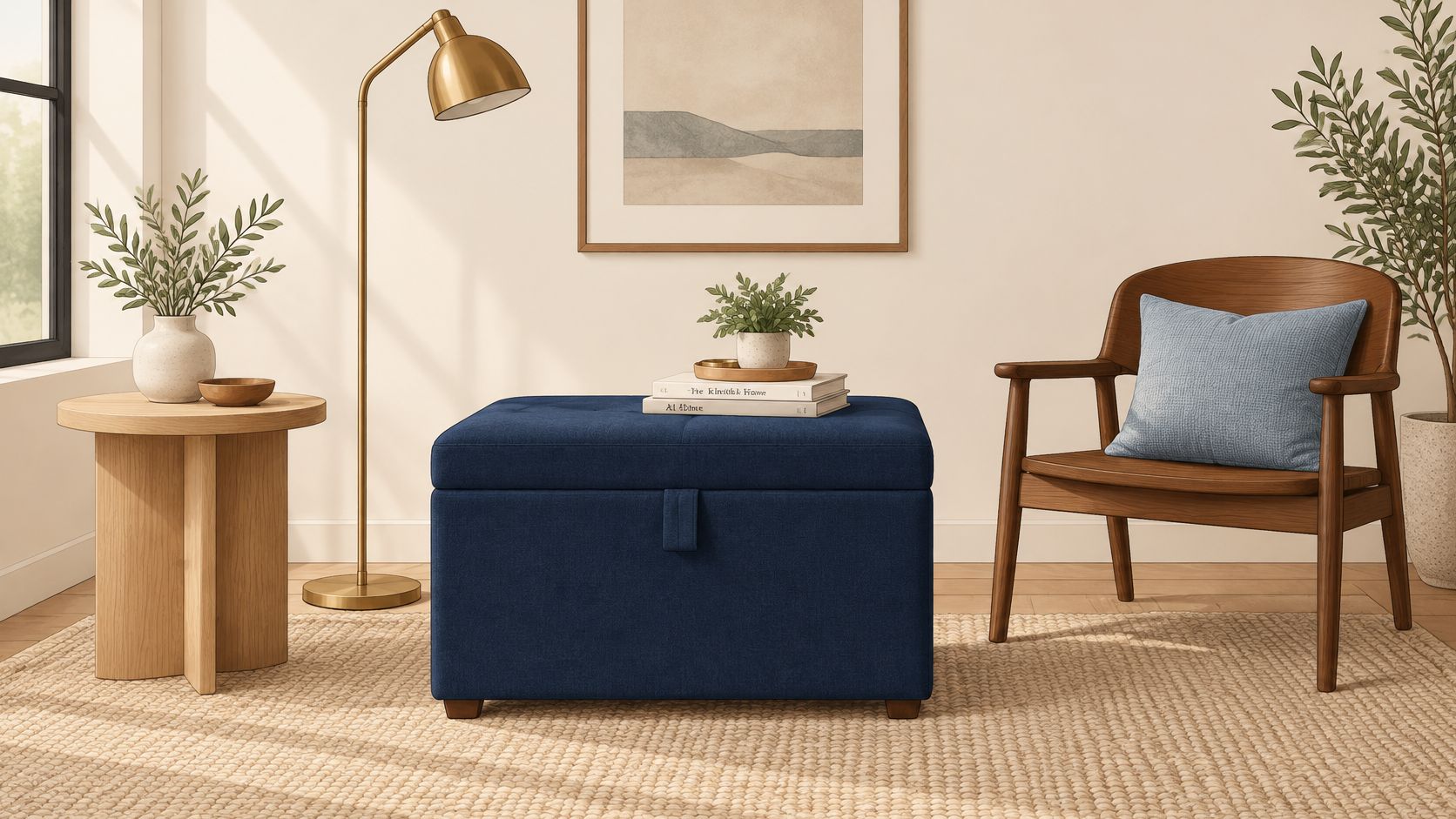
A nearly black, smooth navy reads formal and visually weighty. A softer blue or textured weave feels gentler. Check the fabric beside your wood and upholstery samples in the room's light before deciding.
Accent Pairings That Work With a Navy Ottoman
| Accent | Effect with navy | Pairs well with |
|---|---|---|
| Warm wood, such as oak or walnut | Classic and grounded | Solid wood side table, coffee table |
| Camel or tan leather | Relaxed and traditional | Camel sofa, leather armchair |
| Terracotta or rust pillows | Warm contrast | Cream rug, woven throw |
| Brass or gold hardware | Polished and layered | Table lamp, mirror frame |
| Light or dusty blue | Softer and more current | Pale walls, gray sofa |
| White or cream walls | Crisp and bright | White curtains, light oak floor |
For a studio apartment, let the ottoman provide the main dark accent. Pair it with a warm wood side table and a rust pillow to connect the colors without crowding the room with more dark, bulky pieces.
In apartments, condos, and senior-living spaces, choose small-scale furniture with slim legs or restrained profiles. Keep a clear walking route, especially around an ottoman that people will use throughout the day.
A removable tray adds a wood accent and gives the lid a surface for serving or setting down items, provided the ottoman is suitable for that use. See BILTRITE's guide to choosing a large wood tray for an ottoman for practical selection tips.
Bring a room photo and fabric or wood samples to the showroom. Ask whether you can assess a sample at home. The room's actual light can change how navy looks, so check the color where the ottoman will sit.
Cleaning and Caring for a Navy Ottoman
Follow the care label before following any cleaning shortcut. Navy upholstery needs routine maintenance, but an unsuitable cleaner or aggressive scrubbing can create a more noticeable problem than the original spill.
A useful routine starts gently and keeps moisture controlled.
A Practical Care Routine
- Vacuum weekly: Use an upholstery attachment and crevice tool on the fabric and accessible storage edges to remove grit.
- Lift lint carefully: Use a suitable lint roller as needed. Use a fabric shaver only if the upholstery manufacturer permits it.
- Check the cleaning code: W generally indicates water-based cleaning, S solvent cleaning, WS either, and X vacuuming only. Follow the complete manufacturer instructions.
- Test first: Apply only an approved cleaner to a hidden area before treating a visible mark.
- Blot spills: Work gently from the outside inward rather than rubbing the affected area.
- Dry completely: Allow the upholstery to air dry before use or closing damp items inside. Restore the nap only as directed.
- Manage exposure: Use blinds or change placement where needed, and rotate the ottoman when practical to distribute exposure.
The care label takes priority over that routine. For more guidance on matching treatment to upholstery, consult BILTRITE's upholstery cleaning tips.
Navy Ottoman Problems, Causes and Fixes
| Problem | Likely cause | Fix |
|---|---|---|
| Lint and pilling | Loose fibers and friction from daily sitting | Lift lint gently; use a permitted shaver only, following routine step 2 |
| Pet hair | Fine hairs caught in the surface | Use an upholstery brush or test a clean rubber glove gently, following step 1 |
| Dye transfer on light clothing | Color released during rubbing or contact | Stop the contact and ask the retailer about colorfastness; don't assume the dye will settle |
| Fading | Repeated light exposure | Reduce exposure with blinds or relocation, following step 7 |
| Water spot | Uneven wetting or residue | Follow the approved cleaning method; dry fully as in step 6 |
Care shortcut to skip: More cleaner and harder rubbing aren't better treatment.
Leather needs a separate approach. Dust regularly, and use a lightly damp cloth or leather-safe conditioner only when the finish manufacturer recommends it. The Greenfield team can help identify an appropriate care approach for the selected covering before the ottoman goes home.
Confirm Your Size and Visit Our Greenfield Showroom
A navy storage ottoman earns its place when it fits the room and works smoothly as a seat, footrest, and container. Bring your measurements to the Greenfield showroom, then test the upholstery, cushioning, and lid with the same everyday use in mind.
Bring the Details That Make Shopping Easier
- Room measurements: Note the intended footprint and measure the delivery route.
- A tape measure: Check the actual piece instead of relying on memory.
- Room photos: Include the sofa, walking paths, and nearby windows.
- Material samples: Bring upholstery, wood finishes, or colors you want to coordinate.
- Storage requirements: Measure awkward items, such as game boxes, before choosing a container.
Ask where the ottoman was assembled and what materials it uses. The Federal Trade Commission's Made in USA standard says an unqualified U.S.-origin claim requires all or virtually all domestic content, final assembly and significant processing in the United States, and reliable supporting evidence. Check the specific product's details rather than relying on a brand name.
Local Guidance Without the Pressure
Our family-owned business has served Metro Milwaukee since 1928, with a focus on American-made, Amish-made, and solid-wood furniture. We aim to offer affordable, better-quality furnishings, not just the lowest ticket price.
The showroom carries small-scale furniture, heavy-duty options, and a mattress department. Ask an associate to compare ottoman construction, fabric test information, cushion support, and lid operation. Open and close the lid yourself, and check whether it stays controlled during use. For navy upholstery, inspect how the fabric handles lint and ask about light exposure and care requirements.
Visit 5430 West Layton Avenue in Greenfield to compare pieces in person. The showroom is closed Sunday and Monday. Ask about current storage-ottoman availability and navy upholstery options, since not every ottoman on display or in a photo includes concealed storage.
Bring room measurements and fabric samples to BILTRITE Furniture-Leather-Mattresses for a no-pressure chance to test comfort, inspect lid operation, and ask questions in person.