Hybrid Mattress Benefits Worth Knowing Before You Buy


A couple can share a bedroom, a budget, and even a blanket, yet still disagree about the mattress. One sleeper wants the soft, hugging feel of foam. The other wants the lift and easy movement of coils. Add a warm bedroom, a sensitive shoulder, or a partner who gets up at night, and choosing a bed can feel like negotiating a tiny peace treaty.
That's where hybrid mattress benefits become useful. A hybrid isn't automatically the right answer for every sleeper, but its combination of foam comfort and coil support can solve a very common problem: wanting pressure relief without feeling trapped, and support without sleeping on a hard, flat surface. The best choice depends on body type, sleep position, temperature preference, and how much movement partners share.
A Bedtime Problem Hybrids Were Built to Solve
Choosing the right mattress often comes down to one problem: partners want different things. Jordan sleeps comfortably on plush foam, yet the deep sink makes turning over harder and leaves the lower back feeling unsupported by morning. Casey prefers an innerspring's bounce and airflow, but years of use can make the comfort surface feel too firm.
Their preferences point to a real design tradeoff. Foam cushions pressure-sensitive areas such as shoulders and hips. Coils provide lift, easier movement, and a more open support structure. A mattress built around only one material may leave one partner giving up the feel that helps them sleep.
A hybrid mattress offers a middle path. Its coil support core sits beneath comfort layers made from foam, latex, or gel-based materials. For a side sleeper with broader shoulders, the upper layers can soften pressure as the body settles. For a combination sleeper who changes positions, the coils can make pushing off and turning feel less effortful. Partners also gain two different kinds of support in one surface, although the exact balance depends on the model.
A useful starting point: choose a mattress to address a specific sleep complaint, not just have a popular label.
“Hybrid” describes construction, not one universal firmness level. One model may feel gently cushioned, while another feels more buoyant. A lighter sleeper may barely compress the comfort layers, while a heavier sleeper may reach the coils more quickly and experience firmer support.
The practical question is who needs what. Couples who disagree about softness, sleepers who want pressure relief without feeling stuck, and people who prefer a responsive surface may find a hybrid worth testing. Others may prefer a different design. At a fourth-generation Milwaukee showroom, BILTRITE can help match the feel to each sleeper, explain value bundles, and offer care guidance for protecting the mattress over time.
What a Hybrid Mattress Is
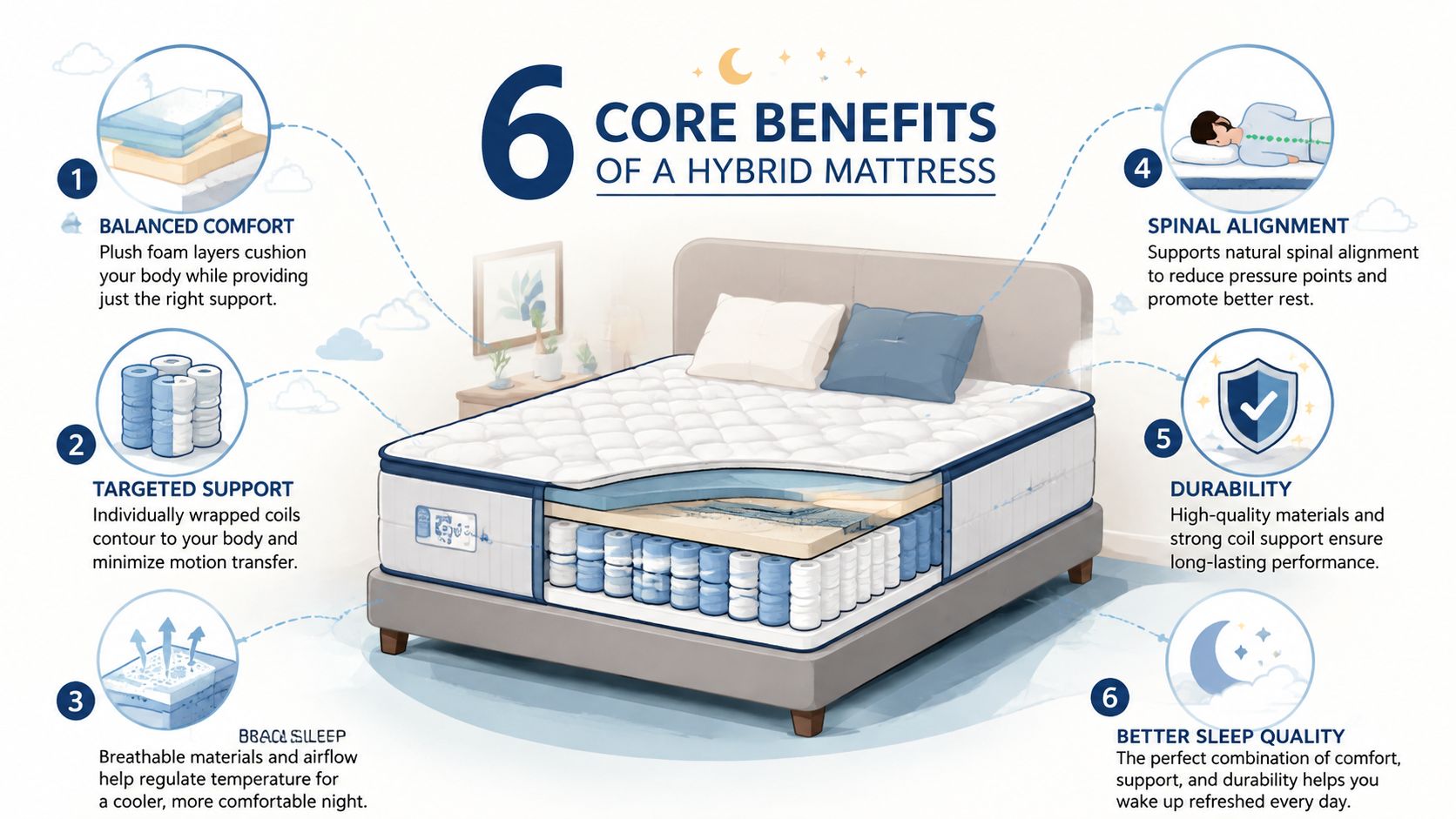
A hybrid mattress layers foam comfort materials over a coil support core. Each part has a different job, and the order matters. The base provides lift, the middle softens the transition, and the top shapes the surface feel.
Start at the support core
At the bottom sits a coil unit, often made with individually wrapped pocketed coils. Each spring responds on its own rather than moving as one connected grid. That lets the support surface react to different body areas, such as a shoulder settling into one spot while the waist receives steadier support nearby.
For a heavier sleeper or someone who changes positions often, the coil core can provide the pushback needed to turn without feeling buried. It also leaves open spaces inside the mattress, which may encourage more airflow than a solid foam block. The result is a support layer with lift and a responsive feel.
Add a transition layer
A transitional foam layer rests above the coils. It softens the change from the firmer base to the upper comfort materials, so the sleeper is less likely to feel the support unit directly. Without that buffer, the surface may feel abrupt. With it, the mattress can cushion the body while the deeper structure stays steady.
This layer can matter to side sleepers, whose shoulders and hips press farther into the mattress, as well as back sleepers who need a smoother handoff between surface comfort and underlying support.
Finish with comfort materials
The top may contain memory foam, latex, gel foam, or a combination of materials. A foam comfort layer is commonly about 2 to 5 inches thick, according to this construction guide comparing innerspring and hybrid mattresses. These materials shape around pressure points and contribute much of the feel a sleeper notices first.
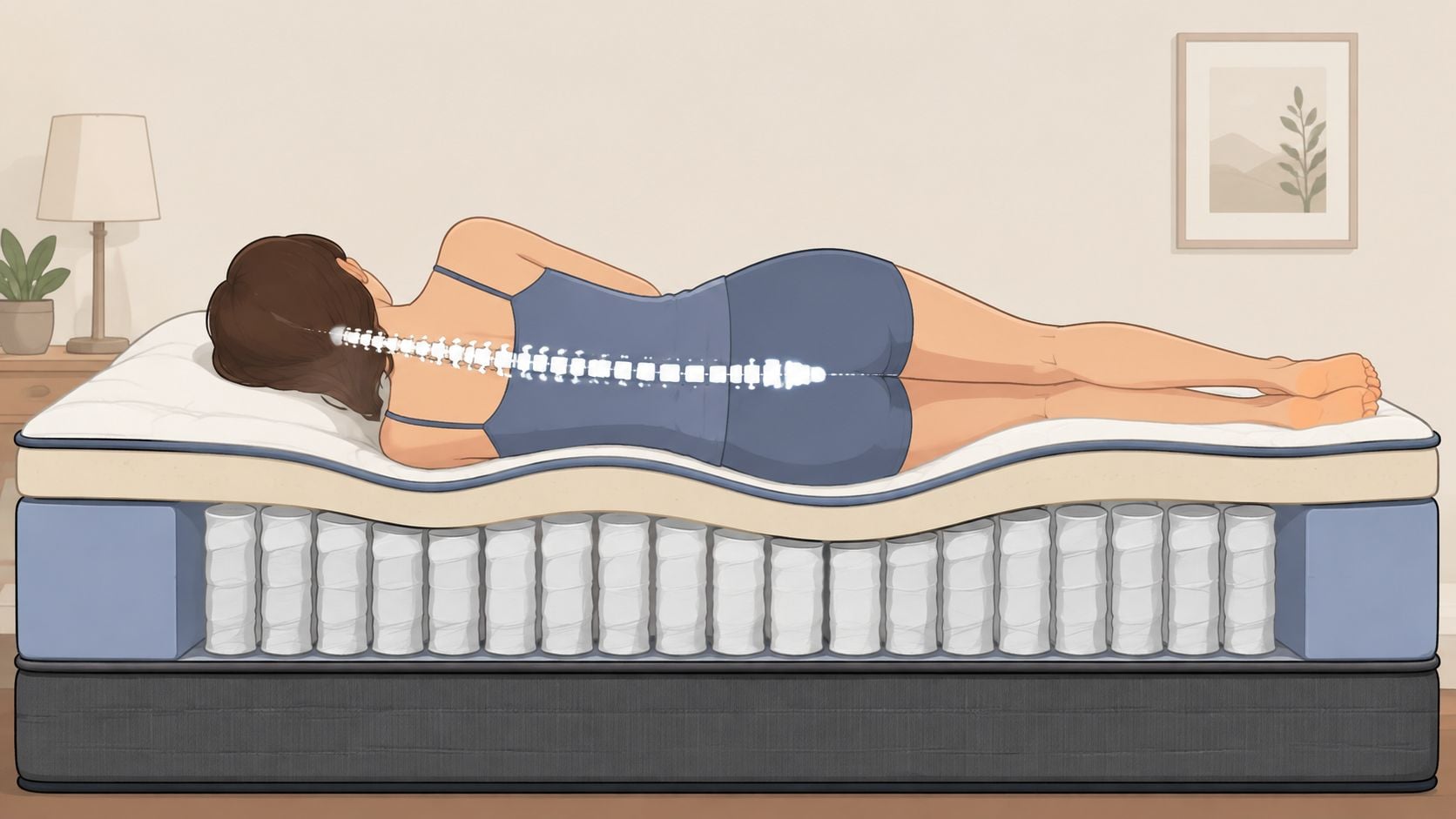
The cover completes the stack. Some covers emphasize breathability or a cooler hand feel, while others focus on quilting and softness. It affects the first impression, but it cannot determine the entire mattress feel.
A traditional innerspring depends more heavily on its spring system, with a thinner comfort layer above it. An all-foam mattress uses foam or latex throughout its structure. Hybrids combine both approaches: foam contours, coils lift, and the sleeper feels both cushioning and responsiveness. The balance changes by model, so testing the mattress in person can clarify whether its support suits your body and sleeping position.
Which Hybrid Benefit Matters Most for Your Sleep Situation?
A hybrid mattress earns its value when its construction matches the way you sleep. Each layer has a defined job: coils create structure and lift, while foam cushions the places where your body meets the surface. The right benefit depends on your position, body shape, and whether you share the bed.
Balanced support
Back sleepers often need steady support beneath the torso, with enough cushioning to keep the hips from feeling pushed upward. Pocketed coils can provide that upward response, while foam softens contact at the shoulders and hips. Combination sleepers may also appreciate the easier repositioning that comes from a responsive support layer.
A 2026 sleep-study abstract associated hybrid cooling mattress use with faster sleep onset, improved sleep architecture, and better sleep efficiency. Participants also reported gains in comfort, support, pressure relief, and coolness. The reported perceived gains included 186% for comfort, 194% for support, 266% for pressure relief, and 295% for coolness in that study's comparison framework. The findings appear in the Sleep study abstract.
Pressure relief
Side sleepers usually feel pressure first at the shoulder and hip, especially when those areas carry more of the body's weight. Foam spreads that load over a wider area, allowing the support system to hold the body while the comfort layer cushions those contact points. This can suit sleepers with broader shoulders, fuller hips, or a preference for a softer surface.
Clinical evaluation of hybrid pressure-relieving surfaces found measurable differences in contact pressure. It reported significantly lower minimum sacral pressure for a powered hybrid than for a foam mattress, with p=0.015 in the evaluation of pressure distribution (clinical pressure-surface evaluation).
A hybrid still needs the right firmness and comfort-layer thickness for your body. A side sleeper who feels a shoulder pressing into the surface may need a different model from a lighter sleeper who prefers firmer support.
Cooling and breathability
Hot sleepers may notice the open space around a coil unit, particularly compared with a dense foam core. Air can move through the support section, while the cover and comfort materials influence how warm the surface feels. This combination may help couples when one partner sleeps warm and the other prefers more cushioning.
A 2023 Sleep study tracking 1,159 nights associated use of a hybrid cooling mattress with 5 minutes faster sleep onset, 4% longer sleep duration, and 2% better sleep efficiency. The same report noted 6% more REM sleep and 8% more deep sleep (Sleep study report).
Durability
Coils form a structural base that can help a mattress keep its shape and support over time. Consumer Reports says mattresses, including hybrids, generally last 8 to 10 years, and its testing checks whether a mattress maintains shape, height, firmness, and support after simulated use.
The expected lifespan still depends on the foam, edge construction, foundation, body weight, rotation, and daily use. A stronger coil unit cannot correct weak materials elsewhere.
Motion isolation
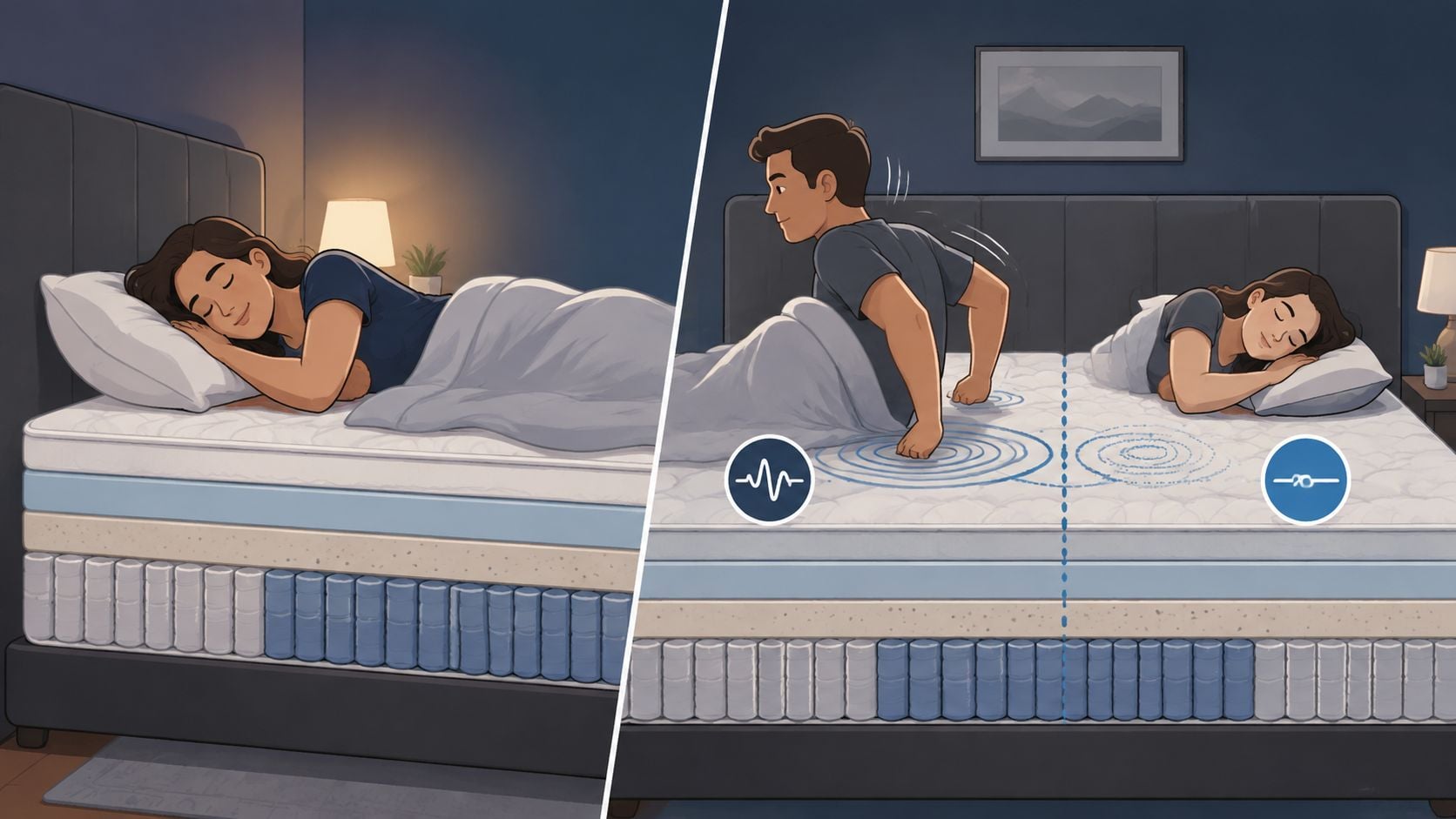
A couple may benefit from pocketed coils that respond close to the source of movement, along with foam that absorbs some motion above the springs. That can make a partner's turn, pillow adjustment, or bedtime exit less disruptive. Spring-based support still has some liveliness, so the amount of movement control varies by model.
Test this benefit together. One partner can lie still while the other changes position, then switch places. A solo test cannot show how the shared surface behaves.
Edge support
A reinforced perimeter can give couples more usable width, especially when both partners tend to sleep near their own side. It also helps adults who sit on the edge to dress and older sleepers who want a steadier surface when getting in or out of bed.
A stable edge lets the sleeper spread out with greater confidence. A weaker perimeter can make the center feel like the only dependable place to rest.
How Hybrids Compare to Innerspring and All-Foam
The differences become easier to feel when the three categories are placed side by side. A traditional innerspring generally feels more springy and open. An all-foam mattress usually offers closer contouring and less bounce. A hybrid combines those sensations, although the exact balance changes by model.
| Feature | Hybrid | Innerspring | All-Foam |
|---|---|---|---|
| Contouring | Foam cushions and shapes around the body | Usually flatter, with less deep contouring | Close contouring and a more enveloping feel |
| Bounce | Responsive, with controlled springiness | Usually the liveliest | Typically less bounce |
| Temperature | Coil space can support airflow | Open spring construction can feel breathable | May feel warmer, depending on foam and cover |
| Motion transfer | Foam and independent coils can reduce movement | Movement may travel more readily, depending on coil design | Often quiet and movement-absorbing |
| Edge support | Often reinforced around the perimeter | Can feel stable, depending on construction | Varies by foam density and perimeter design |
| Weight | Usually heavier because it combines materials | Often lighter than a hybrid | Varies, but dense foam can also be heavy |
| Price tier | Often positioned above basic mattresses | Broad range, including simpler options | Broad range from basic to premium |
A shopper who wants a lively, easy-moving surface may prefer an innerspring. A sleeper who wants deep, slow contouring and minimal bounce may lean toward all-foam. A combination sleeper who changes positions, a couple balancing different preferences, or a person seeking both cushioning and pushback may find the hybrid category more suitable.
The important distinction is that “hybrid” isn't a guarantee of universal compatibility. Weight, sleeping position, and partner sensitivity influence the outcome. Readers who want a deeper explanation of spring-based construction can review what an innerspring mattress is, then compare that feel in person with a hybrid and an all-foam model.
Who Gets the Most Out of a Hybrid
A hybrid suits sleepers who need cushioning above steady support, or couples who want some bounce without every movement traveling across the bed. The right match depends less on the word “hybrid” than on body weight, sleeping position, and how each partner moves at night.
Position and body type
Use firmness as a starting point, not a promise. A lighter sleeper may experience a medium-firm hybrid as quite firm because the body does not compress the comfort layers as much. A heavier sleeper may feel that same mattress softer, with more pressure around the hips. A body-weight range can guide the first choices, but lying on the mattress matters more than the label.
| Sleeper pattern | Useful starting point | What to check |
|---|---|---|
| Lighter body | Medium or softer comfort feel | Whether the surface allows enough contact |
| Average body | Medium-firm feel | Whether support stays even while changing position |
| Heavier body | Firm support with adequate cushioning | Whether the hips sink too far or the shoulders feel blocked |
A strict stomach sleeper with a lighter body may find some hybrids too yielding. A firmer, less-padded surface can keep the midsection from settling too far into the mattress. A shopper who changes position during the night may prefer a feel that allows turning without a slow, stuck sensation. The useful question is how easily the sleeper can settle, roll, and rise, not which category sounds most impressive.
Partner situations and life stages
Couples with different body sizes should test the mattress together. One partner may compress the surface much more than the other, changing the feel on each side. If one person moves often, a hybrid with individually controlled coils and suitable comfort materials may limit the disturbance, while still giving the moving partner a surface that is easier to leave and return to.
Hot sleepers may appreciate the more open support structure, though the foam and cover still affect the overall feel. Seniors may prefer a stable surface that makes repositioning and standing easier. Anyone with ongoing pain should view mattress shopping as a comfort choice, not medical treatment, and discuss persistent symptoms with a qualified healthcare professional.
The body-type mattress guide from BILTRITE can help organize the showroom conversation around actual sleeping habits, body size, and partner needs. In a fourth-generation Milwaukee showroom, experienced staff can help compare feels, explain value bundles, and discuss care steps without reducing the decision to a single mattress label.
Smart Buying Tips Before You Visit the Showroom
A mattress label reveals the parts, not the experience. Before visiting the showroom, note your usual sleep position, your pillow height, whether you wake with pressure at the shoulder or hip, and what your partner notices during the night. These details give the sales associate a useful starting point.
Prepare questions about the construction
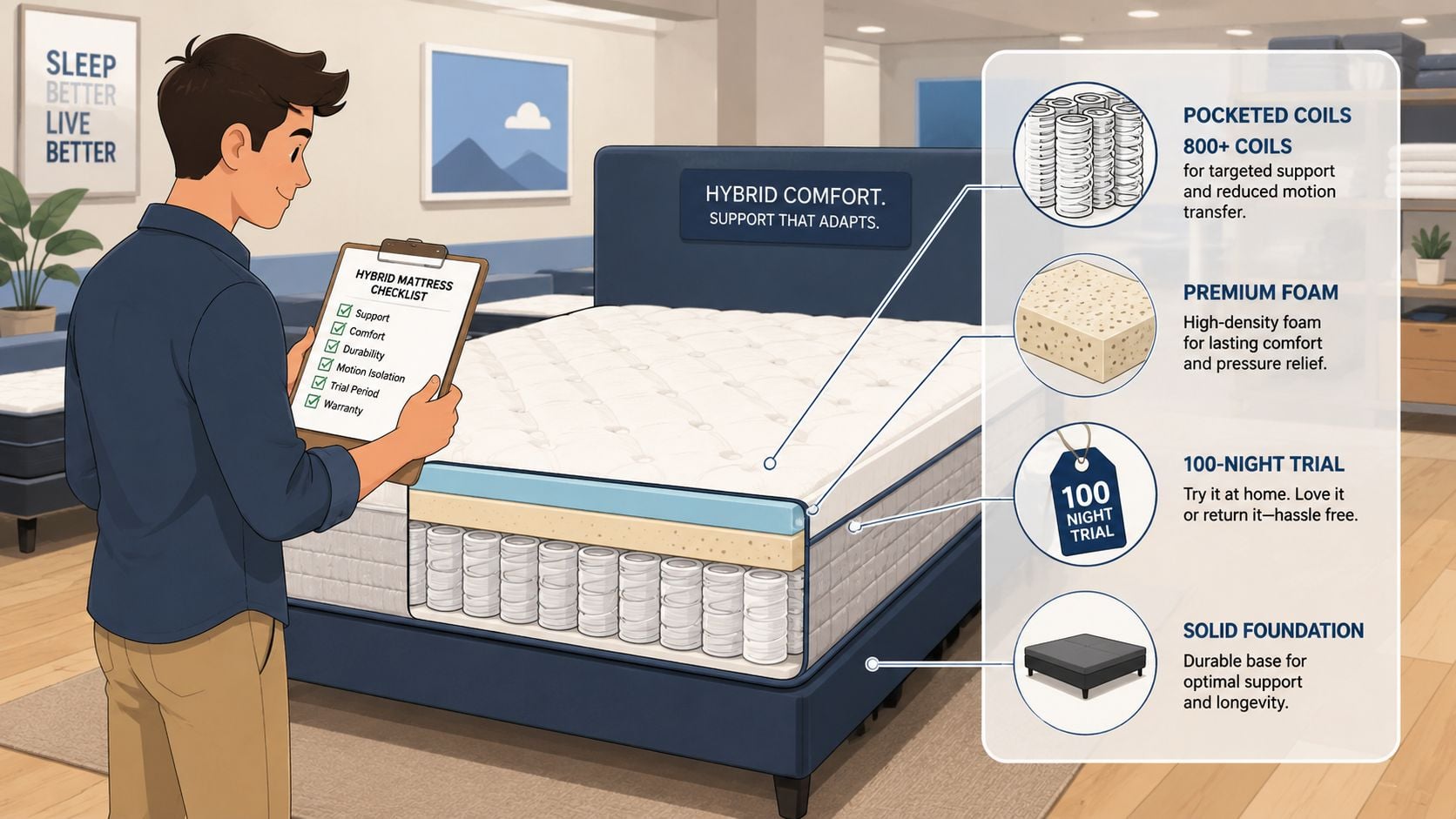
Ask whether the coils are individually wrapped, whether the perimeter has added reinforcement, and whether the support is zoned. Coil count alone does not establish quality. Ask how the coil unit supports the hips, shoulders, and waist, and whether that support suits your body type and sleep position.
Ask about the comfort layers as well. Foam type and density influence contouring, resilience, heat, and how the surface may feel over time. Find out whether the materials have relevant certifications and whether the cover is designed to allow airflow.
Bring a short checklist:
- Which layer supplies most of the support?
- Which materials create the pressure relief?
- Does this model suit a lighter or heavier sleeper?
- What foundation is compatible with it?
- How does the feel differ from the other models being considered?
- What care routine does the manufacturer require?
Test the mattress like you sleep
Sitting on the edge gives limited information. Lie in your normal sleep position for at least ten minutes, using your usual pillow when possible. Notice whether your body settles evenly or whether one area feels strained.
- Side position: Check that the shoulder and hip feel cushioned, while your spine remains reasonably aligned.
- Back position: Notice whether the lower back feels supported without pressure or an obvious gap.
- Edge test: Sit near the perimeter, then lie close to it. The edge should feel stable enough for your body and regular movements.
- Getting up: Roll, change position, and rise as you would at home. A supportive hybrid should not make those movements feel unnecessarily difficult.
The BILTRITE guide to testing a mattress offers another practical way to prepare for the visit.
Confirm the purchase details
Ask about the trial period, warranty exclusions, foundation requirements, delivery, setup, and old-mattress removal. A vague warranty, no trial policy, or unusually low price calls for careful questions before you commit.
Good showroom question: “What part of this mattress creates the support, and what part creates the comfort?”
A knowledgeable associate should explain the answer plainly. Leave knowing the coil construction, foam type, compatible foundation, expected care routine, and what happens if the comfort choice needs reconsideration. A fourth-generation Milwaukee showroom can also explain value bundles and help match the mattress to your household needs.
Caring for Your Hybrid So It Lasts
Proper care begins when the mattress arrives. Use a breathable waterproof protector to block perspiration, spills, and everyday debris without making the surface feel like sealed plastic. Place the mattress on a foundation that meets the manufacturer's requirements, whether that means a sturdy platform, suitable slats, or an adjustable base. The right support underneath helps the hybrid's coil unit and comfort layers perform as intended.
Rotation can spread wear across the sleep surface, but the model's instructions come first. Some mattresses should rotate 180 degrees during the first six months, then seasonally if the manufacturer permits it. A mattress built for one-sided use should never be flipped.
For a small stain, use mild detergent and cold water on a lightly damp cloth. Blot gently instead of scrubbing, and avoid soaking the foam. Trapped moisture can create odors or material problems that are harder to solve than the original spill.
The BILTRITE mattress maintenance guide explains practical cleaning and upkeep habits.
Watch for visible body impressions deeper than 1.5 inches, springs you can feel through the comfort layers, or morning back pain that keeps getting worse. A mattress that is more than seven to eight years old may also deserve closer evaluation. General durability guidance places mattresses, including hybrids, at roughly 8 to 10 years, though construction, use, and care affect the actual lifespan. Regular support checks and gentle cleaning cannot stop normal aging, but they can help the bed stay comfortable longer.
Why Shopping Local Makes the Difference
No amount of online research replaces lying on a mattress in person. A local showroom changes the conversation because your body can test what specifications only describe. Spend several minutes on different hybrids and notice coil tension, foam response, edge stability, and pressure relief. Side sleepers can check whether the shoulder and hip feel supported, while couples can test how movement travels across the surface.
A showroom visit also lets you ask practical questions before delivery. Policies differ, so confirm whether the set includes delivery, setup, removal of an old mattress in donatable condition, financing, price matching, exchanges, or comfort-layer options. Ask which foundation works with the hybrid you choose.
BILTRITE Furniture-Leather-Mattresses is a fourth-generation, family-owned showroom serving Greenfield and Metro Milwaukee since 1928. Its Mattress Center carries over 60 models and 500 or more mattresses in stock. The associates bring over 400 years of combined experience across the team. The store also offers affordable, better-quality furniture, including USA-made, Amish-made, and solid-wood pieces, with choices for smaller spaces and heavier use.
The case for buying a mattress locally is practical. A local warranty team can help with questions and claims in person, and a neighborhood showroom gives you guidance while you compare comfort. BILTRITE is at 5430 West Layton Avenue in Greenfield, Wisconsin, and closes Sundays and Mondays for family time.
Bring a pillow, try several feels, and discuss the sleeper, partner, budget, and bedroom with BILTRITE Furniture-Leather-Mattresses. The team also offers value-focused delivery and setup options.