How to Flip Mattress Safely and Extend Its Life


You're standing beside the bed with the sheets stripped, wondering whether the mattress really needs flipping or whether generic advice is about to create a bigger problem. That hesitation is useful. Learning how to flip a mattress starts with deciding whether it should be flipped at all.
Most modern mattresses are built with a specific comfort side and support side. Turning one of those beds upside down can leave the firm base beneath the sleeper instead of the cushioning layers, changing the feel and potentially working against the mattress design. A two-sided mattress is different, because both faces are made for use.
The practical rule is simple: check the construction and manufacturer instructions before lifting anything. One-sided mattresses generally need head-to-foot rotation, while explicitly flippable mattresses can be turned and rotated to spread wear. A helpful overview of the difference appears in BILTRITE's guide to flippable mattresses.
BILTRITE Furniture has served the Metro Milwaukee community as a fourth-generation, family-owned business since 1928. With more than 400 years of combined team experience, its sleep specialists have helped families sort through the practical details that online shortcuts often miss. This guide covers mattress identification, safe preparation, controlled lifting, realistic scheduling, and the signs that rotation alone may no longer be enough.
Table of Contents
- Introduction Why Flipping Is Not Always the Answer
- Know Your Mattress Before You Flip or Rotate
- Getting Ready to Move Your Mattress Safely
- How to Flip and Rotate Without Damage or Injury
- How Often to Flip and Rotate for Lasting Comfort
- Keep Your Mattress Fresh and Know When to Visit BILTRITE
Introduction Why Flipping Is Not Always the Answer
The old advice was familiar: flip the mattress every few months. That guidance made sense when two-sided innerspring mattresses were common, because alternating both sleeping faces distributed wear across the entire mattress. Archived care instructions for those older designs recommended a full flip and rotation every three months after installation to help preserve comfort and service life. Archived mattress maintenance instructions document that earlier approach.
Today, mattress construction varies widely. Memory foam, hybrid, pillow-top, and other one-sided designs usually place comfort materials above a dedicated support base. Those mattresses should generally be rotated from head to foot rather than flipped over. Recent mattress-care guidance also emphasizes that only beds specifically designed as two-sided should be turned over, while one-sided models should be rotated instead. Modern mattress rotation guidance supports that decision-first approach.
The safest flipping rule: Don't move a mattress until its label, instructions, or construction confirms that both sides are intended for sleeping.
That distinction protects comfort and prevents wasted effort. A mattress that feels soft and supportive on top may feel hard, uneven, or unsuitable when placed upside down. Even if the mattress isn't visibly damaged, the wrong orientation can make the bed less comfortable.
A good inspection takes only a moment. Look for a manufacturer label, read the care instructions, check whether the underside has a finished sleep surface, and compare both faces. If the mattress is clearly marked two-sided or flippable, flipping may be part of its care routine. If only one face has upholstery or cushioning, rotation is usually the correct maintenance action.
Know Your Mattress Before You Flip or Rotate
Mattress identification should happen before bedding removal, furniture moving, or recruiting a helper. The label is the strongest starting point, but physical clues can help when paperwork is missing. A finished, cushioned underside suggests a two-sided design, while a plain, reinforced, or non-skid bottom points toward a one-sided construction.
Mattress categories can overlap, so the safest choice comes from the manufacturer's directions rather than appearance alone. A memory foam mattress usually has a shaped comfort side and a support base. A hybrid commonly combines springs with comfort materials on one face. A pillow-top has its additional cushioning sewn onto the sleeping surface. These constructions are generally rotated, not flipped.
BILTRITE carries flip-able and two-sided options for shoppers who specifically want a mattress designed for alternating surfaces. Its mattress department includes over 60 models, giving families an opportunity to compare feels and constructions with a sleep specialist in the showroom. More information about mattress construction is available in BILTRITE's mattress type guide.
Flip or Rotate Decision Guide by Mattress Type
| Mattress Type | Should You Flip | Should You Rotate | What to Do Next |
|---|---|---|---|
| Explicitly two-sided or flippable | Yes, if the manufacturer allows it | Yes | Alternate the usable faces and head-to-foot positions |
| One-sided memory foam | No | Yes | Keep the comfort side up and rotate head to foot |
| One-sided hybrid | No | Yes | Follow the care label and rotate on schedule |
| Pillow-top or specialized comfort-top design | Usually no | Yes | Preserve the designed top surface and rotate |
| Unclear construction | Not until confirmed | Follow the label first | Contact the seller or manufacturer before turning it |
The table's central decision is not complicated: flip only when both faces are usable sleeping surfaces. A mattress can still benefit from rotation even when flipping is off the table. Changing the head-to-foot position redistributes pressure across areas that otherwise receive the same load night after night.
The mattress shouldn't be flipped merely because it has handles, looks substantial, or resembles an older innerspring bed. Handles can help with positioning, but they don't prove that both surfaces are designed for sleeping.
Getting Ready to Move Your Mattress Safely
A safe flip begins with an uncluttered work area. Remove sheets, blankets, pillows, mattress pads, and anything resting on the bed. Clear lamps, picture frames, fragile décor, chargers, and bedside items that could fall when the mattress shifts.
Check the bed frame, foundation, and surrounding floor before the lift. Loose slats, an unstable foundation, or a frame already pressed against the wall can turn a routine maintenance job into a repair. Families in Milwaukee apartments or compact rooms should also look at the full path from the bed to nearby walls, doorways, dressers, and other furniture.
A short pre-flip checklist
- Confirm the mattress type: Make sure the care label allows flipping before anyone lifts.
- Recruit a second person: Two people can control the mattress more safely than one person wrestling with its weight.
- Protect the route: Move breakables and give the mattress clearance from walls and furniture.
- Inspect the base: Confirm that the frame and foundation are stable and properly positioned.
- Plan the landing: Decide where the mattress will rest if it needs to stand briefly on its side.
Two-person teamwork matters because a mattress can twist unpredictably when one end rises before the other. Each person should stand on an opposite side, communicate before lifting, and keep the movement slow. Bend at the knees, keep the back supported, and avoid twisting while carrying the load.
BILTRITE's practical guidance on moving heavy furniture upstairs safely applies to the same basic principle: the route and the team should be organized before the object moves. In tight spaces, come-apart sectionals and other modular furniture can sometimes be moved out of the way more easily than a large solid piece, creating a clearer path around the bed.
After the movement, the mattress should sit squarely on the foundation. Check the edges, corners, and overhang from every side. A crooked mattress can create uneven support and discomfort, while a shifted foundation can place stress on the frame.
How to Flip and Rotate Without Damage or Injury
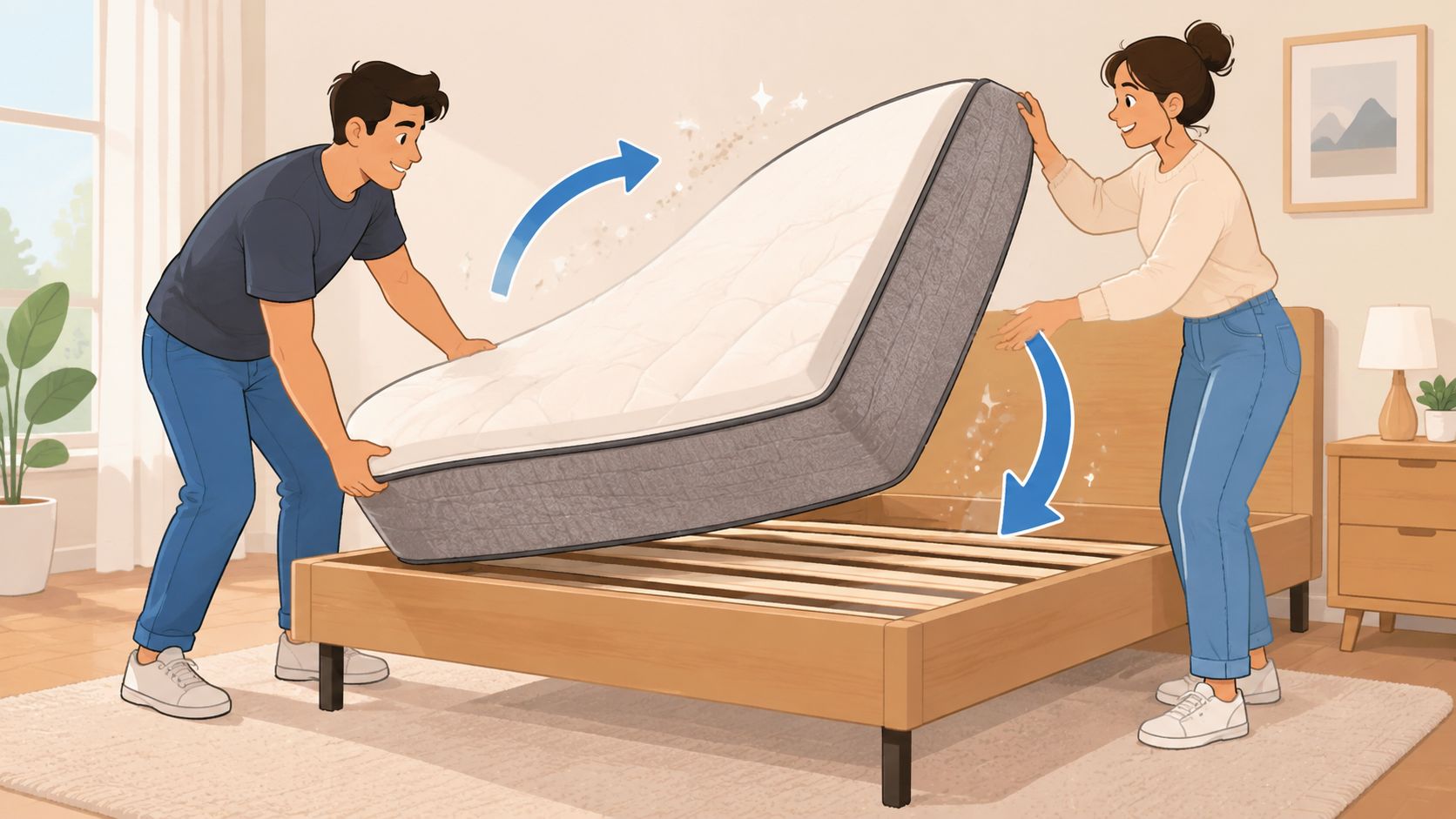
The actual movement should be controlled rather than forceful. Stand on opposite long sides of the mattress, with both people close enough to maintain a firm grip. Lift the mattress slightly off the frame, just enough to free it, instead of trying to raise the entire bed high into the air.
Once the mattress is clear, pivot it onto its long edge. One person guides the upper portion while the other controls the lower portion. The mattress should pause securely on its side before the pair turns it so the opposite face comes down onto the foundation.
Practical rule: Lift together, pivot slowly, and lower together. Sudden pulling creates torque that can strain people, bend frame components, or scrape walls.
Keep hands away from pinch points between the mattress and frame. Handles can assist with alignment when the manufacturer provides them for that purpose, but they shouldn't be treated as a substitute for two-person support. Avoid dragging the mattress across sharp frame edges, because friction can stress the cover, seams, and corner panels.
Low platform beds need extra care because there's less room for hands beneath the mattress. An adjustable base should be returned to a flat, stable position before the mattress is moved, and the base should remain disconnected from any movement that could activate it. Heavy-duty mattresses may require a third person for room control, even when two people handle the main lift.
Rotating without flipping
For a one-sided mattress, keep the sleeping surface facing upward. Pull it clear of the headboard or wall, then rotate it horizontally so the head end moves to the foot end. Work from the corners, keep the mattress close to the foundation, and avoid folding it unless the manufacturer specifically permits bending.
After either maneuver, center the mattress carefully. Align the corners with the foundation, check that no edge hangs beyond the support, and make sure the head-to-foot orientation matches the intended position. Let the mattress settle before replacing the bedding, particularly if the cover shifted during handling.
A practical explanation of the movement appears in BILTRITE's mattress rotation guide. The important detail is consistency. A slow, square, two-person adjustment is safer than trying to finish quickly.

How Often to Flip and Rotate for Lasting Comfort
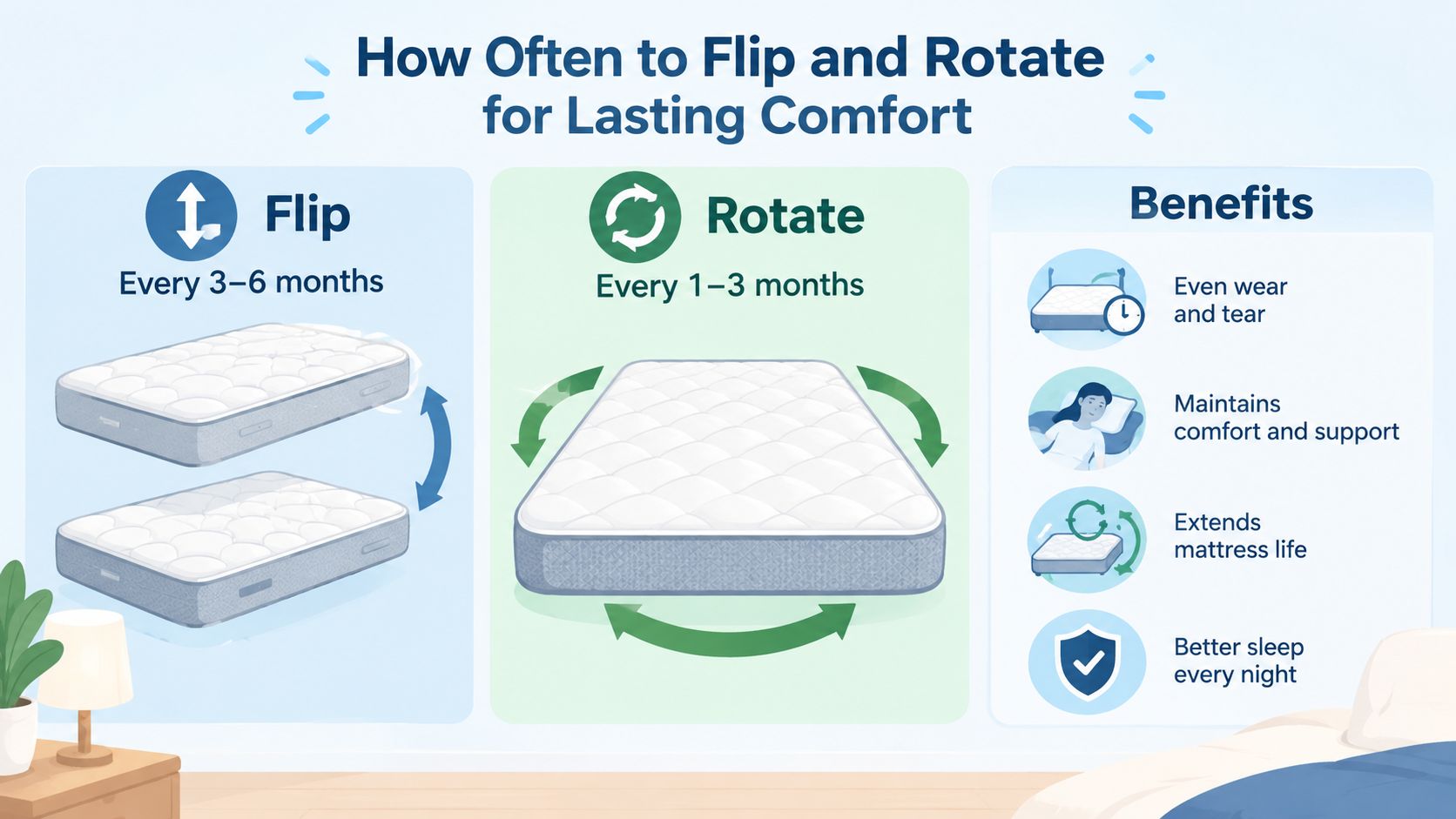
A workable schedule depends on whether the mattress has one usable sleeping side or two. For most one-sided mattresses, the modern maintenance standard is rotation every 3 to 6 months. Guidance commonly recommends rotating every three months during the first year of use, then moving to every six months after the initial break-in period. Mattress rotation schedule guidance explains this pattern and also connects reminders to the four seasons.
A simple seasonal calendar uses March, June, September, and December, creating exactly four rotation reminders each year. Families can attach the task to another recurring household routine, such as changing seasonal bedding or checking bedroom storage.
Two-sided mattresses can use an alternating pattern instead of flipping and rotating on the same day. One practical schedule recommends rotating at month three, flipping at month six, rotating again at month nine, and flipping again at month twelve. A double-sided mattress maintenance schedule provides that cadence.
A quarterly rhythm for double-sided beds
- First quarter: Rotate head to foot while keeping the same sleeping face up.
- Second quarter: Flip to the opposite sleeping surface.
- Third quarter: Rotate the new surface head to foot.
- Fourth quarter: Flip back to the original sleeping surface.
Another care guide advises that flipping and rotating don't need to happen together. Performing one action quarterly, then waiting roughly three months before the other, spreads wear along both the head-to-foot axis and across both sleep surfaces. Alternating mattress care guidance supports this less demanding routine.
Calendar shortcut: One-sided mattress means rotate. Two-sided mattress means rotate and flip on alternating reminders.
Older two-sided innerspring mattresses followed a more active care model, with archived instructions recommending a full flip and rotation every three months. That approach reflected their double-sided construction, not a universal rule for every mattress sold today.
Keep Your Mattress Fresh and Know When to Visit BILTRITE
Flipping or rotating can spread wear, but mattress care also depends on moisture control and regular checks. Use a properly fitted protector, keep the sleep surface dry, and inspect the seams and edges whenever you remove the bedding. Airing the room and following the care label can help maintain a fresher sleep environment.
Pay attention to comfort as well as appearance. Persistent sagging, uncomfortable pressure, or support that feels uneven may indicate that rotation is no longer addressing the problem. A mattress with lasting dips or body impressions may need assessment rather than more frequent handling. Natural-fiber mattresses can also have specific early-care requirements. For deeper upkeep, see mattress maintenance and cleaning tips to extend its lifespan.
BILTRITE Furniture is a fourth-generation, family-owned showroom serving Greenfield and Metro Milwaukee since 1928. Its selection includes affordable, better-quality furniture, USA-made and Amish-made solid wood pieces, compact options for apartments and condos, heavy-duty furniture and mattresses, and a mattress department with over 60 models. The team's combined experience helps shoppers compare a standard one-sided mattress with a flip-able design without pressure.
BILTRITE does not sell online, and the showroom is closed on Sundays and Mondays so the family can protect time together. A local, hands-on visit lets shoppers assess feel, support, construction, and fit in person, factors that a product description cannot fully convey.
BILTRITE Furniture-Leather-Mattresses offers flip-able and two-sided mattresses alongside USA-made, Amish-made, solid wood, small-scale, and heavy-duty furniture. Visit BILTRITE Furniture-Leather-Mattresses at 5430 West Layton Avenue in Greenfield to test mattress surfaces and discuss safe care for the bed already at home.