3 DAY MATTRESS SALE! THURSDAY - FRIDAY - SATURDAY!
98TH ANNIVERSARY SALE-A-BRATION ENDS SATURDAY, NOVEMBER 7TH AT 5PM!
NO CREDIT CARD FEES!
1000's of Items IN-STOCK + 500 Mattresses!
Largest selection of USA Made Furniture & Mattresses + Amish Made!
FREE In-Store Design Services!
BUY LOCAL & LOVE YOUR HOME!
Tuesday-Thursday 10am to 6pm | Friday 10am to 7pm | Saturday 10am to 5pm | Sunday Closed To Be With Family & Friends | Monday Showroom Closed
5430 West Layton Ave, Greenfield - Metro Milwaukee
If a furniture tag says quarter-sawn oak, does that mean the table won't warp, crack, or move with the seasons? Not quite. The cut offers real advantages, but a beautiful grain pattern can't replace properly dried lumber, thoughtful joinery, and a well-applied finish.
For anyone wondering what is quarter sawn oak furniture, the most useful answer starts inside the log, then follows the wood all the way to the showroom floor.
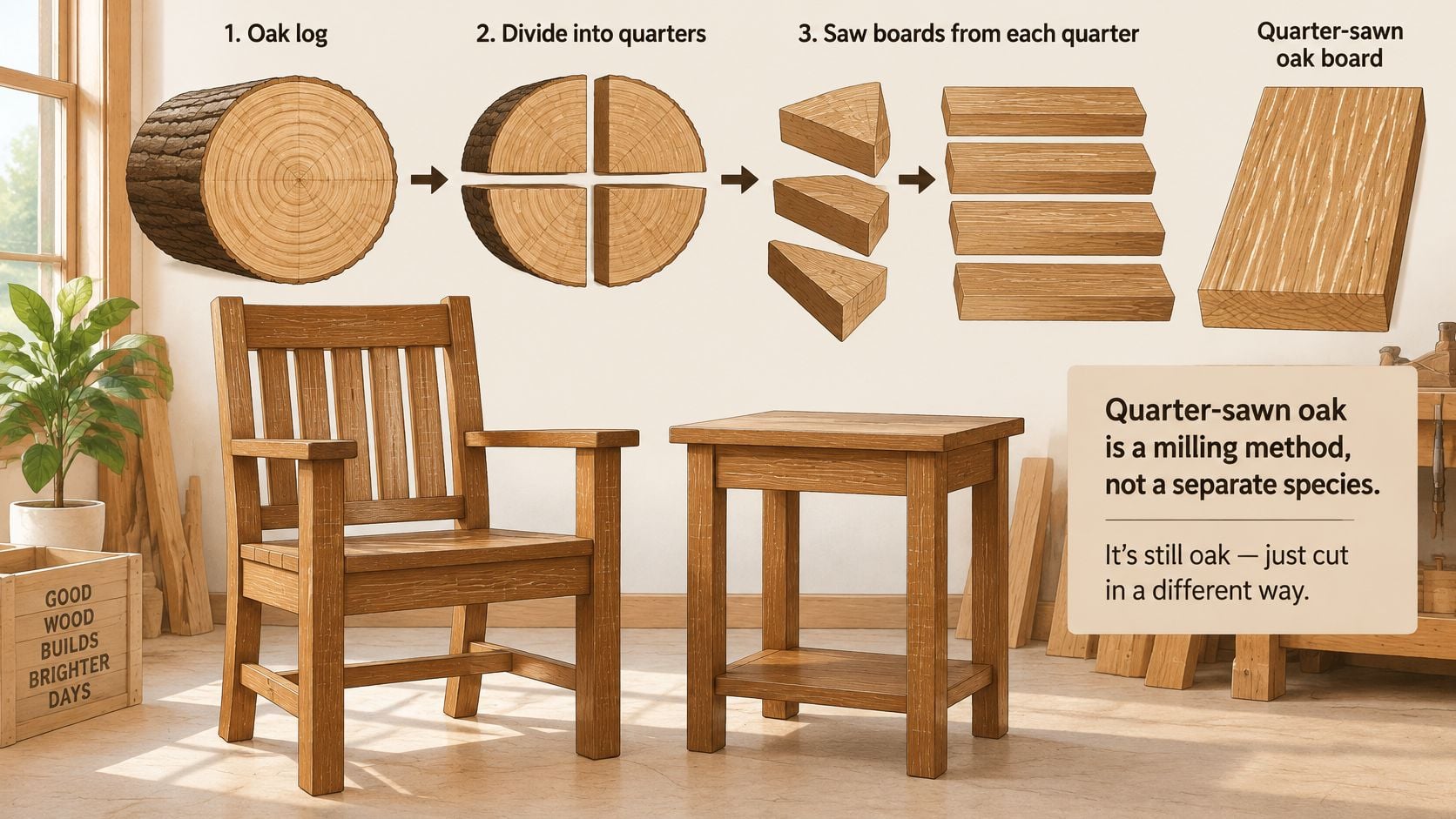
Quarter-sawn oak furniture is furniture made with oak milled in a specific way. Quarter-sawn describes the cut, not a separate species of tree or an automatic grade of quality.
The process starts by dividing a log into quarters through its center. Each quarter is then sawn so the annual growth rings meet the broad board face at roughly 60 to 90 degrees, as described in this guide to quarter-sawn and flat-sawn oak.
Making the Angle Easier to Picture
Think of a stack of pancakes standing on its edge. A slice across that upright stack would show the layers as thin stripes rather than broad, flat surfaces. Tree rings curve rather than stack neatly, but the analogy helps explain why the angle changes the appearance.
With quarter-sawn oak, the face generally shows straight, parallel grain, often accompanied by distinctive ray fleck. The same oak log could instead produce plain-sawn boards with a different appearance and different cross-grain movement.
That's why a dining table tag that says only oak leaves an important question unanswered. Oak identifies the wood; quarter-sawn explains how the lumber was cut.
Showroom question: Which parts of this piece are quarter-sawn oak, and are those parts solid boards or veneer?
Following the Wood Into Furniture
Quarter-sawn oak appears in dining tables, cabinets, desks, bedroom furniture, and chair components. On a broad tabletop, the grain becomes a major design feature. On chair parts, it may be a quieter detail.
A quarter-sawn label can describe solid lumber or a decorative veneer over another material. Neither description alone explains the entire construction, so the component list matters just as much as the name on the tag.
For shoppers sorting out species before choosing a cut, BILTRITE's guide to hardwood furniture and longevity provides useful context. Choosing oak and choosing how that oak is sawn are related decisions, but they aren't the same decision.
Quarter-Sawn Versus Plain-Sawn Oak Compared
Quarter-sawn and plain-sawn oak side by side
Feature
Quarter-Sawn Oak
Plain-Sawn Oak
Growth ring angle to board face
About 60 to 90 degrees
Much shallower angle
Grain pattern
Straight, parallel lines
Cathedral and flame figure
Ray fleck visibility
Prominent
Rarely visible
Width movement with humidity
Lower, mostly radial
Higher, mostly tangential
Cupping tendency
Generally reduced
More likely
Usable board width from a log
Less
More
Labor and processing
More labor
Less labor
The table compares cutting methods, not good furniture against bad furniture. A carefully built plain-sawn oak cabinet can be a better purchase than a poorly assembled quarter-sawn cabinet.
The ring angle is the starting point for most of these differences. It changes which internal surfaces become visible and how a board responds across its width as moisture conditions change.
Choosing a Look, Not Just a Label
Plain-sawn oak often has sweeping arches that resemble cathedral windows or flames. That bolder grain can give a large dining table an expressive, casual look. Quarter-sawn oak generally offers a more orderly background, with flecking that interrupts the straight lines.
Neither look needs to win a beauty contest. A family choosing furniture for an open dining area might prefer lively arches, while another household might favor quieter lines and ribbon-like figure.
Finish matters, too. Shoppers should compare actual wood samples under similar lighting rather than assume that matching stain names will make differently cut boards look identical.
For a calmer overall pattern: Look for consistent straight grain across adjoining boards.
For more visual movement: Consider the sweeping figure available in plain-sawn oak.
For a coordinated room: Compare the actual table, cabinet, and chair finishes together whenever possible.
Understanding the Milling Trade-Off
Quarter-sawing requires additional handling and generally produces fewer wide boards from a log. Those yield and labor trade-offs help explain why a finished quarter-sawn piece often costs more.
That doesn't mean a higher price automatically buys better joinery, thicker components, or a more carefully applied finish. Those are separate details that deserve separate questions.
The broader wood choice matters as well. BILTRITE's walnut versus oak furniture comparison helps distinguish species preferences from milling preferences.
A sensible showroom comparison pairs similar furniture: a table of comparable size, construction, and finish, rather than a basic plain-sawn piece against a highly customized quarter-sawn one. Otherwise, the price difference may reflect far more than the cut.
Why the Ray Fleck Pattern Stands Out
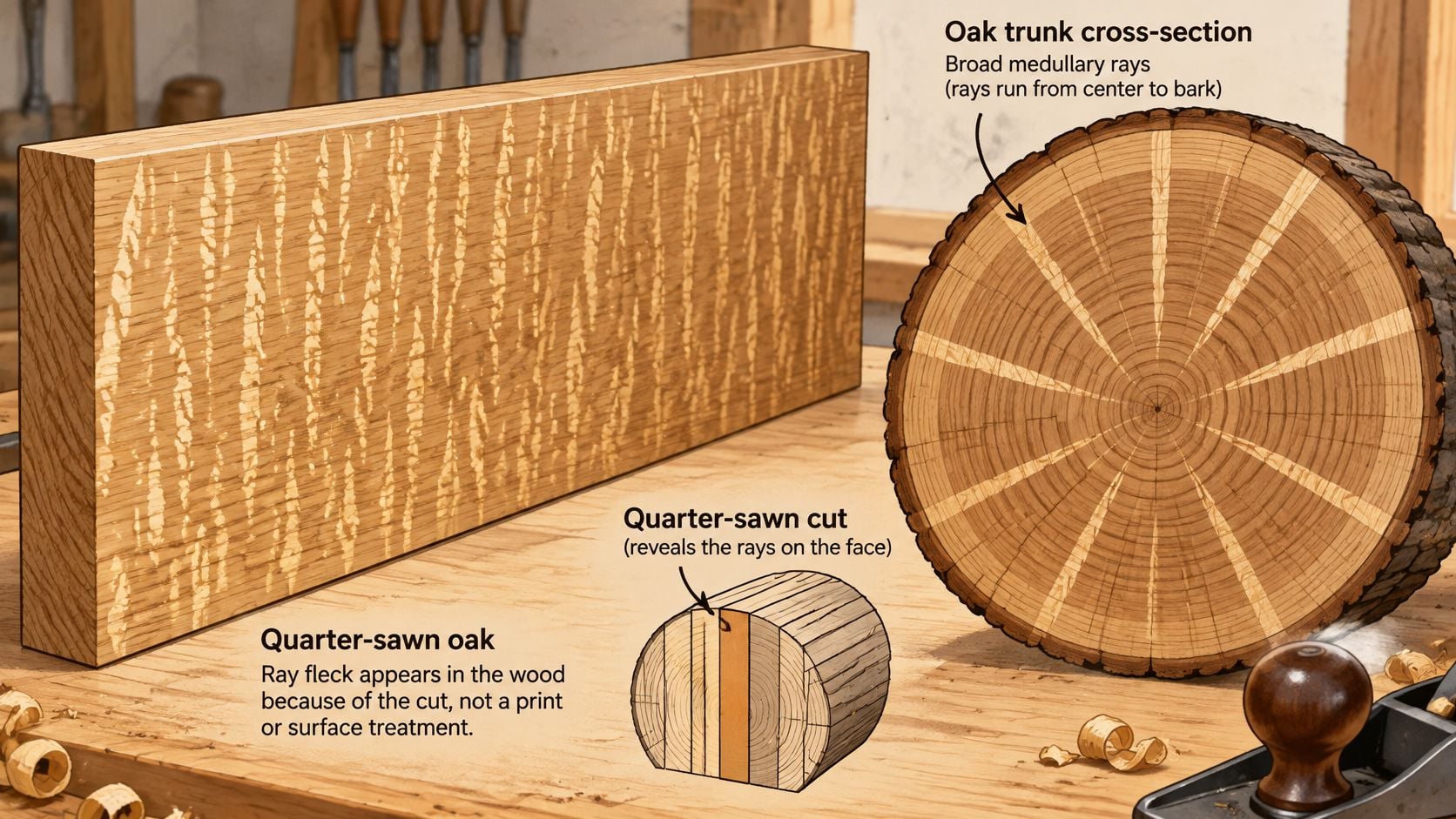
Have you noticed the silvery flecks in some oak furniture? They come from medullary rays, structures that run radially through the tree. A quarter-sawn board exposes those rays, revealing flecks, patches, or ribbons against comparatively straight grain.
Oak rays can be 30 or more cells wide in some cases, according to Penn State Extension's explanation of wood rays. The cut determines how much of these structures appears on the board's face, much like slicing across a bundle reveals its cross-section.
Natural Figure With a Furniture History
Both red and white oak can show ray fleck, though white oak generally has more pronounced figure. Some boards display broad ribbons; others have small, scattered marks. A quieter pattern is a different expression of the wood.
Quarter-sawn oak became closely associated with American Arts and Crafts and Mission furniture in the early twentieth century, with Gustav Stickley's Craftsman work serving as a historical reference. The Metropolitan Museum of Art's collection offers a neutral place to explore historical furniture and design.
That history helps explain why the grain suits sturdy proportions and straightforward forms. Yet the pattern can work just as well on a simple contemporary cabinet; it does not require a period-style room.
Attractive figure shows how the wood was exposed, but it says nothing about how carefully the lumber was dried. The cut shapes the visible pattern, while drying and construction are separate parts of a furniture piece's quality.
Looking Beyond the Show Face
Check the broad finished surface and any accessible end grain. Small checks can form beside rays, and decorative figure alone won't reveal drying defects.
Scan the surface at an angle: Reflected light can make fine openings easier to see.
Inspect accessible edges: Look for checking rather than judging only the central panel.
Ask about preparation: Drying and acclimation matter even when the grain looks striking.
Natural markings give oak its character. Open cracks or questionable seasoning deserve a closer conversation before you buy.
How Quarter-Sawn Oak Handles Seasonal Humidity
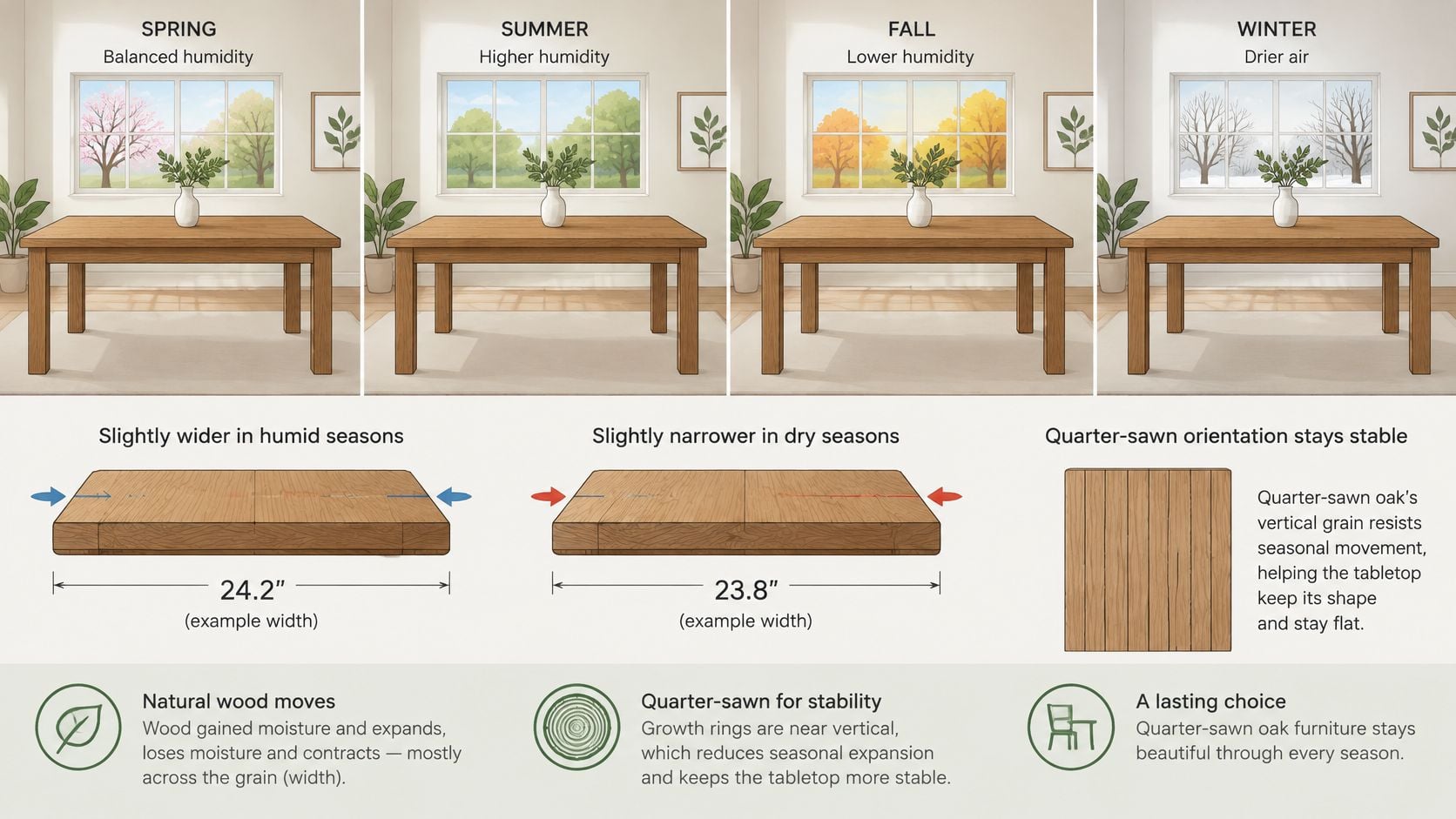
Solid wood continues exchanging moisture with its surroundings. As it gains or loses moisture, it changes dimensions, primarily across the grain rather than along a board's length.
For quarter-sawn boards, width movement follows the lower-movement radial direction. The USDA Forest Service Wood Handbook explains that quarter-sawn material generally shrinks and swells less in width and thickness than plain-sawn material, and directs movement estimates toward radial values for quarter-sawn lumber and tangential values for plain-sawn lumber.
Helping Solid Wood Through Milwaukee Seasons
Metro Milwaukee homes can present very different conditions during heated, dry winter weather and humid summer weather. A dining table doesn't stop responding to those conditions just because it has a protective finish.
Homeowners can help with practical habits:
Keep indoor humidity steady. Use a room hygrometer to watch conditions rather than guessing from how the air feels. Adjust humidification or dehumidification gradually, following the furniture maker's care guidance.
Choose the location carefully. Keep solid-wood furniture away from direct heat vents, radiators, and strong sunlight through windows. Localized heat can dry one area more aggressively than the rest.
Give new furniture time to settle. Place the piece in its intended room and follow delivery guidance before heavily loading cabinets or repeatedly relocating furniture between very different environments.
Caring for the Whole Piece
A bookcase beside a heating register and a table under a sunny window may experience different conditions even inside the same house. Room placement deserves attention before delivery, not only after a drawer starts feeling snug.
BILTRITE's wood furniture maintenance guide offers additional care guidance for everyday use. Cleaning products should suit the finish, and spills should be wiped up promptly rather than allowed to sit.
Everyday care rule: A finish slows moisture exchange; it doesn't turn solid wood into a moisture-proof material.
These habits help protect any solid-wood piece. Quarter-sawn oak offers a useful material advantage, but steady surroundings still give the builder's work the best chance to perform as intended.
Why Quarter-Sawn Does Not Mean Warp-Proof
Quarter-sawn oak is more stable than plain-sawn oak, but it still moves. The cut can reduce certain movement tendencies; it cannot compensate for wood that was poorly dried, a rigid attachment, or abrupt environmental changes.
A solid tabletop needs a secure attachment that still allows seasonal movement across its width. Fastening it rigidly can put stress on the wood as conditions change. Proper drying and acclimation before manufacture also matter.
Cabinet doors offer another useful example. In a frame-and-panel door, the center panel needs room to move within the surrounding frame. A strong joint helps hold the frame together, while the assembly still needs to accommodate the wood's movement. The mortise-and-tenon joint is one construction detail shoppers can learn to recognize.
Common Myths, Corrected
Myth: It never cracks. Seasonal movement and moisture stress can still produce splits or put stress on joints.
Myth: Any visible ray figure proves a quarter-sawn board. Fleck offers a clue, but the ring orientation and the component's specification provide clearer identification.
Myth: The label replaces good construction. The cut is only one part of how a piece performs.
Myth: Quarter-sawn always means white oak. Red oak can also be quarter-sawn.
The finish matters, too. Uneven coverage, neglected edges, or poorly prepared surfaces do not become adequate because of the grain angle. Moisture control, joinery, and finish all contribute to how well a piece handles normal changes. Quarter-sawn is a useful place to start a construction conversation, not a guarantee of performance.
Compare the Construction Before You Buy
A furniture tag can name the wood species and cut, but the component details tell you what you are buying. Use this checklist to compare pieces:
Check
What to Look For
Why It Matters
Species
Red or white oak named on the tag
White oak generally shows stronger ray fleck and better rot resistance
Solid or veneer
Solid quarter-sawn boards in tops, sides, and panels where specified
Veneer supplies the surface appearance, not the thickness of a solid board
Joinery
A clear description of how the furniture is assembled
Helps you compare the build, not just the wood label
Drying and acclimation
The maker's drying specification and how the stock is acclimated
Gives you specific information to compare across pieces
Finish
Even coverage on faces, edges, and undersides
Shows whether less-visible surfaces received attention
Origin and certification
Documented sourcing and any certification listed
Helps establish where materials came from and what the certification covers
Quarter-sawn oak can be red or white oak. The Wood Database's red and white oak comparison explains species distinctions, including white oak's greater decay resistance. Check the tag or ask a salesperson which species is used in each component.
Reading the Specification, Not Just the Surface
For solid-versus-veneer construction, ask which material appears in each part. Solid lumber and veneer can look similar from the front, much like a book's cover tells you little about the pages inside. The core beneath a veneer also contributes to a panel's construction.
BILTRITE's solid wood versus veneer guide explains the distinction. Neither material alone tells you whether a piece is well built, so compare the specifications and construction together.
Drying details are difficult to judge by touch. Ask for the maker's written drying specification, and request a sample certification document if the furniture carries a certification claim. For origin, look for documentation that identifies where the piece or its materials came from.
Inspect finish coverage: Look at accessible undersides and edges as well as the top.
Ask specific questions: Find out which components are solid wood and how the piece is assembled.
Compare complete specifications: Check thickness, hardware, customization, and construction when comparing prices.
Paying for Documented Value
Additional milling labor and reduced wide-board yield can contribute to a higher price. A sustainability claim is a separate question: ask what sourcing or certification documents apply to the actual piece, rather than assuming the cut itself proves responsible sourcing.
BILTRITE's USA-made and Amish-made furniture can be compared using the same checklist. Ask where a piece was made, which components are solid wood, and what its specifications say. Those details make it easier to compare construction and documented sourcing side by side.
Come See Quarter-Sawn Oak in Our Greenfield Showroom
How can you tell whether quarter-sawn oak suits your home? At BILTRITE's Greenfield showroom, you can compare the grain, ray fleck, and finish in person. The family-owned business has served Metro Milwaukee since 1928, and its fourth generation continues that connection to the community.
Take time to look closely. You can sit in a chair, feel a tabletop with permission, and examine accessible end grain alongside a sales associate. BILTRITE offers affordable, better-quality furniture, with selections that include small-scale pieces and heavy-duty options.
A Comfortable Place to Ask Questions
The sales team can help explain wood choices, joinery, and care in plain language. Bring your construction checklist and ask how a specific piece is made.
For different households: Explore small-scale furniture for apartments and heavy-duty options for busy families.
For broader comfort needs: The mattress department offers over 60 models, alongside supportive seating options.
For mobility assistance: Wisconsin power lift recliners are sales-tax exempt.
The showroom is closed Sundays and Mondays. Check the hours before you visit, then take your time comparing materials and asking questions.
BILTRITE Furniture-Leather-Mattresses offers USA-made, Amish-made, and solid-wood selections, including quarter-sawn oak options. Visit the Greenfield showroom to examine the grain, test comfort, and discuss construction in a friendly, no-pressure setting.