3 DAY MATTRESS SALE! THURSDAY - FRIDAY - SATURDAY!
98TH ANNIVERSARY SALE-A-BRATION ENDS SATURDAY, NOVEMBER 7TH AT 5PM!
NO CREDIT CARD FEES!
1000's of Items IN-STOCK + 500 Mattresses!
Largest selection of USA Made Furniture & Mattresses + Amish Made!
FREE In-Store Design Services!
BUY LOCAL & LOVE YOUR HOME!
Tuesday-Thursday 10am to 6pm | Friday 10am to 7pm | Saturday 10am to 5pm | Sunday Closed To Be With Family & Friends | Monday Showroom Closed
5430 West Layton Ave, Greenfield - Metro Milwaukee
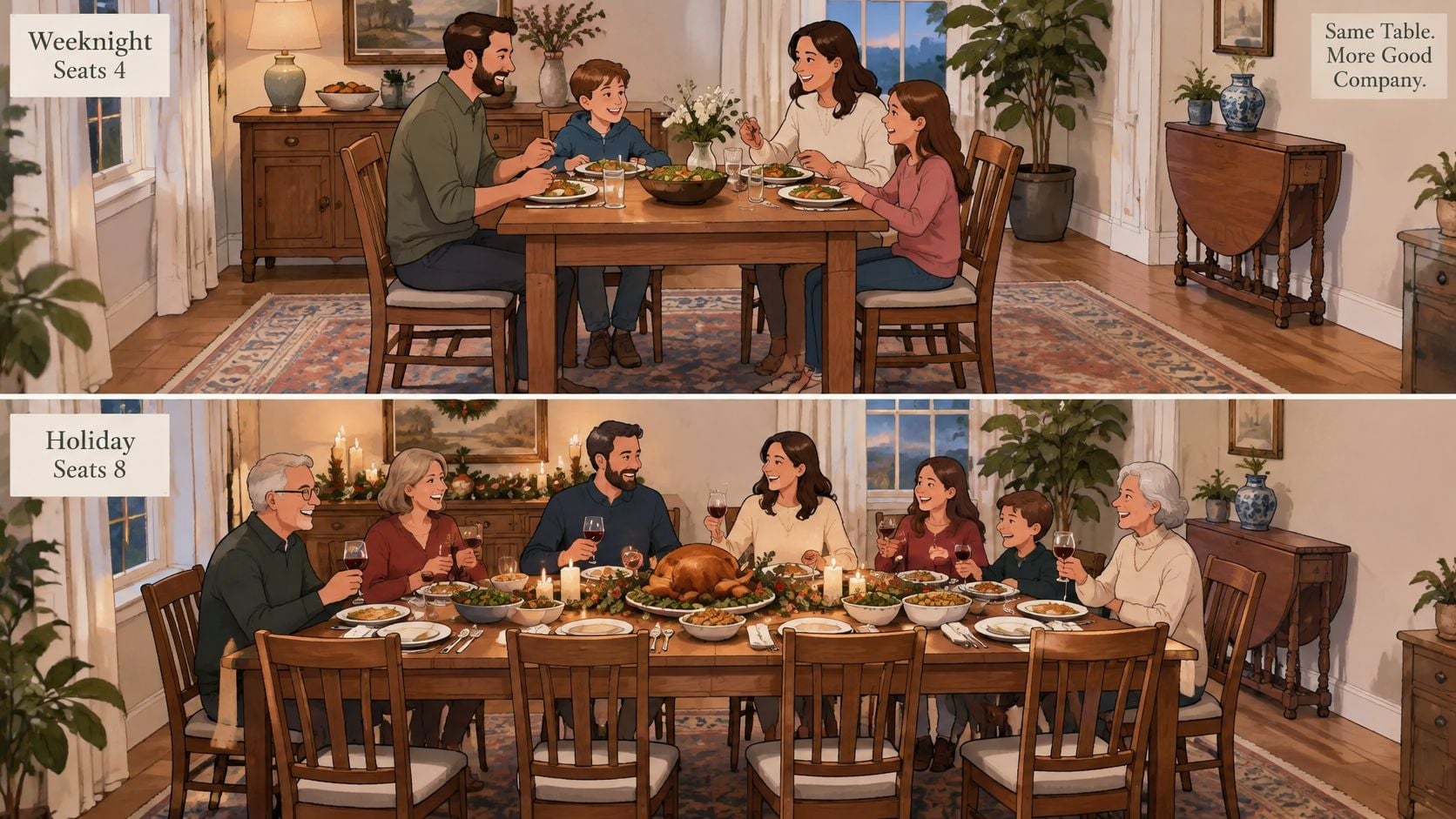
A weeknight table for four rarely stays a table for four. Grandparents come for Sunday dinner, cousins land for a holiday, homework spreads across one end while someone pays bills at the other, and suddenly elbows are negotiating for space. Buying a huge fixed table solves the holiday and punishes every ordinary day, especially in a smaller Metro Milwaukee dining room, condo, or kitchen nook.
That's where a solid wood table extendable design earns its keep, but only when the extension works in the room. Wood species and finish matter. They don't matter first. Mechanism, closed and extended footprint, walkway space, and construction that lets wood move decide whether the table gets used happily for years or avoided because opening it feels like a chore.
Say a family of four eats at the table most nights, then needs eight seats for holidays. That's not a new problem. Extendable tables have solved it for centuries by staying compact against a wall or in a smaller room during daily use, then opening for larger meals. The hardware has changed. The principle hasn't.
Common Extension Mechanisms Compared
Mechanism
How extra length is added
Typical leaves
Best for
Watch for
Butterfly leaf
Center leaf folds inside the table and rises into the gap
One center leaf
Everyday use with room for occasional guests
Center seam, slide alignment and leaf support
Drop leaf
Hinged side leaves fold down and lift up to support the top
Two side leaves
Small rooms that need a compact closed size
Leaf support and a level surface when open
Gate-leg
Swing-out legs hold up the hinged leaves
One or two leaves
Traditional look and tight spaces
Legs need clear floor space to swing
Separately stored leaves
Leaves are kept in a closet or under the table between uses
Two or more leaves
Large family meals and holidays
Storage space and leaves that match the top
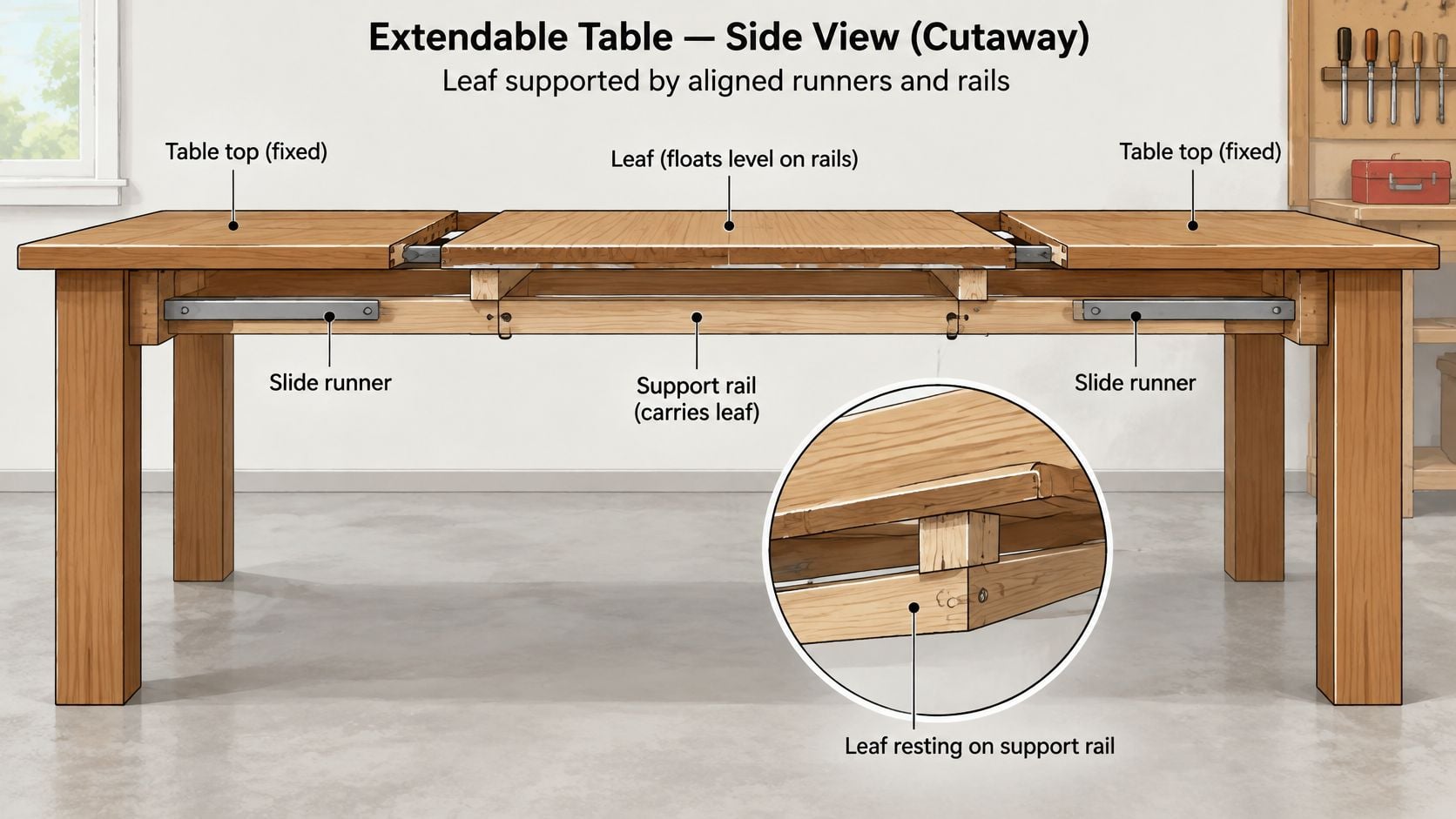
A butterfly leaf is the easiest to picture. Pull the two ends apart, a center gap opens, and the folded leaf stored inside rises, unfolds, and settles between the ends. According to a design guide to expandable dining tables, geared or equalized slides help the halves move evenly, while alignment pins and supported runners reduce lateral movement and keep the leaf level. That guide recommends leaves resting on recessed hardwood runners rather than the seam itself, with two or three 1/4-inch steel alignment pins per leaf along the long edges.
The mechanism isn't a decorative extra. Slides, supports, and alignment hardware decide how steady the table feels closed and fully extended.
Drop-leaf and gate-leg designs fold down at the sides, so they can sit narrowly against a wall. They're strong choices for tight rooms, provided there's floor space for gate legs to swing and the leaf supports lock firmly. Separately stored leaves add the most length for big gatherings, but they need nearby storage and careful handling so edges don't get dinged in a closet.
Three Questions That Narrow It Fast
Ask how often the table will be extended, how much room is available when it's closed, and whether leaves can be stored nearby. Weekly extending favors a butterfly leaf. Rare, very large gatherings favor stored leaves. A table that lives against a wall points to drop leaf or gate-leg.
Sizing Closed and Extended Tables for Your Room
Start with math, then test it on the floor. A useful planning rule is about 24 inches of table edge per seat along the long sides. Exact lengths vary by model, chair width, and whether anyone sits at the ends, so treat the table below as a starting example using one 12-inch leaf at a time.
Seats on long sides
Closed length
With one leaf
With two leaves
4 seats
about 44-48 in
about 56-60 in
about 68-72 in
6 seats
about 68-72 in
about 80-84 in
about 92-96 in
8 seats
about 92-96 in
about 104-108 in
about 116-120 in
10 seats
about 116-120 in
about 128-132 in
about 140-144 in
This idea has deep roots. The Metropolitan Museum of Art record identifies an American gate-leg drop-leaf table dated 1700-1750, and a related museum record describes a drop-leaf table with two demi-lune sections that could accommodate eight chairs when fully opened. Even then, the point was everyday efficiency plus occasional capacity. Shoppers who want more detail on measuring can start with this dining table size guide before they shop.
Tape Both Footprints Before Buying
Use painter's tape to mark the closed footprint and the fully extended footprint on the floor. Put the actual dining chairs inside the outline at their pulled-out positions, not pushed neatly under the table. Then sit down, get up, carry an imaginary serving dish to the kitchen, and walk to every exit.
Planning guidance for extendable dining table layout recommends roughly 36 inches of clearance between a table and an obstacle, with about 44 inches preferred where people regularly walk behind seated diners. For wheelchair and walker users, that same planning discussion notes approach space and knee clearance matter, with a 60-inch turning circle as a common reference, although requirements vary by jurisdiction and building type.
Checks That Expose a Bad Fit
Path to the kitchen: Confirm a person carrying dishes can pass behind seated diners without turning sideways.
Doorway swing: Open every nearby door with the extended outline taped down.
Mobility route: Check that a walker or wheelchair user isn't forced to reverse out of the dining area.
One-person operation: Confirm one person can open, support, and close the mechanism safely. If it needs two strong adults every time, it won't get used.
This matters in Metro Milwaukee condos, senior living settings, and multigenerational homes where the dining area also serves as a daily traffic lane. The honest takeaway is a little counterintuitive. A smaller table with a usable extension often beats a larger fixed table, because it preserves everyday circulation and adds seats only when they're needed.
Why Solid Wood Moves and What Construction to Check
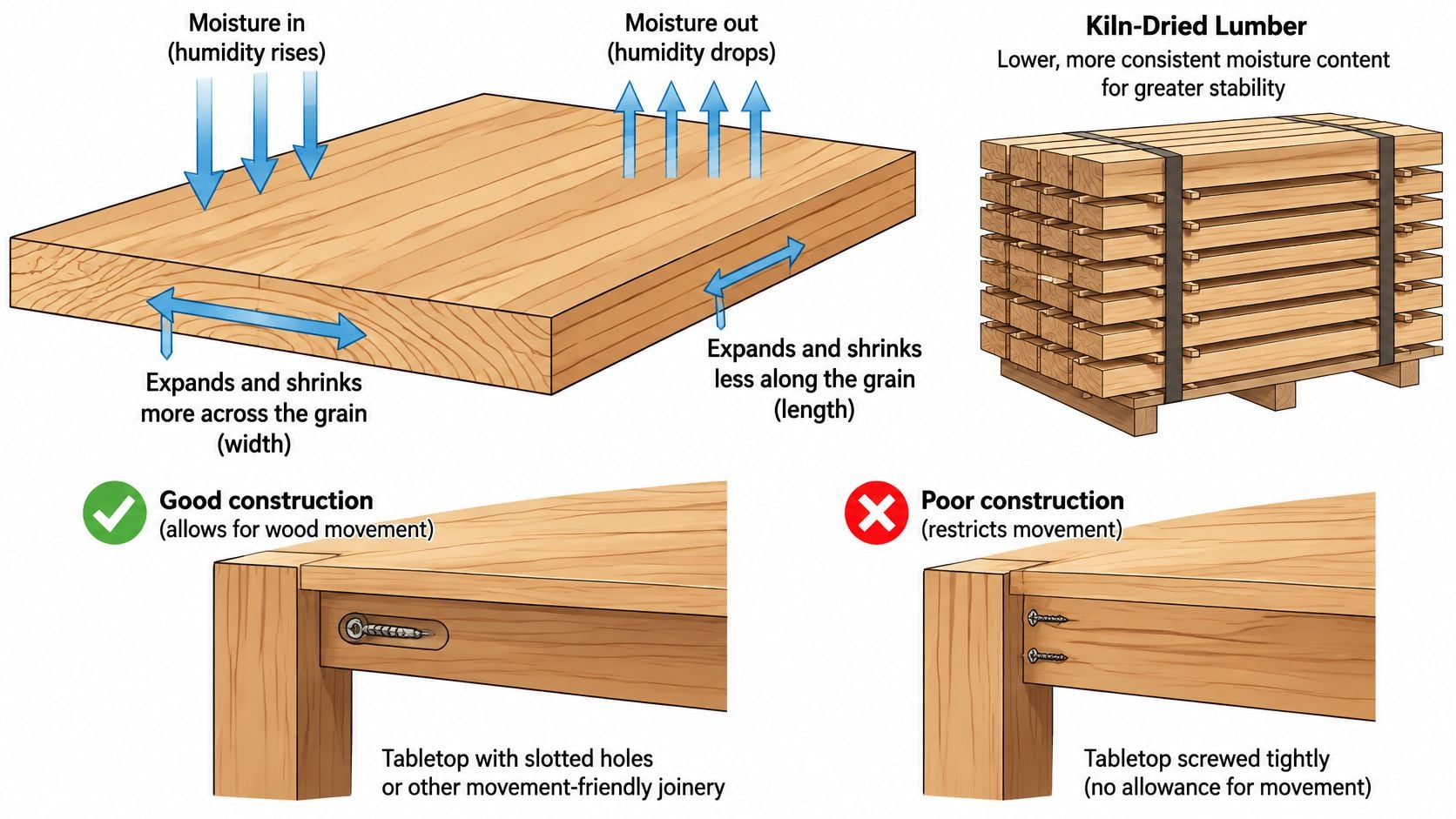
Solid wood isn't inert. It's hygroscopic, which means it gains and loses moisture with indoor air, and it moves much more across the grain than along it. USDA Forest Service guidance in its hardwood lumber drying reference indicates hardwood lumber used for furniture is typically kiln-dried to approximately 6-8% moisture content, a range intended to match common indoor equilibrium conditions.
If the top and leaves start at materially different moisture levels, each part shrinks or swells after delivery at a different rate. The results are familiar. Seasonal gaps open between leaves, slides feel tight, joints rise at the seam, and a top can cup.
Normal Movement Versus a Real Defect
Metro Milwaukee homes get heated, dry winter air and humid summer air, so some seasonal change is expected. A hairline gap that appears in January and closes by summer is normal movement. A split, a leaf that won't sit flush in any season, or a slide that binds hard enough to require force is a construction problem.
Plain truth: Solid wood is not automatically trouble-free. A wide top rigidly fastened to its base can crack because the wood still tries to move.
Better construction allows controlled movement. Elongated screw holes, figure-eight fasteners, and sliding connections let the top expand and contract without tearing joints apart. Strong frame joinery matters too, and shoppers curious about traditional joints can read about what a mortise and tenon joint is before comparing frames. Finish helps, but only to a point. It slows moisture exchange. It never stops it.
Showroom Questions Worth Asking
Matching stock: Were the leaves made from the same species and moisture-conditioned stock as the main top?
Movement hardware: Is the top fastened with elongated holes, figure-eight fasteners, or another sliding connection?
Finish coverage: Does finish cover all faces and edges, including leaf edges and the underside?
Seasonal adjustment: Does the maker allow adjustment of fasteners or slide hardware as seasons change?
Storage before delivery: Will the table be stored indoors before delivery, not in a damp warehouse space?
Placement helps at home too. Keep the table away from radiators, HVAC outlets, direct sun, and exterior doors. Stable placement reduces dimensional cycling, which helps slides keep working smoothly and leaves keep lining up.
How Leaves Stay Level and Supported
Wood choice gets the attention. Support underneath decides whether dinner plates sit level. Leaves should rest on properly aligned runners or support rails, not on the center seam or slide hardware alone.
Technical guidance in the Fine Woodworking guide to making a dining table expand identifies three critical operations. Mating edges must be accurately jointed, extension slides must be appropriately sized, and tabletop sections must be leveled after assembly. For longer tops, that guidance recommends additional support such as a concealed center stretcher or steel reinforcement to limit deflection across the opening.
Why Support Matters More When Extended
Bending loads grow when diners lean on the extended ends. A loaded leaf in the middle can amplify stress at an unsupported center, especially with a heavy serving dish sitting right on the seam. Alignment pins, hardwood runners, and tongue-and-groove or spline details resist lateral shifting, but they complement structural support. They don't replace it.
A table can feel rock solid closed and still sag or rack when opened if the base wasn't designed for the maximum length. Shoppers should judge the extended position as the product itself, because that's the position that justified the purchase.
Run This Test in the Showroom
Close it fully. Run a hand across the seam and confirm the top is flush with no raised center.
Open every leaf. Each section should move without binding, scraping, or a hard shove.
Check underneath. At full extension, confirm continuous support beneath every leaf, not just at the edges.
Ask about storage and limits. Find out where leaves store and the maximum recommended leaf count.
Test the lock twice. Work the locking or leveling system with the table closed and fully extended, then lean lightly on an end and watch for racking.
These five checks reveal whether a table is engineered for repeated conversion or only occasional decorative expansion. A good salesperson should welcome the test and open the table without being asked twice. If the mechanism needs excuses on the showroom floor, it'll need more excuses at home.
Wood Species and Finishes That Suit Daily Use
Choose species for the life the table will live. A household with kids, laptops, craft projects, and nightly dinners needs different surface forgiveness than a formal dining room used twice a month. Janka hardness, the pounds-force needed to embed a steel ball halfway into wood, is the standard way to compare dent resistance, but the practical ranking below is what matters at the table.
Species
Relative hardness
Grain and color
Best fit
White oak
High
Strong grain, warm tones
Busy family dining
Hard maple
High
Light, even grain
Bright, modern rooms
Red oak
Moderately high
Pronounced grain, reddish tone
Traditional style
Black walnut
Moderate
Rich dark brown, straight grain
Formal dining with a refined feel
Cherry
Moderate
Warm reddish tone that deepens over time
Classic, heirloom-style pieces
Eastern white pine
Soft
Soft, light grain
Relaxed rustic look, dents more easily
Hard maple and white oak resist dents best for busy family meals. Black walnut and cherry sit in the middle, with richer color and moderate hardness. Eastern white pine is the softest choice, so it suits a relaxed rustic look where small dents read as character rather than damage. Shoppers deciding between the two most requested looks can compare walnut versus oak furniture for grain and tone differences.
Grain, Color, and Finish
Oak grain stands out, maple reads light and even, walnut runs dark and straight, and cherry deepens over the years. Tabletop color varies from board to board, so ask to see a sample and confirm the leaves match the top's species and finish. A leaf that lives in a closet while the top sits in sunlight can age to a visibly different tone.
An oil finish gives a natural, touchable feel and makes spot repairs easier. Lacquer or polyurethane builds a harder surface that resists water rings and spills better. For daily family use, the harder film finish usually wins. For a quieter dining room, oil is easier to refresh at home.
BILTRITE carries Amish-made and USA-made solid wood dining pieces as craftsmanship categories, with affordable custom options for wood, finish, and hardware, plus fabric or leather choices for matching chairs. Ask to see species side by side in the showroom and compare grain in real light rather than on a screen.
Caring for Your Extendable Table Year After Year
Set expectations. A 2024 study modeling wood-product residence times reported furniture half-life estimates vary by country and dataset, with one country-specific example at just under 14 years and another analysis showing the average furniture half-life declining from 10 years to 8.5 years. A half-life isn't a guaranteed lifespan. It marks the modeled point where about half of items in a population are no longer in their original use.
That distinction matters. A well-maintained, repairable solid wood table can outlast average furniture turnover, especially when joinery can be serviced, hardware can be replaced, and the surface can be refinished. An extendable table has more functional parts, including leaves, hinges, slides, and alignment systems, so maintenance carries extra weight. Detailed habits are covered in this wood furniture maintenance guide, and the routine below covers what protects an extension mechanism most.
Use pads and coasters: Hot dishes and wet glasses cause most preventable surface damage.
Hold indoor humidity steady: Aim for roughly 35 to 55 percent, using a humidifier in heated winters and a dehumidifier in humid summers.
Open with both hands: Pull slides evenly from both sides rather than forcing one corner.
Recheck hardware twice a year: Tighten accessible fasteners and confirm leaf alignment when seasons change.
Dust with a soft dry cloth: Gritty dust acts like fine sandpaper under plates and laptops.
Refinish when wear shows: A worn solid wood surface can be renewed instead of replaced.
Repair and refinishing usually beat replacement for a table with sound joinery. It's cheaper, and the table keeps the size and fit the room was planned around.
Lifecycle research on wood furniture treats reuse, repair, and refurbishment as cascading pathways that extend a wood product's useful life, although durability alone doesn't automatically guarantee lower environmental impact. The buyer's version is simple. Choose stable joinery, serviceable hardware, and a surface that can be refinished, then do the small upkeep. That's how a table stays in service well past the averages.
Choosing Your Table and Visiting Our Greenfield Showroom
Pick the mechanism and size first, then the species and finish. Bring a tape measure, room measurements, and chair measurements to Greenfield, along with the clearances from a taped-floor test at home. In the showroom, pull the leaf out, run the five support checks, and open and close the table more than once. Ask where each leaf stores, how the slides feel, and whether species and finish match across the top and leaves. Shoppers comparing craftsmanship can also review what Amish furniture quality means in joinery and finishing before the visit.
Our family has run BILTRITE since 1928, and we're proud to serve Metro Milwaukee as a 4th generation, family-owned store. Our sales associates bring over 400 years of combined experience, and they're here to help, not to pressure. We don't sell online, because a table's slide action, leaf fit, and finish color can't be judged from a product photo. We're closed on Sundays to be with our families, so plan a visit for another day.
Come on down to our showroom and see for yourself. Test the extension with your own hands, sit in the chairs, and ask every question on the checklist. That's how a table choice gets made with confidence.
At BILTRITE, shoppers will find USA-made and Amish-made solid wood dining tables, small-scale options for condos and senior living, affordable custom choices, and a team that helps without pressure. Visit BILTRITE Furniture-Leather-Mattresses to plan a Greenfield showroom trip, open an extendable table in person, and confirm the closed and extended fit before ordering.