Solid Wood Furniture vs Veneer: A Family Guide

Shopping for a wood table or bedroom set can feel strangely stressful. Two pieces can look almost the same from across the showroom, yet one tag says solid wood and the other says veneer, and suddenly you feel like you need a furniture engineering degree just to buy a dresser.
We’ve helped families sort through that question for generations. At BILTRITE, we’ve been serving Metro Milwaukee since 1928, and one of the most common conversations we have is still this one: “What’s the difference, and which one makes sense for my home?”
That’s a good question, because solid wood furniture vs veneer isn’t just about materials. It’s about how your furniture will handle weeknight dinners, kids doing homework at the table, dry Wisconsin winters, humid summers, moving day, scratches, spills, and whether you want this piece for a handful of years or for a very long stretch of family life.
Welcome to the Great Furniture Debate
A lot of shoppers walk in thinking this decision should be simple. Wood is wood, right?
Then they start looking closer. One dining table has rich grain and a heavier feel. Another has a cleaner price tag and a very smooth, uniform top. A bedroom chest looks beautiful, but the product description includes terms like MDF, engineered wood, veneer, hardwood solids, and suddenly the whole thing gets muddy.
That confusion is normal. We’ve seen it for decades, and it’s one reason we enjoy these conversations so much. Furniture shopping shouldn’t feel like a quiz. It should feel like getting helpful advice from someone who’s been around this stuff a long time.
We’re a fourth-generation family business, and that history shapes how we talk about furniture. We don’t believe every piece needs to be solid wood. We also don’t think every veneered piece belongs in the “cheap” category. What matters is how the piece is built, where it’s going, and what your family needs it to do.
The question behind the question
The question isn’t really, “What is veneer?”
They’re asking things like:
- Will this hold up to daily use?
- If my child scratches it, can it be fixed?
- Will I regret saving money up front?
- Is this something I’ll still like years from now?
- Does this make sense for a starter condo, a family dining room, or a forever home?
Those are the right questions.
Neighborly advice: The smartest furniture purchase usually isn’t the least expensive one or the most expensive one. It’s the one that fits how your home actually works.
If you want a deeper look at why many families still gravitate toward real wood pieces, our guide on the benefits of solid wood furniture is a helpful companion.
Before we get into durability, style, and long-term value, let’s clear up the basic definitions in plain English.
What Are Solid Wood and Veneer Anyway
The easiest way to understand this is to start with what’s under the finish.
Solid wood means the visible wood parts are made from actual boards of wood. Think of a plank cut from a log, shaped and joined into a table top, dresser front, or bed frame. When you see grain on the surface, that wood character continues through the piece instead of stopping at a thin top layer.
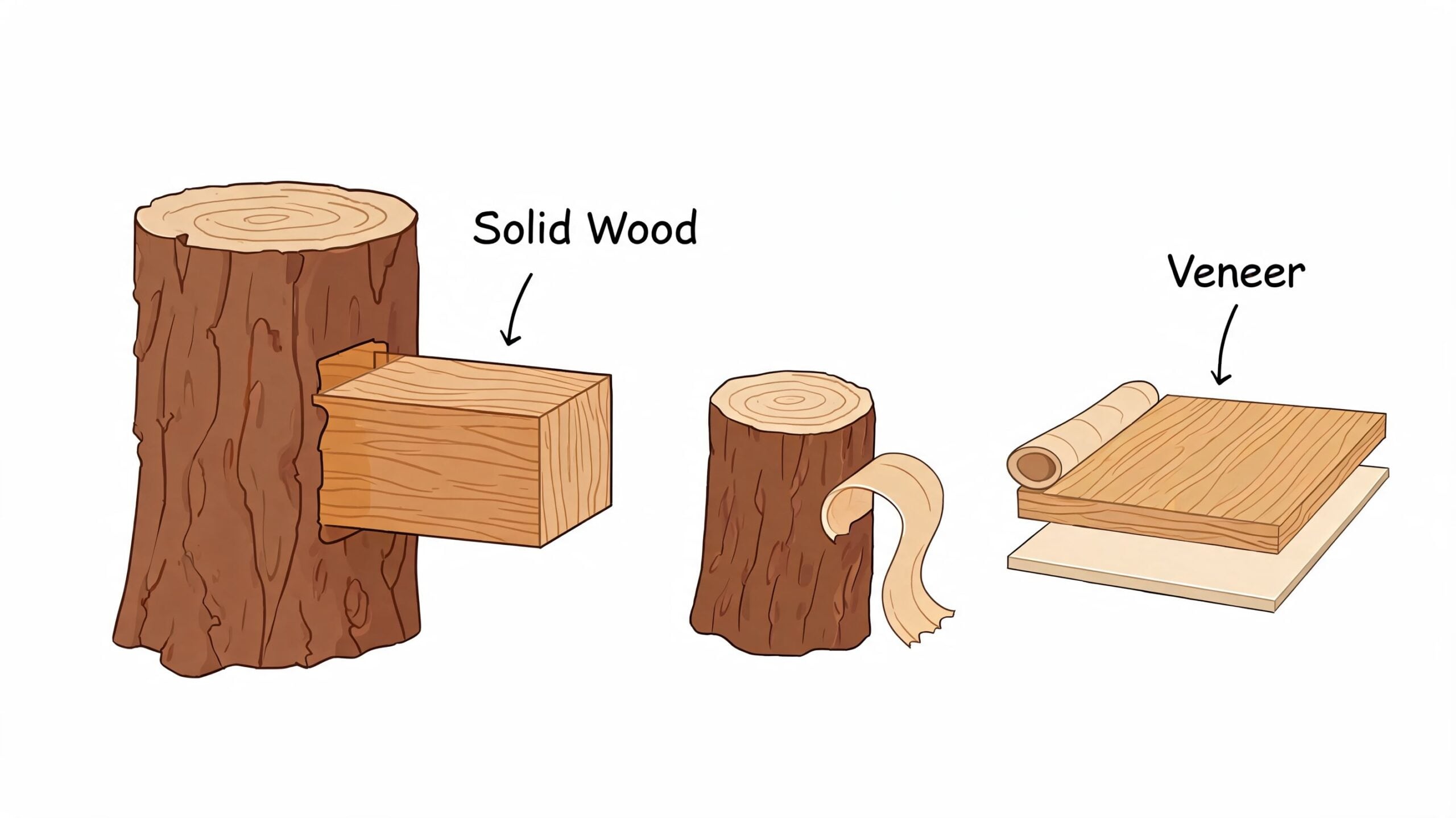
Veneer is different. Veneer uses a thin slice of real wood on the outside, attached over a core material such as MDF, plywood, or particleboard. So yes, the top layer is still real wood. It just isn’t solid wood all the way through.
A simple way to picture it
Think about a solid wood table like a loaf of bread baked from one dough all the way through.
A veneered table is more like a layer cake. The outside can still look beautiful and real, but the inside is made of different layers with different jobs.
That’s where shoppers often get tripped up. They hear “real wood veneer” and assume that means the whole piece is the same as solid wood. It isn’t. The surface may be real wood, but the core construction changes how the furniture behaves over time.
Why manufacturers use both
Solid wood brings authenticity, depth, and repair potential. That’s a big reason it shows up so often in USA-made and Amish-crafted furniture.
Veneer exists for practical reasons too. It can make furniture more affordable, and it can help with stability on large flat surfaces. If you’ve ever wondered why a large cabinet side or broad dresser top might be made this way, the answer often comes down to balancing looks, structure, and cost.
Here’s a quick side-by-side view:
| Feature | Solid wood | Veneer |
|---|---|---|
| What it is | Boards of real wood throughout visible parts | Thin real wood layer over an engineered core |
| Feel | Often heavier, with natural variation | Often smoother and more uniform |
| Surface depth | Grain has visual depth and character | Real wood look on the surface |
| Repair potential | Better suited for sanding and refinishing | Limited because the wood layer is thin |
| Common use | Dining tables, heirloom pieces, Amish furniture | Large panels, cabinet fronts, budget-conscious designs |
One more term that helps
You’ll also hear engineered wood. That’s the category for materials like MDF, plywood, and particleboard that are made from wood fibers, layers, or particles bonded together. They aren’t automatically bad. They just serve a different purpose than solid lumber. If you want that explained in everyday language, our article on what engineered wood furniture is breaks it down clearly.
Solid wood is about full-thickness wood construction. Veneer is about a real wood appearance over a different core.
Once that clicks, the rest of the comparison gets much easier.
A Friendly Head-to-Head Furniture Comparison
Saturday morning. Pancake syrup lands on the table, a backpack gets dragged across the side, and by dinner the same spot is covered with homework, elbows, and hot plates. That is how many Milwaukee families use furniture every day, and after more than 90 years of helping local families choose pieces for real homes, we can tell you this question usually comes down to one thing. How will this furniture age with your family?
Durability in everyday family life
A dining table in a busy home lives a very different life than a nightstand in a guest room.
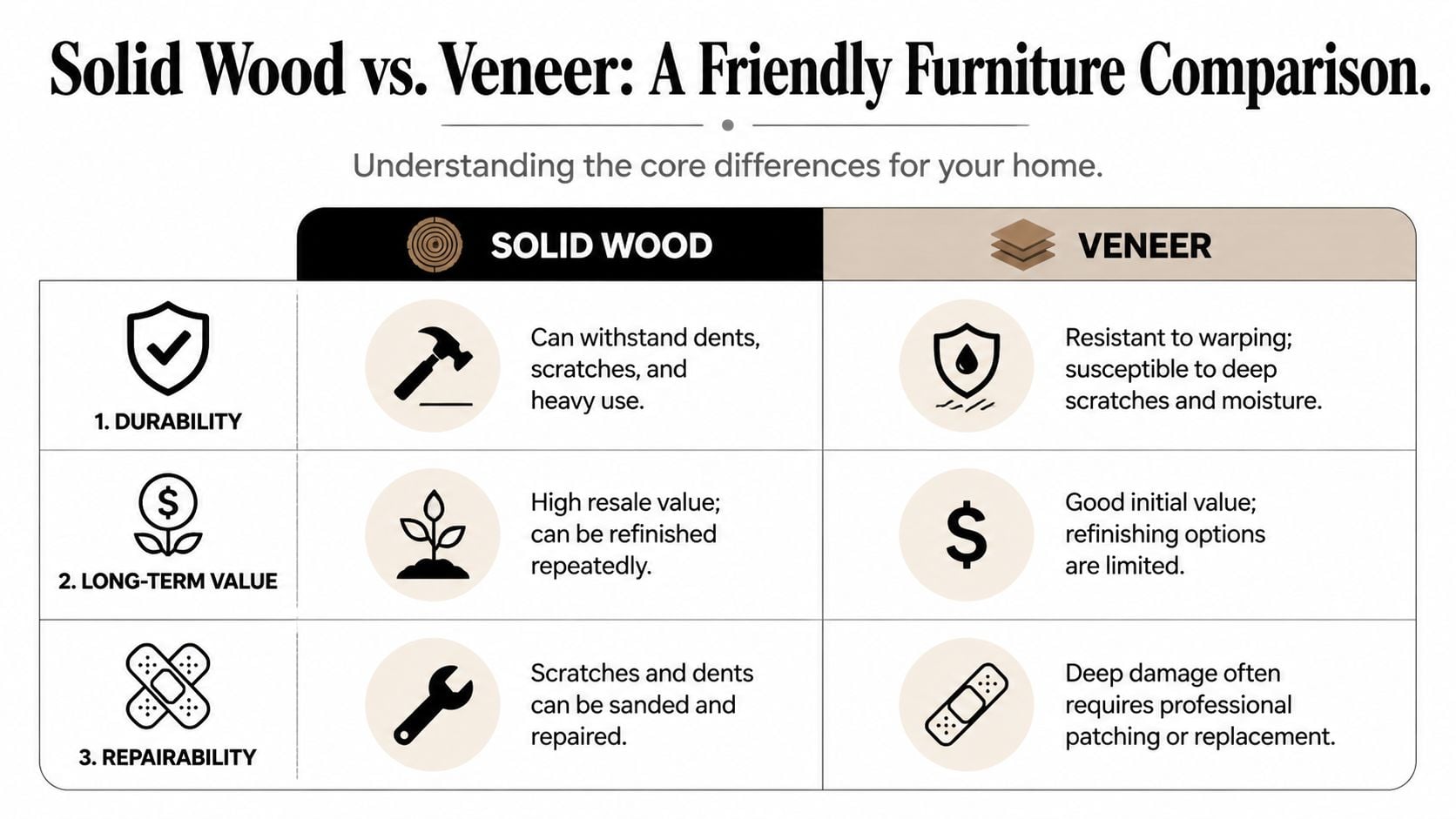
Solid wood usually gives you more margin for error. Small dents, light scratches, and years of use tend to look like part of the story rather than the end of the piece. Veneer can hold up well too, especially in lower-traffic rooms, but surface damage is often harder to shrug off if the top layer gets chipped or moisture reaches the core.
Construction matters here too. CUTR notes that solid wood often holds screws, nails, and glue more reliably than fiberboard-type cores, veneer layers are thin, and the long-term cost picture can shift when a solid wood piece can be refinished while a damaged veneered piece may need replacement sooner, as explained in its wood veneer vs solid wood comparison.
That sounds technical, so here is the plain-English version. A solid wood piece often gives you more chances to recover from normal family wear.
The repair question many shoppers ask too late
This part surprises people.
Solid wood can often be sanded and refinished, sometimes more than once, depending on the piece and the damage. That means a water ring from a plant, marker from a school project, or the scuffs that build up over years do not always send the furniture to the curb.
Veneer has less room for repair because the wood layer on top is thin. Light touch-up may be possible in some cases, but deeper sanding can go through the surface. Once that happens, the repair gets much more limited.
For families, this matters more than it sounds like it should. Furniture in a home with kids is not judged only on how it looks on delivery day. It is judged on how it looks after birthday parties, winter boots, sick days on the couch, and a decade of ordinary living.
Simple rule: If the piece will see spills, bumps, art projects, or daily use, repair options should be part of the decision.
Upfront price and the cost of living with it
Veneer often wins the first-price comparison. That can be a smart choice for a first home, a guest bedroom, a home office, or any room where you want a polished look without stretching the budget.
Solid wood usually asks for more up front, but many families are not shopping only for this year. They are shopping for the years when kids grow, rooms change, and a dresser or table may need a fresh start instead of a full replacement. That is where solid wood can earn back some of its higher price.
At BILTRITE, we have seen both choices make sense. The best fit depends on whether you are buying for a season of life or for the long haul.
A quick decision table
| If this sounds like you | Solid wood may fit better | Veneer may fit better |
|---|---|---|
| Busy family dining room | Yes | Maybe |
| Kids doing homework at the table | Yes | Maybe |
| Guest room or occasional-use piece | Maybe | Yes |
| Want to refinish years later | Yes | No |
| Need lower upfront cost | Maybe | Yes |
| Want something to keep a very long time | Yes | Maybe |
Where we usually steer neighbors
Over the years, a few patterns show up again and again.
- Choose solid wood for dining tables, primary bedroom furniture, desks that get used every day, and pieces you hope your family will still be using years from now.
- Choose veneer for guest spaces, lower-traffic rooms, or style-first pieces where a consistent look and lower starting price matter most.
- Slow down and ask questions if a piece is priced like a long-term investment but built more like a short-term solution.
If you want to compare one more common construction type, our guide to solid wood furniture vs particle board can help you sort out another part of the quality question.
Style Stability and Finding Your Look
Not every furniture choice comes down to battle toughness. Sometimes the question is, “What’s going to look right in this room and stay looking right?”
That’s where veneer earns real respect.
Why veneer can look so polished
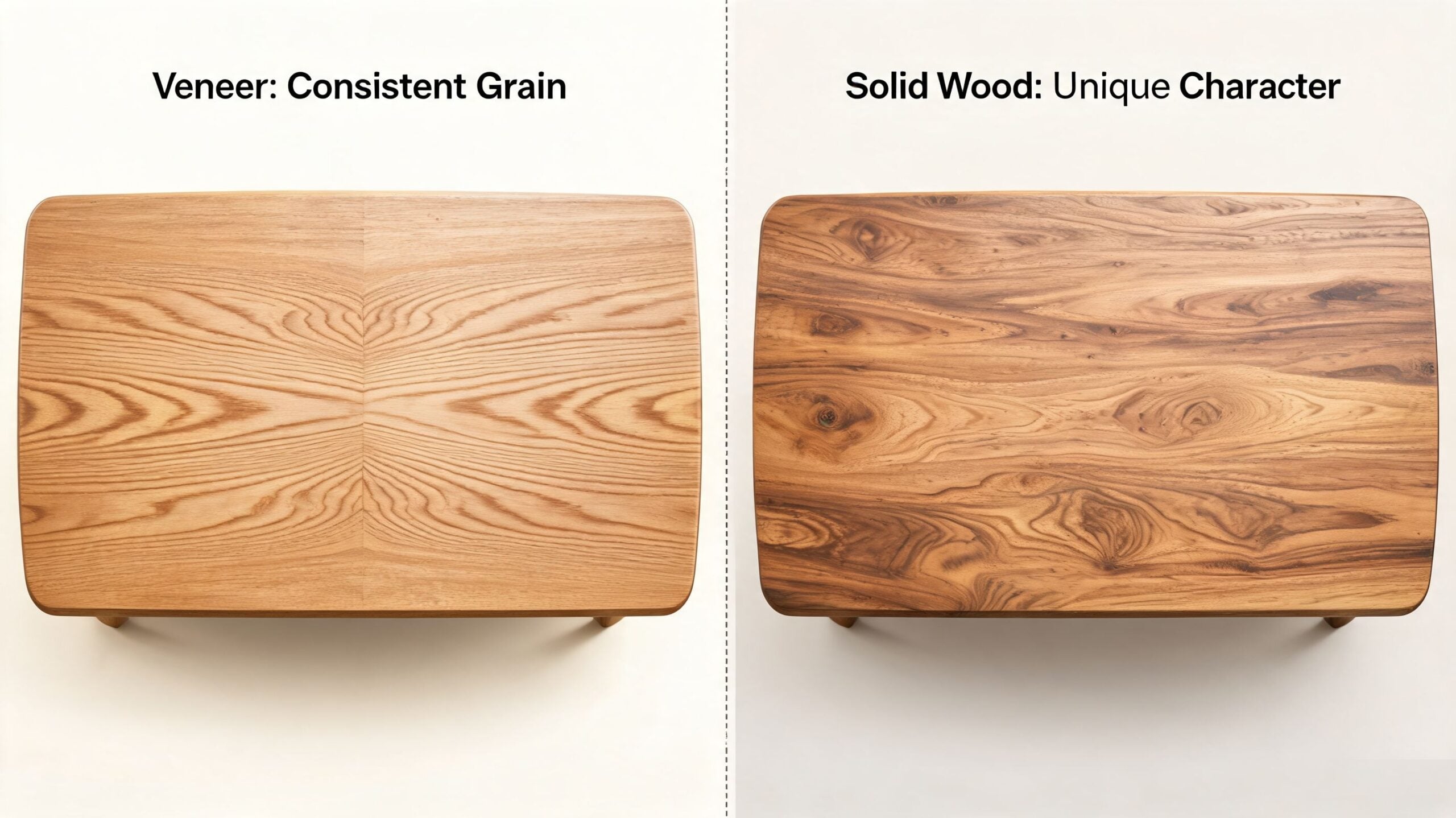
Veneer allows manufacturers to create broad, consistent grain patterns across panels, doors, and drawer fronts. It can also produce matched patterns that look clean and intentional in modern designs.
That visual consistency is hard to get at scale with solid boards, because solid wood naturally varies. Many people love that variation. Others want a calmer, more uniform look, especially in contemporary bedrooms, entertainment walls, and sleek dining collections.
Wisconsin weather matters
Our local climate is part of this conversation too.
Wood is a natural material, and solid wood responds to humidity and temperature changes. It can expand and contract as seasons change. Quality construction helps manage that movement, but it’s still part of how real wood behaves.
Veneer over an engineered core is often more stable on large flat surfaces. According to Artezia’s explanation of veneer stability and wood use, slicing a single log for veneer can yield 10 to 40 times more decorative surface area than sawing it into solid lumber, and veneer on MDF or plywood is highly resistant to warping, cracking, and bowing in spaces with changing humidity.
That’s one reason veneer is often a smart structural choice for:
- Tall cabinet doors that need to stay flat
- Wide wardrobe panels with a smooth, consistent face
- Large casegoods tops where stability matters
- Certain modern designs that rely on even grain across a broad surface
Some of the strongest furniture choices aren’t “all solid wood” or “all veneer.” They’re thoughtfully designed pieces that use each material where it makes the most sense.
Style isn’t one-size-fits-all
Solid wood usually gives you more natural variation, visual depth, and that handcrafted character many families want in Amish-made furniture.
Veneer often gives you sleek symmetry and a more controlled look.
Neither style is wrong. The right one depends on your taste, the room, and how much natural variation you want to live with day after day. If you’re still sorting through looks, our guide to different furniture styles can help connect material choices with the overall feel you want at home.
The Environmental Story Behind the Wood
This part deserves an honest answer, because the environmental story is not as simple as “uses less wood” or “lasts longer.”
The case for veneer
Veneer is resource-efficient. Because it uses thin slices of wood, it stretches each log much further than solid lumber can. That means more decorative surface can come from a single tree, which can support affordability and reduce pressure on premium species.
If you’re focused on using wood carefully, that’s a real point in veneer’s favor.
The part many shoppers don’t hear
The full lifecycle of veneered furniture can be more complicated than the showroom tag suggests.
The process often involves adhesives and engineered cores like MDF, which can contain formaldehyde and other VOCs. By contrast, locally sourced solid wood, especially from Amish craftsmen using traditional joinery and lower-impact finishes, often involves less chemical processing and less transportation energy, as described in this discussion of veneer’s environmental tradeoffs and local solid wood production.
That doesn’t mean every veneer piece is environmentally poor or every solid wood piece is automatically the greener answer. It means you have to look beyond the surface.
Three practical environmental questions to ask
- How long will this stay in my home? A longer-lasting piece can reduce replacement cycles.
- What is the core made from? The answer helps you understand chemical processing and construction.
- Where was it made? Local or regional production can reduce transportation and support makers closer to home.
A furniture piece’s environmental impact comes from the whole journey. Materials, adhesives, manufacturing, shipping, lifespan, and disposal all matter.
For many Milwaukee-area shoppers, this is one reason American-made and Amish-made furniture feels like a meaningful choice. It isn’t only about appearance. It’s also about knowing more clearly how the piece was built and how far it traveled. If that matters to you, our guide to American-made furniture companies offers a helpful starting point.
Let Our Family Help Your Family Choose
A family of five shops for a dining set on Saturday, then comes back a few years later with a different question. The kids are older. Homework happens at the table now. A chair has taken a few hard scoots across the floor. Someone wants to know, "Should we have bought solid wood?"
After helping Milwaukee-area families make this choice for more than 90 years, we can tell you the answer usually comes down to one practical question. How will this piece live in your home?
Choose solid wood for the furniture that becomes part of family life. Dining tables, bed frames, dressers, desks, and other daily-use pieces often have to handle bumps, spills, movement, and years of use. Solid wood gives you more room to repair, refinish, and keep the piece going instead of replacing it when life leaves a mark.
Choose veneer when the piece needs to solve a different problem. It can be a smart fit when you want a lower starting price, a polished and consistent look, or a large surface that stays more uniform. That often makes sense in guest rooms, condos, apartments, or spaces that do not get heavy everyday wear.

Our simple hometown advice
For the long haul, solid wood usually makes more sense.
For a tighter budget, a specific design goal, or a lighter-use room, veneer can be the better fit.
If you're still unsure, stop judging the piece from the front only. Furniture works a lot like a house. The paint color matters, but what matters more is what is underneath, how it is joined, and how it holds up after years of real life. Open the drawers. Feel the edges. Look under the top. Ask what the core is made from. Ask what kind of wear the piece is built to handle.
That hands-on part matters. At BILTRITE Furniture-Leather-Mattresses, shoppers can compare USA-made, Amish-made, solid wood, and other construction types in person and get a clearer sense of what suits their home.
Why seeing it in person helps
Photos miss the details families end up living with.
- How the top feels under your hand
- Whether the grain has natural depth or a more uniform appearance
- How the drawers open and close
- Whether the finish looks warm and natural in real light
- If the piece feels sturdy enough for your household
Our team spends a lot of time helping people sort through those differences in plain language. No pressure. Just real conversations about who will use the piece, how often, and what you want it to look like five or ten years from now. That family-first approach matters to us because we live here too, and we know furniture decisions are rarely just about furniture. They are about dinners, holidays, kids, guests, storage, and whether a piece still works as your family changes.
The right furniture choice should fit your life on an ordinary Tuesday, not just look good in a showroom.
If you're in Greenfield or anywhere around Metro Milwaukee, come by with room photos, measurements, and questions. We are happy to help you compare the options and talk it through like neighbors do.
We’d love to help you sort through solid wood, veneer, Amish-made, USA-made, small-scale, or heavy-duty options in person at BILTRITE Furniture-Leather-Mattresses. Stop into our Greenfield showroom, say hi, and let our family help your family find furniture that fits your home, your style, and the way you live.