OPEN MONDAY, NOVEMBER 23 10AM TO 6PM!
GREBE'S DONUT GIVEAWAY MONDAY, NOVEMBER 23 ONLY!
BLACK FRIDAY + SMALL BUSINESS SATURDAY DEALS ON NOW!
NO CREDIT CARD FEES!
1000's of Items IN-STOCK + 500 Mattresses!
Largest selection of USA Made Furniture & Mattresses + Amish Made!
FREE In-Store Design Services!
BUY LOCAL & LOVE YOUR HOME!
Tuesday-Thursday 10am to 6pm | Friday 10am to 7pm | Saturday 10am to 5pm | Sunday Closed To Be With Family & Friends | Monday Showroom Closed
5430 West Layton Ave, Greenfield - Metro Milwaukee
What does kiln dried hardwood mean, and what should you look for beyond the label? It is lumber dried inside a controlled kiln on a schedule suited to its species and thickness. Furniture wood is commonly dried to about 6-8% moisture content, according to Purdue Extension's guidance on drying hardwood lumber. That figure offers a useful reference when you are comparing solid-wood furniture.
The kiln sets the wood's condition at one point in time. Afterward, a board continues exchanging moisture with the air around it, much like a sponge responding to a room's humidity. A Milwaukee living room in January can be far drier than the kiln's final stage, while a lower-level family room in July can be damper.
So, “Is it kiln dried?” is a useful first question, but it tells you only part of the story. Ask how the lumber was stored after drying and how the finished piece is built to handle seasonal changes. Kiln drying sets a starting point; the construction and the room shape what happens next.
What does a kiln do to lumber? It provides a controlled chamber where heat, airflow and humidity work together to remove moisture at a measured pace. Adjusting any of these conditions changes the drying schedule, so mills can produce different results even with the same wood species.
Wood is hygroscopic: it gains or loses moisture until it reaches equilibrium moisture content (EMC) with the surrounding temperature and humidity. The kiln brings lumber closer to a moisture level suited to its intended use, rather than drying it as much as possible.
Three reference points help explain the process. Purdue Extension, drying hardwood lumber puts the furniture target at about 6-8% moisture content, measured against the wood's oven-dry weight. It also identifies roughly 28-30% as the fiber saturation point for many North American woods, the point below which substantial shrinkage begins.
Reference point
Typical value
What it tells you
Fiber saturation point
roughly 28-30%
Shrinkage begins as wood dries below this level
Furniture lumber target
6-8%
A common drying target for indoor furniture
Conventional kiln temperature
110-180°F
A range used for much hardwood lumber in conventional kilns
Above the fiber saturation point, water remains in the cell cavities, and the board's dimensions change very little. Below that point, moisture leaves the cell walls, so the wood begins to shrink. The change from roughly 28% moisture to the single digits therefore calls for careful control.
A useful comparison is a dense sponge: wood keeps exchanging moisture with the air around it. Its species, density and grain structure affect how it responds as moisture changes, which is why the kiln label alone cannot tell you how a finished piece will hold up. For more on how hardwood choice affects durability and appearance, see this guide to choosing the right hardwood for longevity and style.
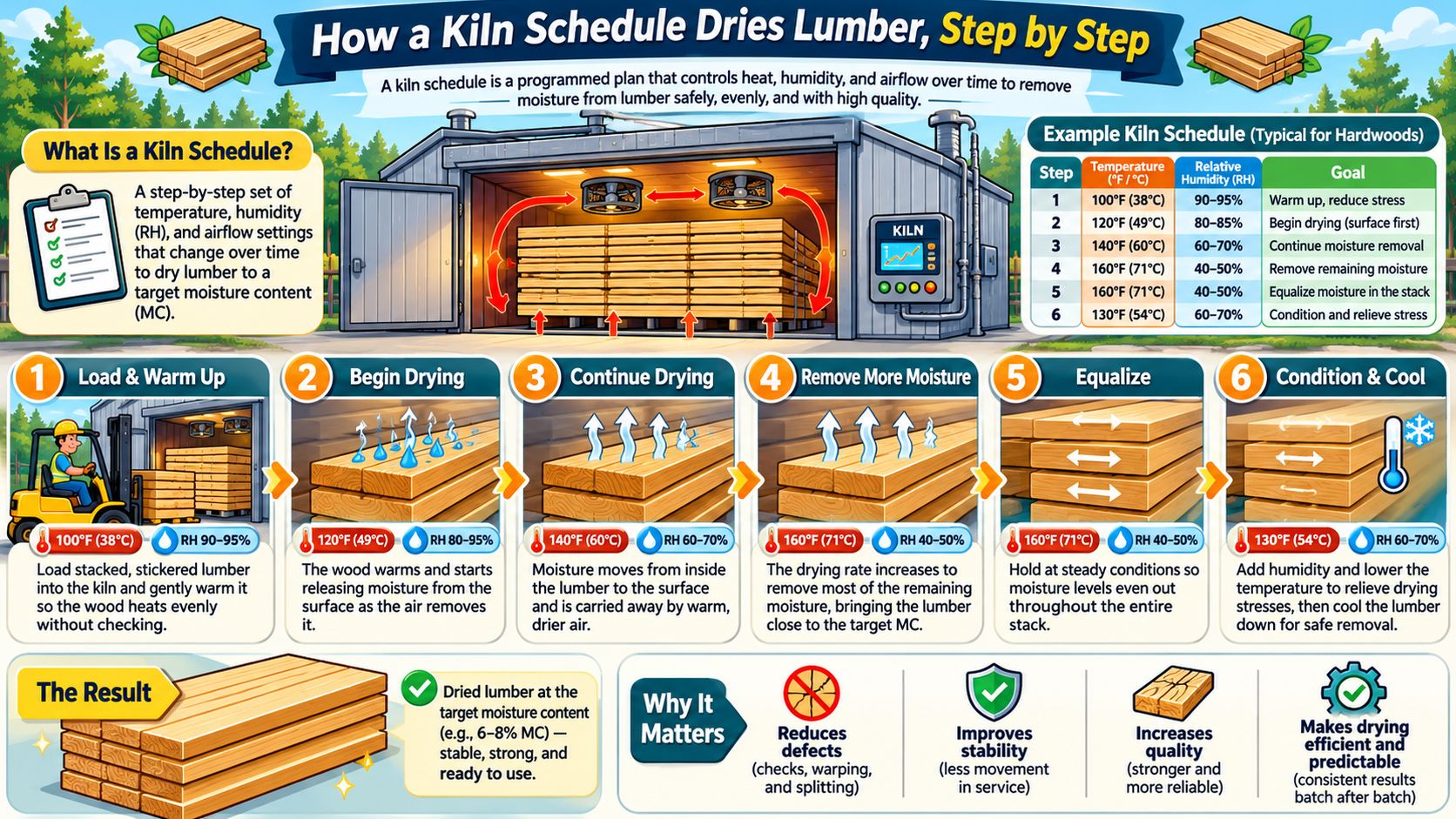
How a Kiln Schedule Dries Lumber, Step by Step
Here's how a well-run load moves through the cycle.
Conventional hardwood kilns commonly operate between 110°F and 180°F, the range the USDA Forest Products Laboratory kiln drying chapter identifies as conventional for much hardwood lumber, including steam-heated kilns and some dehumidification kilns running up to about 160°F. The heat doesn't cook the board from the outside. It coaxes moisture from the interior toward the surface, where air movement carries it away.
Stack the boards with spacers. Green lumber goes onto stickers so air reaches every face, which lets the bulk of the free water leave before the kiln ever switches on. The common slip is misaligned stickers, which lets a stack settle into a bowed shape it keeps.
Sort by species and thickness. Dense woods such as hickory and beech dry more slowly than lighter species, and thick boards dry more slowly than thin ones. Mix 4/4 and 8/4 stock in one charge and the thin boards overdry while the thick ones are still wet in the middle.
Start cool and humid. An early stage that's gentle on the surface keeps the outer shell from shrinking ahead of the wet core. Skip it and end checks open before the schedule is even halfway through.
Raise heat in stages while the fans run. Each step up in temperature pulls more moisture out of the interior. Circulating air is what carries that moisture off the board.
Pull sample boards and check them. Weigh or meter the samples against the target for that stage rather than trusting a clock. Wood doesn't dry on a schedule you can set with a timer.
Change conditions when the samples hit the target. The same USDA chapter notes that kiln conditions are changed when the relevant kiln samples reach the moisture level specified for that stage. The measurement drives the next setting.
Equalize, then condition. Equalizing evens out moisture across the load, and conditioning relaxes the internal stress that built up during drying. Skip this and boards can case-harden, staying stressed long after the meter says they're dry.
Cool the load and store it under cover. Dry lumber left in humid air takes moisture right back on. Storage conditions matter as much as the kiln itself.
The whole sequence is a managed process of heat, humidity, airflow, time and measurement. A well-run schedule leaves boards that meter within a point or two of each other across the load and machine without cupping, springing or a hard, glassy shell.
Air Dried Versus Kiln Dried Lumber
Air drying and kiln drying are two stages of one job: removing moisture from lumber so it can be used in furniture. Mills may begin by air drying boards, then use a kiln to bring them closer to the moisture level needed indoors.
For air drying, green boards are stacked with spacers under cover, allowing moving air to remove moisture gradually. The process costs less and gives internal stress time to ease. In most climates, though, outdoor air cannot dry boards to the low moisture levels suited to indoor furniture. The wood stops drying when it reaches balance with the surrounding air.
A kiln finishes the drying in a chamber with controlled temperature and humidity. Starting with air drying can also reduce the energy needed later: USDA Forest Service research reports that removing each 1 percentage point of moisture by air drying can save approximately 50 to 85 Btu per board foot during the following kiln stage (USDA Forest Service, drying hardwood lumber). The research also notes that commercial experience supports established kiln schedules for North American hardwood lumber 8/4 thick and thinner, covering boards up to roughly two inches, which includes most furniture parts.
For shoppers, the label describes a step in the wood's preparation, not a guarantee of how the finished piece will perform. A board described only as air dried probably has not gone through a kiln and may remain above the moisture level suited to indoor use. Ask whether the lumber was kiln dried, then assess the furniture's construction and care needs.
Why Kiln Dried Wood Still Moves After It Leaves the Kiln
Green lumber is a moving target. It shrinks as it dries, and it does not shrink evenly, because wood across a board's width changes size at a different rate than wood along its length. Kiln drying pulls most of that change forward into the mill, where it can be managed, measured and cut away before a piece is ever assembled. USDA Forest Service guidance states that kiln schedules are adjusted to wood species, thickness, moisture content and stress condition to minimize shrinkage-related defects (USDA Forest Service, wood drying research).
That schedule sets a starting moisture level. It does not freeze the board in place.
Dense species make the job harder. Hickory and beech generally shrink and swell more than lighter woods, and the movement is anisotropic: tangential and radial dimensions change at different rates as moisture content shifts. A wide tabletop moves more across its width than along its length.
The four defects a good schedule is built to avoid
Defect
What it looks like
Kiln control that reduces it
Checking
Cracks along the surface or at the ends of the board
Gradual moisture removal that avoids a fast-drying surface
Honeycombing
Internal cracks hidden inside the board
A slower schedule that manages internal stress
Warp
Boards bow, cup or twist
Stress control and even drying through the thickness
Case-hardening
Outer shell dries too fast while the inside stays wet
Humidity adjusted to protect the surface during drying
Some of these never show up on a lumber stack. Checks may only open after machining. Honeycomb sits hidden inside the board until a saw exposes it. Case-hardening announces itself when a board is ripped and the two halves spring apart.
Why a dry board still breathes
Wood keeps exchanging moisture after drying. A board dried to 6% moisture content and placed in an environment corresponding to about 13% EMC can regain moisture over time and swell, while the same board in dry indoor air loses moisture and shrinks, which is why wood should be installed near its expected in-service moisture content to reduce dimensional changes, furniture cracks and related defects (USDA Forest Service, wood moisture and use).
In an Upper Midwest home, that in-service level is not one number. Winter heating drops indoor humidity hard, and a humid July pushes it back up.
What this means in practice: a solid wood tabletop that opens a hair at a seam in February and closes again in June is responding to indoor humidity, not failing the kiln. Stable indoor humidity and a proper acclimation period can matter nearly as much as the drying that happened at the mill.
The cut of the board plays a role here as well, since grain orientation changes how much a piece moves across its width. Quarter sawn oak is the classic example of a cut chosen partly for stability, and this explanation of what quarter sawn oak furniture is shows why the saw pattern on the face tells you something about how the piece will behave.
Every customer who buys wood furniture or a mattress from BILTRITE Furniture-Leather-Mattresses receives written care information, which is where habits like keeping indoor humidity steady start paying off.
What to Ask Before Buying Solid-Wood Furniture
A kiln-dried label tells you how lumber was dried, not how the finished piece was built. Kiln drying is process control. It does not rate strength, and it says nothing about craftsmanship on its own (Purdue Extension hardwood drying guide). Ask questions about the wood, construction, and finish to understand what the label leaves out.
What species is it, and which parts are solid? Species affects how wood responds to moisture. Ask whether the top, frame, drawer fronts, and panels are solid wood or engineered material.
What is the lumber's final moisture range? Ask for a specific range and whether the maker checks moisture before assembly.
Were the boards stress-relieved after drying? Ask how the lumber was checked for drying stress, especially if boards were resawn or machined after drying.
How long did the lumber acclimate before assembly? Ask whether it had time to adjust to conditions close to where the furniture will be used.
Which joints allow wood to move? Ask how panels and frames accommodate seasonal movement. A mortise and tenon joint can create a strong frame connection, while the design still needs to allow cross-grain parts to move.
How is the finish applied, and how many coats are used? A finish slows moisture exchange at the surface. Ask what finish protects the piece and how it is maintained.
Do the drawers and doors fit cleanly? Check that gaps look even and that drawers and doors move smoothly.
What is the piece rated to hold? Ask for a load rating when capacity matters. Drying does not determine how much a table, bench, or other piece can support.
Listen for answers that explain the choices behind the build, not just the drying label. Specifics about materials, joinery, and finish help you judge the piece; if an answer is unclear, ask for it to be explained in plain language.
A helpful salesperson should be comfortable walking through these questions without pressure. They are a practical part of choosing solid-wood furniture.
How Kiln Drying Plays Out in Real Homes
Where the piece lives
Main movement risk
What to check
Dining table in a heated home, Wisconsin winter
Dry air pulls moisture out, the top shrinks and seams open slightly
Is the top built with floating panels or fasteners that let it move?
Dresser in a lower-level room, humid summer
Wood absorbs moisture and drawers or side panels swell and stick
Were drawer sides and case panels given room to expand?
Kitchen cabinetry near a steamy range
Repeated humidity swings stress doors and panels
Do doors and end panels have clearance to move?
Heavy-duty bench or bed frame used daily
Joinery and frame construction carry the load
How is the frame joined, and what is it rated for?
A room can be managed. Keep indoor humidity reasonably steady, avoid pushing a piece right against a heat vent or a damp exterior wall, and let new furniture settle in place for a few days before loading drawers or hanging anything on it. Small adjustments early are easier than fixing a split panel later.
These are normal patterns in solid wood, which is why the goal is a piece built to move well rather than a piece that never moves. A short guide to wood furniture maintenance covers the seasonal side of that in more detail.
Visit Our Greenfield Showroom to Feel the Difference
How can you tell whether solid-wood furniture is built to handle everyday use? Start by looking closely at the piece, then ask how its wood was dried and how the furniture was constructed. Kiln drying sets a starting point, not a guarantee: the finish, joinery, and room conditions matter too.
At BILTRITE, you can feel a finish, test how a drawer closes, and sit on a frame while comparing pieces. Ask how the wood was dried and acclimated, and how the construction allows it to move as humidity changes. The showroom carries solid wood, Amish-made, and USA-made furniture, along with small-scale and heavy-duty options.
Bring the checklist from earlier in the article to compare answers on different pieces. Room measurements can help you assess fit, and details about the room's humidity can make your questions more specific. Ask about drying and acclimation, too. A clear answer can help you understand what the kiln process does, and what the furniture's construction must do afterward.
Before visiting, read this guide to Amish furniture quality for more context on the craftsmanship of Amish-made pieces.
Visit BILTRITE Furniture-Leather-Mattresses at 5430 West Layton Avenue in Greenfield to compare solid-wood furniture in person and ask the team about the details that matter to you.