OPEN MONDAY, NOVEMBER 23 10AM TO 6PM!
GREBE'S DONUT GIVEAWAY MONDAY, NOVEMBER 23 ONLY!
BLACK FRIDAY + SMALL BUSINESS SATURDAY DEALS ON NOW!
NO CREDIT CARD FEES!
1000's of Items IN-STOCK + 500 Mattresses!
Largest selection of USA Made Furniture & Mattresses + Amish Made!
FREE In-Store Design Services!
BUY LOCAL & LOVE YOUR HOME!
Tuesday-Thursday 10am to 6pm | Friday 10am to 7pm | Saturday 10am to 5pm | Sunday Closed To Be With Family & Friends | Monday Showroom Closed
5430 West Layton Ave, Greenfield - Metro Milwaukee
Is a solid wood home office desk worth the money because of the wood, or because of how it's built? Most shoppers answer that question with a species name, and most sales floors are happy to let them. The better answer comes from three measurements, a drawer you pull all the way out, and a look at the underside nobody photographs.
More people are working from home than they used to. In the first quarter of 2024, 35.5 million people teleworked or worked at home for pay in the United States, equal to 22.9% of people at work, according to U.S. Bureau of Labor Statistics telework data. Roughly one in five people at work spent the day at a desk in a spare bedroom, a dining alcove, or a converted closet.
That kind of daily use grades a desk on three things: whether it fits your body and your equipment, whether the build survives years of it, and whether the worn parts can be repaired. The word solid answers none of those. Start with the tape measure and work outward.
Does this desk fit the person and the gear, or does it just say solid on the tag? A desk that doesn't fit gets abandoned. You lean toward the monitor, hook a wrist over the front edge, tuck your knees sideways, and by week three the kitchen table looks better again. Fit comes before species and before finish. Five minutes with a guide to measuring for a home office desk settles more than an hour of browsing.
These are the minimums to check before you buy. The OSHA guidance on computer workstation desks recommends placing a monitor at least 20 inches from your eyes, on a desktop large enough for the monitor, keyboard, pointing device, and the materials you work from.
Check
Minimum or range
Why it matters
Monitor distance from eyes
at least 20 inches
Keeps text readable without leaning forward
Under-desk width
wide enough to sit square
Gives knees and thighs room instead of a twist
Knee-level clearance depth
clear of drawers and aprons
Stops the knees from hitting the structure
Foot-level clearance depth
room for feet flat on the floor
Lets you rest without cramping the ankles
Keyboard height, seated work
forearms relaxed, wrists about level
Typing shouldn't shrug your shoulders
Keyboard height, standing work
near elbow height when you stand
Matters if you plan to stand part of the day
Screen distance sets the minimum depth. A monitor on its own stand eats a big slice of depth before the keyboard gets any room. A shallow top pushes the screen into your face. That is a fit failure, not a wood failure.
Depth Beats Width on a Working Top
A 48-by-24-inch desk works harder than a 60-by-20-inch desk for someone who types all day. Width buys clutter space. Depth buys posture. Two monitors on a shallow top force both screens close, and cable management will not fix bad geometry.
The room matters as much as the desk. Take a den that is 10 by 12 feet, with a closet on one wall and a window on another. A 60-inch desk centered under the window can block the closet door swing or leave the screen facing a bright pane all afternoon. Measure the wall, tape the door swing on the floor, and sit where the desk will live before you commit.
Clearance for Knees, Not Just for Looks
Under-desk clearance is where handsome desks fail. A center drawer stack, a deep apron, or a decorative stretcher eats the space your legs need, and you end up sitting angled with your legs pushed to one side. If the desk has a pencil drawer in the middle, check that your knees clear it at your normal chair height.
Feet need depth too. A desk that's fine at the knee can still cramp the ankles if the base or a modesty panel runs low and close.
Height Now and Height Later
Match keyboard height to the person who will sit there, not to a catalog photo. Seated, your forearms should hang relaxed and your wrists should stay about level. If you stand for part of the day, the keyboard should land near elbow height, not up by your chest.
If a sit-stand converter is in your future, do the math before you buy. A tall fixed desk plus a converter lifts the keyboard well above a relaxed seated position, and you'll spend the day reaching up. Choose a desk with an adjustable range, or one set deliberately low so the converter has room to work. That choice is about your shoulders, not the species of the top.
The three-question store check: can your knees move freely, can your keyboard sit at a natural height, and can you read the screen without leaning forward? If any answer is no, the desk is the wrong size no matter how good the wood looks.
Choosing the Right Wood for a Desktop
A monitor arm, a full mug, and a second grader's homework all land on the same top. That mix tells you more about the right wood than a label that only says solid. Each species trades hardness against color and aging. Match the board to the person and the gear, then ignore which sample costs the most on the rack.
Wood
Look and feel
Best fit for a home office
Hard maple
Pale, fine and even grain
Heavy daily use and monitor arms
White oak
Tight grain with grey-brown tones
Busy desks that need a durable top
Red oak
Open grain with warm amber color
Traditional offices and classic style
Black walnut
Rich, dark brown with strong figure
Showpiece desks and lighter use
Cherry
Smooth grain that deepens with age
Refined spaces with light to moderate use
Eastern white pine
Soft, knotty and rustic
Casual desks where dents are acceptable
What the Janka Number Actually Tells You
Janka hardness measures the force needed to drive a steel ball halfway into the wood. It is the closest thing a desktop has to a wear rating. Hard maple and white oak sit at the hard end of common desk woods, so both belong on a surface that sees real work. Red oak runs just behind them. Its open grain and warm amber tone suit a traditional office.
Black walnut is softer than the oaks. It looks rich and dark, and it dents more easily, so keep a walnut top for a showpiece or lighter daily use. Skip it where someone drops a camera lens twice a week. Cherry starts lighter and deepens over years of light, and it marks sooner than maple. Eastern white pine is soft enough to dent with a fingernail. Choose it only if a casual rustic look matters more than a clean surface. Plenty of owners regret that choice by month three.
Rankings move a little by test source and by how the grain runs. Use them to sort hard from soft. Do not treat one published figure as a promise cut into the board.
Single Slab or Glued Boards
Both are real solid wood. A single slab is one wide board: dramatic, pricier, and more likely to cup when room humidity swings. A top glued from narrower boards edge to edge stays flatter, and the maker can match the grain on purpose. Shops often pair one species on the base with another on the top.
Pick a grain you will still like in ten years. Then put your money on the finish. A 2025 life-cycle assessment of furniture in Scientific Reports identifies polishing and painting as steps that improve both appearance and durability in solid-wood furniture. That is the gap between a top that wipes clean after a spill and one that stains.
Durability lives in the joinery, not on the hang tag. A 2022 Journal of Industrial Ecology study put three wood-based chairs through front-to-back cyclic-load testing. The benchmark solid-wood chair supported a 350-pound load and lasted 173,326 cycles before failure, while the comparison fast-furniture chair supported 250 pounds and lasted 135,823 cycles (Journal of Industrial Ecology). That works out to roughly 40% greater load capacity and 27.6% more tested cycles for the better-built piece.
A desk isn't a chair, but the lesson carries. What gives out first is the joint, the fastener, and the panel, not the story on the showroom card.
A Five-Minute Inspection List
Component
What to look for
Red flag
Top
Solid boards glued edge to edge with a thick, consistent edge
Thin veneer over a core, shown by a laminated edge line
Legs and aprons
Mortise-and-tenon or dowel joints, glued and sometimes pinned
Staples or loose corner blocks holding the frame
Drawer corners
Dovetail or finger joints
Stapled corners with a light, flimsy feel
Drawer slides
Full-extension metal slides rated for the drawer load
Plastic slides or drawers that sag when opened
Hardware
Solid pulls screwed into real wood threads
Pulls that rattle or spin when tightened
Underside and edges
Even seal and finish on all surfaces
Bare, blotchy or unfinished undersides
Why the Joint Matters More Than the Board
Look at how the leg meets the apron. A mortise-and-tenon joint cuts a tongue into the apron that seats into a matching pocket in the leg, glued and often pinned with a dowel. That's the joint that resists the racking you create by leaning on a desk for years. Here's how a mortise-and-tenon joint works if you want to know exactly what you're looking at.
Staples and corner blocks are faster and cheaper to assemble, and they loosen first. Push gently on the corner of a display desk. Any wobble now becomes a permanent lean in your house.
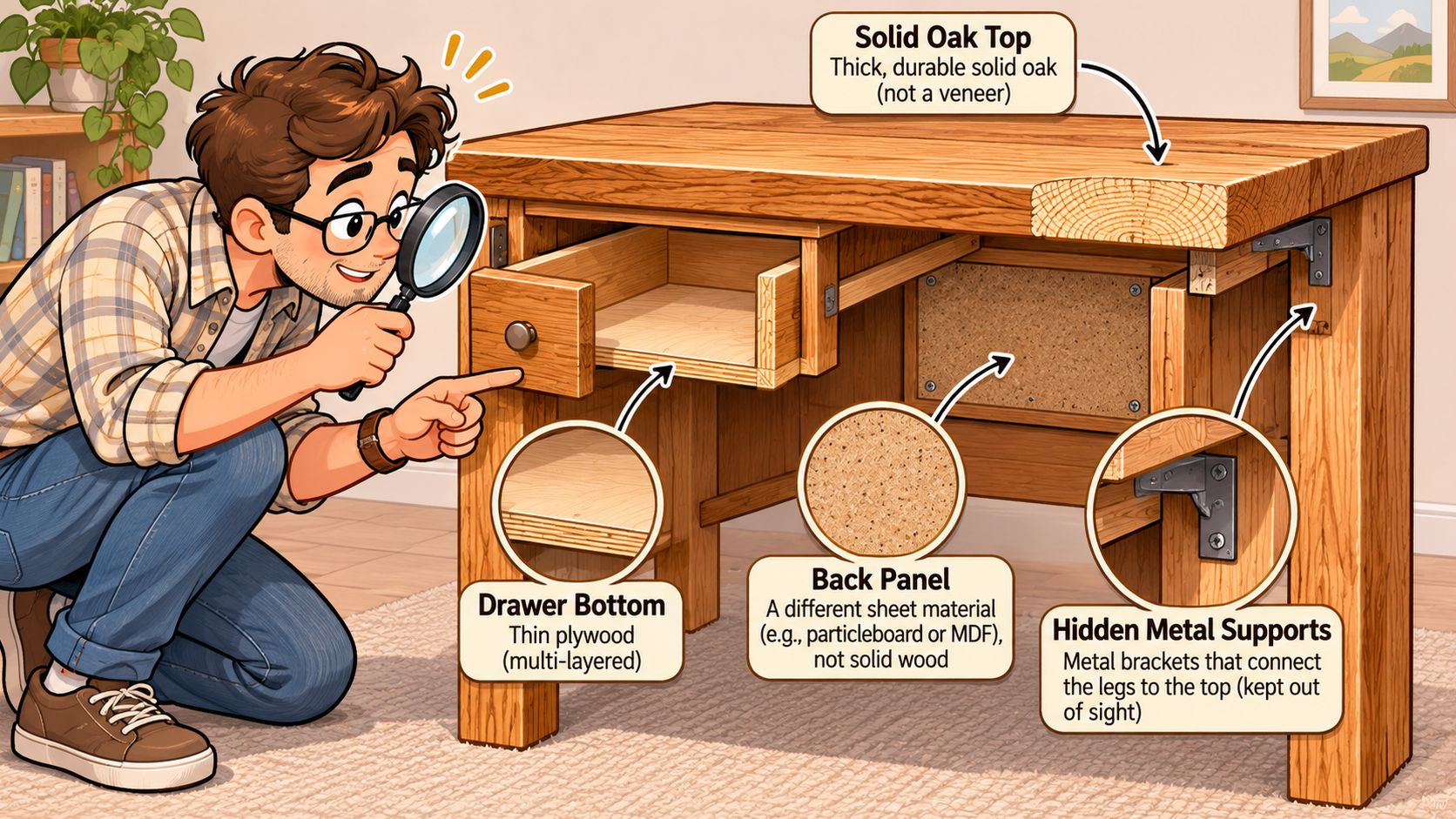
Drawers tell you almost as much. Open every one, pull it fully out, then press down on the front. A drawer that racks sideways has thin sides or cheap slides. A drawer bottom set into a groove beats one stapled to the underside every time.
Hardware is the third tell. A pull that spins means the screw is biting into composite or a wallowed-out hole. A pull that threads into real wood stays tight.
Then turn the desk over. An even seal on the underside and on the edges says the maker finished the parts nobody sees, which is usually a sign the rest got the same care.
The caveat worth knowing: the same study cautioned that durability alone doesn't guarantee a lower environmental impact, since extra material, finishes, and adhesives add manufacturing impact. Long service life matters most when it comes with repairability and efficient material use.
Finish, Edges and Indoor Air Questions to Ask
Sit down before you trust the word "solid." Rest your forearms on the front edge in the posture you work in, and watch for glare from a window or an overhead light. OSHA's computer workstation purchasing guide recommends a matte desktop finish to cut glare and advises against glass tops. Sharp leading edges should be avoided where your arms meet the surface. Rounded or sloping edges stay comfortable after a long day.
Solid wood is the main material, but drawer bottoms, back panels, dust dividers, and hidden supports are often composite. Those hidden parts change how a desk behaves in a closed room.
Ask what those hidden parts are made of. Assembled furniture can emit 50 to 90 percent less formaldehyde than the component panels tested individually, according to the U.S. Environmental Protection Agency's guidance on formaldehyde and indoor air. That guidance identifies pressed-wood products made with urea-formaldehyde adhesives as important indoor formaldehyde sources, and medium-density fiberboard generally carries the highest resin-to-wood ratio and the highest emissions among common UF pressed woods. Know the parts, and the risk stays manageable.
Get three straight answers before you buy:
Which parts are composite? A plain answer beats a certification sticker.
What's in the finish? Ask about chemistry, not just sheen. This overview of non-toxic furniture finish options covers the common chemistries.
How should the room be ventilated after delivery? Open the windows for the first stretch of off-gassing.
Placement, Humidity and Everyday Care
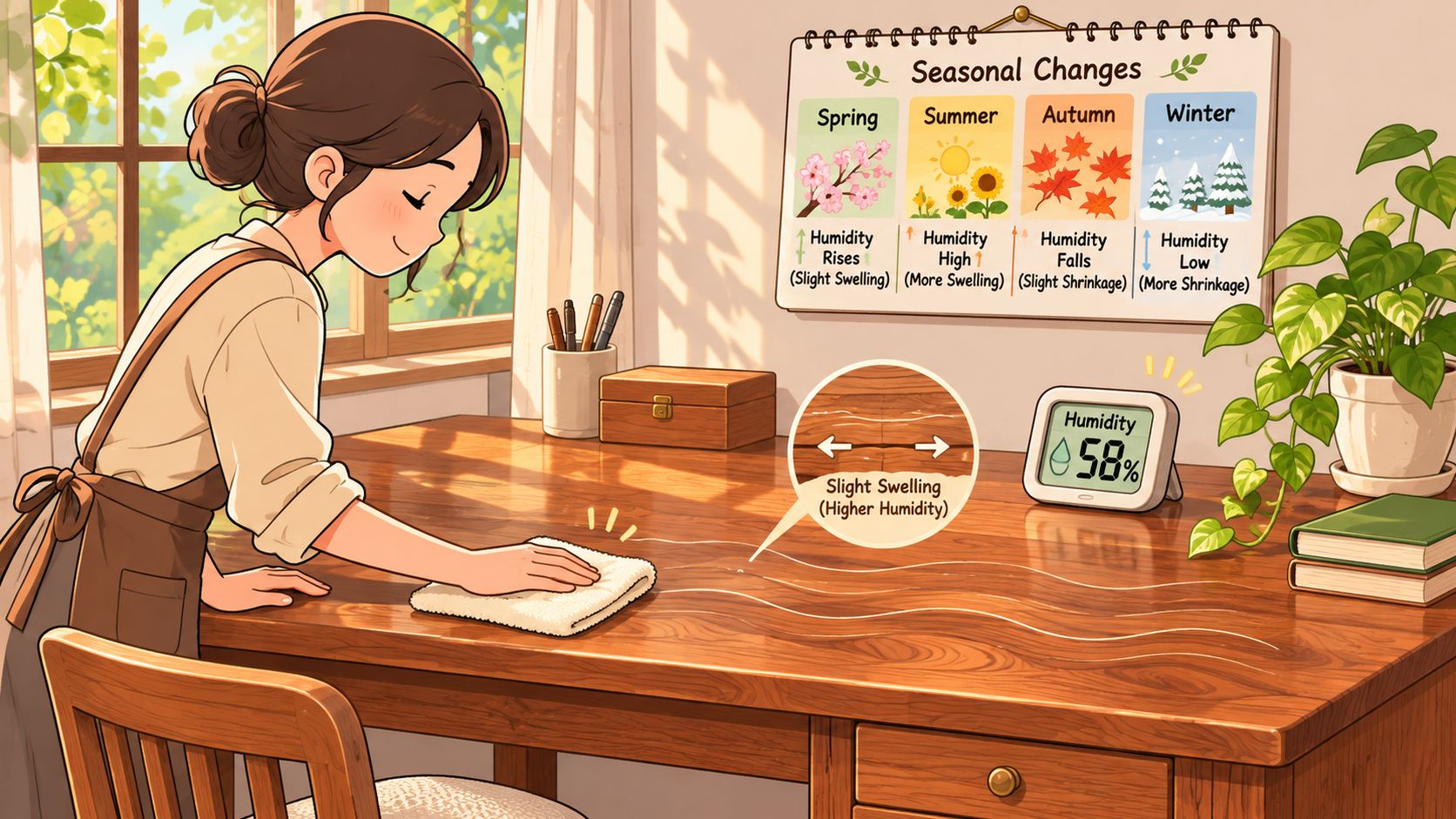
Wood moves. Furniture-grade hardwood is commonly dried to about 6% to 8% moisture content before it's built, and it keeps swapping moisture with the air in your home afterward: more humid air produces slight swelling, drier air produces slight shrinkage, according to USDA Forest Service research on wood moisture and furniture. That means your desk breathes with the seasons.
Leave breathing room around the piece rather than wedging it against a radiator, heat vent, exterior wall, or damp basement corner. Steady indoor conditions do more for a solid top than any product you can buy.
Daily care comes down to three habits:
Wipe spills right away. Water and coffee ring the finish before they reach the wood.
Clean with a soft damp cloth and a mild cleaner the maker recommends. No soaking, no scrubbing.
Skip harsh chemicals. Ammonia and silicone sprays dull a finish fast.
A desk mat protects the top where your keyboard and wrists sit, and felt pads under a monitor stand stop scratches. Once a season, check for small gaps at a top joint or drawers that stick in humid or dry months. Every customer at BILTRITE Furniture-Leather-Mattresses receives written care information for their wood, fabric, or leather furniture and mattresses, which is the right thing to check before trying any product. More routine guidance lives in this wood furniture maintenance overview.
What a Solid Wood Desk Costs in 2026
Price tracks the desk you will sit at: top size, wood, joints and drawers, and extras such as a lift. A 48-inch top and a 60-inch top of the same depth are different desks. An electric lift adds motors, columns, and controls on top of the hardwood, so a sit-stand solid wood piece costs more than a fixed-height top of the same size.
Read the tag only after the desk fits you and your gear.
Match sizes before you match prices. Width and depth change knee room, where the monitor sits, and how much of the top you use.
Grade the build. Use the joint, drawer, and hardware checks from earlier. Those parts decide whether the frame stays square under daily use.
Ask whether the finish can be repaired or refreshed. A top you can refinish stays in service longer. Joinery is what you live with, so spend there and save on finish color.
Lock size, height range, and drawer count first. Then pick the wood that matches how you work.
Buyers already rank repair highly. A furniture-consumer study run from November 2024 through August 2025 gave repairability a mean importance score of 4.14 and ease of assembly and disassembly 3.93 on its reported scale (SAGE journal study). A desk you can repair, refinish, and take apart for a stairwell stays through job changes and moves. The purchase then covers more years at the chair.
Test the Desk in Person at Our Greenfield Showroom
Would you trust a label that says solid if your knees never touched the apron? A desk is a body-fit purchase. You cannot test knee clearance or catch glare from a product photo, and a frame that feels planted for one person can feel wrong to someone two inches shorter. Those two inches change where your forearms land and whether your thighs clear the underside through a long workday.
Bring two things: monitor measurements and a rough sketch of the room with door swings marked. Sit in your normal working posture and set the chair to your usual height. Open each drawer, press down on the fronts, and run a hand along the front edge and the underside. Check whether a window reflection lands on the finish. While you are seated, look at the joints and the drawer hardware. If a front flexes under a normal push, the word solid on the tag is not doing the job your back needs.
A fourth-generation family has been serving home furnishing needs since 1928. Free in-store design services put a consultant on a single desk or a whole room, so you can match the piece to the rest of the space. Custom options cover fabric, leather, wood, finish, and hardware, which is the practical way to get a top in the species you want. The range runs from small-scale pieces for apartments, condos, and senior living to heavy-duty desks, including USA-made and Amish-made solid wood.
Come in ready to sit. Visit BILTRITE Furniture-Leather-Mattresses to plan the trip, then test the drawers yourself and compare construction and fit against your monitor size and your budget.