OPEN MONDAY, NOVEMBER 23 10AM TO 6PM!
GREBE'S DONUT GIVEAWAY MONDAY, NOVEMBER 23 ONLY!
BLACK FRIDAY + SMALL BUSINESS SATURDAY DEALS ON NOW!
NO CREDIT CARD FEES!
1000's of Items IN-STOCK + 500 Mattresses!
Largest selection of USA Made Furniture & Mattresses + Amish Made!
FREE In-Store Design Services!
BUY LOCAL & LOVE YOUR HOME!
Tuesday-Thursday 10am to 6pm | Friday 10am to 7pm | Saturday 10am to 5pm | Sunday Closed To Be With Family & Friends | Monday Showroom Closed
5430 West Layton Ave, Greenfield - Metro Milwaukee
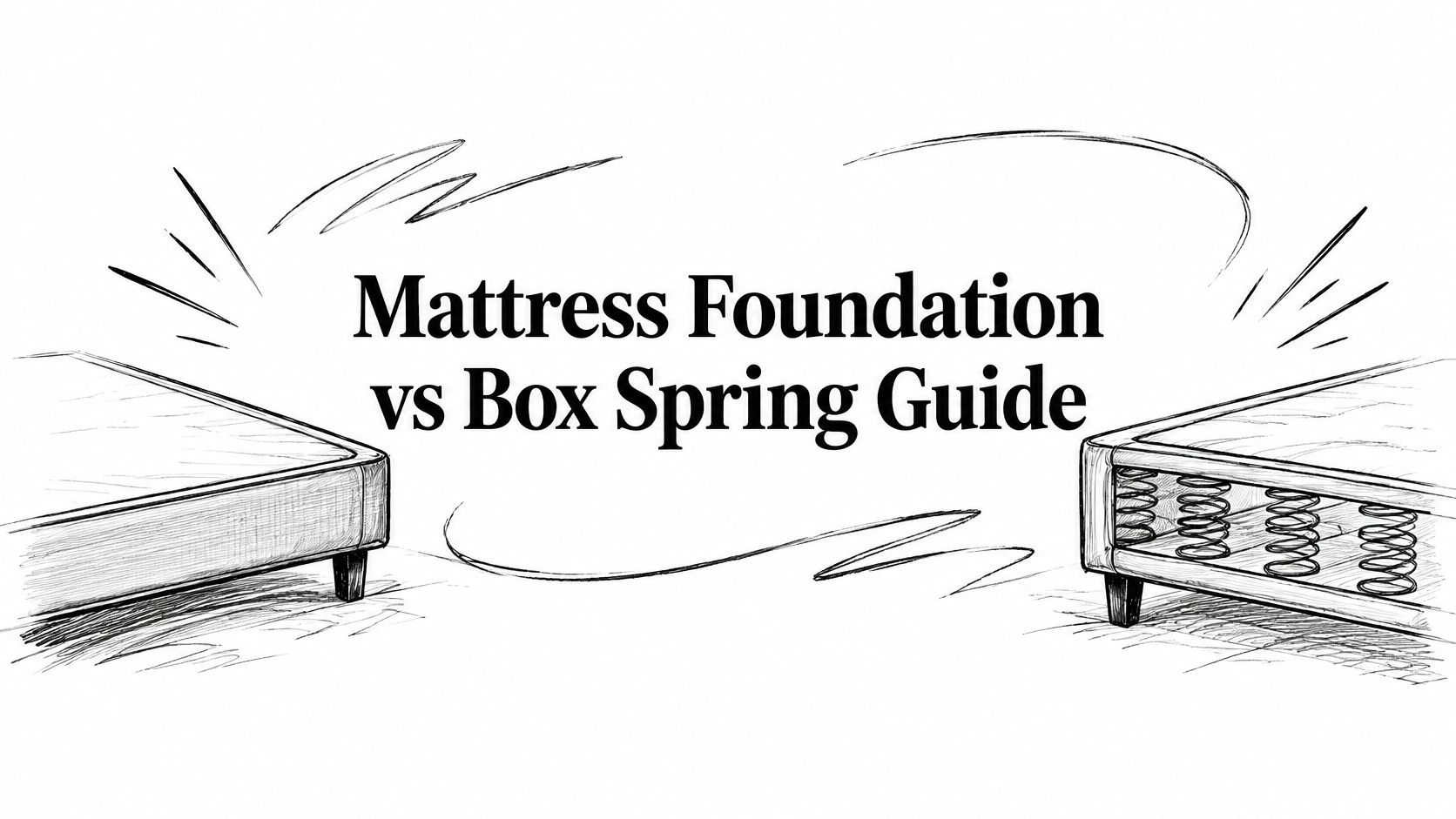
Could a base that fits a mattress still be the wrong base for it? Absolutely, and that's the missing piece in many mattress foundation vs box spring comparisons. Size matters, but so do the parts beneath the fabric, the finished bed height, and the mattress maker's approval.
For Metro Milwaukee families replacing a mattress, keeping a familiar bed frame, or planning for easier transfers, the best starting point isn't the product nickname. It's the exact mattress label and the support instructions that go with it.
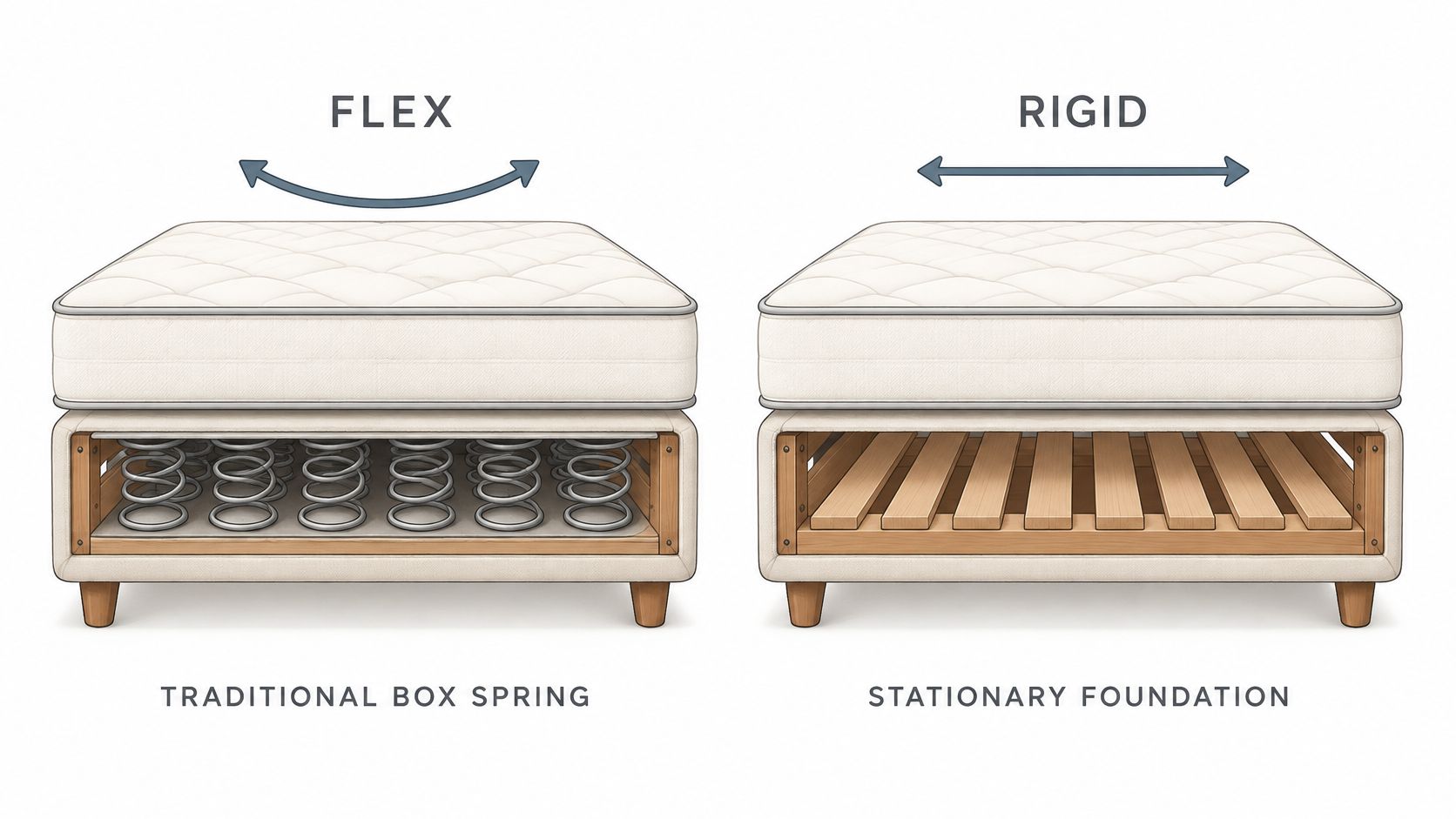
A mattress foundation is the broader support category; a traditional box spring is one type of foundation that contains working springs. In everyday shopping, however, foundation often means a rigid, non-spring base. That everyday meaning is used in the comparison below.
Feature
Box spring
Mattress foundation
What it is
One type of foundation with working springs
Broader covered support for a mattress
Inside
Wood or metal frame with coils or torsion modules
In a non-spring model, a solid deck, slats, metal grid, foam, or a mix without working coils
Feel
Limited flex, some bounce and shock absorption
Firmer, more even support with little deflection
Best mattress match
Innerspring built for a spring base
Foam, latex, and many hybrids that forbid flex
Typical height
Choose the listed profile to suit the complete bed height
Choose a low or standard profile after measuring the complete bed
Main risk
Too much flex can bend foam, speed sag, and affect a warranty
A weak deck, wide gaps, or missing center support can still fail
The National Institute of Standards and Technology technical review describes foundations as structures that support a mattress, enhance its performance, and potentially extend its service life, and identifies the box spring as the most common foundation type in that review. Its definition includes rigid frames, foam, box springs, and combinations of materials.
That broad definition explains why shoppers can hear different answers without anyone describing the construction clearly. A fabric-covered rectangle might contain flexible springs, fixed wooden supports, or a metal grid. The outside alone doesn't settle the question.
The name doesn't reveal the mechanism
Say a household replaces an older innerspring mattress with memory foam. The existing base looks clean, fits inside the frame, and has always been called a box spring. None of those details establishes whether it provides the support the replacement mattress requires.
The reverse can happen, too. A product sold under the familiar box spring name may be a rigid foundation without springs. Rejecting it because of the name could mean overlooking an appropriate option.
BILTRITE's family has helped Metro Milwaukee neighbors sort out furniture and sleep setups since 1928. That local history supports a plain-spoken approach: identify the mattress, identify the base, and check the intended combination before choosing height or upholstery.
Practical rule: Match the base to the mattress label, not the word on the fabric cover.
Support Rules That Protect the Warranty
A mattress label and warranty paperwork give you a practical starting point for checking support. A platform bed may eliminate the need for a separate foundation, provided its construction meets the mattress requirements. The table below summarizes the support details stated in a published mattress and flat-foundation warranty: cross-slats at least 3 inches wide, gaps no greater than 4 inches, at least five legs for queen, king, and California king frames, including rigid center support, and four legs for twin and full frames.
Bed size
Legs
Center support
Slat width
Maximum gap
Twin
4
Not always required; confirm model instructions
At least 3 inches
4 inches
Full
4
Not always required; confirm model instructions
At least 3 inches
4 inches
Queen
At least 5, including a center leg
Rigid center support to the floor
At least 3 inches
4 inches
King
At least 5, including a center leg
Rigid center support to the floor
At least 3 inches
4 inches
California King
At least 5, including a center leg
Rigid center support to the floor
At least 3 inches
4 inches
Use these figures as one maker's stated requirements, then check the paperwork for your specific mattress. A different model may call for another arrangement, so the mattress instructions determine which base is suitable.
Measure the support, not the appearance
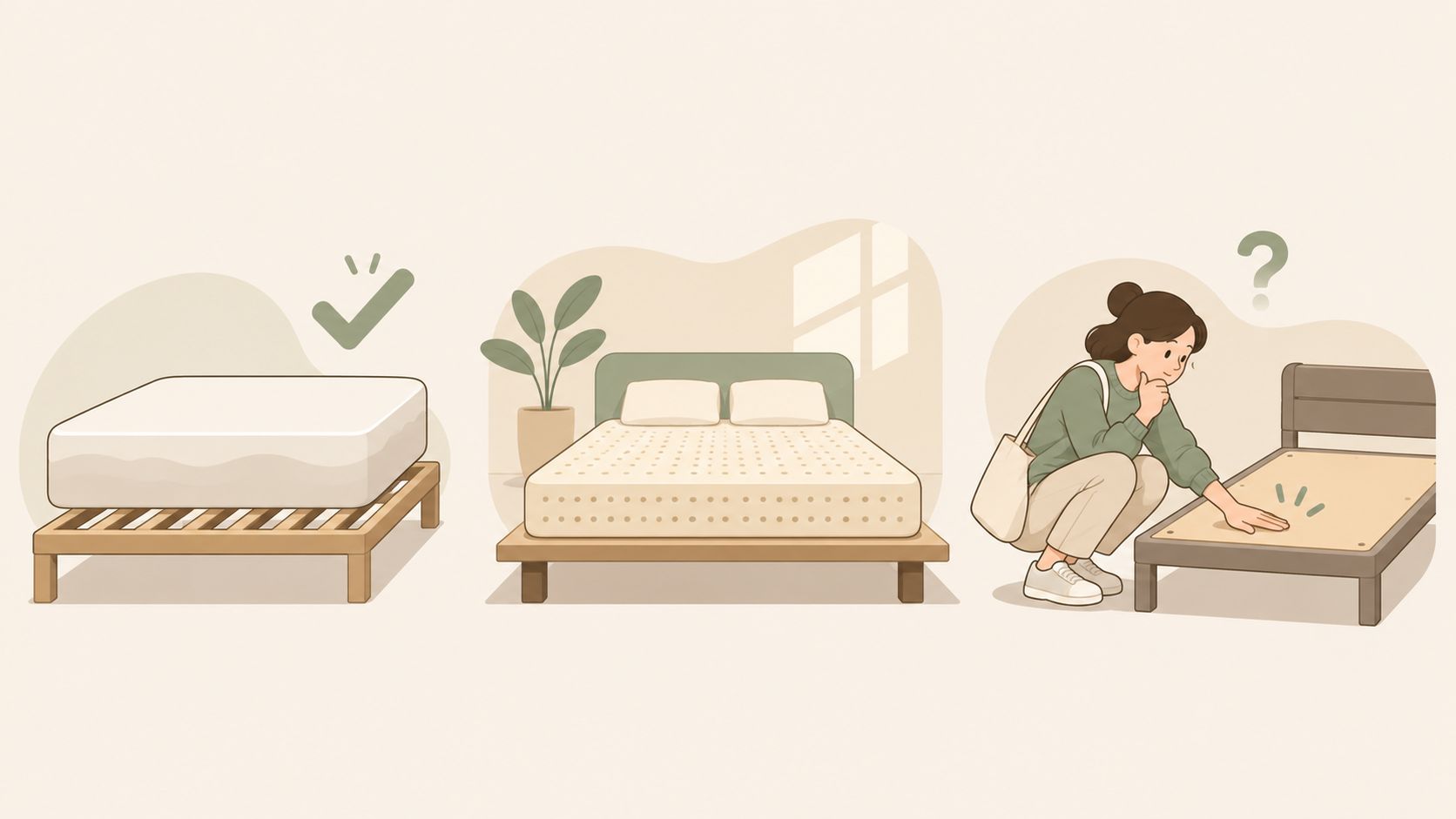
Measure each slat across its flat upper face to check its width. For the gap, measure the clear opening between neighboring slats, not the distance from the center of one slat to the center of the next. Check several openings if the slats can shift.
Then look under the middle of the frame. A center rail that hangs above the floor does not transfer weight to the floor like a center leg does. Rounded or loose slats, and slats without adequate support, deserve attention even when the gaps appear acceptable.
Check the label and warranty for these details:
Permitted base types: See whether the mattress allows a spring base, rigid foundation, platform, or adjustable base.
Slat requirements: Note both the maximum opening and minimum slat width.
Center reinforcement: Confirm any required rails, legs, and floor contact.
Total load: Account for the mattress and occupants when checking capacity.
A fabric cover alone does not show how much weight a foundation can support or how it performs over time. Ask for its stated weight capacity, height, warranty terms, compatibility information, and any test conditions supporting durability claims.
ASTM F1566 describes evaluation methods for mattress components and foundations, including firmness, firmness retention, durability, impact response, and surface deformation. These categories help clarify what a test evaluates. They are not a reason to jump on a showroom base or improvise a stress test at home.
Before deciding to skip a foundation, measure the clear slat openings and confirm that required center legs reach the floor.
How Springs and Solid Decks Are Built
The engineering difference is controlled flex versus a rigid deck. Looking beneath the covering makes that distinction easier to understand than comparing product names.
A traditional box spring has a perimeter frame surrounding metal springs or torsion modules. Under load, those internal components compress slightly, allowing a compatible mattress-and-base combination to absorb impact and respond together.
A stationary foundation replaces that moving interior with fixed support. Solid panels, closely spaced slats, wire grids, and steel framing can all provide a relatively level surface with little deflection, as explained in the Sleep Foundation's box spring guide.
Follow the weight through the bed
The mattress rests on the deck or spring unit. That structure transfers weight into the foundation frame, then into the bed frame or base legs, and finally to the floor. A weak connection anywhere along that path can undermine an otherwise suitable setup.
For foam, latex, and many hybrids, unwanted bending beneath the mattress can permit deformation and conflict with support requirements. A flexible base isn't a reliable way to turn an overly firm mattress into a softer model.
BILTRITE's explanation of the parts of a bed helps distinguish the mattress support from the surrounding frame, rails, and decorative headboard. Those pieces perform different jobs, even when they arrive as a coordinated bedroom set.
Inspect what the covering can hide
During an in-person comparison, the useful checks are straightforward:
Identify the interior: Ask whether functioning coils are present rather than assuming from the product name.
Check the perimeter: With permission, gently assess whether the frame racks or twists.
Look at the fasteners: Slats and joints should stay securely positioned.
Trace the center support: Confirm where the middle rail transfers its load.
Listen during normal use: Squeaks or uneven response deserve investigation, not dismissal.
A rigid foundation isn't automatically stronger. Thin beams, loose joints, or inadequate reinforcement can leave it poorly suited to a heavy mattress and its occupants. Likewise, a spring unit can remain appropriate when the mattress was engineered for that response and the unit is sound.
The useful comparison is an approved, well-built spring system against an approved, well-built rigid system, not old-fashioned against modern.
The resulting feel should be intentional: a little bounce and a softer landing from a compatible spring base, or the mattress's designed response on stable support.
Height Feel and the Tested Mattress Set
A support can be structurally compatible and still make the bed awkward to use. Finished sitting height deserves its own check, especially for shorter adults, children, and people planning for changing mobility.
The complete height includes the frame's support elevation, the foundation or box spring, and the mattress itself. Shopping by foundation height alone leaves out the component that may contribute the most visible bulk.
Test the complete height stack
A taller base may suit someone who prefers a higher sleeping surface. A low-profile foundation can help keep a thick mattress from becoming difficult to climb onto, while also leaving more of a low headboard visible.
Storage needs a separate measurement. A taller box spring raises the mattress, but it doesn't automatically increase clearance beneath the bed frame. Storage bins must fit under the rails and clear any center legs.
A practical showroom assessment includes:
Sitting down: The sleeper should be able to approach and sit without an awkward climb.
Foot placement: Check whether the feet can rest securely during the intended transfer.
Standing up: Test the movement, not just the appearance of the bed.
Room fit: Compare the assembled height with the headboard and nearby furniture.
BILTRITE's low-profile mattress guide can help households think through a lower overall setup without confusing mattress thickness with foundation profile.
Check the intended fire-safety configuration
The U.S. federal open-flame standard took effect on July 1, 2007, and the Consumer Product Safety Commission's explanation of the mattress standard describes requirements under 16 CFR Part 1633, including a maximum peak heat-release rate of 200 kilowatts and maximum total heat release of 15 megajoules during the first 10 minutes.
The standard limits fire growth rather than requiring one particular mix of springs, foam, fabrics, or barriers. That makes the intended mattress-and-foundation configuration important, not just the materials named in a sales description.
Labeling should identify whether the mattress is intended for sale alone or with a specified foundation. An old base doesn't become interchangeable because its edges line up with the new mattress.
Before reusing a base: Confirm the intended set configuration as well as the physical fit.
Which Base Fits Your Sleep Setup
The most useful verdict starts with the household's actual situation. A guest-room mattress on an approved platform presents a different decision from a heavy-duty primary bed or a replacement mattress going onto an unidentified older base.
Situation
Choose
Why
All-foam or latex mattress
Rigid foundation or an approved platform
Flex lets foam bend and can conflict with the warranty
Classic innerspring
Box spring only if the label allows it
A compatible mattress and spring base are designed to share some motion
Hybrid
Usually a rigid foundation
Model-specific permission determines whether a box spring is acceptable
Reusing an older base
Keep it only if coils, frame, and label agree
A soft spring unit can be the wrong support for a replacement mattress
Low headboard or shorter sleeper
Low-profile foundation
An unnecessarily tall setup can be difficult to climb onto
Two adults or a heavy-duty mattress
Rated foundation with required center legs
Fabric wrap doesn't reveal load capacity
Make the reuse decision deliberately
An existing base needs to pass separate checks for condition and compatibility. A level, quiet spring unit can still be unsuitable for a mattress that prohibits flex; an approved rigid foundation can still need replacement if its rails are broken.
For example, a family keeping a solid-wood bed doesn't necessarily need to replace the decorative frame. The mattress support inside that frame can be evaluated separately, provided the final combination meets all applicable instructions.
Compare real mattress choices together
BILTRITE Furniture-Leather-Mattresses offers hybrid, innerspring, memory foam, latex, flip-able, heavy-duty, and semi-heavy-duty mattresses, along with adjustable-base options. Comfort choices include extra firm, firm, medium, plush, and ultra plush, so support construction and preferred cushioning can be considered separately.
The selection includes flip-able, two-sided mattresses. These still need an even, approved base; flipping a mattress doesn't compensate for an uneven structure beneath it. Rotation and flipping should follow the individual mattress instructions.
Available sizes include Twin, Twin XL, Full, Full XL, Queen, King, California King, King 2PC, and California King 2PC. Matching size names is a starting point, while actual frame dimensions and the intended support arrangement complete the fit check.
For a smaller room: Consider the complete bed footprint and usable transfer space, not mattress size alone.
For heavier everyday use: Prioritize a documented load rating and appropriate reinforcement.
For changing household needs: Compare stationary and adjustable options before committing to a fixed-height setup.
The same practical approach suits furniture shopping beyond the bed. BILTRITE specializes in USA-made, Amish-made, and solid-wood furniture, with small-scale and heavy-duty choices for different homes. Affordable, better-quality furniture means weighing construction and usefulness alongside the price, rather than choosing by appearance alone.
When an Adjustable Base Beats Both
An adjustable base suits a household that needs position changes, rather than only a surface to support the mattress. Raising the upper body for reading or changing head and foot positions may help someone settle into a more comfortable daily routine. For reflux-related comfort preferences or mobility concerns, consider whether those movements are useful, without treating the base as a medical treatment.
Home Textiles Today reports that stationary foundation dollar value fell 23.5% in 2025, while adjustable-base unit shipments rose year over year as the broader mattress market weakened. That points to continued interest in adjustable products, not a reason to assume every household needs one.
Match the function to the person
A tall box spring can suit a sleeper who prefers its approved spring response and higher surface. Storage space underneath depends on the frame's clearance, not the box spring's thickness.
A low, rigid foundation keeps the setup stationary and avoids operating considerations. An adjustable base adds movement, so check power access, moving parts, and whether the mattress can flex with it.
Before choosing an adjustable setup, check:
Mattress approval: Confirm the exact mattress is approved to bend with the base.
Split sizing: Make sure both halves fit the intended mattress and frame arrangement.
Clearance and access: Check moving components, under-bed space, and the delivery route.
Operating details: Ask about power access, capacity, normal noise, and emergency lowering during an outage.
An adjustable bed base provides position changes for a mattress, while a power lift recliner is a separate seating product.
BILTRITE Furniture-Leather-Mattresses offers senior living furniture and mattresses. Families and caregivers can compare sitting height and everyday movements in person, rather than assuming a taller bed or motorized base will automatically make transfers easier.
Any transfer assessment should reflect the individual's abilities and caregiver needs. During a demonstration, try sitting at the edge, reaching the controls, changing positions, and returning the bed to the position used for getting out.
Try the Base With Your Mattress in Greenfield
What should you bring when comparing a mattress and its base? A photo of the model tag and a few frame measurements can replace guesswork with details you can check in the showroom.
Bring the details that settle the choice
Photograph the paperwork. Capture the mattress model tag and warranty requirements for foundations, box springs, and slat openings.
Measure the frame. Record the inside width and length, count the legs, and check whether center legs need to touch the floor.
Inspect the existing base. Note sagging, broken slats, loose rails, or squeaks.
Calculate the intended load. Add the sleeper's weight to the mattress weight, then compare the total with the base's stated capacity.
Choose daily priorities. Decide whether storage, a lower sitting height, or adjustable head and foot positions matter most.
Use BILTRITE's guide to testing a mattress to compare comfort while lying on the mattress, not just by looking at its label. The Mattress Center has over 60 mattress models on sale, including 36 flip-able styles.
Select model sets include a free mattress protector or a free heavy-duty bed frame. Free white-glove delivery is offered on mattress-only purchases of $999 or more. Ask how the mattress, base, and finished bed height fit together before choosing.
Keep the visit comfortable
At BILTRITE's Greenfield showroom, families can lie down on different setups, compare how they feel, and ask questions. BILTRITE is a fourth-generation, family-owned business serving Metro Milwaukee since 1928. The showroom is closed on Sundays and Mondays.
Bring the mattress label and frame measurements to BILTRITE Furniture-Leather-Mattresses in Greenfield for a hands-on comparison of support, comfort, and finished height.