Pocketed Coil Mattress vs Innerspring Guide to Better Sleep

A couple in Metro Milwaukee may start the night comfortably, only to discover that one partner's turn, stretch, or late-night trip out of bed wakes the other. That familiar frustration is why pocketed coil mattress vs innerspring isn't just a technical phrase. The spring design beneath the comfort layers can affect motion, pressure, support, and the overall feel of sharing a bed.
Both mattress types can serve a household well when they're thoughtfully built. A pocketed coil mattress usually gives each sleeper a more localized response, while a traditional innerspring often delivers a lively, lifted feel with strong airflow. The better choice depends on the sleep job the mattress needs to handle, the people using it, and the quality available at the chosen price point.
This guide from BILTRITE, a fourth-generation, family-owned business serving the Metro Milwaukee community since 1928, breaks down the difference in plain language. Readers will find a side-by-side comparison, practical guidance for couples and different sleep positions, and showroom tests that reveal more than a label ever can. For broader habits that support restful nights, the BILTRITE guide to having a good night's sleep offers additional helpful ideas.
Table of Contents
- Introduction Why Your Coil Choice Changes How You Sleep
- Understanding Pocketed Coil and Traditional Innerspring Mattresses
- Head to Head Comparison on Comfort Support and Motion
- What Matters More Than Coil Type Alone
- Which Mattress Fits Your Sleep Style and Household
- What to Look For and Test at BILTRITE
- Making Your Final Choice and Visiting Us in Greenfield
Introduction Why Your Coil Choice Changes How You Sleep
The couple described above isn't necessarily choosing between a “good” mattress and a “bad” one. They're choosing between two support systems that handle movement differently. In a connected spring unit, pressure can travel through the network. In a pocketed system, the springs respond more locally, so a partner's movement may stay closer to the original pressure point.
That difference matters most when two people share a bed, but it isn't the only consideration. A mattress also needs to support the body without creating uncomfortable pressure around the shoulders and hips, make position changes manageable, and feel stable near the edges. The top comfort layers, the edge construction, and the overall workmanship all shape that experience.
The quick comparison
| Comparison Criteria | Pocketed Coil | Traditional Innerspring |
|---|---|---|
| Spring movement | Coils compress independently | Coils are interconnected or formed from linked wire |
| Motion isolation | Usually stronger because movement stays more localized | Movement is more likely to travel across the spring network |
| Contouring | More adaptable response around curves and pressure points | More uniform, lifted feel with less localized response |
| Support feel | Can range from gently responsive to firmly supportive | Often springy, buoyant, and familiar |
| Airflow | Open coil structure allows airflow | Open coil structure allows airflow |
| Value considerations | Performance depends heavily on comfort layers and construction | A well-built model can offer straightforward support at a practical price |
Traditional innerspring mattresses have a much older patent history. Early designs appeared in the 1850s and 1860s, including an 1853 patent from New York inventor Edward Bushnell and another version introduced in Germany in 1860, as documented by the New York Times history of innerspring bedding. Pocketed coil systems trace back to 1899 to 1900, when James Marshall developed and patented an individually wrapped spring system in Canada, the United States, and the United Kingdom, followed by a major commercial milestone in 1925, when Simmons introduced a mass-produced Beautyrest mattress using encased coils, according to Furniture Today's spring-making history.
By the end of this guide, shoppers should be able to identify which construction better suits a restless partner, a side sleeper, a firm-surface fan, a guest room, or a busy family budget. They'll know how to judge the mattress in person instead of relying on the coil label alone.
Understanding Pocketed Coil and Traditional Innerspring Mattresses
A mattress spring system is easiest to understand as a group of small support workers beneath the comfort layers. The question is whether those workers respond independently or move together.
How pocketed coils respond
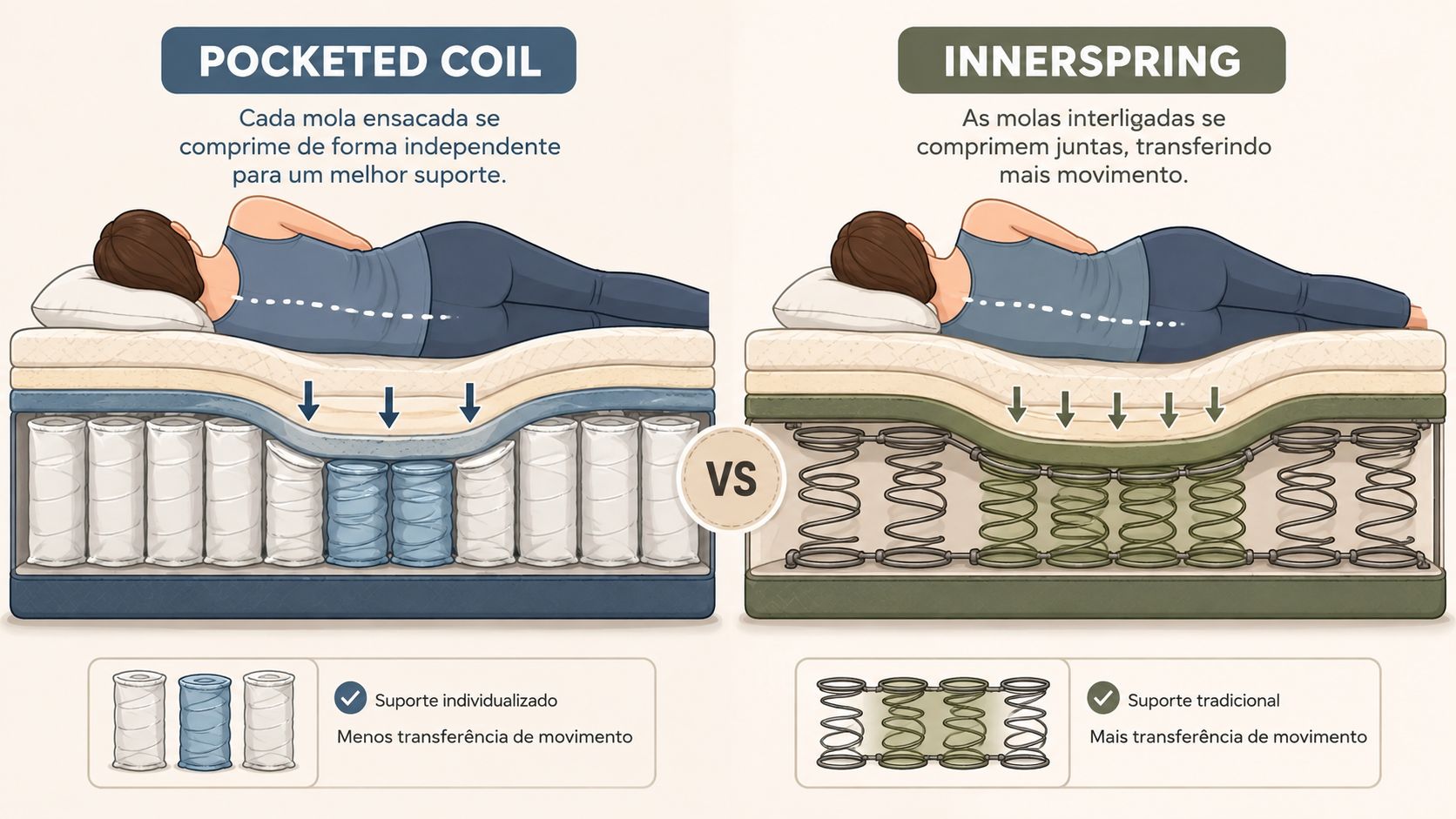
A pocketed coil mattress contains individual springs wrapped in fabric pockets. Each coil compresses according to the pressure directly above it, without a mechanical connection to the neighboring coil. A shoulder can press into one area while nearby springs continue providing support rather than moving as one broad unit.
That independent action creates what mattress guides call more localized response and point elasticity. The mattress can feel softer at the first stage of compression and firmer as the spring compresses, helping it respond to different body shapes and loads. The BILTRITE explanation of pocket coil mattresses provides another plain-language look at this construction.
An everyday analogy helps. Think of independent shock absorbers on a vehicle. Each one reacts to the bump beneath its own wheel, rather than forcing every wheel to bounce together. A pocketed spring system works on a similar principle, although the comfort layers above it also influence what the sleeper feels.
How traditional innersprings move
Traditional innerspring mattresses use interconnected spring designs. Adjacent coils may connect through wire, hinges, or a continuous strand, allowing the support network to act more like a single structure. Pressure in one area can therefore influence a wider portion of the bed.
The main coil families include:
- Bonnell coils: The classic hourglass-shaped springs joined into a connected framework. They tend to create a familiar, springy feel.
- Offset coils: Springs with squared edges joined by helical wire hinges. The hinged design can add flexibility and may reduce motion transfer compared with Bonnell construction.
- Continuous coils: Rows formed from one strand of wire, often running head to toe. This approach can provide consistent support while maintaining a linked structure.
A connected coil system resembles a trampoline with its surface tied together. Press down in one location, and the surrounding surface reacts. That can feel buoyant and responsive, which some sleepers enjoy, but the same shared movement can be noticeable to a partner.
The important distinction isn't that every traditional innerspring feels identical. Coil shape, comfort materials, edge reinforcement, and workmanship can change the result. The useful starting point is whether the springs act independently or transfer force through a connected network.
Head to Head Comparison on Comfort Support and Motion
A pocketed coil mattress and a traditional innerspring can both feel supportive, but they deliver that support differently. The following criteria help translate the construction into nightly experience.
Motion isolation
Pocketed coils generally have the advantage for couples because each spring compresses independently. A movement on one side is less likely to travel directly through the entire support core. That doesn't mean every pocketed model will feel perfectly still. Thin comfort layers, weak construction, or a lively surface can still allow some disturbance.
Traditional interconnected springs tend to spread movement farther across the bed. That characteristic produces the familiar bounce, but it can also make a partner's turn or rise more noticeable.
The practical difference: Independent coils localize pressure. Connected coils share more of the response.
Contouring and pressure relief
A pocketed system can adapt more precisely around the shoulders, hips, and other curved areas because nearby springs don't have to compress in exactly the same way. The comfort layers above the coils remain important, though. A firm surface with minimal cushioning may still feel too hard for a side sleeper, even when the coils are pocketed.
A traditional innerspring usually offers a more uniform lift. That can suit people who like to sleep on top of the mattress and move easily, but it may provide less localized cushioning around prominent pressure points.
Independent pressure-relief research supports judging the whole support structure rather than focusing on a label. Mattress layer structure has been shown to change low-pressure area, maximum pressure, average pressure, and pressure index during lying comfort testing, as reported in this clinical pressure-relief research.
Support and edge feel
Support isn't the same as firmness. A supportive mattress keeps the body from dropping too far while allowing enough give for comfort. Pocketed coils can provide a targeted response, while traditional systems can feel more uniformly firm and buoyant.
Edge support depends on perimeter construction, not on the coil category. A shopper should sit near the side, lie close to the edge, and notice whether the mattress holds steady or collapses beneath the body.
Durability and sag resistance
The spring design matters, but durability also depends on wire quality, comfort layers, foundation compatibility, rotation practices, and how the mattress is used. A pocketed system's independent response may limit the way pressure spreads, but it doesn't guarantee that every budget model will resist wear equally well.
A well-built traditional innerspring can remain a sensible value when its support core and cushioning are matched to the sleepers. The more useful question is whether the complete mattress maintains comfortable support under the loads placed on it.
Breathability and temperature
Both constructions leave open space around the coils, allowing air to move through the support core. That can help a spring mattress feel less enclosed than a solid foam design. The surface materials still influence temperature, so thick or heat-retaining comfort layers can change the experience above either type of spring system.
A shopper who sleeps warm should lie on the mattress long enough to notice the surface feel, rather than judging cooling performance from the word “innerspring” or “pocketed” alone. More practical guidance is available in the BILTRITE overview of innerspring mattresses.
What Matters More Than Coil Type Alone
The pocketed coil label can set useful expectations, but it can't tell the whole story. Two mattresses with pocketed springs may feel very different if one has thoughtful cushioning and edge reinforcement while the other has a thin, less supportive build. The same principle applies to traditional innersprings.
Coil count needs context
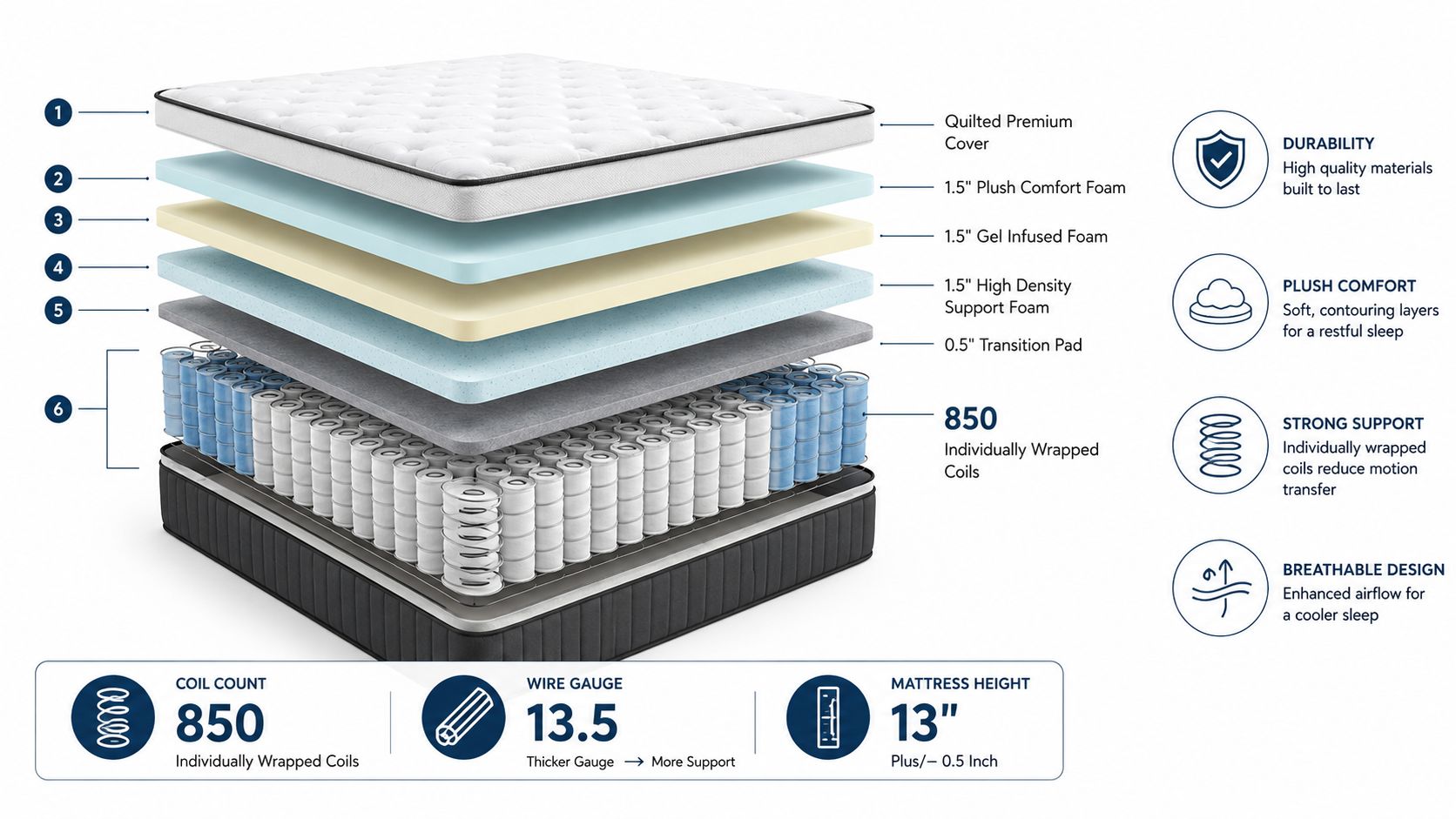
Coil count is one of the most visible specifications, yet raw count doesn't reveal how the mattress performs. Independent reviews note that lower-cost innerspring models may have around 500 coils or fewer, while better-quality models can have 800 or far more, as discussed in this review of innerspring mattress construction. Those figures are useful context, not a stand-alone buying rule.
More springs can create a more detailed response, but the result also depends on wire thickness, coil geometry, spring height, tempering, and the materials above the support core. A mattress with many thin springs isn't automatically more durable or comfortable than one with fewer, sturdier springs.
Comfort layers change the experience
The sleeper's body interacts with the top layers before reaching the coils. Foam, fiber, latex, or other cushioning materials determine how much the surface cradles the shoulders and hips, how quickly it responds to movement, and how much of the underlying spring feel comes through.
This is why a pocketed coil mattress can range from lightly cushioned and lively to pressure-relieving. A traditional innerspring can also gain comfort from better padding, even though the connected spring system still shapes its response.
Judge response, not marketing language
Pressure dispersion and compression behavior offer more meaningful clues than coil count alone. The laboratory literature cited earlier found measurable differences in coil compression under load, including different compression distances and force-gauge values between weight-bearing and non-weight-bearing groups, which reinforces the value of evaluating how a mattress responds to real pressure.
At a showroom, this means looking for several signs:
- Even support: The body should feel held without a pronounced dip beneath the heaviest areas.
- Comfortable pressure: Shoulders and hips shouldn't feel jammed against the surface when lying in a natural position.
- Controlled movement: Position changes should feel manageable without excessive bounce or a trapped sensation.
- Stable edges: Sitting and sleeping near the perimeter should feel secure.
The practical tradeoff is straightforward. A lower-cost pocketed model may not isolate motion as well as shoppers expect if the rest of the build is thin or poorly matched to the sleepers. A carefully built traditional innerspring may provide better value when the household prefers firm, buoyant support and doesn't need strong motion control.
Which Mattress Fits Your Sleep Style and Household
The right construction depends on the job the bed must perform every night. A couple with different schedules needs something different from a single sleeper furnishing a guest room.
Couples and light sleepers
A pocketed coil mattress deserves close consideration when one partner wakes easily from movement. Independent compression can help contain the disturbance, especially when the comfort layers absorb some of the surface motion. Couples should still test the actual model together, because performance varies by build.
A traditional innerspring may remain a reasonable choice for partners who enjoy bounce and aren't bothered by movement. The connected feel can make the bed lively and easy to move across, but it may not suit a light sleeper who notices every turn.
Side and combination sleepers
Side sleepers often need the mattress to give around the shoulders and hips while supporting the rest of the body. Pocketed coils can provide a more localized response, particularly when paired with cushioning designed for pressure relief. The BILTRITE guide to choosing a mattress for a sleep position can help shoppers connect body position with surface feel.
Combination sleepers need a different balance. They may appreciate pocketed coils for targeted support, but they also need enough responsiveness to change positions without fighting the mattress. A surface that sinks too much can make movement tiring, while an overly rigid surface can create pressure.
Back and stomach sleepers
Back and stomach sleepers often prefer firmer pushback and a more lifted position. A traditional innerspring can feel natural for someone who likes strong, immediate support and easy movement. A firmer pocketed coil mattress can also work, especially when its comfort layers prevent the body from sinking too far.
No sleep position automatically determines the answer. The key is whether the mattress keeps the body comfortably supported without creating pressure or an unstable feeling.
Seniors and sleepers needing easier movement
Older adults and anyone who relies on the edge to sit down or stand up should pay close attention to perimeter stability. Either construction can work if the mattress has dependable edge reinforcement, but the actual edge must be tested rather than assumed.
A responsive surface can also make turning and getting out of bed easier. BILTRITE's selection includes senior living and heavy-duty mattress options, allowing shoppers to compare support, height, and edge feel in person.
Budget-conscious households and guest rooms
Traditional innerspring construction can make sense when the goal is straightforward support at a practical price. A guest room may not need advanced motion isolation if it's used by one person or by visitors with different expectations.
Budget shoppers shouldn't dismiss pocketed coils, but they should inspect the complete build. A well-cushioned, stable mattress may offer better long-term value than a model chosen only because its label sounds more advanced.
What to Look For and Test at BILTRITE
Mattress shopping works best when the body gets involved. Since BILTRITE doesn't sell online, the showroom experience gives shoppers time to lie down, compare surfaces, and ask direct questions before making a decision.
Start with the household test
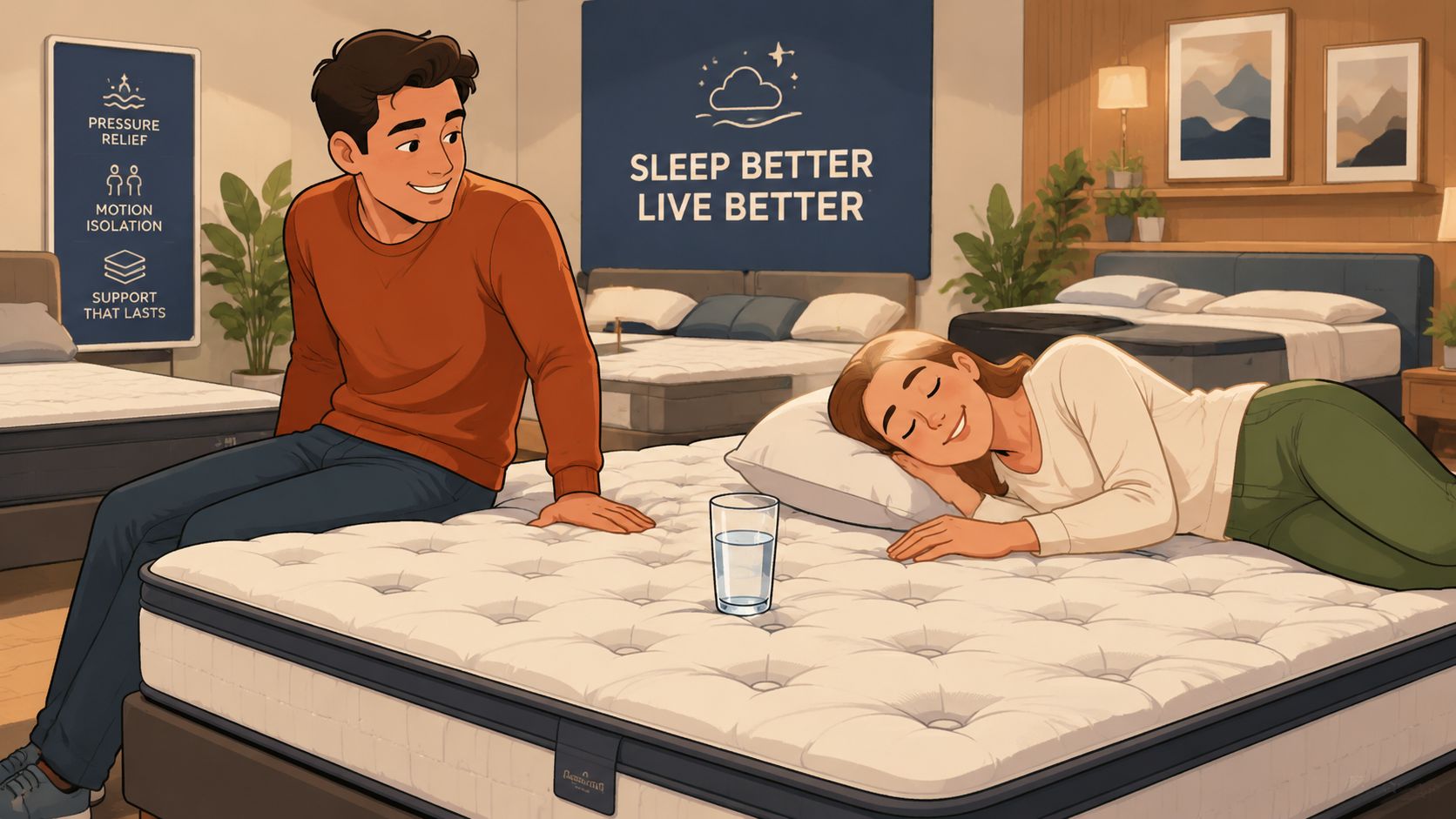
Partners should test the mattress together. One person can roll, sit, and rise while the other remains still on the opposite side. The goal isn't to perform a scientific experiment in the aisle. It's to notice whether the movement feels contained enough for the household.
A simple glass-of-water demonstration can make motion easier to observe, but the sleeper's own body remains the most important measure. If one partner feels every movement, that model probably isn't meeting the household's main sleep need.
Check pressure in natural positions
Each shopper should lie on the back and side, using the same pillow brought from home if possible. After allowing the body to settle, the sleeper should notice whether the shoulders and hips feel supported, whether the lower back feels strained, and whether changing positions requires excessive effort.
The BILTRITE guide to testing a mattress offers a useful checklist for making that in-store trial more meaningful. Clothing should allow comfortable movement, and shoppers shouldn't feel rushed through the process.
Ask construction questions
A helpful showroom conversation goes beyond “How many coils does it have?” Questions can include:
- Coil design: Are the springs individually wrapped, offset, Bonnell, or continuous?
- Comfort layers: What materials create the surface feel, and how much cushioning sits above the support core?
- Perimeter support: Does the edge have reinforcement for sitting and sleeping near the side?
- Foundation needs: What type of base supports the mattress properly?
- Two-sided options: Can the mattress be flipped or rotated to help manage wear?
BILTRITE's Mattress Center carries over 60 models and 500-plus mattresses in stock, giving shoppers room to compare construction and feel across price points. The team includes sleep specialists, and the sales associates bring over 400 years of combined experience, so questions can be answered without turning the visit into a pressure-filled sales pitch.
BILTRITE also carries USA-made and Amish-made furniture, solid wood pieces, small-scale options for apartments and smaller homes, and heavy-duty furnishings for households that need extra support. Value extras may include white-glove delivery on qualifying purchases, old mattress removal in donatable condition, and a complimentary protector or heavy-duty frame on select sets. These details should be confirmed during the showroom visit because availability and qualification can vary.
Making Your Final Choice and Visiting Us in Greenfield
The decision becomes clearer when the mattress is matched to the household's main priority.
Choose a pocketed coil mattress when motion isolation and localized contouring matter most, provided the comfort layers, edge support, and overall construction are strong enough for the sleepers. This path often suits couples, side sleepers, and people who want a more adaptable spring response.
Choose a traditional innerspring when a lifted, buoyant feel, open airflow, easy movement, and practical value matter more than maximum motion control. A well-built connected spring mattress can still be a smart choice for a firm-feel fan, a single sleeper, or a guest room.
There's no universal winner in the pocketed coil mattress vs innerspring discussion. The best mattress is the one that supports the actual people using it at a quality level that fits the household's budget. A label can start the conversation, but lying down, moving around, and testing the edges reveals far more.
BILTRITE Furniture-Leather-Mattresses has served Greenfield and Metro Milwaukee as a family-owned business since 1928. The showroom at 5430 West Layton Avenue is closed on Sundays and Mondays so the team can protect family time, and shoppers are welcome to visit during open hours for a relaxed, in-person comparison.
BILTRITE Furniture-Leather-Mattresses offers a large mattress department with over 60 models, plus affordable, better-quality furniture, USA-made and Amish-made pieces, and supportive options for many households. Visit BILTRITE Furniture-Leather-Mattresses in Greenfield, test pocketed coil and traditional innerspring mattresses in person, and let the local team help find a comfortable fit without pressure.