What Is an Innerspring Mattress? A BILTRITE Family Guide

You’re probably here because mattress shopping got weird fast.
You started with one simple question, what is an innerspring mattress, and ten minutes later you were staring at words like pocket coils, hybrids, cooling gels, edge support, and comfort layers. That happens all the time.
At our family store, we talk to folks in Metro Milwaukee every day who just want a straight answer. They want to know what they’re sleeping on, whether it will hold up, and whether it makes sense for their body, their budget, and their home. That’s fair.
An innerspring mattress is one of the oldest and most familiar mattress types around. It uses a support system made of steel coils, with cushioning layers above and below. If you like a mattress that feels supportive, breathable, and easier to move around on, this style is worth a serious look.
We’ve been helping families with furniture and mattresses since 1928, and one thing we’ve learned is this. “Classic” does not mean outdated. Sometimes it means the design solved a real problem and kept proving itself year after year.
Your Guide to the Classic Innerspring Mattress
A lot of people walk into a mattress showroom thinking they need the newest thing in a box. Then they lie on a well-built innerspring and say, “Oh. This feels familiar.” That reaction makes sense.
The innerspring mattress has been around for a long time because it gives people something many still want. Steady support, airflow, and a little bounce.
A quick bit of history
The innerspring mattress was first patented by Heinrich Westphal in 1871, introducing steel coils for better support than the straw or feather beds of the time. By the 1930s, it had become a widely recognized mattress style, and it remains the most common mattress type in the United States, according to this history of the innerspring mattress.
That history matters because it explains why innersprings still show up in so many homes. They were built to solve a basic problem. People needed a sleep surface that felt more supportive and lasted longer than older stuffing-based beds.
Why people still choose them
For many families, an innerspring just feels right.
A parent who sleeps hot may like the extra airflow. A back sleeper may like the firmer, lifted feel. Someone caring for an older parent may want a mattress that feels easier to get in and out of.
Those aren’t trendy reasons. They’re practical ones.
Tip: If you grew up sleeping on a traditional mattress and liked that “on the bed” feeling instead of sinking deep into it, there’s a good chance you already understand the appeal of an innerspring.
Why we still talk about them so much
In our part of Wisconsin, we see a lot of shoppers who care about long-term value. They don’t just want a mattress that feels good for five minutes in a showroom. They want one that makes sense for real life.
A good innerspring often shines in this context. Not every innerspring is built the same, and that’s important. But when the coils are strong and the materials on top are solid, you get a mattress style that has earned its place in the bedroom.
What’s Really Inside an Innerspring Mattress
The easiest way to think about an innerspring mattress is like a layer cake.
The middle does the heavy lifting. The top and bottom make it comfortable and stable.
The two main parts
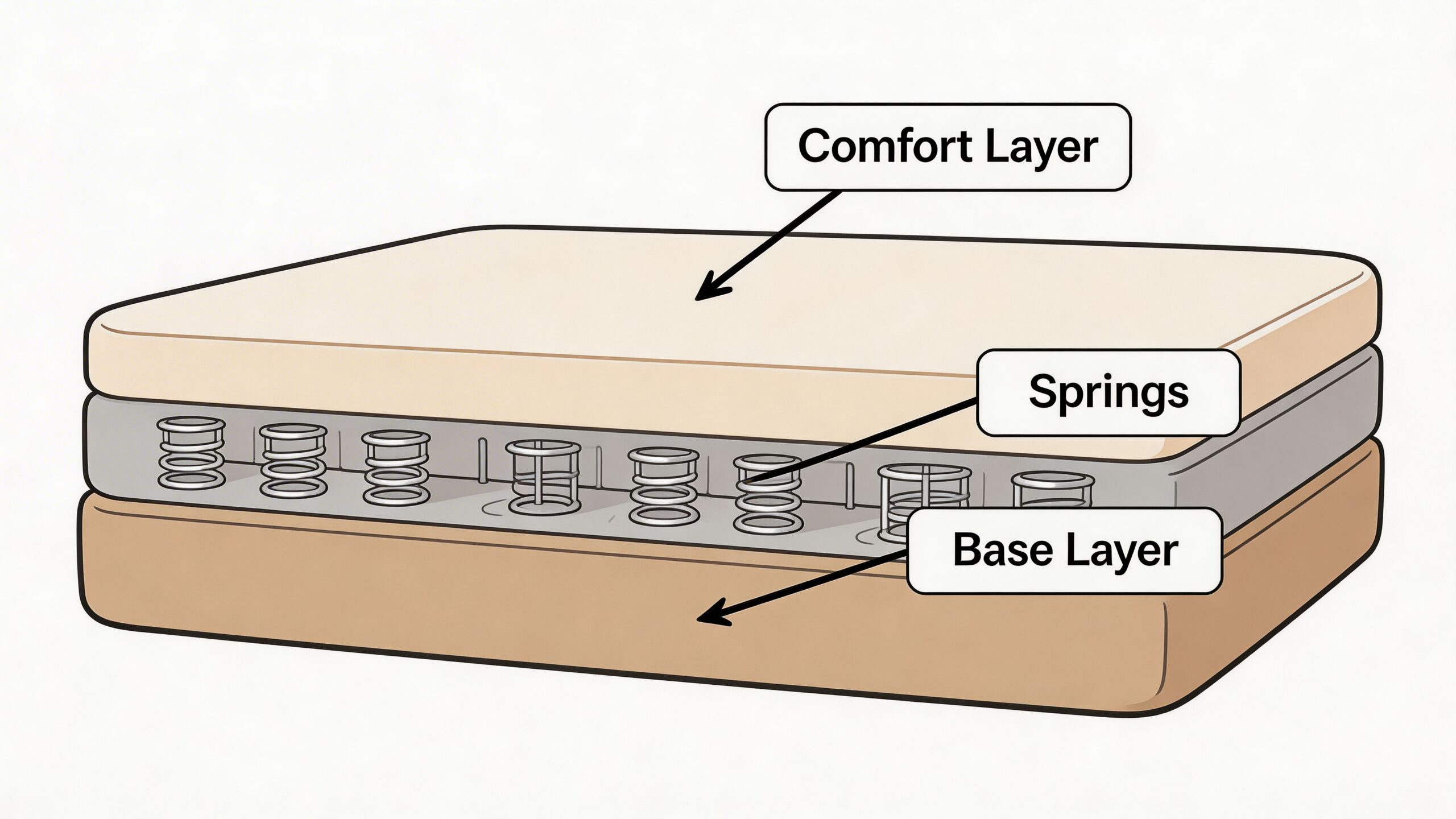
At its most basic, an innerspring mattress has:
- A coil support core that carries your weight and gives the mattress its pushback
- Comfort layers near the surface that soften the feel and help with pressure relief
That combination is what creates the overall feel. If the coils are sturdy but the comfort layers are skimpy, the mattress may feel too hard. If the top layers are more thoughtful, the bed can still feel supportive without feeling harsh.
The comfort layers matter more than people think
Many people assume the springs are everything. They’re not.
The comfort layers in an innerspring are generally thin, which helps distinguish them from hybrids. Quality versions use durable materials like high-density urethane foam and thick cotton batting to help prevent sagging and improve breathability. In flippable models, those comfort layers can be placed on both sides to extend usable life, as described in these innerspring mattress construction details.
Why innersprings usually sleep cooler
This part is simple. Air moves through the open coil structure.
That open space gives heat somewhere to go. Compared with mattresses that have more dense foam through the whole build, an innerspring often feels less stuffy. That can be a real benefit for hot sleepers, especially during a humid Milwaukee summer.
A common point of confusion
People sometimes mix up innersprings and hybrids.
A traditional innerspring usually has thinner comfort layers and a more straightforward, supportive feel. A hybrid also uses coils, but adds thicker foam or latex on top. If you want a deeper dive into surface comfort, our guide on what does a mattress topper do can also help explain how top layers change feel without changing the core support.
Key takeaway: The springs are the engine, but the comfort layers decide whether the ride feels firm, balanced, or too stiff.
The Heart of the Mattress A Guide to Coils
If the innerspring mattress were a car, the coil system would be the engine. This is the part that shapes support, bounce, durability, and whether you feel your partner rolling over at night.
That’s why two innerspring mattresses can look similar from the outside and feel completely different once you lie down.
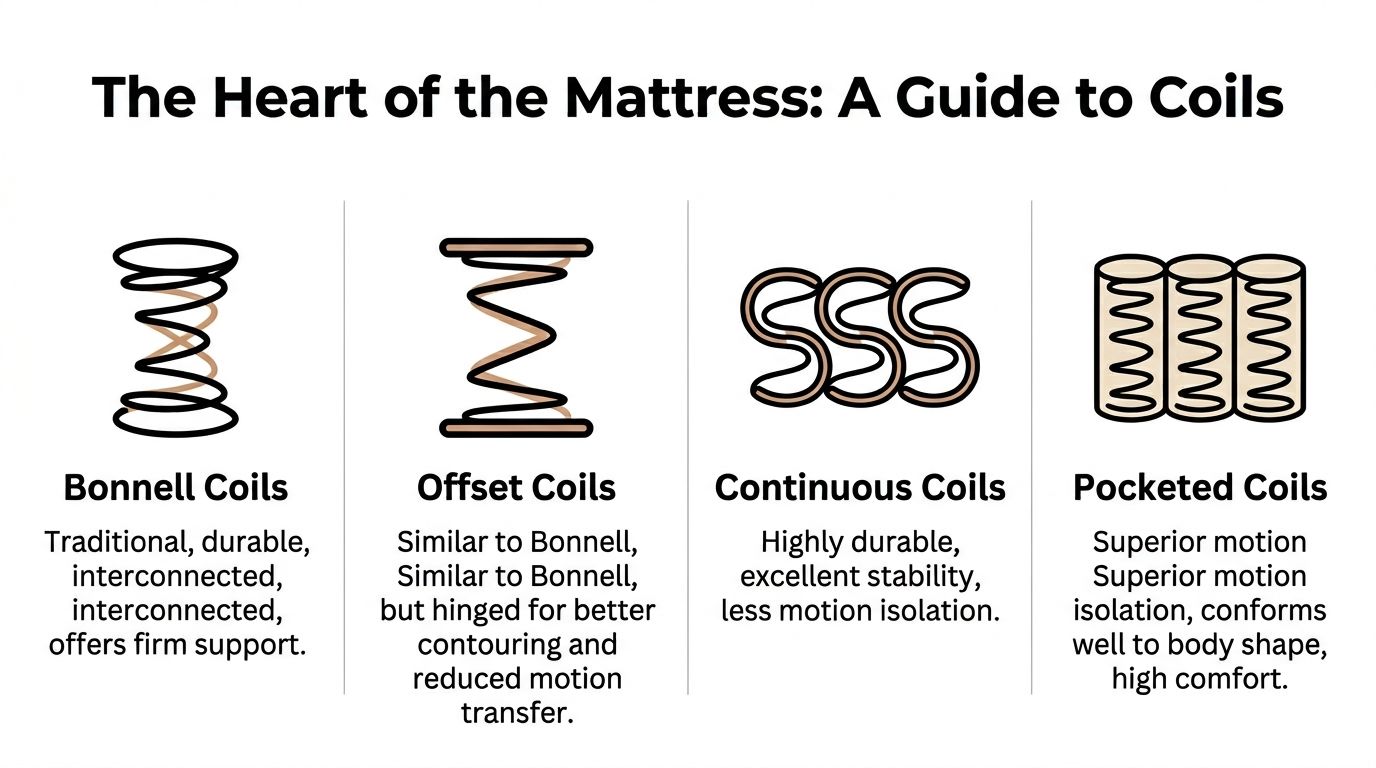
The four main coil types
Here’s the plain-English version.
| Coil type | What it feels like | Good fit for |
|---|---|---|
| Bonnell | Traditional and sturdy | Shoppers who want a classic feel |
| Offset | A bit better at shaping to the body | People who want support with some extra give |
| Continuous | Stable and durable | Folks who want a consistent feel across the bed |
| Pocketed | More independent movement | Couples and sleepers who want less motion transfer |
Bonnell coils
These are the classic hourglass-shaped springs many people picture first.
They’re durable and familiar. Because they’re connected, they tend to move more as a unit. That can create a supportive, sturdy feel, but it can also mean more motion transfer.
Offset coils
Offset coils build on the traditional design.
They’re shaped to allow a little more flexibility and contouring than Bonnell coils. If someone likes the reliability of a traditional innerspring but wants a bit more body conformity, this type often lands in a nice middle ground.
Continuous coils
This style uses rows of coils formed from a single wire.
They’re known for stability and durability. The tradeoff is that they can behave more like one connected system, so they usually do not isolate movement as well as pocketed coils.
Pocketed coils
These are individually wrapped springs.
Each coil can respond more independently, which helps reduce motion transfer and can offer more targeted support. If one partner tosses and turns, this is often the first coil type people ask about. If you want a closer look at that design, our article on what is pocket coil mattress breaks it down further.
What coil count means
People love to ask, “How many coils should I look for?”
A useful benchmark for a queen mattress is at least 600 coils, with higher-end models reaching 800 to 1,000 for more precise support, based on this guide to innerspring mattress coil design.
That said, coil count is not the whole story. A well-made mattress with solid materials can outperform a flashy number on a tag.
What wire gauge means
Wire gauge tells you how thick the steel is.
A lower gauge number means a thicker wire. Thicker wire usually feels firmer and can handle more weight. Thinner wire may feel softer at first, but it may also wear out faster if the overall build is not strong.
Think of coil count and wire gauge like ingredients in a family recipe. The number matters, but the quality matters too.
Shopping advice: Don’t judge an innerspring by one stat alone. Coil type, coil count, wire gauge, edge support, and comfort materials all work together.
The Good and The Not-So-Good of Innersprings
We’re a family business. So let’s be honest about this.
An innerspring mattress can be a smart choice. It can also be the wrong choice for some sleepers. The trick is knowing the difference before you bring one home.
What many people like
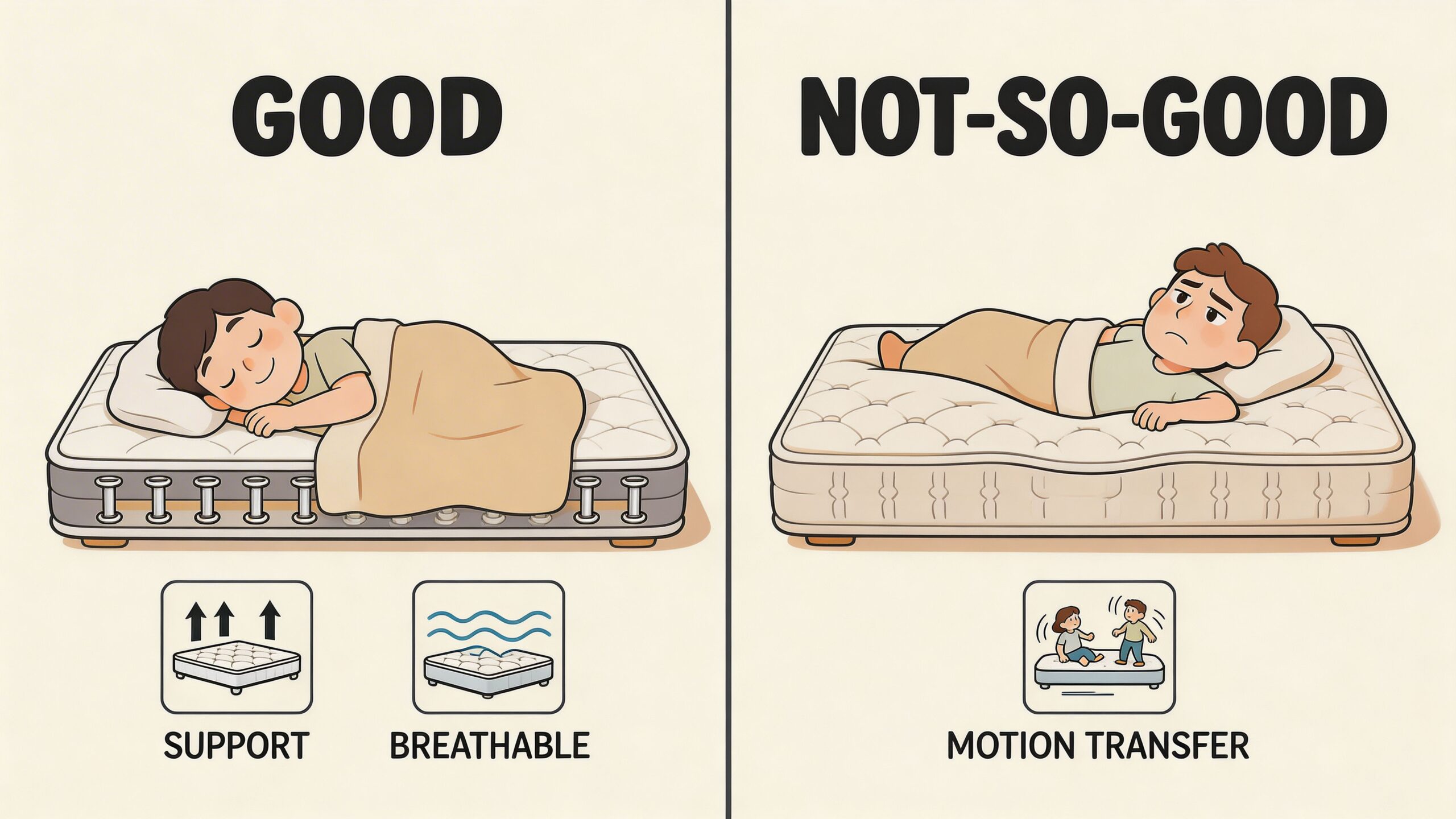
A good innerspring tends to do several things very well.
- Support: Many sleepers like the lifted, steady feel.
- Cooling: Airflow through the coil unit helps many beds feel less heat-trapping.
- Ease of movement: It’s often easier to roll over or get out of bed on a springier surface.
- Familiar feel: A lot of shoppers prefer the traditional mattress feel they grew up with.
For back sleepers and stomach sleepers, that more supportive surface can be especially appealing.
Where some people get disappointed
The weak point is usually not “innerspring” as a category. It’s cheap construction.
A simpler spring bed may pass along more motion from one side to the other. Some may not cushion shoulders and hips as much as a deeper foam build. Others may feel fine for a short test, then show body impressions sooner if the top materials are light-duty.
Matching the mattress to the sleeper
Comfort preference is important here.
If you want a deep, slow, body-hugging feel, a traditional innerspring may feel too buoyant. If you dislike being swallowed by foam, an innerspring may feel refreshingly easy to live with.
A lot of confusion also comes from firmness labels. “Firm” can mean supportive in a good way, or hard in a bad way, depending on the materials and your body type. Our guide to firm vs plush mattress can help sort that out.
Honest takeaway: A well-built innerspring can be durable, breathable, and supportive. A lightly built one can feel noisy, transfer motion, or wear unevenly. Build quality matters more than the label.
Who Sleeps Best on an Innerspring Mattress
Not every mattress is right for every person. That’s normal.
But innersprings do tend to make a lot of sense for a few specific groups. Practical needs matter more than marketing buzzwords in these situations.
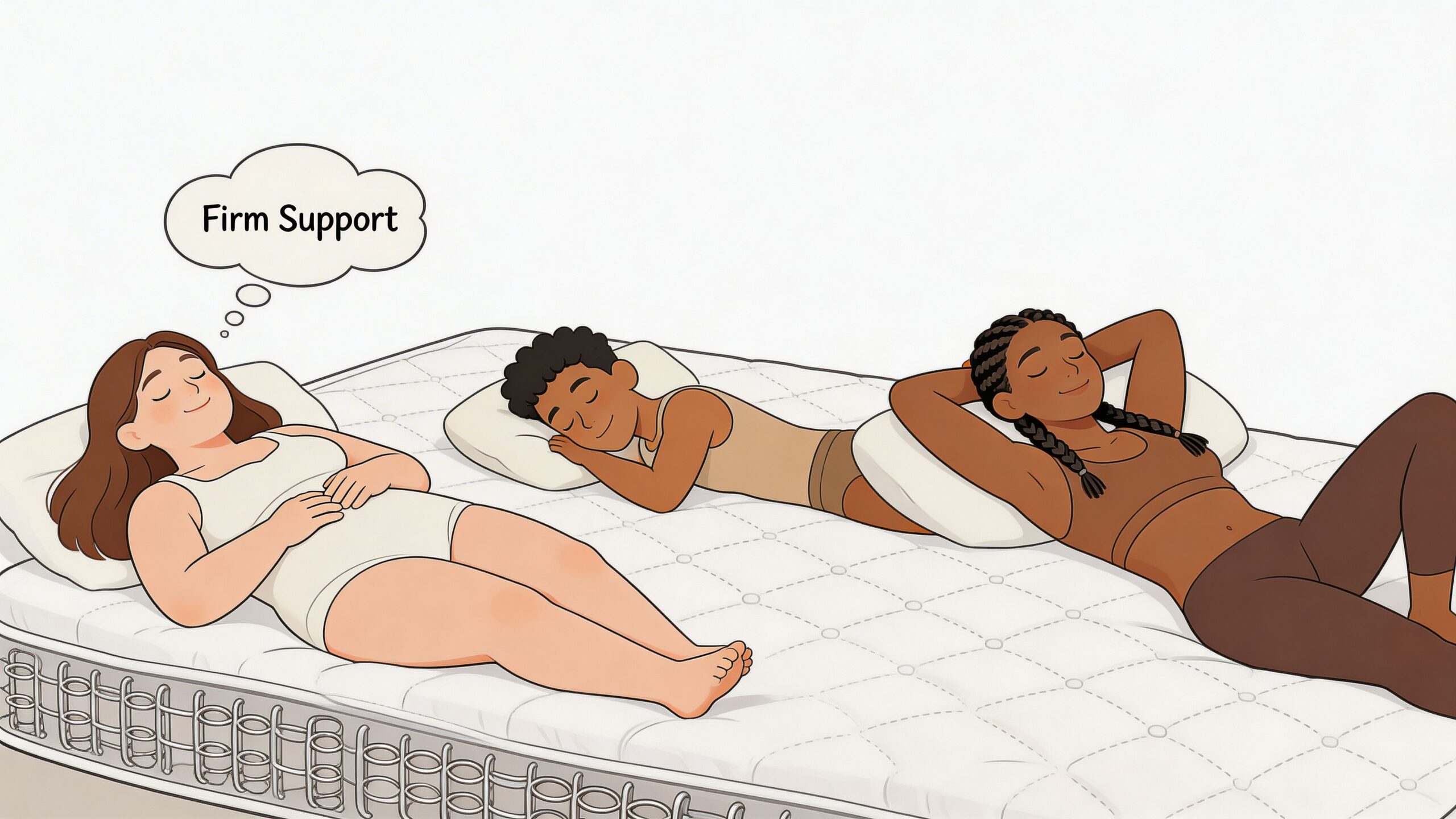
Hot sleepers
If you wake up warm, an innerspring is worth trying.
The open interior helps air move through the mattress instead of trapping heat in a solid block of foam. For many people, that creates a sleep surface that feels fresher and less stuffy through the night.
Back sleepers and people who like a lifted feel
Some sleepers want to feel supported from below, not cradled from all sides.
That’s one reason innersprings are often a good fit for back sleepers. The surface can feel flatter and more stable, which many people find helpful for maintaining a comfortable sleeping posture.
Seniors and heavy-duty needs
This group gets overlooked in a lot of online mattress advice.
While many guides stay broad, innerspring mattresses can be especially suitable for seniors and those needing heavy-duty support. USA-made, flip-able models can provide extended life and more even wear, which helps maintain consistent support over time. One cited source states that quality innersprings retain 90% of their firmness after 8 years, outperforming many foam alternatives in long-term durability, according to this overview of innerspring mattress durability and support.
For seniors, two practical details matter a lot:
- Edge support: A stronger edge can make sitting down and standing up feel steadier.
- Consistent surface feel: Even wear matters when someone depends on reliable support night after night.
For heavier individuals, stronger coils and sturdier overall construction can make a major difference in comfort and lifespan.
Families who want long-term value
A lot of Milwaukee families are not shopping for a guest room mattress they’ll barely use. They’re buying for everyday life.
That means kids climbing in on Saturday mornings, one partner sleeping warmer than the other, maybe a dog at the foot of the bed, and a budget that still has to cover groceries and school stuff. In that real-world setting, a durable innerspring can make a lot of sense.
If you’re also trying to match mattress feel to how you sleep, this guide to the best mattress for your sleep position can help narrow the field.
Making Your Innerspring Mattress Last Longer
A mattress lasts longer when people take care of it. That sounds obvious, but a few simple habits really do matter.
And this is one area where a good two-sided mattress can still be a real advantage.
Rotate it and flip it if the design allows
Proper care can significantly extend a mattress's life. Flippable designs help support even wear, and that has been part of the appeal of quality innerspring construction for generations, as explained in this history of mattress manufacturing and durability.
If your mattress is two-sided, flipping spreads wear across both surfaces instead of concentrating it on one. If it’s one-sided, regular rotation still helps.
Use a mattress protector
This is one of the simplest ways to protect your investment.
Spills, sweat, allergens, and everyday grime all add up. A protector helps keep the mattress cleaner and can reduce the kind of wear that shortens useful life. For more practical upkeep advice, our article on mattress maintenance cleaning tips to extend its lifespan is a good companion read.
Make sure the support under it is solid
Even a good mattress can feel wrong on a weak foundation.
If the frame, foundation, or support system underneath is sagging, the mattress has to absorb stress it was not meant to handle. That can affect comfort and wear.
A simple care checklist
- Rotate regularly: This helps spread body impressions more evenly.
- Flip when appropriate: Two-sided models benefit the most.
- Keep it protected: A mattress protector is much easier to wash than a mattress.
- Check the support underneath: Weak slats or an uneven base can shorten mattress life.
Practical advice: The people who get the most years from their mattress usually do the boring stuff consistently. Rotate it. Protect it. Support it properly.
Finding Your Innerspring Mattress at BILTRITE
By now, you can probably see why the answer to what is an innerspring mattress is more useful than “it has springs.”
It’s a mattress style built around steel coils, thinner comfort layers, airflow, and support. For the right sleeper, that can be a very sensible choice. Especially if long-term value matters more than trend-chasing.
Some people will still prefer all-foam or hybrid designs. That’s fine. But if you want breathable support, easier movement, and a more traditional sleep feel, a well-built innerspring deserves a close look.
At BILTRITE Furniture-Leather-Mattresses, we help shoppers compare those differences in person, not just by reading tags. Our Greenfield showroom has over 60 mattress models and 500+ mattresses in stock, along with sleep specialists whose combined experience across our team exceeds 400 years, based on our store information above. That matters because small details, like edge feel, ease of getting in and out of bed, and whether a mattress is one-sided or two-sided, are a lot easier to understand when you can try them.
We’re a fourth-generation family business serving Metro Milwaukee since 1928. We’re proud of our local roots, our focus on better-quality furniture and mattresses, and our mix of USA-made and Amish-made options. We also know that many shoppers want practical features, not gimmicks. That’s why people often come to us looking for heavy-duty mattresses, small-scale options, and flip-able designs that are getting harder to find.
We don’t sell online, and that’s intentional. Mattress comfort is personal. It helps to lie down, ask questions, and talk it through with someone who isn’t trying to rush you.
If you’re sorting through mattress choices and want a straight answer from a local family business, come visit BILTRITE Furniture-Leather-Mattresses in Greenfield. We’d love to help you compare innerspring, hybrid, and foam options side by side, talk through what fits your sleep style, and show you durable choices for families, hot sleepers, seniors, and heavy-duty use. Come say hi when you’re ready.