Oversized Lift Chair Guide: Sizes, Weight Limits and Fit

Most popular advice on an oversized lift chair boils down to one slogan, go bigger. That slogan is wrong, and it leads shoppers straight to the wrong chair. A seat that is too wide or too deep can leave the user sliding forward, reaching sideways for the armrests, and trying to stand with feet that are not firmly planted.
The better rule is simple. Choose the largest model that still allows a centered, controlled rise, with both feet flat, steady arm support, and no twisting toward a walker. Bigger helps only when the extra size matches the body, the room, and the doorway.
Table of Contents
- Seat Width and Weight Limits at a Glance
- What an Oversized Lift Chair Does Differently
- Measure Doorways and Hallways Before You Order
- Lift Power, Upholstery and Remote Controls to Compare
- Making Standing Up Safe at Home
- Paying for a Lift Chair After Insurance and Sales Tax
- Test an Oversized Lift Chair in Greenfield
Seat Width and Weight Limits at a Glance
Minimum seat width by user weight and body size
| User or Percentile | Minimum Seat Width (in) | Metric (cm) |
|---|---|---|
| 400-lb user | 22 | 55.9 |
| 600-lb user | 26 | 66.0 |
| 95th percentile bariatric hip width | 26.4 | 67 |
| 99th percentile bariatric hip width | 28.7 | 73 |
Those figures come from research summarizing ANSI/BIFMA X5.41-2021 and bariatric anthropometric guidance, which identifies minimum seat widths of 22 in (55.9 cm) for a 400-lb user and 26 in (66.0 cm) for a 600-lb user. The same guidance places the 95th percentile bariatric hip width near 26.4 in (67 cm) and the 99th percentile near 28.7 in (73 cm). Treat the table as a floor, not a shopping list, because two people at the same weight can have very different hip widths.
Measure the Body First
Seat width should start with seated hip breadth, not the outside width printed in large type. Outside width includes arms, padding, and frame, none of which tells the user how much usable cushion sits between those arms. A chair can look generous from across the room and still pinch at the hips.
- Sit on a firm chair: Keep feet flat and sit upright in normal clothing.
- Measure at the widest point: Run a soft tape across the hips while seated and write down that number in inches.
- Compare usable cushion width: Check the distance between the inside faces of the armrests on each model, not the exterior measurement.
- Add a little clearance: Leave enough room for posture changes and for hands to settle, but not so much that the body drifts sideways during the lift.
Sizing rule: Enough width to sit without compression, not enough width to swim.
Check Weight Rating With a Margin
The rated capacity on the chair label should sit comfortably above the user's body weight. Do not shop right at the limit. Daily use includes shifting weight, leaning on one arm, and settling into the seat, and a margin gives the frame and motor an easier job over years of cycles. Shoppers who want the details behind ratings can review the guide to lift chair weight capacity before narrowing the list.
Depth deserves the same respect as width. A seat that is too deep pushes the user away from the backrest or forces a slouch so the feet can reach the floor. That slouch turns into a forward slide when the chair begins to rise, and a slide makes the standing transition harder to control.
What Good Fit Looks Like
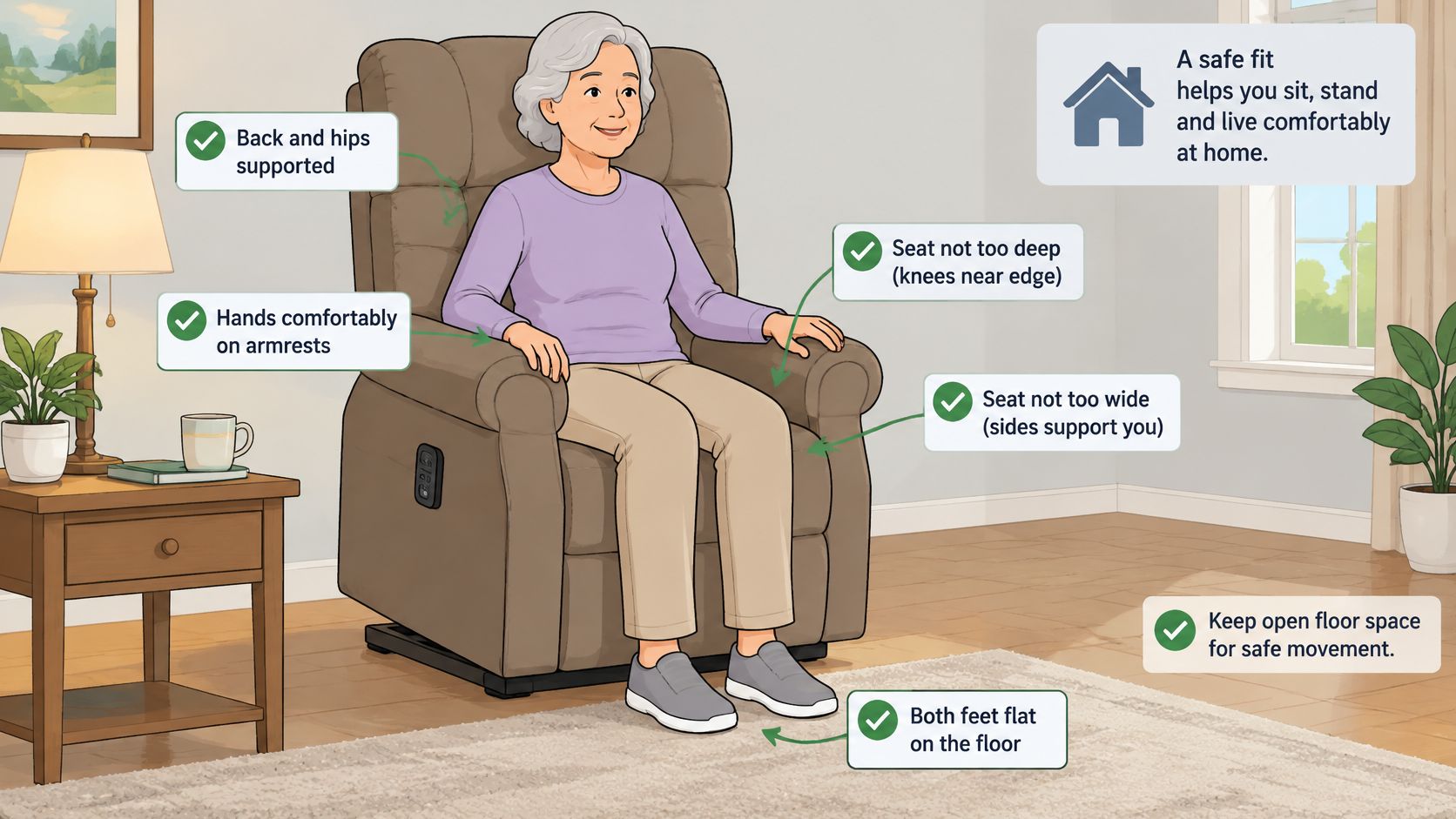
- Lower back contact: The back rests against the backrest without a gap that invites slumping.
- Knees near the cushion edge: Thighs get support while the calves can drop naturally toward the floor.
- Feet flat during lift: Both soles stay planted as the seat rises, with no toe reaching or heel lifting.
- Armrests clear of the hips: Arms support the elbows without squeezing the body or pushing it off center.
That combination matters more than a headline number. A wider frame helps only when cushion geometry, seat depth, and rated load capacity work together. If the hips are supported, the arms are reachable, and the body stays centered through a full recline and lift, the size is doing its job.
What an Oversized Lift Chair Does Differently
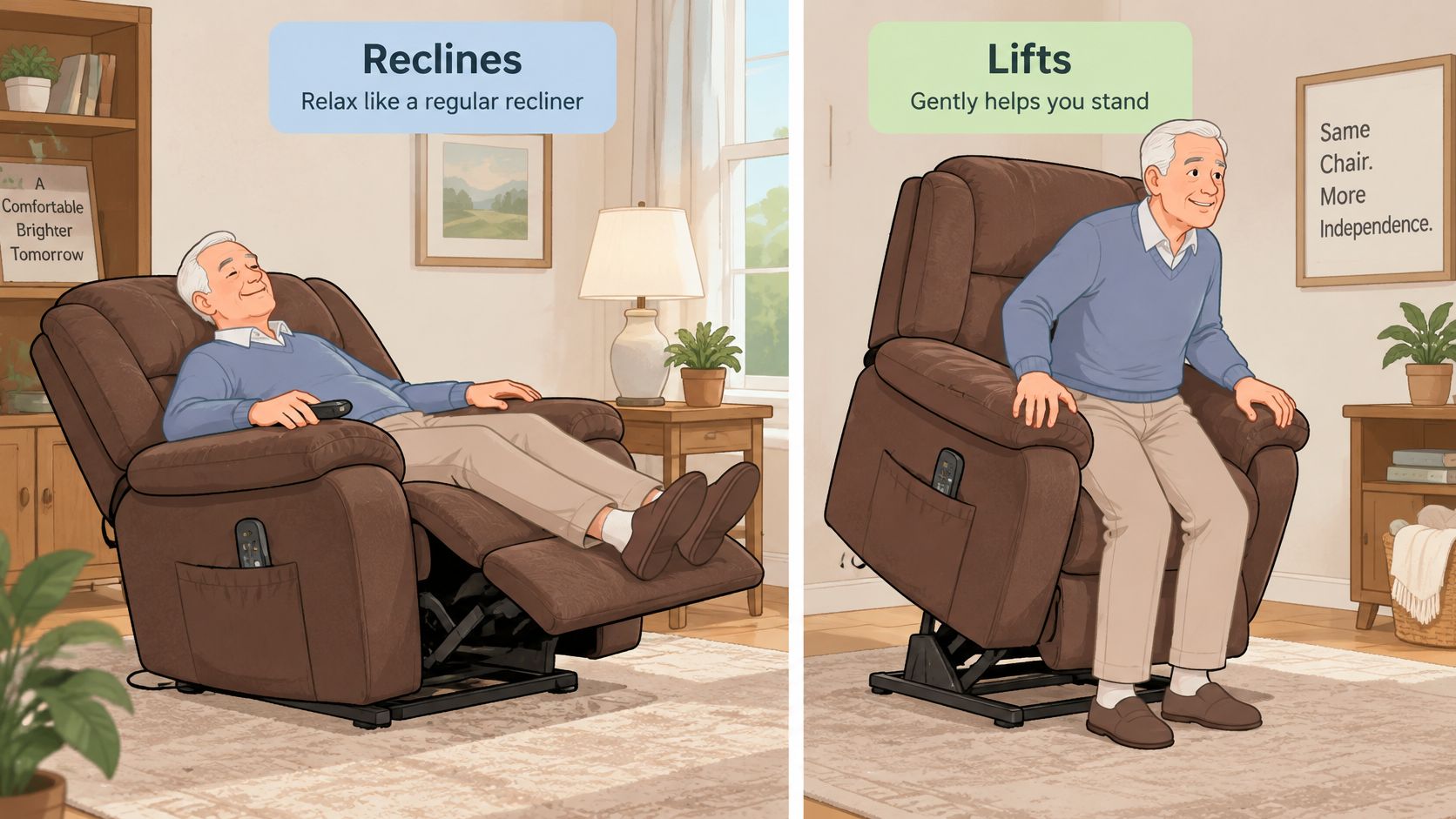
Think of an oversized lift chair as a recliner with a helping hand. A regular recliner changes posture, leaning the back and raising the feet. A lift chair does that too, and then it helps the user move between sitting and standing.
One Sit to Stand, Step by Step
Say the user is settled in, feet up, watching the evening news. A press of the remote brings the footrest down and the back upright. Then the base keeps going, the whole seat rises and tilts forward, and the user's feet take more weight gradually until standing takes only a small final effort. To sit down, the user backs up to the raised seat, feels it against the legs, and lets the motor reverse the motion and lower the body gently into place.
That sequence is the defining function. U.S. patent documentation for lift chairs describes a powered mechanism that raises the chair and tilts it forward to bring the occupant toward standing, then reverses to lower the person into the seat. The same patent history characterizes lift chairs as intended for "elderly, disabled and infirm persons" and identifies people over age 65 as a principal user group.
Who Usually Needs That Help
The typical shopper is not chasing a gadget. It is someone with sore hips or knees who cannot push up from a low, soft sofa without rocking for momentum. It is also the spouse or adult child who has been offering an arm at every rise and wants a chair that stays planted instead of tipping or rocking during the transfer.
Size changes the engineering job. A wider seat needs a reinforced frame, a stable base, and a motor matched to the load, all working as one system. If any part lags behind, the recline may feel fine while the lift feels strained. Judge an oversized model on the full cycle, down, back, up, and forward, not on how cushy it feels in the first ten seconds.
Measure Doorways and Hallways Before You Order
A chair's advertised width does not tell you whether it can reach its spot. Measure the full delivery route, including door openings, hallway turns, and the space where the chair will sit.
Clear width needed along the delivery path
| Path | Clear Width Needed | Measuring Note |
|---|---|---|
| Accessible route, continuous | 36 in | Measure the clear opening, not the door slab |
| Narrow point such as a doorway | 32 in, for no more than 24 in | Trim, hinges and handrails reduce width |
| Medical-care door opened to 90 degrees | 32 in minimum clear opening | Lever hardware, no tight grasping or twisting |
The U.S. Access Board accessible routes guide calls for at least 36 inches of continuous clear width, with a short narrowing to 32 inches permitted for no more than 24 inches. At home, that means a brief pinch point may be manageable, while a narrow hallway followed by a tight turn needs closer attention.
Measure the Opening, Not the Door
Open each door fully. Measure from the inside face of the door to the opposite trim, accounting for hinges, stops, and handrails. The ADA guidance for accessible medical care spaces specifies a 32-inch minimum clear opening with the door at 90 degrees, along with maneuvering clearance and hardware that does not require tight twisting, pinching, or grasping.
A chair measuring 43 inches wide by 41 inches deep by 40 inches high illustrates why the route matters. Compare its dimensions with the narrowest opening, then consider whether it can turn through corners without scraping walls or getting stuck.
The Tape Measure Checklist
- Entry and interior doors: Record the clear opening of every doorway along the route, with doors fully open.
- Hallways and corners: Measure the narrowest points and check each turn. A chair may pass through a doorway but be unable to angle through the hall.
- The destination room: Use painter's tape to mark the chair's width and upright depth in its intended position.
- The reclined footprint: Extend the outline to show the footrest and reclining back, then check that a caregiver or walker can still pass.
For tight entries, review furniture options for narrow doorways before settling on a chair size. Bring your route measurements to the showroom so you can discuss fit before ordering. BILTRITE Furniture-Leather-Mattresses offers in-home delivery, and a measured route helps clarify access details ahead of delivery.
Stand inside the taped outline. Check that a caregiver can stand beside the chair and use the remote without being squeezed against a wall. The extended footrest should not block the only route to the bathroom or kitchen. If either check fails, change the chair's position or choose a smaller footprint.
Lift Power, Upholstery and Remote Controls to Compare
Feature checklist for comparing oversized lift chairs
| Feature | What to Check | Why It Matters |
|---|---|---|
| Lift power | Smooth, steady lift at the user's full weight | A weak or jerky lift turns a transfer into a struggle |
| Lift and recline range | Full cycle fits the room with clearance | A larger footprint can block walkers and side tables |
| Upholstery | Fabric or leather suited to family use, easy to clean, cushion firmness | Comfort over long sitting and easier daily care |
| Seat and frame | Reinforced frame and stable base | Keeps a large chair steady during the lift |
| Remote controls | Easy-to-read buttons, reachable from the seat, cord routed safely | Simple use for older adults and fewer trip hazards |
Lift Power and Range
The motor should raise the user's full weight smoothly and steadily, with no hesitation at the start, no pause halfway, and no jerky lurch as the seat tilts forward. A short demo with a salesperson sitting in the chair proves nothing if the actual user is heavier. The person who will live with the chair should run the full cycle, more than once.
Range is a room question as much as a chair question. Run the chair from fully reclined to fully lifted and notice how much floor the cycle claims at each end. The extended footrest, the reclining back, and the forward tilt all need clearance from walls, side tables, and the path a walker takes to approach the chair.
Upholstery and Cushion Feel
Fabric tends to feel warm and grippy, which helps the user stay put during the lift, while leather wipes clean easily after spills and everyday lotions. Households comparing covers can look at lift chairs in leather to see how that option reads in a living room. Either way, ask how the cover handles routine cleaning, because this chair will see daily, hours-long use.
Cushion firmness changes the rise. A firmer seat gives the user a stable platform to push against as the chair lifts. A very soft seat feels inviting at first sit, then asks for more effort at standing and can let the hips sink below the knees. Sit for several minutes, not seconds, and pay attention to where the body settles.
Judge a cushion by the exit, not the entrance. Standing up is the test.
Frame, Base, and Remote
Ask directly about the frame and base construction. On an oversized model, a reinforced frame and a wide, stable base keep the chair from flexing or shifting as the load moves forward during the lift. Rocking or creaking during a showroom cycle is information, so do not ignore it.
The remote deserves a hard look too.
- Buttons: Large, clearly labeled, and easy to tell apart by touch.
- Reach: Comfortable to hold and use from a reclined position without stretching.
- Cord routing: Long enough to use, short enough to keep off the walking path, with a sensible place to park the handset.
In a shared home, the remote also decides who can operate the chair. Grandkids, visiting family, and caregivers will all pick it up, so simple controls protect everyone. Compare two or three models against the same checklist, write down what stood out on each, and ask the team to demonstrate every function rather than guessing from the tag. Not every household needs every feature, and paying only for what serves daily life is smart shopping.
Making Standing Up Safe at Home
Midnight is when the landing zone earns its name. The chair has finished its lift, both feet need the floor, and a throw rug, a cord, or a side table is sitting exactly where the first step has to land.
A seat that is too deep leaves the feet dangling short of the floor. A seat that is too wide forces the arms to reach outward instead of pressing down where they are strong. Oversized only works when the user can still rise with both feet planted and both armrests under a steady push.
The risky moment is the transfer itself. Clinical guidance on preventing injuries from mobility and disability aids emphasizes that mobility-device injuries frequently occur during transfers, not ordinary walking, and recommends proper device fit, maintenance, caregiver training, clear floors, adequate lighting, and nonslip footwear. Sitting to standing asks the body to move its weight forward and up at the same time, so the chair has to support that motion or the transfer gets harder.
Run the Home Fit Routine
Take the seat measurements from earlier and rehearse them, with a helper standing nearby for the first runs.
- Clear and light the area: Move throw rugs, cords, and side tables out of the landing zone, and confirm the path is well lit and the floor surface is non-slip.
- Plant both feet: Sit fully back, then rise with both feet flat, evenly spaced, in footwear that grips rather than slides.
- Check arm and walker access: The user should reach both armrests without twisting, and a walker should roll straight up to the chair instead of approaching at an angle.
- Run one full cycle: Watch for a jerky start, a forward slide on the cushion, or any moment where the feet lose contact with the floor.
If any step feels wobbly in the showroom, it will not improve at home later that night. Buy the largest chair that still passes this routine. A bigger model that fails the plant-and-push test is the wrong purchase, even if it was the original plan. Shoppers weighing the broader case for these chairs can review the main lift chair benefits before that rehearsal.
When Memory Changes the Risk
Button size, reach, and cord routing belong in the control comparison covered earlier. The safety question at home is narrower: who else might press the remote.
Store the handset where the user can reach it, and where someone with memory or thinking changes cannot start the lift by accident or on impulse. That risk is documented. A 2024 review by Ontario's College of Occupational Therapists reported three fatal cases in which older adults with cognitive impairment used the remote to raise the chair and then fell after reaching a standing position, and it recommends including power recliner lift chairs in home assessments.
A consumer lift chair assists a person's own rise. It is not a medical patient lift, and it does not replace professional transfer equipment or hands-on caregiver instruction. When weakness, a recent fall, or cognitive decline is part of the picture, an occupational therapist or clinician should evaluate the transfer before the chair becomes the daily routine.
The best oversized lift chair is the largest one that still keeps every rise centered, planted, and controlled.
Paying for a Lift Chair After Insurance and Sales Tax
Insurance will not buy you a bigger chair. Medicare treats the powered seat-lift mechanism as the potentially covered item, not the recliner around it. CMS guidance on seat lift mechanisms identifies them as potentially covered under the Durable Medical Equipment benefit when reasonable-and-necessary requirements are met. Coverage is not automatic.
The Medical Bar Is Specific
The criteria described for seat-lift mechanisms include severe hip or knee arthritis or severe neuromuscular disease, complete inability to stand from a regular chair, and the ability to walk independently or with a cane or walker after standing. The mechanism must also be part of the physician's treatment plan. Comfort, convenience, and a wish for a roomier chair do not qualify on their own.
Shop the oversized model as a fit purchase. The chair worth paying for is the largest one that still lets the user rise with both feet planted and steady arm support. A wider, plusher frame can be the right household choice, and you should budget for that chair yourself. It does not ride along with a claim for the mechanism. Families comparing prices can review the typical cost of lift chairs before paperwork starts.
Paperwork and the Actual Split
A verbal "a lift chair would help" from a doctor is not enough. You need Part B or Medicare Advantage coverage, a physician's prescription or certification of medical necessity, and a Medicare-participating supplier that accepts assignment. CMS-849, the Certificate of Medical Necessity for Seat Lift Mechanisms, is the form commonly used for that certification. Approval still leaves a bill. Medicare guidance on lift chair payment describes the beneficiary paying 20% of the Medicare-approved amount when the supplier accepts assignment, after the deductible, and that share applies to the mechanism rather than to every extra inch of chair.
Sales tax is a separate question at the register. Ask whether a Wisconsin exemption applies to this power lift chair, and require the quote to show the answer. Do not assume every recliner is exempt, and do not expect an insurance form to settle the tax.
A Short Cost Checklist
- Eligibility: Confirm the diagnosis and mobility criteria with the physician first.
- Supplier status: Verify Medicare participation and assignment before ordering.
- Out-of-pocket share: Get the deductible and the coinsurance in plain numbers.
- Tax treatment: Confirm whether any Wisconsin sales tax exemption is reflected in the quote.
Take that list to the doctor and the showroom. A chair bought on hoped-for insurance, without the eligibility check, becomes a full-price problem after delivery. Pay for the fit that keeps the rise planted and supported. Leave the rest of the recliner off the claim.
Test an Oversized Lift Chair in Greenfield
The biggest chair on the floor is the wrong chair if your feet leave the ground or your arms cannot push off a steady rest. Choose the largest model that still lets the user rise with both feet planted. Then run the full lift and recline, and match cushion feel and arm height to the measurements from home.
BILTRITE Furniture-Leather-Mattresses has been family-owned since 1928, now in its fourth generation serving Greenfield and Metro Milwaukee. The floor holds 48 models of power lift chairs, set among sofas, sectionals, loveseats, chairs, recliners, lift chairs, and sleeper sofas, along with senior living furniture and mattresses. Much of that selection is USA-made and Amish-made. In-home delivery is available once the sit test confirms the fit.
Pack the seated hip measurement in inches, the clear width of every door, hallway, and corner, and the user's weight so the rating has a margin. Note walker or cane use, sore joints, and balance. A prescription already in hand can come along, but the sit test still decides.
The showroom is closed on Sundays and Mondays. Use the time in the chair. Ride it up. Ride it down. If the feet skate or the armrests feel unsteady, step down a size. Bigger is not automatically safer.
An oversized lift chair earns its place when the size supports the rise, and BILTRITE Furniture-Leather-Mattresses helps Metro Milwaukee families test that fit in person with power lift recliners, heavy-duty and senior living furniture, and USA-made and Amish-made pieces for the whole home. Bring the hip, doorway, and hallway measurements to the Greenfield showroom, run the full lift cycle with both feet planted, and talk through the options before you order.