Solid Wood Furniture Unfinished: What to Know First


Most finishing advice starts with a stain chart. That's the gap. Color is the last decision, not the first. Solid wood furniture unfinished is bare hardwood that still has to be checked, settled in the room, and coated for the way that room is used.
A pale chair can be a solid maple leg or a printed panel with a wood-looking face. One moves with winter heat and summer humidity. The other can hide a different material in the drawer box. Households that sort those facts first avoid a pretty finish on the wrong piece.
The checks are plain. Is the wood solid where weight, spills, and hands land? Has it sat indoors long enough to settle? Does the coating match food, elbows, or light dust? A fourth-generation, family-owned showroom in Greenfield has helped Metro Milwaukee households with those questions since 1928.
Table of Contents
- What Unfinished Solid Wood Furniture Really Is
- Benefits and Trade-Offs Compared Side by Side
- How to Verify the Wood Before You Buy or Finish
- Let the Wood Acclimate Before You Finish It
- Finish Options and Which Suits Each Room
- How to Finish Unfinished Wood Step by Step
- Keeping Unfinished Wood Looking Good for Years
- Decide Whether to Finish at Home or Visit Our Showroom
What Unfinished Solid Wood Furniture Really Is
Picture a maple dining chair that arrives pale and a little rough. No stain, no sealer, no topcoat. That's unfinished solid wood. Grain, color shifts, and small character marks stay visible because nothing has covered them yet.
Treat the lumber as a blank canvas. The finish is the choice that comes later, after the wood is identified and the room is known. Solid means the main parts, such as legs, the frame, and a tabletop, are cut from real hardwood boards. A thin veneer over particleboard can look similar from the doorway. It isn't the same material under a wet glass.
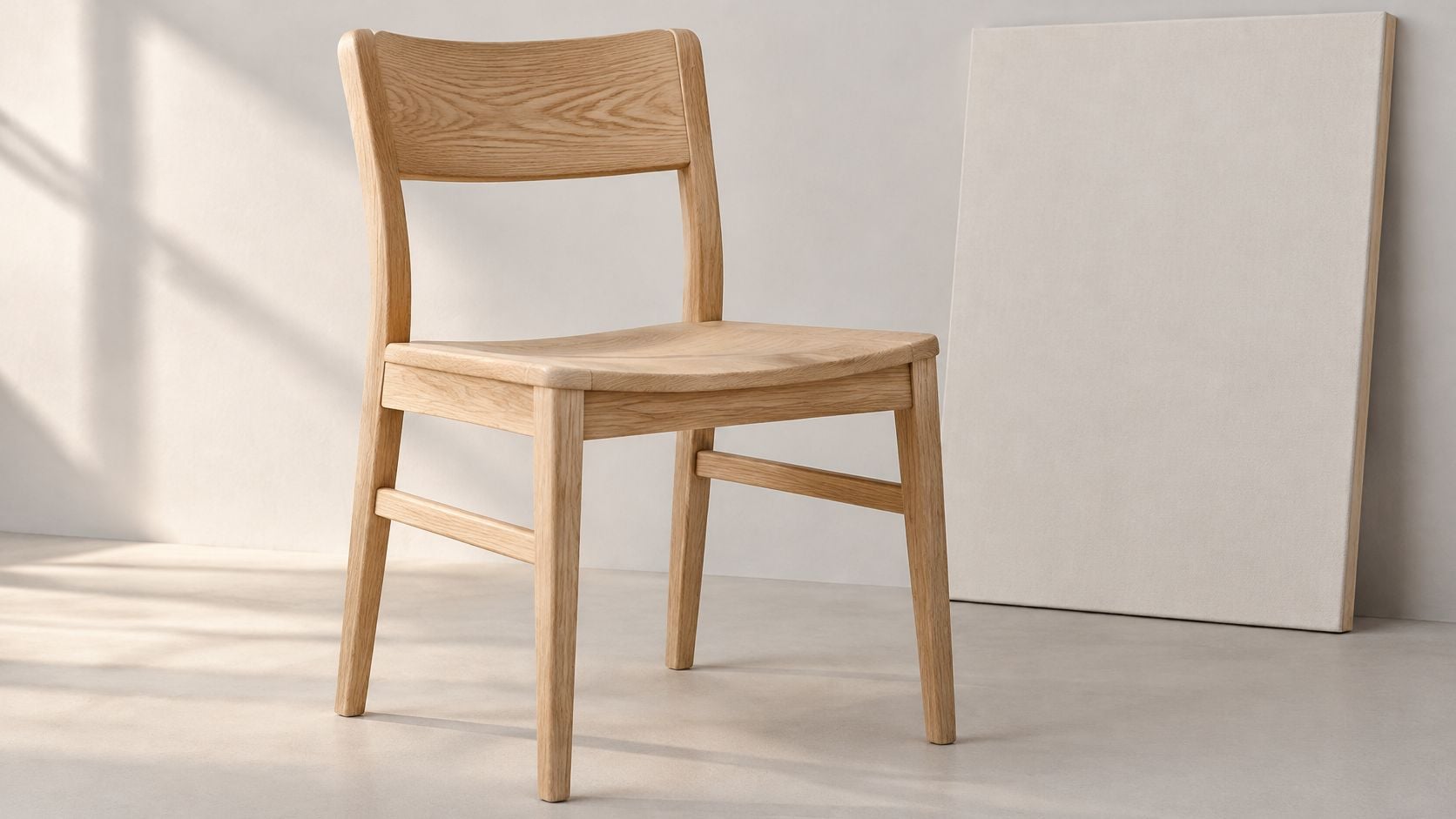
The useful question is simple. Is the piece solid throughout, or only on the faces people see?
The upsides are hands-on. The household picks stain and sheen. The wood ages with visible character. A scratch can be sanded and recoated. A new piece can sit beside oak floors or a walnut sideboard without a factory color fight.
The downsides show up in daily life. The surface needs sealing before everyday use. Spills and water rings mark raw wood fast. Indoor humidity makes boards swell and shrink.
BILTRITE Furniture-Leather-Mattresses offers solid wood furniture and small scale furniture, including USA-made and Amish-made pieces, for apartments as well as family rooms.
Three home questions keep the project honest.
Time: How many evenings can go to sanding and drying?
Care: How messy is the room, and who wipes spills?
Look: Should the grain stay easy to see, or does the top need a tougher film?
Benefits and Trade-Offs Compared Side by Side
| Feature | Unfinished solid wood | Pre-finished solid wood | Unfinished composite wood |
|---|---|---|---|
| Color and look | Chosen by you | Set at the factory | Chosen by you over a panel surface |
| Protection at delivery | None until sealed | Factory coating in place | None until sealed |
| Formaldehyde concern when raw | Low for solid boards | Lower, coatings reduce emissions | Higher until sealed |
| Movement with humidity | Expected, managed by acclimation | Expected, slowed by coating | Edges swell if left unsealed |
| Effort to finish at home | Moderate to high | None | Moderate, and sealing matters more |
| Repair ability | Sand and refinish | Harder to refinish | Limited |
How a household should read the rows
Unfinished solid wood gives full control of color and an easy repair path. Sand the mark, recoat, and the board is still the same board. That control costs evenings, a ventilated space, and a real sealer before dinner plates land on it. A solid wood versus veneer comparison helps when a smooth face is hiding a panel core.
Pre-finished solid wood saves that time. The coating is already on, so Tuesday's delivery can hold a lamp that night. The color is fixed, and a later refinish means cutting through a factory film instead of starting from bare grain.
Unfinished composite panels often cost less, and they aren't the same material. A raw panel can release more formaldehyde until a coating or laminate closes the surface. Solid boards are a different exposure story. Drawers, backs, and shelves on a "wood" piece may still be engineered, so the label on the top doesn't settle the whole cabinet.
Who each option actually suits
Busy families: Pre-finished solid wood, when upkeep time is short and the factory color already fits.
DIY owners: Unfinished solid wood, when sanding and a custom stain sound like a good weekend, not a chore.
Custom-color shoppers on a tight build: Unfinished composite only after every panel is named and then sealed, not because the word unfinished sounds healthier.
A Made in USA label is an origin claim, not a synonym for solid wood, unfinished, or high quality. The Federal Trade Commission standard says an unqualified Made in USA claim requires a product to be "all or virtually all" made in the United States. Final assembly must happen in the United States, significant processing must take place there, and all or virtually all components must be made and sourced domestically. Foreign content must be nonexistent or negligible, and the seller needs reliable evidence. Solid lumber can still arrive with imported slides, fasteners, or hardware. Ask what "made" covers before treating a flag on a hangtag as a full parts list.
Practical rule: The right option matches your time, your room, and your tolerance for upkeep.
How to Verify the Wood Before You Buy or Finish
The common miss is the part nobody photographs. A top looks like oak. The drawer box, the back, or a shelf is fiberboard. Unfinished describes a surface, not a construction method, so the material underneath and the coating system both deserve a look before money changes hands, especially in a child's room or a home where someone is sensitive to indoor air.
When composite parts do appear, the EPA composite-wood standards cap formaldehyde emissions at 0.05 ppm for hardwood plywood, 0.11 ppm for medium-density fiberboard, and 0.09 ppm for particleboard. Those limits give you a concrete question to ask at the counter: a seller who can cite the emission rating of a panel usually knows what that panel is made of, too.
A six-step check before money changes hands
- Ask for every part, not just the top. Species and construction should be named for legs, frames, tops, drawers, backs, and shelves. "Solid wood accents" can mean two rails and a panel everywhere else.
- Read the end grain and the joinery. On a solid board, grain continues through the end the way a cut rope still shows its strands. A veneer cap often shows a thin line of real wood over a pale, uniform core. Mortise-and-tenon or dowel joints in hardwood look different from a screw driven into a crumbly edge.
- Open a drawer and study the corners. Dovetails, those interlocking wedge-shaped pins and tails, take time to cut and usually pair with solid drawer boxes. Staples, glue blocks, or a plain butt joint on thin stock point to faster assembly. While the drawer is out, look at how the back panel attaches. Screws into solid framing hold up better than staples into a thin sheet.
- Pull the piece away from the wall. Backs, drawer bottoms, and shelves are the usual substitutes. Tap them. Solid lumber sounds tighter and shows grain on the hidden face. A panel often shows a seam, a staple line, or a printed pattern that stops at a cut.
- Request the material disclosure in writing. A spoken "it's all wood" is hard to remember six months later. A spec sheet names plywood, fiberboard, and solid parts separately.
- Feel edges and look for panel seams. A natural wood surface has grain that changes under a raking light. An unfinished composite edge feels softer, may fuzz when lightly sanded, and can show a layered or speckled core. More photos of those clues sit in this guide on how to tell if furniture is real wood.
Why the coating still counts at home
Verification decides what the piece is. The finish you apply decides how it behaves. Cure conditions do real work here, because coatings harden by releasing solvent or water, and a room that is too cold, too damp, or too still slows that release. Ventilate while finishes cure, hold temperature and humidity steady, and give each coat the full dry time on the label. A finish rushed in a cold garage stays soft longer and shows every fingerprint.
If the seller can't name what each part is made from, keep looking.
That rule saves more regret than any stain fan deck.
Let the Wood Acclimate Before You Finish It
Wood keeps trading moisture with the air. When indoor humidity and temperature swing, boards swell or shrink. Joints open, panels cup, and drawers start to stick or rattle. A Metro Milwaukee winter makes the point quickly. Forced-air heat dries a room hard. A humid July pushes moisture back into the same boards. Unfinished surfaces exchange that moisture faster than a coated one.
The USDA Forest Products Laboratory reports that hardwood lumber for furniture, cabinets, and millwork is usually dried to 6%–8% moisture content, and the same guidance identifies 30% as the approximate moisture-content point at which shrinkage begins for most species. Kiln-dried stock in that 6%–8% band is far less likely to jump the way green lumber does. Asking whether the lumber was kiln-dried, and what moisture range was targeted, tells you more than the phrase "solid wood" alone.
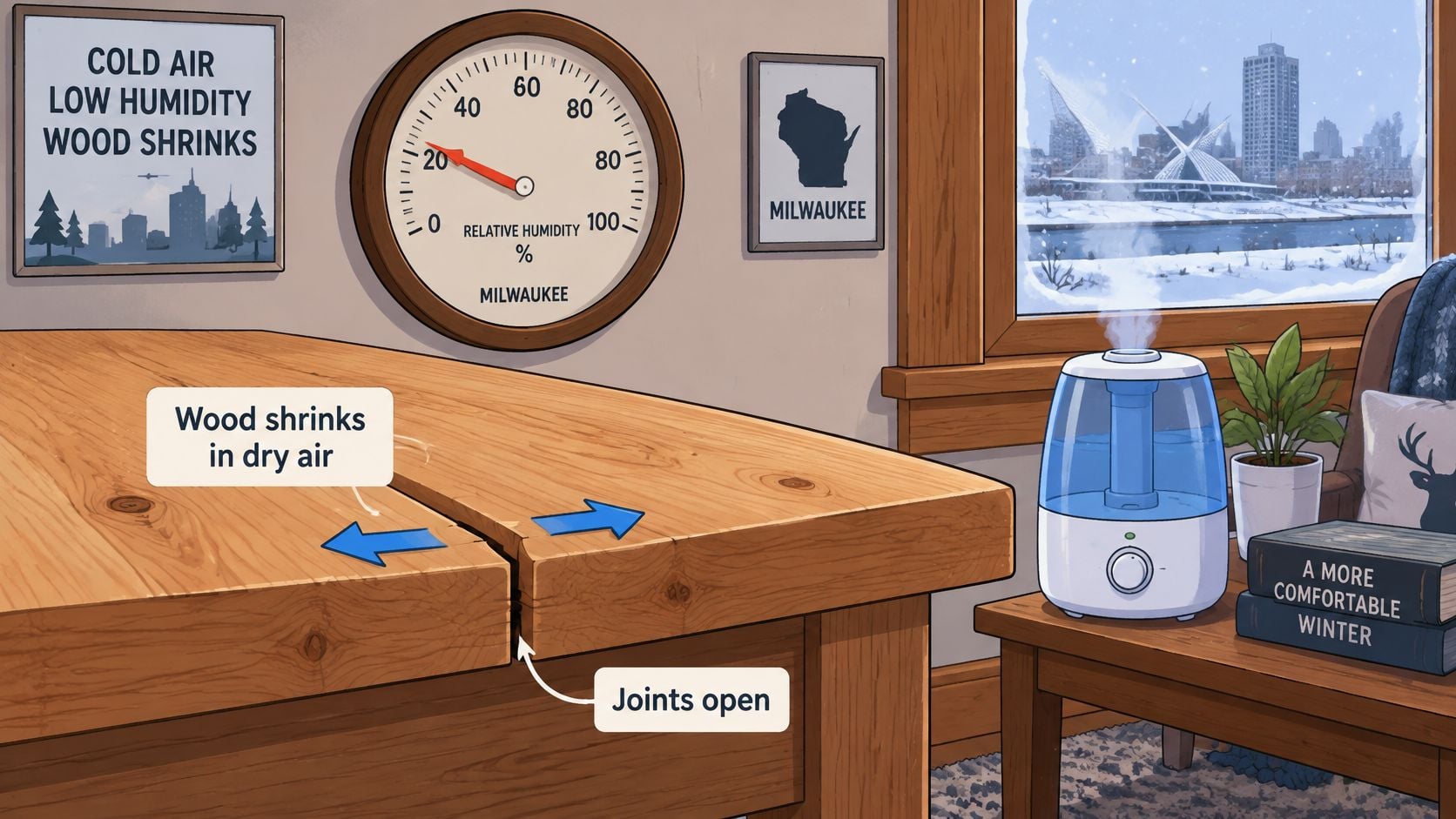
A finish slows moisture exchange. It doesn't stop movement. Coating a piece while it's still changing size can lock in a temporary shape, then leave checks, tight drawers, or a stressed joint when the room settles.
A simple indoor routine
- Park the piece in its final room for one to two weeks before any sanding. The goal is for the wood to meet that room's temperature and humidity, not the delivery van's.
- Keep it off heat and glare. Radiators, HVAC discharge, exterior doors, and direct sun create local moisture swings the rest of the room doesn't share.
- Read the room with a simple hygrometer. One number on a side table beats guessing from how the air feels.
- Sand and finish only after the wood has settled. The coating should follow the indoor size, not a size the board had in a warehouse.
| Indoor relative humidity | What it does to solid wood | What to do |
|---|---|---|
| Below 30% | Wood shrinks, joints can open, and drawers may loosen | Run a humidifier during dry winter months |
| 30% to 50% | Boards stay closer to their indoor size | Hold the room steady, then sand and finish |
| Above 50% | Wood takes on moisture and can swell at edges | Use air conditioning or a dehumidifier, and wait before coating |
Movement can't be switched off. Sudden swings can. Finish a piece that's already calm, and coat undersides and edges along with the show face so one side doesn't move faster than the other.
Finish Options and Which Suits Each Room
| Finish type | Look | Protection | DIY difficulty | Best fit |
|---|---|---|---|---|
| Raw, no finish | Natural and matte, shows every mark | Low | Easiest | Decorative pieces rarely touched |
| Penetrating oil | Warm, low sheen | Moderate, needs regular upkeep | Easy to reapply | Pieces you refresh yearly |
| Wiping varnish | Warm, low to medium sheen | Good | Moderate | Bedroom and occasional pieces |
| Water-based polyurethane | Clear and light, little color change | Strong and easy to clean | Moderate, fast drying | Desks and heavily used surfaces |
| Oil-based polyurethane | Warm amber tone | Very strong | Moderate, longer drying time | Dining tables and family use |
Match the film to the mess
A dining table meets tomato sauce, lemon, hot dishes, and spray cleaner. Oil-based polyurethane builds the strongest film of this set and shrugs off that mix better than oil alone. It dries slower, smells stronger while it cures, and shifts the wood toward a warm amber. For a deeper look at that choice, see which wood finish holds up on a dining table.
A bedroom dresser mostly sees folded shirts and a little dust. Wiping varnish gives a warm, low-to-medium sheen and enough protection without a thick plastic look. It's a moderate project, not a one-wipe job.
A home desk collects elbow oil, mug rings, and constant wiping. Water-based polyurethane stays clear, cleans up with water, and dries fast enough for a weeknight schedule. Odor is lower than with oil-based products. Color change is small, which matters on a pale maple top you don't want turned orange.
An occasional side table that holds a lamp and almost nothing else can stay raw or take a penetrating oil. Oil looks warm and low-sheen, and it's easy to refresh once a year. It won't stop a red-wine spill the way a film finish will. Raw wood is the easiest path and the weakest one. Hand oils and dust become the finish you didn't choose.
Oil-based coatings bring amber tone, stronger odor, and longer dry time. Water-based coatings dry faster, shift color less, and smell milder. Neither one freezes the board in place when the seasons change. The humidity habits still apply after the last coat.
Test the full schedule on a hidden spot, such as the underside of a tabletop, before the whole piece gets committed. Conditioner, stain, and topcoat together can look different from the can lid.
How to Finish Unfinished Wood Step by Step
Work only after the wood has settled in the room. Then build the coating in thin layers, on every face, not just the one guests see.
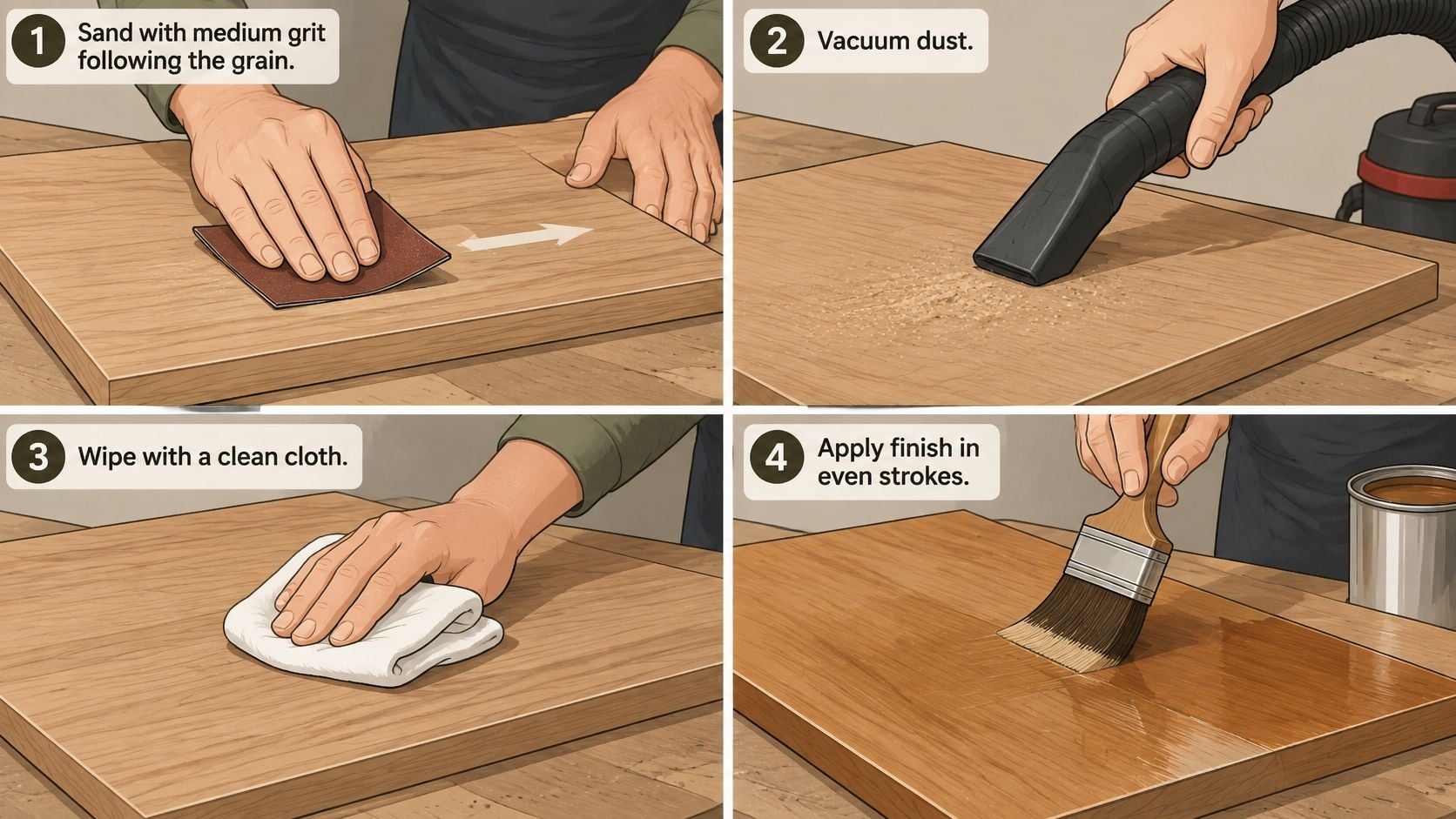
- Sand with the grain, from about 120 grit to 180 or 220. Take off mill marks and raised grain. Stop before the surface turns glassy. Over-polishing makes stain absorb in blotches instead of an even tone. A sanding block keeps flat tops flat. Curves want a flexible pad, not a hard block digging grooves.
- Vacuum, then wipe with a lightly damp cloth, and let the wood dry. Dust left in the grain becomes bumps under a clear coat. A soaking rag raises the grain again, so the cloth should be barely damp and the surface fully dry before stain.
- Test the whole schedule on scrap or an unseen area. Conditioner, stain, sealer, and topcoat interact. A scrap of the same species shows the true color. The can photo won't.
- Seal end grain first. End grain drinks finish and pulls moisture in along the board's length. An extra first coat there, wiped before it gets sticky, evens absorption with the face grain.
- Lay stain on evenly and wipe the excess. Puddles dry darker and look like stains you didn't plan. Work one section at a time so a lap line doesn't set in the middle of a top. More sanding and recoating detail lives in this walk-through on how to refinish wood furniture.
- Brush or wipe thin topcoats, and follow the recoat time on the label. Thick coats wrinkle, stay soft, and trap dust. Ventilate the room. Keep the piece out of direct sun while it dries so one edge doesn't skin over early.
- Cure fully before use, with kids and pets elsewhere. Dry to the touch isn't ready for a plate or a laptop. The label's cure window is the one that counts. Coat undersides, edges, and insides too, so moisture doesn't move faster through the bare side.
Manufacturing defects within the manufacturer's warranty period are covered, unless the furniture has been abused or altered to void the warranty. A home finish can count as that kind of alteration, so read the paperwork before sanding a piece that still has factory coverage.
What a sound result looks like
Daylight should show an even sheen, no dry patches, and no tacky spots. Run a hand along the edge. If it grabs, the film isn't ready for the room yet.
Keeping Unfinished Wood Looking Good for Years
Care follows the room, not a single spray sold for every surface. Each customer at the Greenfield showroom receives written care information for wood, fabric, or leather furniture and mattresses. These habits match that kind of note.
Dining
Wipe spills as they happen. Acids and water left to sit creep under even a strong film.
Use coasters and pads. Hot dishes and wet glasses are the usual ring makers.
Clean with a wood-safe product. Harsh sprays cloud polyurethane and strip oil.
Bedroom and occasional pieces
Dust with a soft cloth. Grit rubbed in a circle acts like fine sandpaper.
Refresh oil or wax only on penetrating finishes. A film finish doesn't need a heavy polish piled on top.
Watch handles and chair rails. Those spots wear first because hands live there.
Desks
Lift mugs and clean the ring the same day. A dried ring is harder than a wet one.
Check sun fade near windows. Clear films don't block every ray, and one side of a top can lighten.
Skip silicone polishes. They can make a later recoat crawl and refuse to stick.
Still-raw pieces
Wipe handling areas often. Skin oils darken bare wood in a patchy map.
Don't leave raw wood in a splash zone. A sealer belongs on that piece before it becomes a daily table.
A seasonal once-over
Keep furniture out of direct sun and off heat vents. Hold indoor humidity as steady as the house allows. Each season, look for small gaps, cupping, or thin finish along edges. A worn patch can be refreshed with light sanding of that spot only, a full dust cleanup, and a thin recoat of the same finish family. Mixing a water-based patch over an oil-based film, or the reverse, is how a repair peels.
A labeled sample of the existing finish, brought along on a showroom visit, gives the team something real to match. General care steps are also laid out in this wood furniture maintenance guide.
Decide Whether to Finish at Home or Visit Our Showroom
Finish at home when sanding and coating sound like a pleasant weekend, the room can be aired out, and the piece is light enough to shift while each coat cures. Get help, or choose the finish with the piece, when the cabinet is large, the table has family history, or the color has to sit well beside floors and fabrics already in the room. The same three checks apply either way: confirm the wood is solid, give it time to settle, and test the finish on a hidden patch or sample board.
A showroom visit answers the questions a photo cannot. You can compare grain side by side, feel whether a top is solid or veneered at the edge, lift a chair to gauge weight, and ask which species, finish, and care routine fit a kitchen table versus a bedroom dresser. BILTRITE Furniture-Leather-Mattresses is a fourth-generation, family-owned Greenfield business serving Metro Milwaukee since 1928, and the store is closed on Sundays and Mondays, so a weekday or Saturday visit is the easy plan.
Bring measurements, a photo of the room, and any drawer, shelf, or labeled finish sample you want to match. At BILTRITE Furniture-Leather-Mattresses, look for the solid wood, USA Made, and Amish made icons, try how a seat feels, and talk through unfinished surfaces, stains, and everyday care while the piece is in front of you.