Bookcase King Size Headboard Guide


The bedroom has a king mattress, two crowded nightstands, and a growing pile of books beside the bed. The wall still feels unfinished, but adding another cabinet would make the room feel tighter. A bookcase king size headboard can solve both problems, as long as the room is measured carefully and the headboard is mounted with real attention to weight, clearance, and stability.
This is more than a decorative backdrop. It's a substantial storage piece that changes how the primary suite works. The right choice brings warmth, keeps bedtime essentials close, and gives the bed a strong visual anchor without asking the room to hold several separate storage pieces.
Table of Contents
- Why a Storage Headboard Transforms Your Primary Suite
- Measuring Your Space for a Flawless Fit
- Choosing Materials That Last a Lifetime
- Safe and Secure Installation Techniques
- Styling Your Shelves for Comfort and Character
- Experience the BILTRITE Difference in Person
Why a Storage Headboard Transforms Your Primary Suite
A primary bedroom often collects clutter in predictable places. Books land on the floor, reading glasses disappear under pillows, chargers stretch across the nightstand, and small decorative pieces compete for the same limited surface. A bookcase headboard gives those items a home directly behind the bed, where vertical space would otherwise go unused.
For a couple redesigning a spacious but unfinished bedroom, the change can be surprisingly noticeable. The bed becomes the room's focal point, while open shelves provide space for books, framed photographs, baskets, and a small lamp. In a smaller bedroom, the same arrangement can reduce the need for separate nightstands or wall shelving. That matters because every additional piece needs floor space, walking clearance, and visual breathing room.
A storage headboard also creates a more settled feeling. Instead of a mattress floating against a blank wall, the bedroom gains an architectural feature that frames the bed. Wood adds a sense of warmth, while open compartments keep daily necessities visible and reachable.
Practical rule: Storage should make bedtime easier, not create another surface that demands constant tidying.
A bookcase king size headboard works especially well for people who want function without a heavily furnished look. It can hold the things used every evening while keeping the rest of the room calmer. Thoughtful organization ideas, including ways to reduce bedroom clutter, can be found in these five bedroom storage solutions.
The design does have a tradeoff. A deep headboard has more presence than a flat upholstered panel, and it can make the bed feel larger. That's why the piece should be treated as part of the room's layout, not as a last-minute accessory. The wall width, walkway, outlets, trim, and bed height all deserve attention before a purchase is made.
The global bedroom furniture category provides useful context for this kind of integrated design. One major estimate valued the market at USD 266.15 billion in 2024 and projected USD 383.12 billion by 2030, with a 6.5% CAGR, while another forecast estimated USD 132.49 billion in 2026 and USD 165.07 billion by 2031. These are projections for the broader bedroom furniture market, not for bookcase headboards specifically, as reported by Grand View Research's bedroom furniture market overview. The takeaway is simple. Storage-forward bedroom furniture belongs to a large, expanding category because homeowners continue to value pieces that combine sleeping, organizing, and space-conscious design.
Measuring Your Space for a Flawless Fit
The delivery team can bring a beautiful bookcase headboard to your primary suite and still find that it crowds a doorway, covers an outlet, or leaves too little room to walk. Measure the room before choosing a style. Deep storage pieces carry more weight and project farther than a flat headboard, so their footprint needs a deliberate plan.
A standard U.S. king mattress measures 76 inches wide by 80 inches long, creating 6,080 square inches, or about 42.2 square feet, according to this king bed dimensions guide. Treat those figures as the starting point, then add the frame, headboard, nightstands, and walking space.
Measure in this order
-
Check the usable wall width. Measure between corners and account for door swings, windows, trim, and the space required by nightstands. Mark the mattress centerline so the headboard can be positioned evenly.
-
Measure the bed frame. Record the frame's outside width and inspect its headboard attachment points. King frames do not all share the same bolt-hole positions, so confirm the mounting plan before assuming the pieces will connect directly.
-
Record the finished bed height. King mattresses commonly range from 9 to 12 inches thick, as noted by Dimensions.com's king-size bed guide. Add the foundation or platform height, then measure from the floor to the top of the mattress. This tells you where the lower shelves and headboard openings will sit beside the pillows.
-
Locate trim and outlets. Baseboards may keep a deep headboard from resting flush against the wall. An outlet behind a shelf can become difficult to reach, especially when lamps and charging cables need regular access. Note switch plates, vents, and any wall obstruction too.
-
Measure the projection into the room. A typical king bookcase headboard runs about 81.5 inches wide, 43 inches high, and 11 inches deep, based on this king bookcase headboard listing. An 11-inch projection can noticeably reduce the walkway in a narrow suite. Solid wood king headboards often measure around 82 inches wide and 12 inches deep, giving the bed a broader visual frame, as shown by this solid wood king bookcase headboard example.
Plan for intentional overhang
Extra width can look balanced, but it must fit the actual wall. Mark the expected headboard edges with painter's tape. Then check whether each shelf clears a doorway, window casing, nightstand, and walking route. This quick outline exposes problems before delivery, when changes become harder and more expensive.
A headboard can match the bed beautifully and still be wrong for the room if its depth blocks trim or consumes the walking path.
Bring the measurement record to the showroom, along with photos of the wall, frame, outlets, baseboards, and nearby doors. That information helps the furniture team confirm fit, mounting, and delivery access before the piece arrives.
Choosing Materials That Last a Lifetime
A bookcase headboard carries more responsibility than a simple decorative panel. It supports the visual weight of the bed while holding books, baskets, lamps, and personal belongings. Material choice affects how the shelves feel, how the finish ages, and how confidently the piece handles everyday use.
Solid wood is the strongest choice for a long-term bedroom investment. Its grain gives the headboard character, and a well-built frame can be repaired, refinished, or passed along rather than treated as temporary furniture. Wood species and finish still matter, so shoppers should inspect the surface, shelf construction, joinery, and back panels rather than relying on the word “wood” alone. A practical overview of furniture wood choices appears in this guide to selecting wood for furniture.

Compare the construction, not just the finish
Engineered panels can offer an approachable price and consistent surfaces, but buyers should examine edge treatment, shelf support, and fastener quality. A decorative finish can look appealing in a showroom, yet the underlying construction determines whether the headboard feels sturdy after repeated use.
Solid wood and wood-based panels aren't interchangeable. Each can suit a different budget and design, but a deep storage headboard deserves careful scrutiny because shelves magnify any weakness. Thin shelves, unsupported spans, loose back panels, or poorly fitted hardware can lead to wobble and sagging.
Amish-made furniture brings another consideration, craftsmanship. Skilled makers focus on joinery, proportion, finish quality, and repairable construction. That doesn't mean every piece has the same design or price, so the right approach is to inspect the actual headboard and ask how it was built.
BILTRITE Furniture-Leather-Mattresses carries USA-made, Amish-made, and solid-wood furniture, including bedroom pieces suited to shoppers who want durable construction and finish choices. The store also offers options ranging from smaller-scale furniture for apartments to heavier-duty pieces for families.
A family bedroom may need a headboard that tolerates more activity than a quiet guest room. Children may reach the shelves, pets may brush against the lower edges, and adults may rearrange books or décor frequently. In that setting, better-quality construction is a sensible value, even when it isn't the cheapest option.
The market context supports the importance of material and bed construction. One report identified wood as the leading material type with 52% share in 2025, while beds held 38% share as the dominant product type, and Asia Pacific represented 41% of the global bedroom furniture market in 2025, according to Persistence Market Research's bedroom furniture report. Those figures describe the wider category, but they help explain why wood construction and integrated sleep furniture remain central to bedroom furnishing.
Safe and Secure Installation Techniques
A deep, heavy storage headboard changes the installation job. In a primary suite, it can project far enough to affect walkways, cover outlets, or meet baseboards. Treat it as structural bedroom furniture, not a lightweight wall decoration. Plan on two adults, suitable hardware, and a level surface.
Use a two-person workflow
-
Read the hardware instructions first. Confirm whether the headboard attaches to the bed frame, the wall, or both. Use only fasteners suited to the wall and the furniture.
-
Find the studs. Mark stud locations before drilling. Wall brackets or cleats should connect to sound structural points, rather than relying only on hollow-wall anchors.
-
Check the finished height. Put the foundation and mattress in their final positions, then measure from the floor to the mattress top. Aim for roughly 4 to 6 inches of headboard overlap above mattress height so pillows cannot slip behind the panel, following this headboard mounting guide.
-
Mark and level the hardware. A small error becomes obvious across a king-size headboard. Mark both ends, check the center, and use a level before drilling.
-
Lift with two people. One person guides the headboard while the other supports its weight and watches the brackets or cleat. Keep fingers away from pinch points.
-
Tighten and re-check. Secure every fastener with the correct tool. Test for wobble, confirm that the bed remains centered, and check the top edge with a level.
Measure the room's usable depth before installation. Leave enough clearance for walking, opening nearby drawers, and reaching outlets. Check the baseboard as well. A deep unit may sit unevenly against the wall unless the rear design accounts for that trim.
The mattress and foundation must be at their finished heights before you set the mounting position. Otherwise, the headboard may leave a visible gap or place the pillow edge uncomfortably low.
Installation planning should follow the same order as assembling a bed frame. Heavy or wall-mounted pieces deserve professional help when the mounting surface, weight, or hardware is uncertain.
Safety comes before speed: If the headboard shifts or feels unstable, stop using the bed until the mounting points and fasteners have been checked.
Styling Your Shelves for Comfort and Character
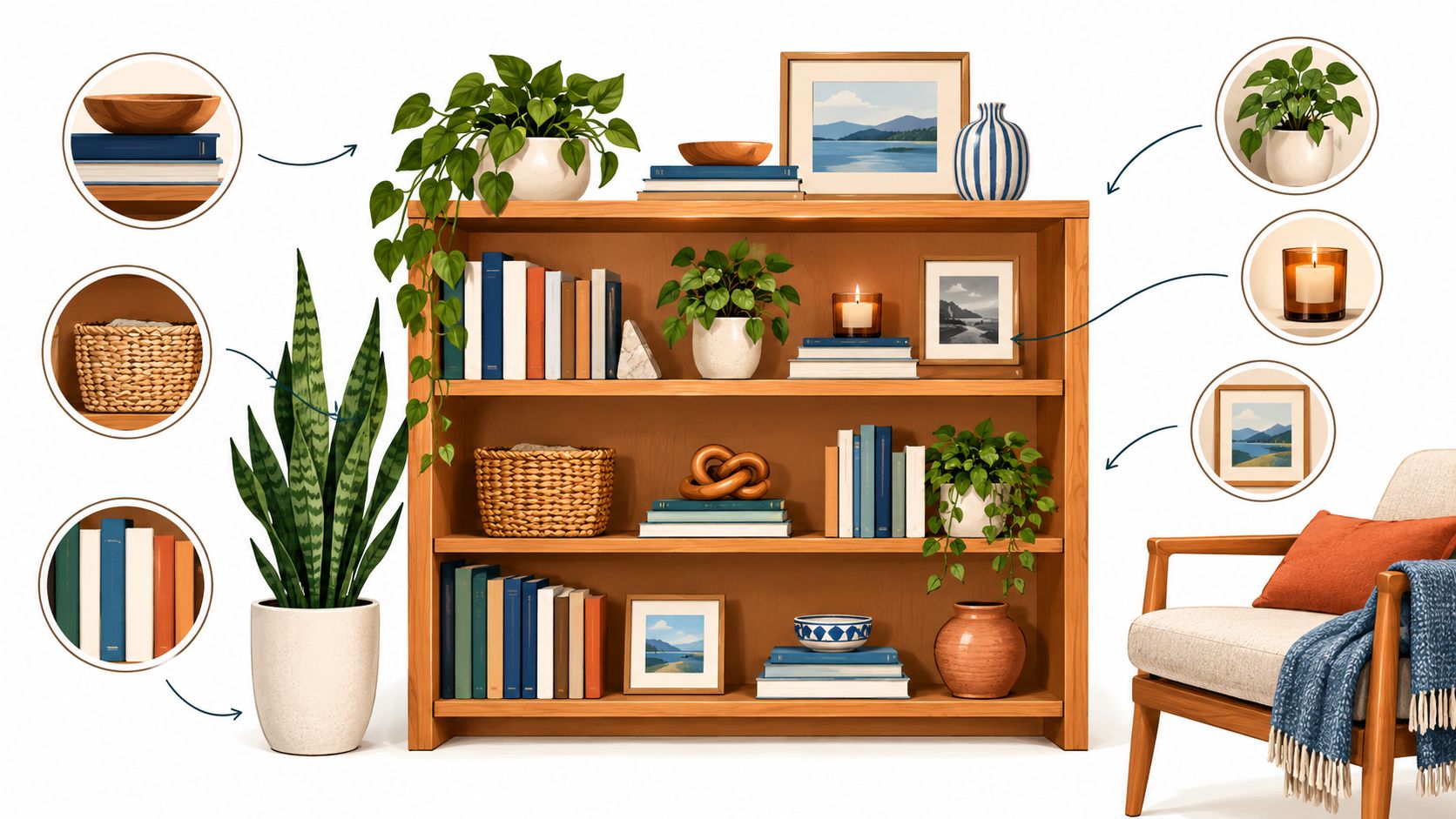
A bookcase headboard can make a bedroom feel personal, but open shelves can also become a display of every object that hasn't found a home. The most inviting arrangements mix useful items with a few meaningful accents, leaving enough open space for the wood and the room to breathe.
Begin with the items used at bedtime. Reading material belongs within easy reach, while glasses, a small clock, or a charging accessory can sit in a basket or designated compartment. The shelves shouldn't force anyone to stand on the mattress or reach across a lamp to retrieve something.
Build a balanced arrangement
A useful styling approach combines several kinds of objects:
-
Books: Stack a few horizontally and place others vertically. Varying direction creates movement without requiring more decoration.
-
Baskets: Use baskets for small personal items that need to stay nearby but don't need to remain visible. They also soften the strong lines of built-in shelving.
-
Photos: Place family photographs where they can be enjoyed from the bed, but avoid filling every compartment with frames.
-
Greenery: A small plant can add softness and color. Choose an appropriate container and keep water away from unfinished wood.
-
Lighting: A compact lamp can provide reading light, though cords should be routed safely and kept away from areas where they can snag.
The most attractive shelf arrangements usually have a visual rhythm. A taller object on one side can balance a stack of books or a basket on the other, while an empty cubby gives the eye a resting place. Symmetry can look calm, but a slightly varied arrangement often feels more natural in a family bedroom.
Pillows deserve attention, too. They can hide too much of the headboard if piled high, or leave the shelves looking disconnected if kept too low. The right amount depends on the headboard height, mattress thickness, and whether the shelves are meant to be decorative or used every evening.
For more approachable ideas, see these shelf decorating tips. The same principle applies in a bedroom: group related objects, vary height, and remove anything that creates visual noise or makes daily use harder.
Keep heavier objects on lower, well-supported shelves and reserve upper areas for lighter décor. The shelves should contribute to rest, not encourage late-night rearranging.
Experience the BILTRITE Difference in Person
A bookcase king size headboard needs to be experienced at full scale. Photos can't show how far the shelves project into a room, how a finish looks under different light, or whether the construction feels stable when a hand rests on the frame. Seeing the piece in person gives shoppers useful information before delivery.
BILTRITE is a fourth-generation, family-owned business serving Metro Milwaukee since 1928. The Greenfield showroom brings together affordable, better-quality furniture, USA-made and Amish-made solid wood pieces, bedroom furnishings, and a mattress department with over 60 models. That range helps households compare a headboard with the mattress height and bedroom pieces already under consideration.
The team includes sales associates with over 400 years of combined experience. Their role is to answer practical questions about scale, materials, delivery access, construction, and comfort, not to pressure shoppers into a rushed decision. BILTRITE also keeps its doors closed on Sundays and Mondays to support family time, a choice that reflects its community-first approach.
The store serves Greenfield and the wider Metro Milwaukee area from 5430 West Layton Avenue in Greenfield, Wisconsin. A showroom visit is especially useful for anyone comparing solid wood finishes, checking shelf depth, or deciding whether a large storage headboard will suit the room.
A measurement sheet, mattress details, and a few room photos can make the visit even more productive. With those details in hand, the BILTRITE team can help narrow the choices while keeping safety, function, and long-term value at the center of the conversation.
BILTRITE Furniture-Leather-Mattresses offers USA-made, Amish-made, solid-wood bedroom furniture and a mattress department with over 60 models for shoppers planning a more functional primary suite. Visit BILTRITE Furniture-Leather-Mattresses in Greenfield to see bookcase headboard options in person, check finishes and proportions, and talk with a knowledgeable local team.