Top Grain Leather Sofa Recliner Guide for Families


The familiar advice sounds simple: buy top-grain leather, and the recliner will hold up. That advice skips the most important question. Top grain describes the part of the hide and its surface treatment, not a standardized durability grade. A family choosing a top grain leather sofa recliner needs to know how that particular finish behaves when the seat front bends, the arms compress, and the footrest opens.
A handsome leather sample can't demonstrate all of that. The useful comparison combines the hide, its finish, the moving hardware, and the people who'll use the seating every day. That's how a furniture purchase becomes a comfortable fit for movie nights, visiting grandchildren, and ordinary evenings at home.
Table of Contents
- Top Grain Leather Next to the Other Hides
- Why the Finish Matters More Than the Label
- Mechanisms Frames and a Real Sit Test
- Size Clearance and Tight Milwaukee Doorways
- Simple Care for High Wear Spots
- USA Made and Amish Made Options We Carry
- Visit Our Greenfield Showroom and Try One
Top Grain Leather Next to the Other Hides
Top-grain leather comes from the dense outer layer of the hide after the lower split is removed. It retains the grain structure, although the surface may be buffed or finished to make its appearance more consistent. Full-grain leather comes from that same outer portion but preserves the natural grain surface, a distinction explained in this upholstery-industry leather guide.
That difference is easier to understand with a cushion-sized sample than a tiny swatch. Natural markings can look subtle on a small piece but become more noticeable across a sofa. A more uniform finish can make adjoining cushions look closely matched without making the underlying material synthetic.
Leather Types on a Sofa Recliner
| Leather type | Hide position | Surface | Everyday fit |
|---|---|---|---|
| Full-grain | Outer hide, split removed | Natural grain left intact | Patina lovers and lower-traffic rooms |
| Top-grain | Outer hide, split removed | Lightly buffed or finished for even color | Daily family seating |
| Corrected-grain | Outer hide, more heavily sanded | Thick pigment and a very uniform look | Kids, pets, and easier cleanup |
| Split | Lower layer under the grain | Often embossed to imitate grain | Light use, not high-flex seats |
| Bonded | Leather fibers plus binders | Coated and least natural | Skip for a recliner that moves daily |
These categories aren't completely separate rungs on a quality ladder. Corrected-grain leather can also be top-grain leather. The first term describes what happened to the surface; the second identifies the portion of hide.
Full-grain appeals to households that enjoy natural variation, wrinkles, and the gradual development of patina. Its placement in a lower-traffic room is a lifestyle suggestion, not a declaration that full-grain leather can't handle everyday seating. Finish, construction, and care still matter.
Match the Material to Family Life
For a busy family room, lightly corrected or protected top-grain leather can offer a useful balance between natural texture and consistent appearance. More heavily pigmented leather may suit a household that values easier cleanup over pronounced grain. Neither choice makes a recliner scratch-proof or maintenance-free.
Split leather lacks the outer grain layer. Bonded material uses leather fibers combined with binders and a surface coating, so it shouldn't be mistaken for a continuous hide. For seating that folds regularly, the stronger purchasing approach is to prioritize a documented upholstery specification rather than an appealing leather-sounding name.
Shopping shortcut: The material covering the seat doesn't automatically identify the material covering the outside back, arms, or footrest.
A useful product description should identify whether those panels are matching leather, another leather category, or a synthetic match. A matching color alone doesn't answer that question.
The difference between top-grain and full-grain leather offers another starting point for sorting the terminology. BILTRITE Furniture-Leather-Mattresses also offers custom furniture options with choices of fabric, leather, wood, finish, and hardware, allowing households to consider more than a single catalog look.
Why the Finish Matters More Than the Label
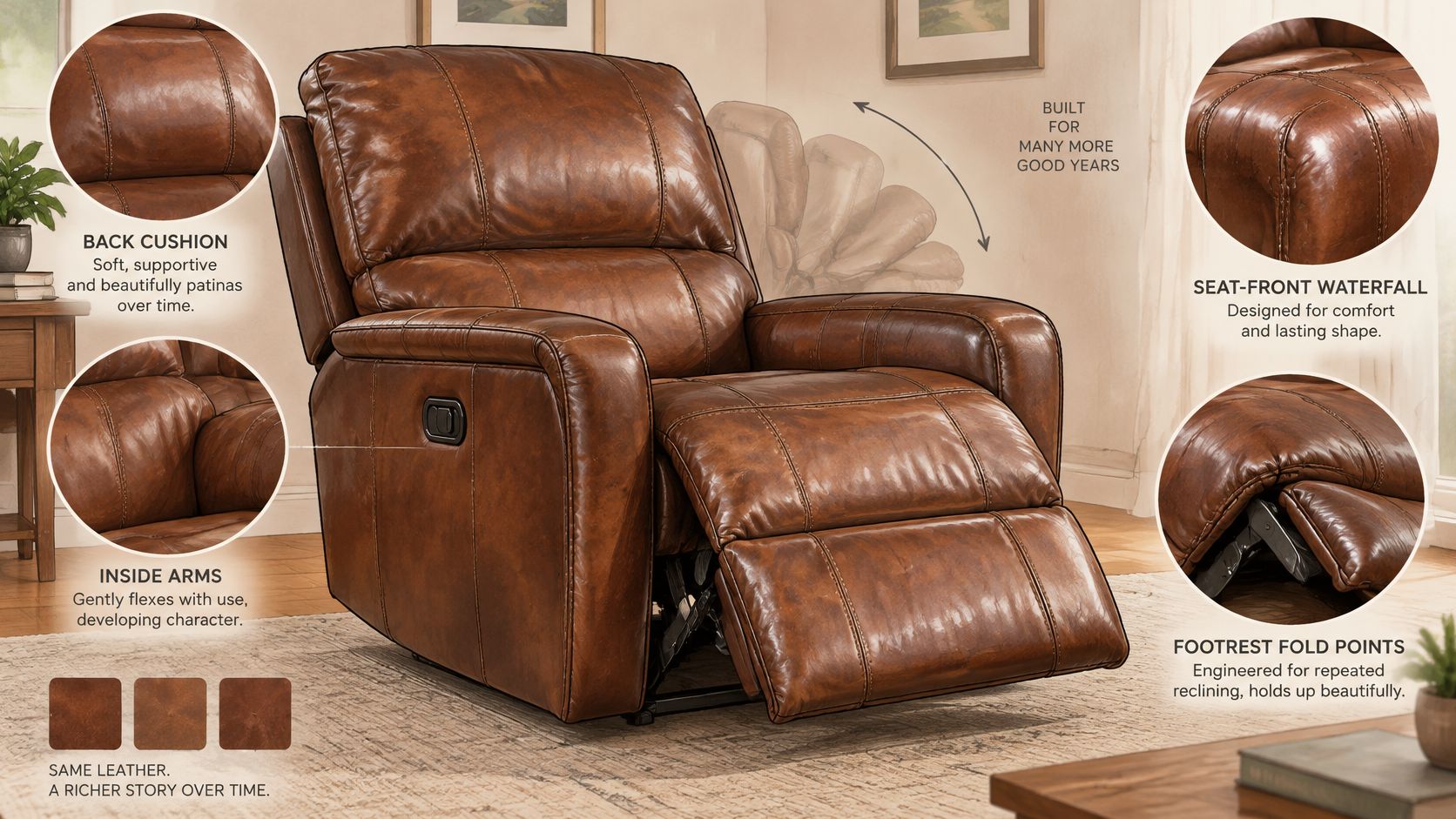
“Top grain” describes where leather comes from on the hide, not how well it will hold up in a recliner. The finish matters because a moving chair repeatedly flexes the seat-front waterfall, the rounded edge beneath the knees, as well as the inside arms, back cushions, and footrest transitions. Those are places where a surface has to bend, rub, and recover.
The photograph identifies features to inspect on a showroom model. The useful question is how the covering responds as those parts move.
What Laboratory Tests Establish
A European furniture-upholstery procurement specification references tear testing under EN ISO 3377-1, pH under EN ISO 4045, dry flex under EN ISO 5402-1, and colorfastness under EN ISO 11640. It lists a minimum average tear load above 20 N, with recommended dry-flex endurance of 20,000 cycles for certain aniline leathers and 50,000 cycles for semi-aniline, coated, pigmented, and other categories. These are procurement thresholds, not universal residential requirements or promises about household lifespan.
Abrasion testing answers a narrower question. ASTM D7255, adopted in 2006 and revised in 2022 uses a rotary-platform abrader to assess visible specimen damage or change in mass. The standard cautions that abrasion resistance is only one contributor to durability.
A high cycle count does not convert neatly into years of use beside the television. Sunlight, body heat, pet contact, cushion compression, and recliner movement all affect upholstery in ways a single laboratory method cannot represent.
Read the Finish at Its Bending Points
A lightly finished surface generally shows more natural grain and calls for prompt attention to spills. More pigment can give a more uniform protective surface, while a heavy coating may reduce breathability and show cracking or loose-looking puddling as the seat compresses.
During a showroom inspection, watch how the upholstery behaves:
- Seat front: The cover should bend without forming an unusually sharp, strained crease.
- Inside arms: Adjacent panels should move without scraping tightly against each other.
- Footrest transition: Full extension should not pull the covering drum-tight.
- Back cushion: Compression should look natural, without seams drawn into obvious tension.
Opening a recliner reveals how its upholstery is fitted around the moving parts.
Useful paperwork names the finish category, applicable test method, care requirements, and warranty coverage. Fabric double-rub scores do not substitute for leather-specific information, and an impressive abrasion result cannot make up for poor upholstery fit.
Mechanisms Frames and a Real Sit Test
The first opening of a footrest proves that it opens. It doesn't establish whether the frame, linkage, fasteners, and actuator can tolerate repeated household use.
Published lounge-seating test comparisons from a furniture testing laboratory describe a 25,000-cycle recliner test, including a representative large-occupant protocol applying 270 pounds to the backrest, 270 pounds to the seat, and 50 pounds to the legrest. Those controlled test loads illustrate a testing procedure, not an automatic occupant rating for every recliner.
The relevant documentation belongs to the exact model, not merely its collection. A household needs the rated occupant capacity and the manufacturer's coverage for the frame, motion mechanism, motors, transformers, springs, and switches.
Sit-Test Checks for a Leather Recliner
| Check | Pass | Warning sign |
|---|---|---|
| Footrest cycle | Full extension and the front frame stays down | Front lifts, scrapes, or stops short |
| Return to close | Seats shut evenly with little side play | Click, grind, or a leftover gap |
| Body support | Head, lumbar, and arms meet the occupant when seated fully back | The occupant slides forward or slouches |
| Capacity | The exact model rating covers the heaviest daily user | Only the collection is rated, not this chair |
A useful test begins with the occupant seated fully back, rather than perched at the edge. The lower back should meet the lumbar support without the person having to scoot forward. The armrests should support relaxed arms instead of lifting the shoulders.
Seat depth deserves particular attention. A deep seat may look generous but leave a shorter adult choosing between back support and comfortable knee placement. A smaller-scale chair can provide better everyday comfort than an oversized model that encourages slouching.
Test the Controls Without Helping Them
Each reclining seat should be opened and closed repeatedly while the shopper listens for scraping, grinding, or uneven movement. Controls should remain accessible in the positions the occupant uses. A person shouldn't have to twist awkwardly or lean across a moving gap to find the switch.
- For frequent users: Frame reinforcement, suspension, cushion recovery, and serviceable hardware deserve close attention.
- For heavier adults: The documented model capacity matters more than a substantial-looking arm or oversized cushion.
- For older adults: Stable arm support and straightforward controls may matter more than the deepest available recline.
BILTRITE Furniture-Leather-Mattresses offers heavy-duty furniture and mattresses, providing an appropriate category to compare when ordinary seating specifications don't meet household needs. The recliner buying guide can help organize those comparisons before a showroom visit.
A power lift recliner is a separate standing-assistance option, not another name for a power reclining sofa. A lift recliner doesn't swivel, and its suitability should be evaluated around the user's transfers and daily mobility needs.
Size Clearance and Tight Milwaukee Doorways
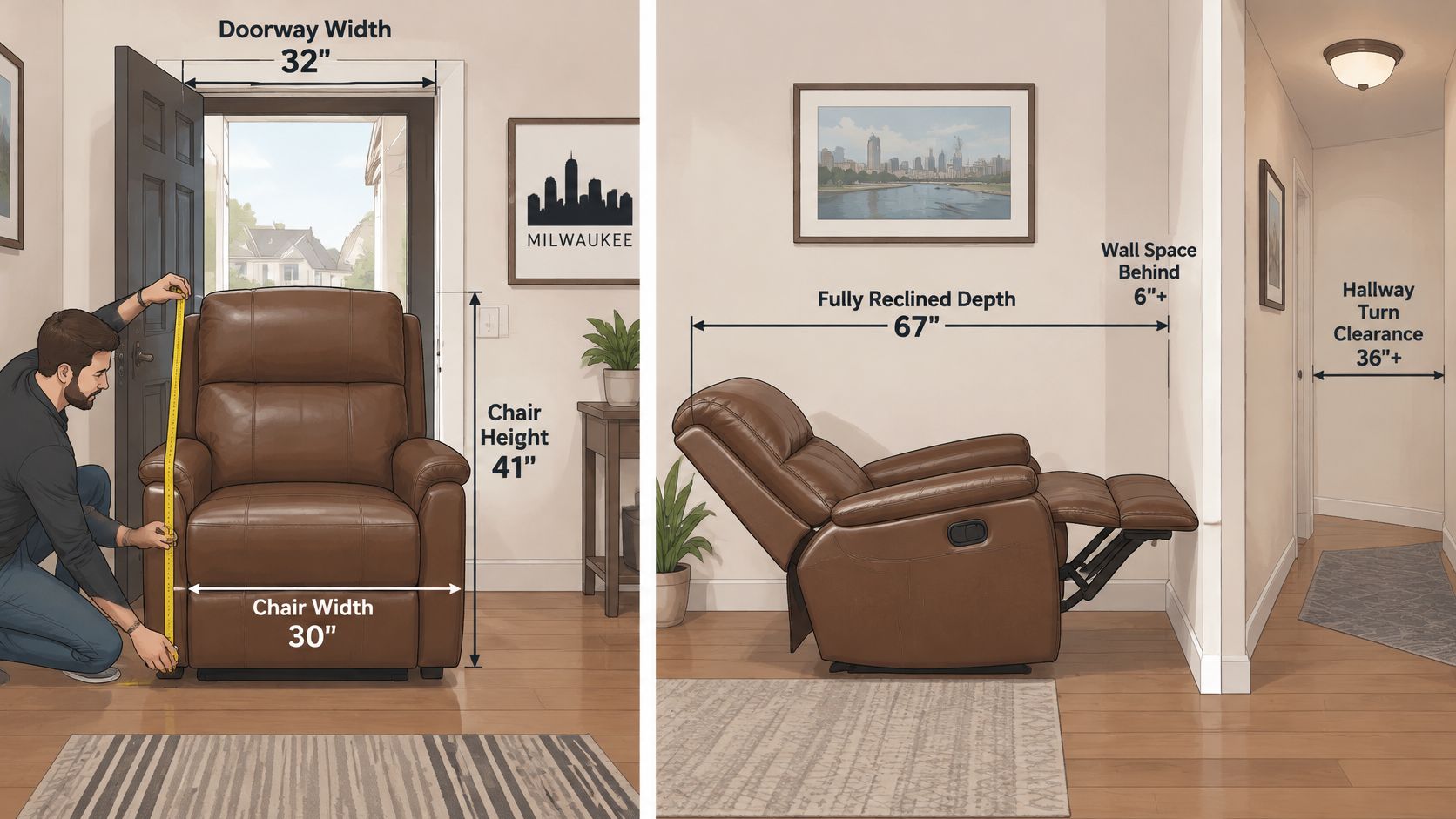
A top-grain label won't tell you whether a reclining sofa can make it through your front door. Check both the route into the home and the space the recliner occupies as it opens. A moving footrest and reclining back need room, just as the upholstery needs to flex across the seat front, arms, and footrest.
A room sketch should show the sofa closed and fully reclined. Include the manufacturer's specified rear clearance, then check that the footrest will not meet a table, wall, or cabinet.
Measure the Route and the Recline
Use a tape measure, a simple floor sketch, and photographs of tight turns. Measure the clear opening with the door open, rather than relying on the door's stated size.
- At the entrance: Record the opening, overhead clearance, and obstacles such as railings or storm doors.
- Along the route: Note hallway turns, stairs, landings, and spots where a large piece may need to change direction.
- Inside the room: Mark the fully reclined depth and the manufacturer-specified rear clearance.
- Beside the seating: Leave enough space to keep moving upholstery clear of nearby furniture.
Power models need a practical route to an electrical supply. Keep cords out of walking paths and away from moving parts. Ask about the specific model's power arrangement rather than assuming all reclining sofas connect the same way.
Come-Apart Construction Can Solve an Access Problem
Older Metro Milwaukee homes, apartments, and condos may have tight entrances or awkward turns. Come-apart sofas and sectionals separate into sections to help with access, but measure each section and the route it must travel.
Our guide to furniture for narrow doorways explains what to consider. BILTRITE offers come-apart sofas and sectionals, so the route into your home can be part of choosing the furniture, not a delivery-day surprise.
For shared movie nights, confirm which seats recline and whether their mechanisms operate independently. A sectional's seat count alone does not tell you how many reclining positions it has.
A smaller room can still accommodate comfortable seating. Plan the layout with the footrests extended, keep a usable walking route, and check the delivery path before choosing a model.
Simple Care for High Wear Spots
A finish wears the way paint wears on a door hinge. Flat panels stay quiet. The coating shows its age where the surface has to bend. Top grain names the hide's place on the animal and the finish on that surface. How long a recliner stays pleasant depends on how that finish flexes across the seat front, the arms, and the footrest every time someone sits down and the mechanism travels.
Keep the maker's cleaner and conditioner sheet with the receipt. A generic spray, saddle soap, or heavy oil can fight the coating the factory chose. An open, absorbent surface and a pigmented coating can both leave the tannery labeled top grain, and each one calls for its own product and its own amount.
Dust collects in stitching and along cushion edges the way grit collects in a sliding track. A soft, dry cloth lifts those particles before sitting works them into the finish.
- After a spill, blot with a clean, absorbent cloth so the liquid stays put.
- Before any bottle touches the sofa, confirm the cleaner is approved for that finish and try a small dab where a cushion meets the frame.
- Condition on the maker's schedule, using the stated amount.
- Around pets, keep nails trimmed and set any throw so it stays clear of the footrest gap.
One extra, heavy coat can turn a matte arm glossy, then tacky. The surplus product sits on the coating instead of feeding it, and the shine shows up first on the spots hands touch most.
A Dated Log Beats a Memory
Once a month, close the recliner, open it fully, and write what you see. A line such as "March 12, right arm, slight shine, coating intact" is easier to trust than a memory from last winter. Note a sharp new fold, a loose flake, a polished patch, or two panels rubbing. A fresh crack or a coating that lifts calls for the manufacturer's advice.
Relaxed creasing belongs on a cover with enough ease to travel with the cushion and the mechanism. Sudden tightness, a scrape, or a patch that grows from one log entry to the next is the change to act on.
Sun through one window, or heat from a nearby register, dries a finish faster than ordinary room air. Shift the sofa off that line when the layout allows. Our leather furniture care guide walks through everyday cleaning choices, and the maker's sheet still decides which products to use and how much.
USA Made and Amish Made Options We Carry
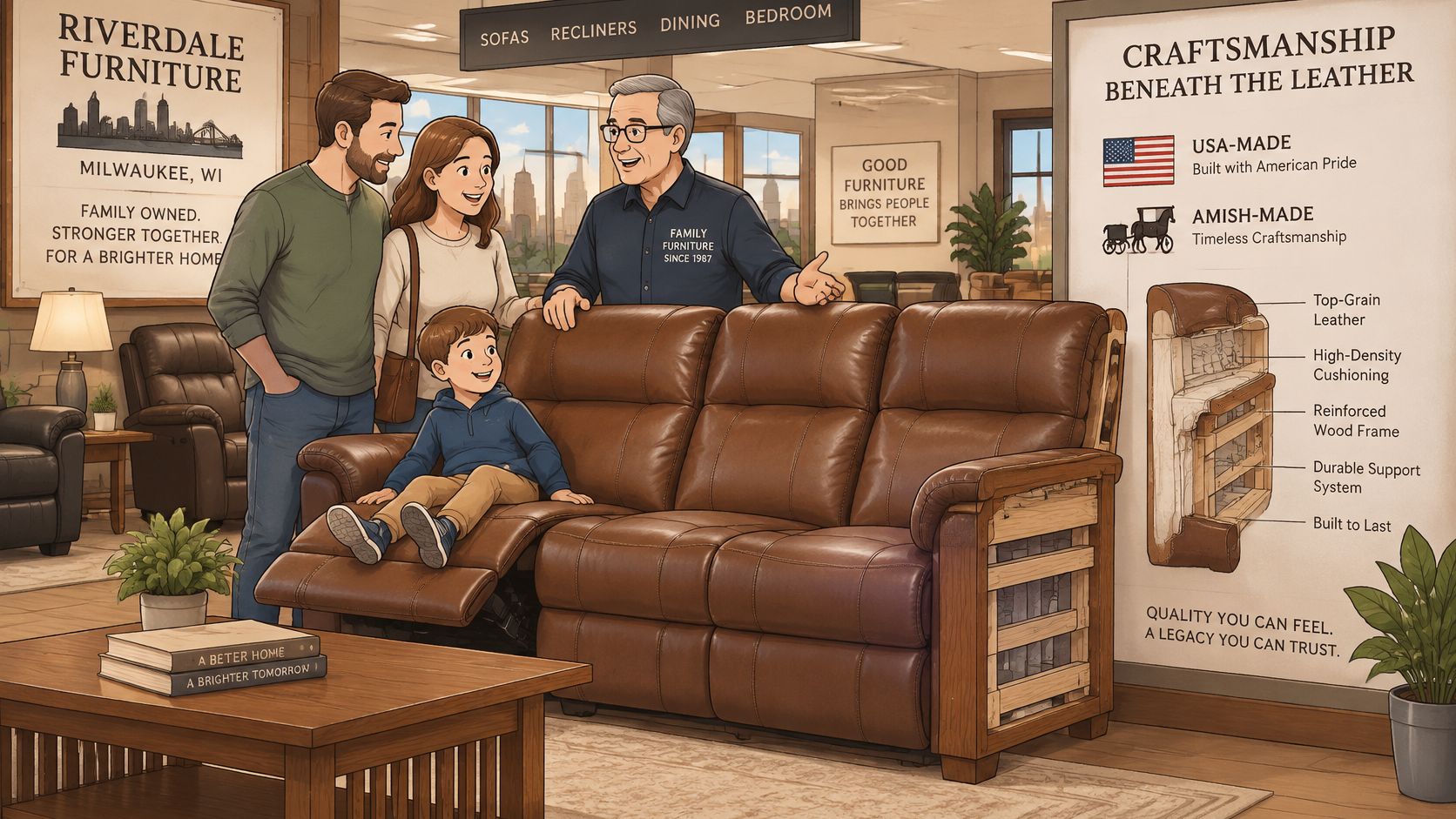
A recliner's origin label can help narrow a search, but it does not tell you how the seat will feel or how its mechanism will move. Compare the construction and intended use of each piece, then consider how it fits the household and room.
BILTRITE has served customers since 1928. Its specialty categories include USA-made furniture, Amish-made furniture, solid wood, small-scale furniture, and heavy-duty furniture and mattresses. The living room selection also includes sofas, sectionals, loveseats, chairs, recliners, lift chairs, and sleeper sofas.
Craftsmanship Without Assumptions
Labels such as Amish-made and USA-made describe an option's origin, not every detail of its construction. A solid-wood table and an upholstered reclining sofa serve different purposes, so look at the materials and features of the particular piece rather than assuming a label means the same thing across categories.
For shoppers exploring domestic options, our USA-made leather furniture guide is a useful starting point. Most furniture can also be customized to suit personal style and comfort, with choices that may include fabric, leather, wood, finish, and hardware.
Value comes down to the piece itself: its construction, comfort, available customization, and care needs. These details are more useful for comparison than price alone.
Different Seats for Different Needs
BILTRITE has 150 styles of recliners and 48 models of power lift chairs. A standard recliner supports relaxing, while a lift chair is designed to assist with standing. They may both recline, but they address different needs.
- For compact homes: Small-scale furniture can help keep seating in proportion to the room.
- For shared living spaces: Sofas, sectionals, and chairs provide different seating options within one room.
- For additional support: BILTRITE offers heavy-duty furniture and senior living furniture, as well as mattresses for these needs.
A household can compare these categories with the actual furniture in view, rather than relying on a label or photograph alone. The showroom's selections include Amish-made and USA-made options alongside other furniture styles, making it easier to consider which construction and features suit the home.
Visit Our Greenfield Showroom and Try One
Top grain is a hide position and a finish, not a durability grade. On a sofa recliner, the useful test is how that finish flexes on the seat front, the arms, and the footrest while the chair moves.
Recline the piece all the way. Watch the leather at the front edge of the seat, along the arm where a hand rests, and across the footrest as it rises. Those three spots take the bend. The leather there works like a jacket elbow: you learn the give by flexing it, not by reading the tag. A stiff finish can sit smooth while closed, then crease hard once the mechanism opens. A supple top grain finish should fold with the cushion.
A short household checklist keeps the visit practical. Doorway and hallway measurements, a room sketch, and notes about daily users turn a wide search into a side-by-side comparison on the floor.
Bring the Questions That Affect Ownership
- Comfort: Each regular user should settle into a natural resting position and stay long enough to feel the seat, arms, and footrest in motion.
- Access: Delivery-path photographs show a tight turn to the person planning the route.
- Specifications: Ask about model capacity, construction, manufacturer coverage, and care requirements.
- Getting home: Confirm delivery arrangements or free in-store pick-up before you buy.
Selected floor models can be bought at our Greenfield showroom. Custom options let a household choose fabric, leather, wood, finish, and hardware so the piece matches style and comfort. Free in-store pick-up fits when the vehicle, the extra hands, and the furniture dimensions all line up.
Plan the Greenfield Visit
We are closed on Sundays and Mondays at BILTRITE Furniture-Leather-Mattresses in Greenfield, in the Metro Milwaukee area. Call 414-238-2020 with questions before you come.
Open and close the recliner a few times. Feel whether the top grain finish stays comfortable where your legs meet the seat front and where the footrest meets your calves. The right piece suits the people, the room, and the daily routine.
Affordable, better-quality leather seating, USA-made options, and small-scale and heavy-duty furniture give families practical choices beyond a leather label. A visit to BILTRITE Furniture-Leather-Mattresses in Greenfield lets you test that flex, look at the upholstery while the chair moves, and ask questions in person.