Double Recliner Leather Guide: Grades, Fit and Care

Why should a couch that fits on a showroom floor still fail in a living room? Shoppers often check width, pick a color, and sit down once, but a double recliner leather piece asks harder questions. Does it fit when fully reclined, can each seat move on its own, and will the leather handle two people using it every day?
Table of Contents
- What a Double Recliner in Leather Really Is
- Leather Grades Compared at a Glance
- Sizing the Room and the Delivery Route
- How the Two Recliners Work and How They Hold Up
- Caring for Leather So It Lasts for Years
- What a Leather Double Recliner Costs and Where the Value Lives
- Is a Leather Double Recliner Right for Your Household
- Visit Our Greenfield Showroom to Test Both Seats
What a Double Recliner in Leather Really Is
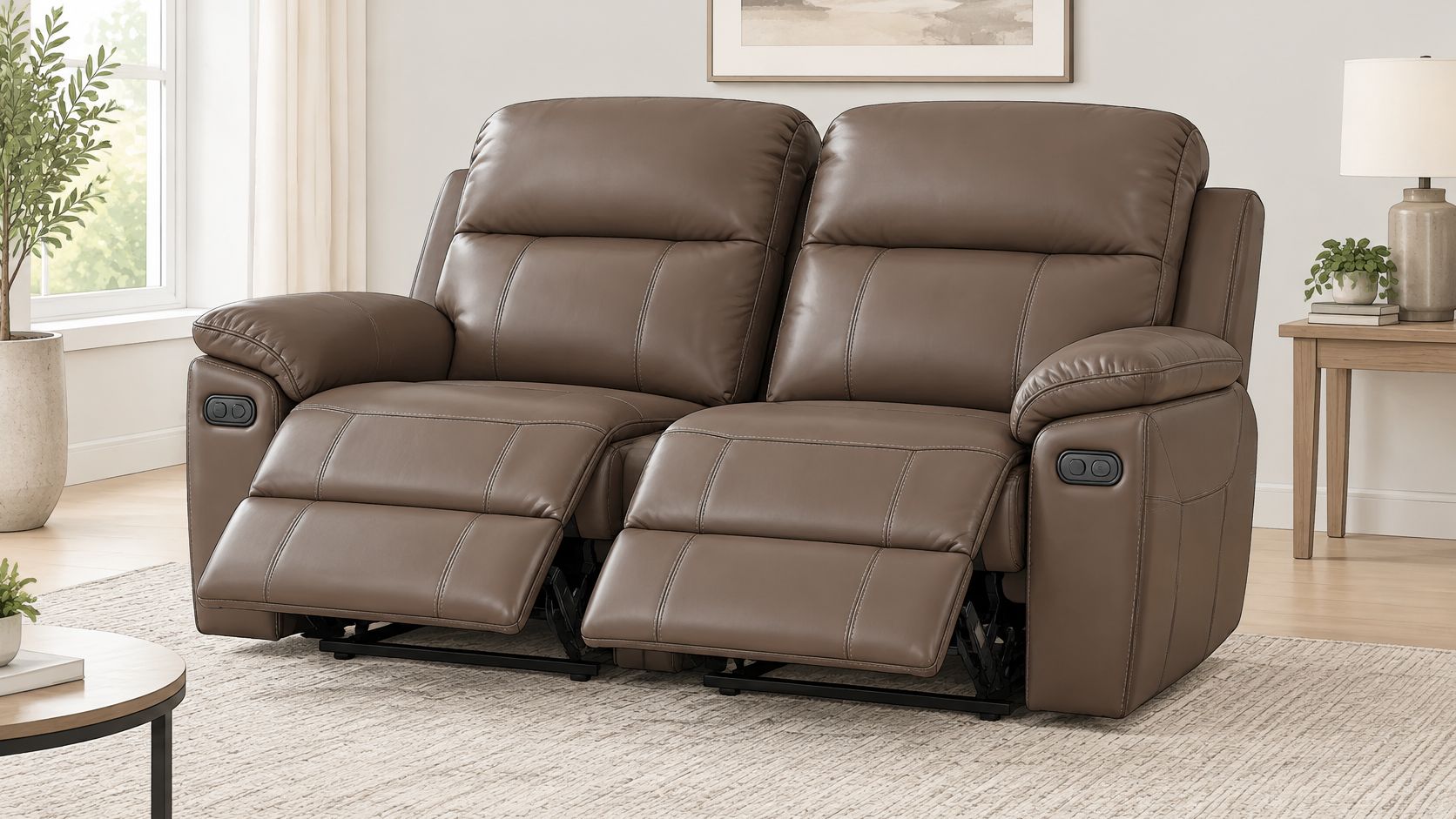
One person wants to sit upright through the movie; the other is ready to put their feet up. A double recliner in leather is a two-seat reclining sofa or loveseat with a reclining back and footrest at each seat, upholstered in leather. The seats sit side by side, while their reclining positions may work independently.
Two common layouts are a loveseat with two reclining seats and a sofa with two recliner seats and a center console between them. Check how each side operates before choosing a layout. The controls and mechanism determine whether one person can recline while the other stays upright.
Reclining furniture has a long history. Edward Knabusch and Edwin Shoemaker developed their first reclining porch chair in 1928, and a patent for the first reclining chair of that line was filed on January 24, 1929, according to The Henry Ford's account of early reclining-chair milestones. An upholstered indoor version followed, bringing the reclining position into everyday living spaces.
With two seats in regular use, the leather and reclining hardware need to stand up to frequent sitting and movement. Check the upholstery, how each seat reclines, and whether the piece can get through the room's delivery route. Test both seats independently so one side never sets the limit for the other.
BILTRITE Furniture-Leather-Mattresses has served Metro Milwaukee since 1928. Its Greenfield showroom gives shoppers a place to compare furniture in person.
Leather Grades Compared at a Glance
The word genuine causes real confusion. It only confirms real leather, it doesn't rank quality, durability, or finish, so grade matters more than that label. Shoppers comparing options, including premium USA leather choices, should ask which layer of the hide was used and how the surface was finished.
Leather grades at a glance
| Grade | What It Is | Daily Durability | Care Level |
|---|---|---|---|
| Full-grain | Top layer of the hide with the natural surface kept | Strongest fibers, develops a patina over time | Wipe, condition once or twice a year |
| Top-grain | Surface sanded and finished for an even color | Durable and uniform, a common premium choice | Wipe, condition once or twice a year |
| Corrected-grain | Surface corrected and coated with a heavier finish | Consistent look, easy to wipe clean | Wipe clean, avoid harsh cleaners |
| Split leather | Lower layer of the hide, coated or embossed | Less durable, lower cost | Gentle cleaning, avoid heavy wear areas |
| Bonded leather | Shredded leather fibers bonded to a backing | Least durable, can peel over time | Damp cloth only, keep dry |
Full-grain keeps the tightest natural fibers, so armrests and headrests resist wear well and gain character instead of looking tired. Top-grain trades a little natural variation for even color, which is why it's common in better recliners that need both seats to match. Visible marks bother some families, delight others, and neither reaction is wrong.
Corrected-grain gets a heavier coating, so spills wipe up easily but natural character hides under the finish. That coating has to flex, though, or footrest edges and seat fronts can crack where the leather bends daily. Split leather comes from the lower hide layer and costs less, so expect shorter life in high-contact spots. Bonded leather uses shredded fibers on a backing and is the least durable, with peeling as the usual first failure.
Tests that predict recliner wear
Labels don't bend, leather does. ASTM leather standards include separate upholstery methods for cold-crack resistance, flexing of the finish, grab tensile strength, trapezoid tear strength, accelerated aging, and heat-aging stability. EN 13336:2022 also treats upholstery leather through mechanical, colorfastness, staining, and tear-performance evaluation.
Those tests map directly onto a double recliner. Repeated opening flexes the seat front, footrest edges, inside arms, and hinge-adjacent panels, while body oils concentrate on the two most-used seating positions. Shoppers can do simple checks in store:
- Fold the sample: Bend it firmly and look for finish cracks or flaking.
- Rub the sample: Use a clean cloth and check for color transfer.
- Compare zones: Match high-contact areas against low-contact panels for consistent finish.
- Ask for documentation: Request the leather specification and test basis, not just a grade name.
Matching across both seats matters too. Replacing one damaged panel later can be difficult if the original dye lot or finish is discontinued, so consistent color today protects tomorrow.
Sizing the Room and the Delivery Route
Start at the narrowest point on the route. Measure the front door, hallway, stairs or elevator, turns, and final room opening. Record the smallest clear width and height at each point. For more ideas on planning a tight entry, see furniture options for narrow doorways.
A delivery guide says many recliners, even when partially disassembled, need approximately 28 to 36 inches of clear width for safe movement. Review the OROA guide to measuring doors, stairs, and elevators. Measure the actual opening with the door open, allowing for trim, banisters, and corners. A come-apart design can make delivery easier, but measure each piece, its packaging, and the space needed for reassembly.
Room and delivery measurements to take
| Measurement | Where to Take It | Compare Against |
|---|---|---|
| Clear doorway width | Narrowest point, door open | About 28 to 36 inches for many recliners |
| Closed width | Arm to arm across both seats | Wall space and walking path |
| Closed depth | Back to front, closed position | Floor space in the room |
| Reclined depth | Wall to footrest tip, fully reclined | Extra room the footrests need |
| Seat height | Floor to top of seat cushion | Comfortable standing for each user |
| Back clearance | Back of recliner to wall when reclined | Manufacturer's specification |
Check the recliner's boxed and assembled dimensions against your route measurements. Then measure the room with the recliner closed and fully reclined. Reclined depth shows whether the footrests clear a coffee table and whether the back has enough wall clearance. Mark the fully reclined footprint on the floor with tape to see how much walking space remains.
Fit for easier standing
For senior users and caregivers, seat height, cushion compression, and armrest support all affect how easily someone can rise. A deep, soft seat may feel cozy but make standing harder for someone with sore knees. Firm armrests can provide a steadier push-off.
Measurement rule: Measure in the reclined position, not just the closed position. The fully open footprint determines how much usable floor space remains.
How the Two Recliners Work and How They Hold Up
A double recliner runs two mechanisms, so inspection goes beyond upholstery. One useful definition keeps the conversation honest. The U.S. General Services Administration test defines one recliner cycle as moving from closed to TV position, then full recline, and returning fully closed, with cycling to 25,000 cycles or until failure, in the GSA upholstered furniture test method.
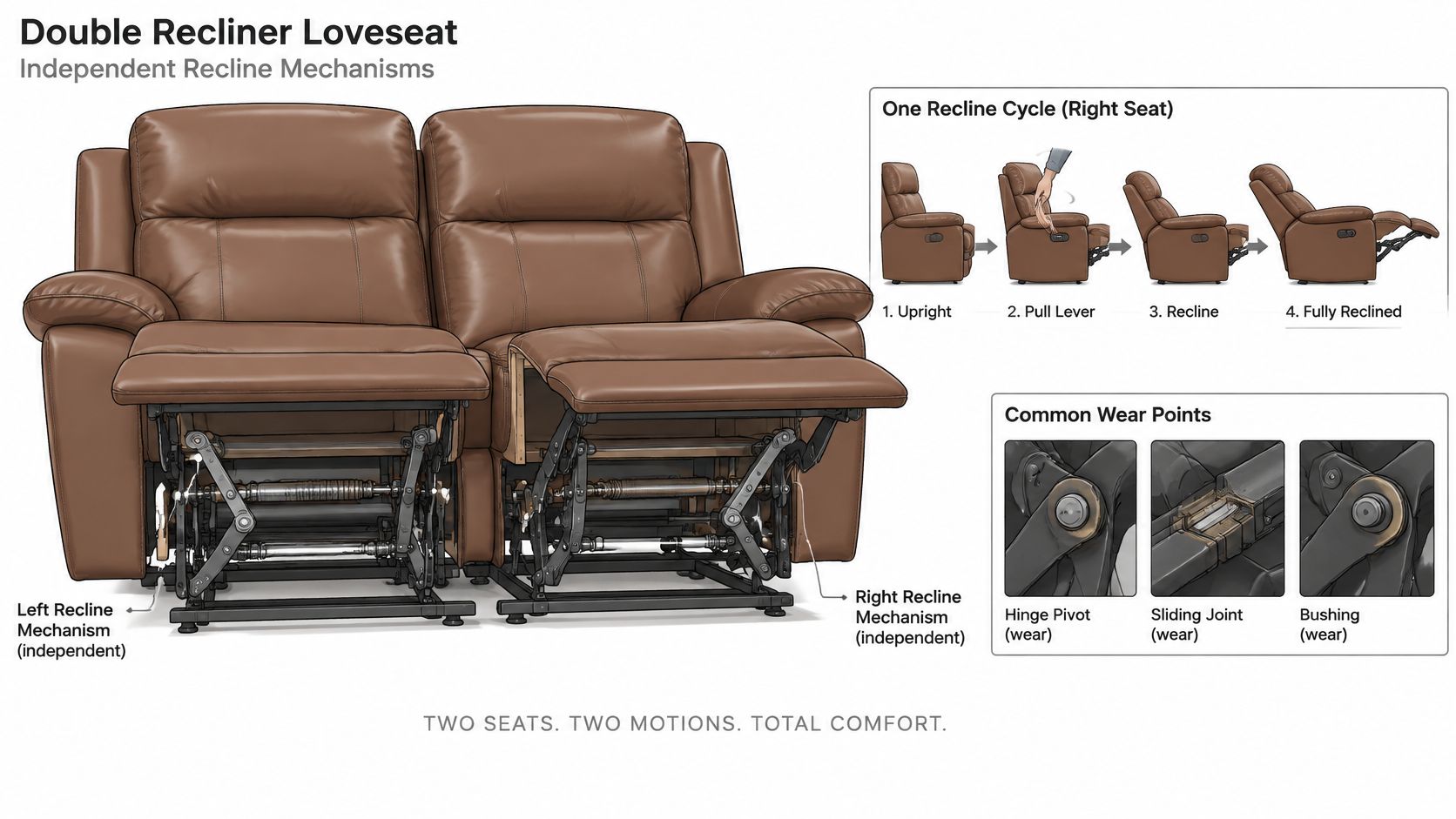
That benchmark turns into three store questions. Has the exact mechanism been tested at or above that cycle count? Does the frame stay square after testing? Is the weight rating stated per seat rather than for the whole loveseat? Two seats rarely wear evenly, since one side often gets used more, loaded unevenly, or treated as a step by busy feet.
Independent seats versus shared motion
Independent seats let one person sit upright while the other reclines fully, and that's the whole charm of the category. A shared mechanism removes that freedom. Shoppers comparing motion styles can review the different types of power reclining seating and then test both controls while seated, not standing beside the piece.
Power models add practical checks:
- Outlet needs: Confirm whether each seat needs its own outlet or one shared connection.
- Battery backup: Ask whether backup is included if power goes out mid-recline.
- Control placement: Reach the buttons without twisting, leaning, or hunting by feel.
- Console connection: Check whether the center console structurally links the two mechanisms.
Warning signs worth noticing
A tested mechanism can still feel sloppy if fasteners, pivots, or seat-to-frame joints aren't secured well. Squeaks, looseness, and a shifting console during a showroom test are early warnings, not quirks to ignore. Run each side through its full range twice and listen.
Warranty reading needs the same care. The warranty should separate cosmetic leather wear from mechanical failure and state coverage for upholstery, frame, and reclining hardware clearly. BILTRITE Furniture-Leather-Mattresses does not sell extended warranties or protection plans, so the manufacturer's terms deserve a careful read before purchase.
For senior users or high-frequency family use, independently tested cycle performance and a clear per-seat capacity mean more than a generic heavy-duty label. Numbers beat adjectives every time.
Caring for Leather So It Lasts for Years
How can a leather double recliner stay comfortable and presentable through years of regular use? Start with simple upkeep and pay attention to the places each person touches most. Quality leather furniture is commonly estimated to last about 15 to 25 years, compared with roughly 7 to 12 years for quality fabric upholstery, according to Furniture Academy guidance on leather furniture. Construction, leather grade, use, and maintenance all affect how long it lasts. For care suited to different leather types, see this guide to caring for leather furniture.
Two seats mean two sets of armrests, headrests, and cushions to check. Dust can also collect in the center area, so include it in your regular cleaning.
The care routine
- Dust weekly: Use a soft cloth or brush, including between the seats.
- Blot spills promptly: Press gently with a clean cloth rather than rubbing.
- Test cleaner first: Try it on a hidden spot and let it dry before using it on a visible area.
- Protect the finish: Keep the recliner away from direct sunlight, heat vents, fireplaces, and bright windows.
What damages the finish
Leather resists everyday use but can be damaged by harsh chemicals and sustained sun. Harsh household cleaners, alcohol, bleach, sunscreen, hair products, and some insect repellents can harm the protective finish. Sunlight and heat can also fade or dry the leather, particularly on exposed headrests and armrests.
Sharp objects can scratch or cut the surface. Jeans rivets, pet claws, and keys can all catch on a cushion; a throw can help protect a favorite pet seat.
Blot, don't rub. Rubbing can spread a spill across the finish.
Before buying, ask for the cleaning instructions for the specific leather and check how the warranty covers upholstery, frame, and reclining hardware. Care needs can differ between a protected finish and a lightly finished hide, so match your routine to the material.
What a Leather Double Recliner Costs and Where the Value Lives
A leather double recliner is a real investment. BILTRITE Furniture-Leather-Mattresses focuses on affordable, better-quality furniture, including USA-made leather furniture. The price reflects more than appearance: leather grade, frame construction, and the type and number of reclining mechanisms all matter. Two independently reclining seats have separate hardware, so compare what each seat offers, not just the total price.
A simple value check
- Confirm the leather grade: Ask what type of leather covers the seating surfaces and what material is used elsewhere.
- Check the mechanisms: Find out how each seat reclines and review any available details about testing and weight limits.
- Read the warranty: Check coverage for upholstery, frame, and reclining hardware separately.
- Consider the years of use: Divide the purchase price by the years you expect to use the recliner to estimate its yearly cost.
That calculation can make a higher upfront price easier to assess. A recliner used every evening may offer more value to your household than one used only occasionally, even at the same price.
For mobility assistance, compare a power lift chair with a standard recliner based on the support and movement each person needs. BILTRITE offers both recliners and power lift chairs, so shoppers can discuss options that fit their household.
Bring your budget and must-have features to the conversation. A clear comparison helps you decide where to spend and which features matter most.
Is a Leather Double Recliner Right for Your Household
Oversized recliners can crowd walkways and sit too deep for shorter users. The right fit depends on who uses each seat, how the room is arranged, and whether the two recliners meet different needs.
Pros
- Easy wipe-downs: Finished leather handles snack spills and everyday dust with a soft cloth.
- Separate recline positions: Each person can choose a position without negotiating over one shared footrest.
- Softens with use: Quality leather relaxes over time and develops character many families enjoy.
Cons
- Natural marks: Patina and variations in the hide may bother shoppers who want a uniform surface.
- Higher upfront cost: Two leather seats and two reclining mechanisms cost more than a single chair.
Consider a young family with kids and a dog. A tough, wipeable finish can make everyday cleanup easier, while two independently reclining seats let family members settle in differently. A retired couple in a small room may care more about seat height and arm support, which can make standing easier. A movie-night pair may value independent recline, while couples who prefer sitting close may choose a model without a console.
The best choice comes down to how each person will use the seats and how the furniture fits the room. A leather double recliner suits households that value separate reclining positions and can accommodate its size; another style or material may serve a different household better.
Visit Our Greenfield Showroom to Test Both Seats
How can you tell whether a leather double recliner will suit your household? At BILTRITE Furniture-Leather-Mattresses' Greenfield showroom, you can compare recliners in person. The store has 150 styles of recliners, along with come-apart sofas and sectionals for homes with tight delivery routes.
Bring your room and doorway measurements, then check how a double recliner fits the space when both seats are fully reclined. Once you find a model to consider, test each seat separately: operate its controls, listen for anything that concerns you, and check that the recline feels comfortable. This helps you understand how the two mechanisms work independently.
Ask about the leather, mechanism, care, and warranty coverage for the specific model. BILTRITE offers USA-made and Amish-made furniture, as well as custom options where you can choose fabric, leather, wood, finish, and hardware. The showroom has served Greenfield and Metro Milwaukee since 1928.
BILTRITE is open Tuesday to Thursday from 10am to 6pm, Friday from 10am to 7pm, and Saturday from 10am to 5pm. It is closed on Sundays and Mondays.
Bring your measurements and questions to BILTRITE Furniture-Leather-Mattresses. Comparing the available options in person can help you choose a leather double recliner that fits both your room and the way your household uses it.