


Queen or King Bed: Which Size Fits Your Home

Most size charts treat a queen or king bed like a tape-measure contest. Wider wins, and the conversation stops. That shortcut skips what changes a night in a Metro Milwaukee house: how two people sleep, whether someone can stand up safely, and whether the path to the bathroom stays open.
A queen is the size most couples already live with, and it earns that spot. A king buys width, then asks the room, the sheets, and the budget to keep up. BILTRITE has sorted this with Greenfield families since 1928, four generations in, and the honest call is rarely "always take the bigger one."
Which size lets both sleepers rest, and still leaves a clear way around the bed?
Table of Contents
- Queen and King Dimensions at a Glance
- Will a King Fit Your Bedroom Layout
- Sleep Space and Couple Comfort
- What a King Costs Beyond the Mattress
- Matching Foundations, Sheets and Split King Options
- Aging in Place, Transfers and Bedroom Safety
- Queen or King for Your Sleep and Space
- Visit Our Greenfield Showroom to Test Both Sizes
Queen and King Dimensions at a Glance
| Size | Dimensions (in) | Sleeping surface | Best fit |
|---|---|---|---|
| Queen | 60 × 80 | 4,800 sq in (about 33.3 sq ft) | Couples in standard bedrooms |
| King | 76 × 80 | 6,080 sq in (about 42.2 sq ft) | Couples wanting more width per sleeper |
| California King | 72 × 84 | 6,048 sq in | Taller sleepers in long rooms |
A standard U.S. queen mattress measures 60 × 80 inches, and a king measures 76 × 80 inches, per the ChartsLoom bed size chart. Length is the same on both. The entire difference is sideways.
That chart puts the surface at about 33.3 square feet for a queen and 42.2 square feet for a king, about 26.7% more area. In plain inches, that's 4,800 against 6,080. The king adds 16 inches of width, which works out to 8 inches per sleeper when two adults share.
Same length, a different job
A California king measures 72 × 84 inches, about 6,048 square inches. It gives up some of the standard king's width and adds four inches of length. Tall sleepers in a long, narrower room often sleep better on that shape. Couples who keep bumping elbows usually want the standard king's extra width instead.
"King" is not one number worldwide. A U.S. king is typically 76 × 80 inches, while some European and U.K. king and super-king formats use other dimensions. Shoppers around Milwaukee should use the U.S. sizes and read the label before a special order crosses an ocean's worth of assumptions.
The footprint outgrows the tag
Rails, upholstery, a headboard, or storage hardware can sit several inches past the mattress. Measure the whole piece, not the hangtag, before a delivery truck turns onto the block. A queen sheet set or base will not stretch onto a king. Foundations and fitted sheets have to match the size you buy.
Practical rule: Tape the outside of the frame, including the headboard, and ignore the mattress label until that rectangle fits the room.
Will a King Fit Your Bedroom Layout
A king that looks generous on a showroom floor can pinch a 12-foot-wide bedroom once the door, the closet, and a dresser all claim their space. Walk the room before you fall in love with the width.
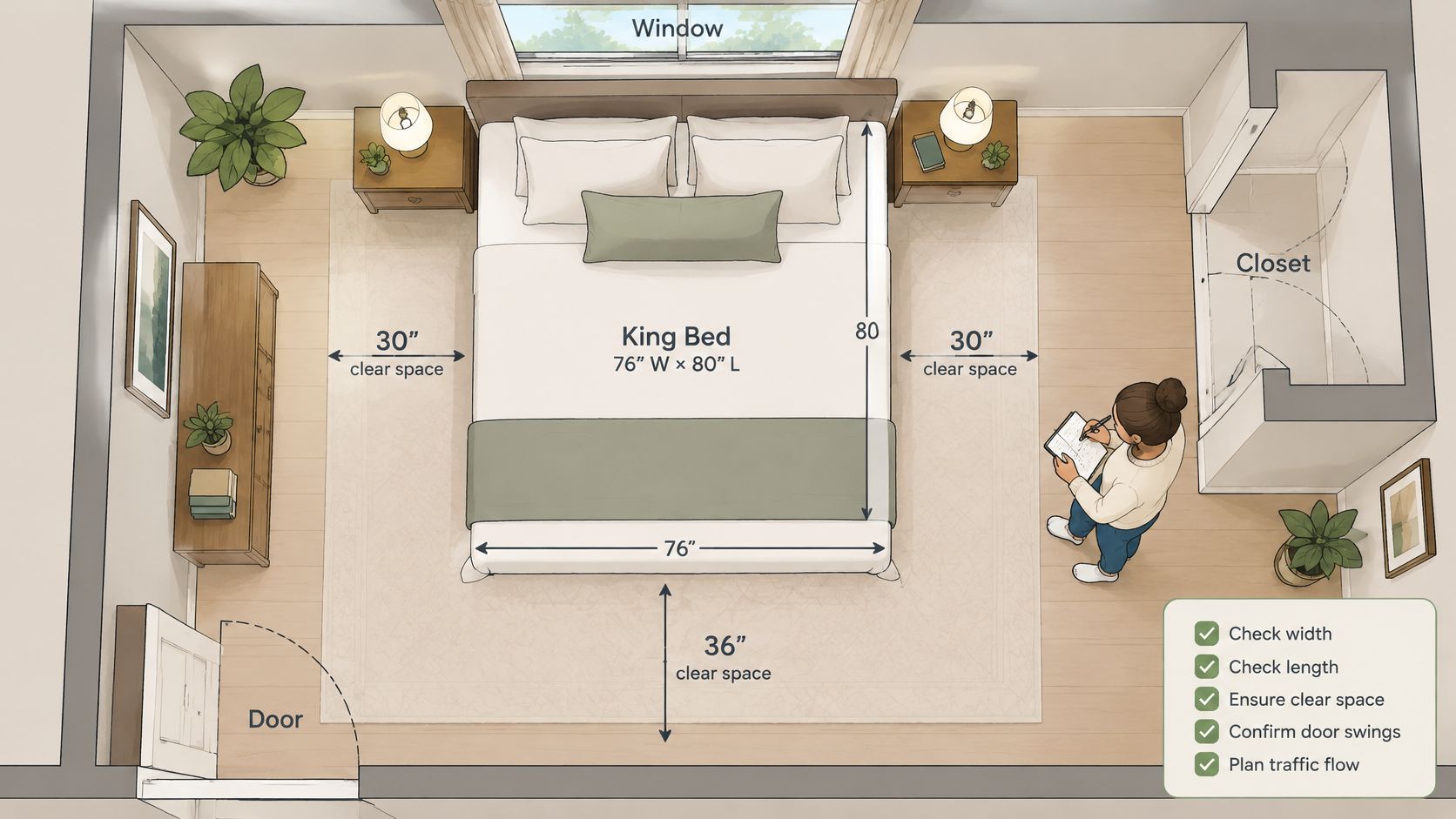
A fuller placement walk-through lives in this guide on how to arrange bedroom furniture. Use it after the tape test below, not instead of it.
- Measure the shell first. Write down the room's width and length, then mark where the door, closet, and window swing. A door that opens into the bed is a daily annoyance, not a small detail.
- Add the footprint. Include the frame and headboard, not just the mattress. Those extra inches are what hit the dresser.
- Hold walking room. Plan about 24 inches of clearance on the sides you use to get in and out. Less than that and you're sidestepping the bed at 2 a.m.
- Tape both sizes. Mark a king rectangle and a queen rectangle on the floor with painter's tape, side by side if the room allows. Standing inside the tape tells you more than a sketch.
- Test the furniture you already own. Both nightstands should still sit beside the bed, and dresser drawers should open without hitting the frame. If a drawer stops halfway, the bed is too wide for that wall.
- Live with the tape for a day. Walk to the bathroom and back with the lights low. If you clip a corner in the dark, you'll clip it every night.
What the tape usually decides
A queen leaves floor for a dresser, a reading chair, or a small desk. A king can crowd a modest primary bedroom, block a door swing, or leave a path so narrow that laundry baskets live in the hallway. Say the room is 11 feet wide and the bed sits between two nightstands. The king rectangle often eats the chair. The queen rectangle often keeps it.
Sleep preference still matters, but the room check often picks the size before anyone lies down. If the taped king blocks a swing or a drawer, stop there. Don't talk yourself into a bed the house can't use.
Sleep Space and Couple Comfort
Split the width and the math gets personal. A queen gives each adult about 30 inches. A king gives each adult about 38 inches. Eight inches sounds small until a restless partner, a golden retriever, and a 6 a.m. alarm all share one surface.
What shared sleep actually does
More width is not automatic better sleep. A peer-reviewed review of bed-sharing found that sharing a bed can worsen objective sleep through increased movement and fragmentation, even while partners report better subjective sleep. The evidence is also limited by small samples and inconsistent findings. A laboratory study in that same body of work found couples sharing a bed experienced approximately 10% more REM sleep, less fragmented REM sleep, and greater synchronization of sleep stages, but also more limb movements.
So closeness can feel good and still chop up the night. Separation can calm a light sleeper and still leave someone feeling miles away. The right queen or king bed depends on movement, snoring, mismatched schedules, temperature, and how the two of you like to sleep, not on a bigger number alone.
Who should lean which way
Light sleepers and mismatched schedules usually do better on a king. Turning, snoring, and a partner who comes to bed two hours later stop landing in the same 30-inch lane.
Couples who sleep close and keep similar hours are often happy on a queen. The narrower surface keeps you near each other and gives the room back a walking path.
Pets, kids, and hot sleepers change the math fast. A child who migrates to the middle, or two people who can't agree on a blanket weight, will use every extra inch. A queen can still work if the pet has a bed of their own and the schedules match.
A king is the right call for highly restless sleepers or two very different routines. It is not a better bed for every couple.
Lie down together for several minutes on the same model in both sizes. Check the edge while you sit, then have one person roll over and notice how much motion crosses the mattress. Edge support and motion transfer tell you more than the size tag. Bring that answer home and match it to the tape on your floor.
For a closer look at two-sleeper picks, read finding the mattress that works for two sleepers.
What a King Costs Beyond the Mattress
The mattress is only the first line on the bill. A king uses more materials at the same comfort level and construction, so the sticker is higher before sheets, a base, or a delivery crew enter the picture. Shoppers who price only the mattress usually get surprised at the register.
These figures are market-wide averages for 2025, not BILTRITE prices. Dataintelo's hybrid mattress market report put queen hybrids at an average reported price of $2,950 and 41.2% of hybrid-mattress revenue, and king hybrids at $3,600 and 35.6%.
| Size | Average reported price | Share of hybrid-mattress revenue |
|---|---|---|
| Queen | $2,950 | 41.2% |
| King | $3,600 | 35.6% |
| Difference | $650 | 5.6 points |
That $650 gap is the mattress alone, on one construction style. The rest of the upgrade stacks on top.
- Same mattress, larger cut: Compare identical comfort and construction in both sizes. A plush queen against a firm king is not a size comparison.
- Sheets and a comforter: Queen and king sets are sold separately. Most families replace the set when they move up, so bedding gets bought twice in one year.
- Foundation or base: A king base costs more and has to match the new width. The old queen foundation stays behind.
- Headboard and frame: Anything wider than the mattress, including a solid wood headboard, gets replaced or rebuilt.
- Delivery and placement: Stairs, tight turns, and bedroom setup can add a fee the mattress tag never shows.
- Hauling the old bed: Removal is a real line item unless the seller includes it.
A king is worth that stack when both sleepers want the extra room and the taped layout still walks. A queen keeps the total lower without giving up much comfort when the room is modest. Ask for one written quote that lists the mattress, bedding, base, and delivery together. A side-by-side of what a good mattress costs helps you see which lines are the mattress and which lines are the size.
Price the bedding once, with the bed, so those dollars aren't counted again at home.
Matching Foundations, Sheets and Split King Options
| Piece | For a queen | For a king | Can you swap sizes? |
|---|---|---|---|
| Fitted sheet | Queen sheet set | King sheet set | No |
| Mattress protector | Queen protector | King protector | No |
| Foundation or base | Queen base | King base or split base | No |
| Comforter | Queen comforter | King comforter | No, most covers are size-specific |
| Split configuration | Not applicable | King 2PC (two Twin XL) | Check base and frame compatibility |
A queen fitted sheet on a king mattress will not tuck. It rides up, the corners pop off, and the sleeper spends the night remaking the bed. Protectors and most comforters fail the same way. Buy the set that matches the mattress, not the set left over from the last bedroom.
When a split king earns its seam
A King 2PC is two Twin XL mattresses side by side. Each sleeper can pick a different firmness, which settles a lot of "too soft / too hard" arguments. The pieces are also easier to carry up a narrow Milwaukee stair than one 76-inch slab.
The trade-off is a center seam. Some couples never notice it. Others feel a ridge unless a king topper or a well-fitted king sheet bridges the gap. The base or frame has to be built for two pieces, with center support so the inner edges don't sag. A standard one-piece king foundation is the wrong platform.
If you're unsure whether the new mattress even wants a traditional foundation, start with whether you need a box spring. Then run this list before you order.
- Confirm the mattress size on the order, including King 2PC versus a one-piece king.
- Confirm the base width and, for a split set, that the frame has a center rail.
- Match the sheets and protector to that exact size. Don't plan to "make the old set work."
- Check the headboard and frame width against the finished footprint, not the mattress alone.
- Confirm delivery access for one large piece or two Twin XL pieces, including the tightest turn on the way in.
Miss one of those and the mattress can arrive before the base that holds it.
Aging in Place, Transfers and Bedroom Safety
Size is the wrong first question when someone needs help getting in and out of bed. Height and the walk to the bathroom decide whether the room stays usable.
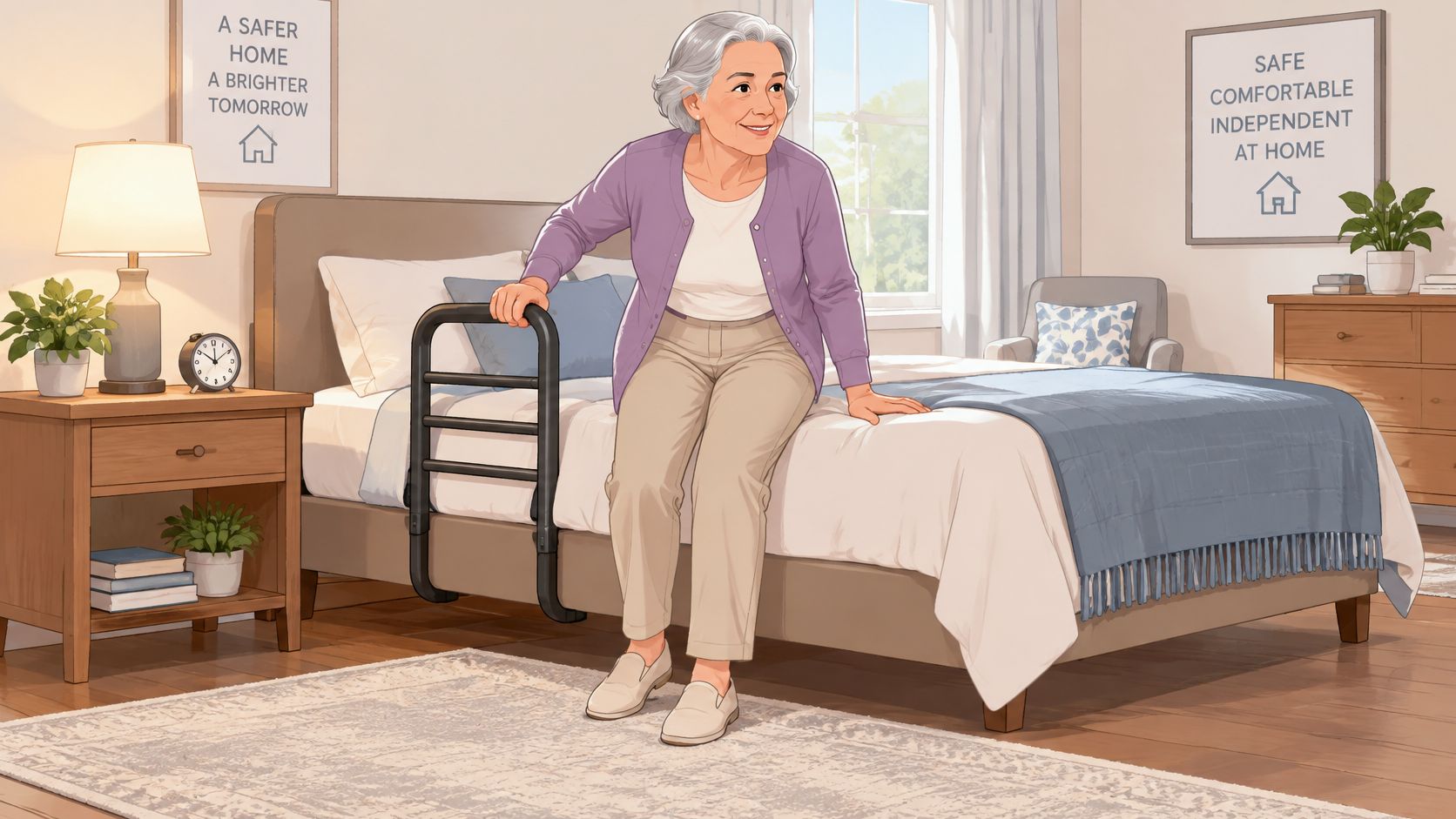
Research on home safety found that bedroom accessibility problems commonly involved bed height and missing support rails. 80% of evaluated homes had beds higher than the recommended 45 to 50 cm range, and half of the patients reported minor injuries related to bed-height problems.
Width helps transfers. Bulk can steal the path.
A king gives more room to turn and more room for a caregiver on either side. That same footprint can narrow the walk to the bathroom and shove nightstands into the lane. A queen often leaves more clearance. A crowded shared surface can still make repositioning harder when two adults and a helper are all at the edge.
Mattress thickness, foundation height, frame design, and edge firmness determine the actual sit-to-stand height. A thick pillow-top on a tall foundation can raise the seating surface well above a comfortable hip height even if the mattress tag looks ordinary. Edge firmness matters because a soft edge lets the sitter sink and lean before their feet are planted.
A five-minute safety check
- Measure floor to mattress top on the finished bed, foundation included.
- Sit the sleeper on the edge with both feet flat on the floor.
- Watch the stand. They should rise without pitching far forward or pushing off a wobbly nightstand.
- Walk the route to the bathroom with a light on, then with only a night-light. Clear means no cords, no laundry, no chair in the lane.
- Check rails or a grab point and whether the frame can accept them. A rail that can't mount is not a plan.
The useful question is which setup keeps enough sleeping width, a clear lit route, and a sit-to-stand height the sleeper can manage.
Families planning to stay in the house should weigh that trio together. A king that fits the wall and blocks the bathroom is the wrong bed. More on raising or lowering the surface is in this note on adjustable bed height.
Queen or King for Your Sleep and Space
Here's the verdict. Choose a king when the taped layout still has clear walkways and both sleepers want the extra width. Choose a queen for everyone else. That's the standard that fits most Metro Milwaukee bedrooms without a fight.
One sleeper, standard room. A queen is plenty of surface and it leaves floor for a dresser, a chair, or a desk. Spending up to a king so one person can drift across 76 inches rarely changes the night.
Two restless sleepers, or a kid or pet in the bed. The extra width per person is the point of a king. Use it when turning, snoring, or a small visitor keeps crossing the center. Skip it if you already sleep well on a queen and the room is tight.
A small or awkward room. Favor the queen even for couples. A door that clears, a drawer that opens, and a path you can walk in the dark beat a few extra inches of mattress. You can always add a better mattress on the size that fits.
Aging in place. Pick the size that keeps the route open and the bed at a workable height. That can be a queen with a lower foundation, or a king with real clearance on the side a caregiver uses. Don't let the wall measurement make the call alone.
A king adds width for the people in the bed. A queen protects the room around it.
If the room fits a king with clear walkways and both sleepers want that width, buy the king. Otherwise a queen stays the comfortable, practical standard. Test both, then order the sheets, the base, and the frame for the size you kept.
Visit Our Greenfield Showroom to Test Both Sizes
You can't settle a queen or king bed from a photo. Lie on both sizes, roll over, and sit on the edge. That's the test, and it happens in the store because BILTRITE doesn't sell online.
We've been family-owned and operated since 1928, now in our fourth generation, serving Greenfield and Metro Milwaukee. The showroom is at 5430 West Layton Avenue. Bring your room measurements, a note on who moves at night, and questions about foundations, bedding, or delivery. Our sales associates have over 400 years of combined experience. They're here to help, not to pressure.
The mattress department carries over 60 models, so you can compare comfort on a queen and a king without guessing from a tag. In Wisconsin, power lift recliners are also exempt from sales tax, which matters when mobility help belongs in the same house as the new bed. We're closed Sundays and Mondays so our families can be together. When you do come in, the team can walk through delivery and old-mattress removal for your specific order.
Come on down to our showroom and see for yourself. No pitch, just a few minutes on each size and a straight answer about what will fit the room.
BILTRITE Furniture-Leather-Mattresses carries queen and king mattresses, solid wood and Amish-made bedroom pieces, and USA-made beds you can sit and lie on before you decide. Bring your measurements and try both sizes with someone who will talk through fit, height, and delivery without rushing you. Visit BILTRITE Furniture-Leather-Mattresses in Greenfield and find the bed that fits the sleepers and the room around them.