Leather Sofa High Back Guide for Comfort and Support


What if the tallest back in the showroom isn't the most comfortable seat in the room? A leather sofa high back design can look supportive in a photo and still leave someone slumped, perched, or working too hard to stand up. The smarter way to shop is to judge the whole package together: seated geometry, leather finish, cushion support, and the daily care routine a household can realistically keep.
Table of Contents
- What Makes a Sofa High-Back and Who Benefits
- Measurements That Decide Comfort
- Leather Grades Compared for Everyday Wear
- Reading Abrasion Ratings Without Guesswork
- Frame and Cushion Construction That Lasts
- Styling a High-Back Leather Sofa at Home
- Caring for Leather So It Lasts
- Test Your Next High-Back Sofa in Our Greenfield Showroom
What Makes a Sofa High-Back and Who Benefits
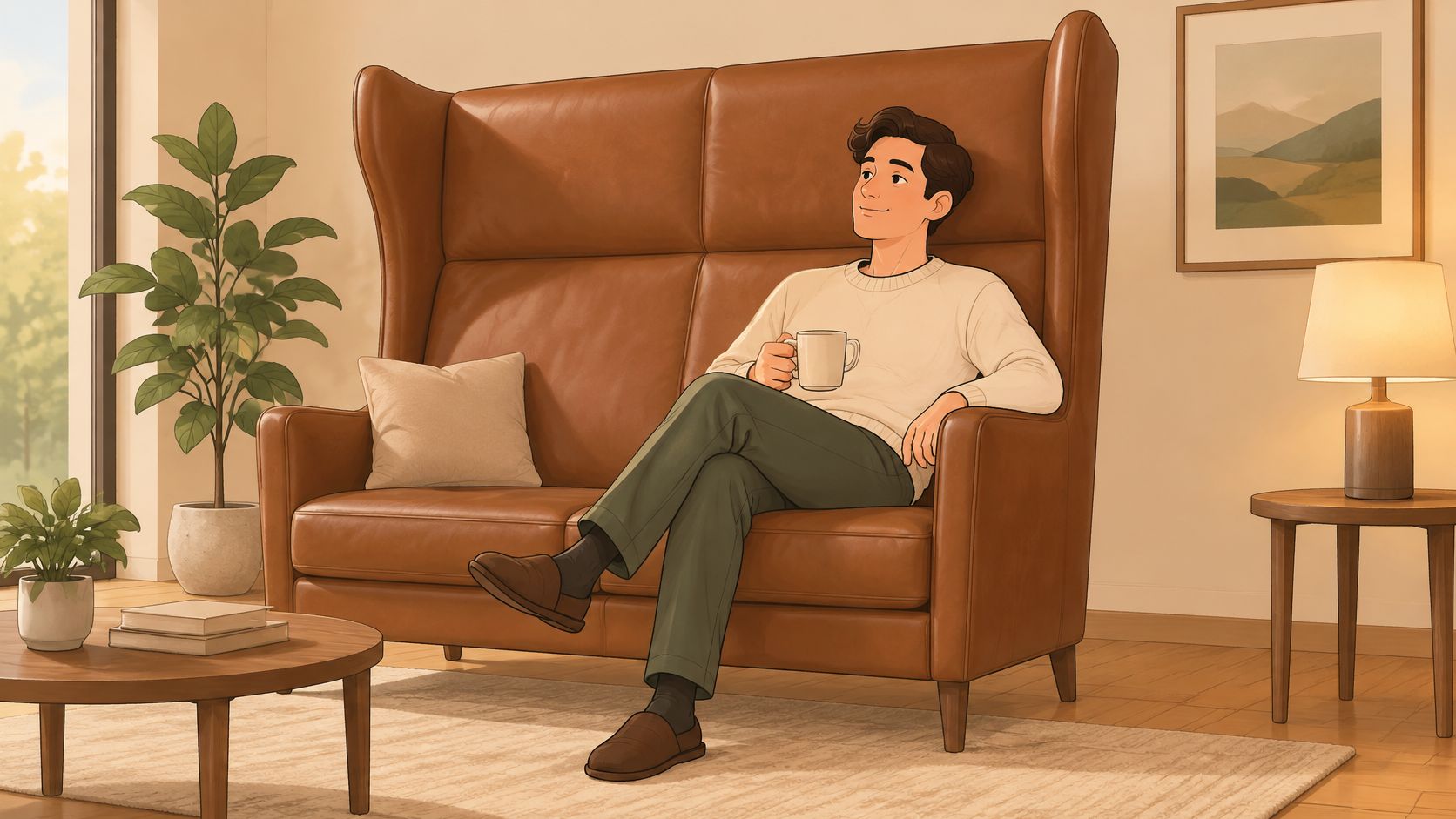
How does a high-back sofa earn its place in a living room? A seat back that reaches well above the cushion can support the upper back and shoulders, and may give the head somewhere to rest. For someone reading after dinner, that extra support can make a long sit more comfortable.
A useful working definition is a seat back at least 24 inches above the seat cushion, as described in What A Room's 2025 high-back sofa guide. Judge the measurement from the cushion, not the floor. Tall legs or a thick cushion can make a sofa look high without providing extra back support.
Who usually loves the extra height
Older adults may value steady head and neck support while reading or watching a game. Caregivers may prefer a seat that feels upright and secure instead of deep and loungey. For families, a high back can suit movie nights, homework help, and long conversations.
The trade-off is fit. A tall back does not guarantee comfortable support; if it pushes the head forward, the added height works against the sitter. A large frame can also crowd a smaller room or block sight lines in an open space. Leather color and back height alone cannot tell you whether the sofa will suit its users. Check how the seated position feels, then consider whether the leather finish and care routine fit daily use.
Start with three questions: Who sits here most often? Do they want head support, or mainly a taller look? Is there enough room between the sofa, wall, and coffee table? Their answers help narrow the choice without letting appearance make the decision.
Measurements That Decide Comfort
Back height alone misleads shoppers every week. Seat height, usable depth, arm height, and back angle work as a team, and one weak number can undo the rest. Start with the targets below, then test how they feel together in person.
Target measurements for a high-back leather sofa
| Measurement | Target range | Why it matters |
|---|---|---|
| Back height above compressed seat | 45 cm or more | Supports the upper back and shoulders |
| Lumbar support height | 15 to 25 cm above compressed seat | Keeps the lower back supported without forcing the spine forward |
| Backrest angle | 110 to 120 degrees | Linked to lower lumbar disc pressure when paired with lumbar support |
| Seat height | 40 to 55 cm | Lets feet rest securely and eases standing up |
| Usable seat depth | 49.8 cm maximum | Lets shorter users sit back without slumping |
| Seat width | About 45 cm per person | Gives each person room to sit comfortably |
| Arm height | 17.3 to 27 cm | Supports relaxed shoulders and elbows |
Measure from the compressed seat
Don't measure from a fluffy, uncompressed cushion. Sit down first, let the cushion settle, and then judge the back height from that compressed seat surface. Cornell ergonomics guidance identifies approximately 45 cm or more above compressed seat height as a useful full-backrest benchmark, with lumbar support positioned about 15 to 25 cm above the compressed seat surface.
That same guidance explains why lumbar contact matters so much. Supported sitting reduces trunk-muscle activity, while sitting can increase intervertebral-disc pressure by roughly 50% compared with standing when the lumbar curve flattens. A backrest angle near 110 to 120 degrees, combined with lumbar support, is associated with lower lumbar disc pressure.
Practical rule: A tall back can't fix a seat that's too deep. If someone's lower back loses contact with the cushion, the posture usually slides into a slump within minutes.
The angle question, reconciled
Shoppers may hear a slightly different number for older adults, and that's okay. A recent older-adult study found a supportive tested combination near knee height with a 105-degree backrest angle, which sits just outside the range above. Treating roughly 105 to 120 degrees as the comfortable zone, then confirming it with a real sit test, is the sensible approach.
Sit-to-stand ease belongs in the same conversation. Low seats, deep seats, and overly soft cushions make standing harder because feet can't get planted and the body has to climb out of the seat. Both feet should rest flat on the floor before rising, without a heavy push through the arms.
For a plain-language refresher before a shopping trip, the guide to sofa dimensions in inches helps translate showroom numbers into room planning. Bring those measurements along, compare them across several sofas, and don't trust overall height on a tag to tell the whole comfort story.
Leather Grades Compared for Everyday Wear
Here's the most common point of confusion at the leather rack. The words genuine leather on a tag don't say which part of the hide was used, how the surface was finished, or how it'll age in a busy family room. Two sofas can both carry that label and behave very differently after years of jeans, pets, snacks, and Sunday naps that spill into Monday.
Leather grades and what they mean at home
| Grade | What it is | Wear over time | Upkeep |
|---|---|---|---|
| Full-grain | Outer surface kept with natural markings | Highest, develops patina | Gentle conditioning as directed |
| Top-grain | Sanded outer surface with a uniform finish | High and more even | Low, regular dusting and wipe-downs |
| Corrected-grain | Sanded, then embossed or coated | Good and consistent | Low, wipe clean |
| Split leather | Lower layer of the hide | Lower, more prone to wear | Higher, needs careful cleaning |
| Bonded leather | Shredded fibers held with a binder | Lower, can peel or crack | Low, avoid moisture |
| Leather-look alternative | Synthetic surface, not real leather | Moderate, surface coating wears first | Wipe clean with approved cleaner |
Grade is only half the story
Full-grain keeps the hide's natural character, including small markings, and tends to develop a rich patina that many folks love. Top-grain offers a more even look and is a familiar choice for family sofas because it balances durability with a consistent surface. Corrected-grain goes further toward uniformity, which appeals to households that want a tidy appearance with kids and pets in the mix.
Split leather comes from a lower layer and generally needs more careful handling. Bonded leather sits at the budget end, but the binder that holds shredded fibers together can peel or crack sooner than a solid hide surface. Leather-look materials can wipe clean easily, yet they aren't leather and won't age the same way.
Finish matters just as much as grade. A pigmented or finished surface tends to resist stains more evenly, while an aniline surface shows more natural variation and patina. Neither choice is automatically right. The better question is which surface fits the household's tolerance for marks, sun exposure, and routine cleaning.
Before comparing prices, ask the showroom team to name the grade and finish on each sofa under consideration. The overview of premium USA leather gives shoppers a helpful starting point for those questions, and a clear answer makes price comparisons much fairer.
Reading Abrasion Ratings Without Guesswork
Does a high abrasion rating tell you how a leather sofa will hold up at home? Only when you know which test produced it. Different methods rub materials in different ways, apply different loads, and use different failure points. A cycle count means little without those details.
Common abrasion tests and what they tell you
| Test method | Where you see it | What the number means | Question to ask |
|---|---|---|---|
| Wyzenbeek double rubs | North American upholstery specs | Back-and-forth passes until visible wear or two yarns break | Is the rating for leather or a fabric cover? |
| Martindale cycles (ISO 17076-2) | Leather specifications | Ball-plate rubbing cycles until visible wear | What load and failure point were used? |
| Taber cycles | Leather and fabric specifications | Abrasion wheel cycles until surface change | Which conditioning environment was used? |
What the Methods Measure
The Wyzenbeek test repeatedly rubs a sample with an abrading material. Residential upholstery commonly falls between 10,000 and 25,000 double rubs, with 12,000 to 20,000 double rubs described as suitable for medium-duty use, according to American Leather's guide to upholstery fabric rub tests. Each back-and-forth pass counts as one double rub. Testing stops when visible wear appears or the first two yarns break. Check that the rating describes the cover material being considered, not a different upholstery sample.
For leather, ISO 17076-2 specifies a Martindale ball-plate method. It applies controlled mechanical rubbing and records the cycles required to produce visible wear or surface damage. Two samples with the same cycle count may have been tested under different loads, so the numbers are not directly comparable without the test conditions. On a high-back sofa, the upper back and shoulder areas meet repeated friction from clothing. The lower back and seat junction also face compression, sliding, and body oils.
Questions that cut through the sales tag
- Which test method was used: Ask for the method name, not just the final cycle count.
- What load and conditions applied: Request the load, conditioning environment, and leather area tested.
- Where did the sample fail: Ask whether failure meant visible wear, finish loss, or other surface damage.
- What's excluded from the warranty: Confirm whether dye transfer, scratches, and finish wear are covered or excluded.
A high rating does not make leather scratch-proof. Pet claws, belt buckles, toy edges, and rough clothing hardware can mark a surface that performs well in a rubbing test. Use the rating to compare like with like, then consider the leather finish and the friction the sofa will meet in daily use. A test result is one part of the decision, not a substitute for checking how the material suits your household's routine.
Frame and Cushion Construction That Lasts
Think of it this way: the leather is the paint, and the frame is the foundation. Beautiful upholstery can't rescue a sofa that twists, creaks, or sags after a few years of family use. The checklist below keeps the conversation focused on what's happening under the surface.
A six-point construction checklist
- Frame material: Ask whether the frame is kiln-dried hardwood or an engineered alternative, because a stronger frame holds its shape through years of daily loading.
- Joints: Glued and doweled or corner-blocked joints hold up better than stapled joints when people shift, flop, and push off the arms.
- Suspension: Sinuous springs or strong webbing under the seat spread weight across the deck, so one favorite spot doesn't dip early.
- Seat foam: Ask about foam density and whether the cushion uses layered foam with a firmer core, since deep seat decks on high-back designs must stay supportive as they age.
- Back fill: Check whether back cushions use fiber or foam fill, because fiber feels plush but needs fluffing, while foam holds a crisper profile.
- Come-apart options: Ask which models come apart for narrow doorways, stairs, and tight corners, which can save real stress on delivery day.
That last point matters in plenty of Metro Milwaukee homes with older stairwells and snug basement turns. A come-apart design can be the difference between a smooth delivery and a sofa that never reaches the family room. Measuring the tightest turn before ordering protects both the furniture and the walls.
The three-point press test
Finish with hands, not just questions. Press firmly at the seat front, along the cushion edge, and on top of the arm. Each spot should respond with firm, even resistance rather than a hollow, crunchy, or lopsided feel.
Sit on each end and shift weight gently from side to side. Repeated creaking, loose arms, or a twisting base are early warnings worth taking seriously. For more detail on what separates a sturdy build from a flimsy one, the guide to leather sofa quality walks through the construction questions in plain language.
Styling a High-Back Leather Sofa at Home
On a 9-foot wall, a high-back leather sofa can leave a 4-foot gap for a side table while defining the seating area. In an open-plan room, placing its back toward the dining space creates a visual boundary without closing off the layout. Judge the fit by the sofa's seated geometry and the room around it, not back height alone: allow space for the side table, a clear route through the room, and comfortable use of the seat.
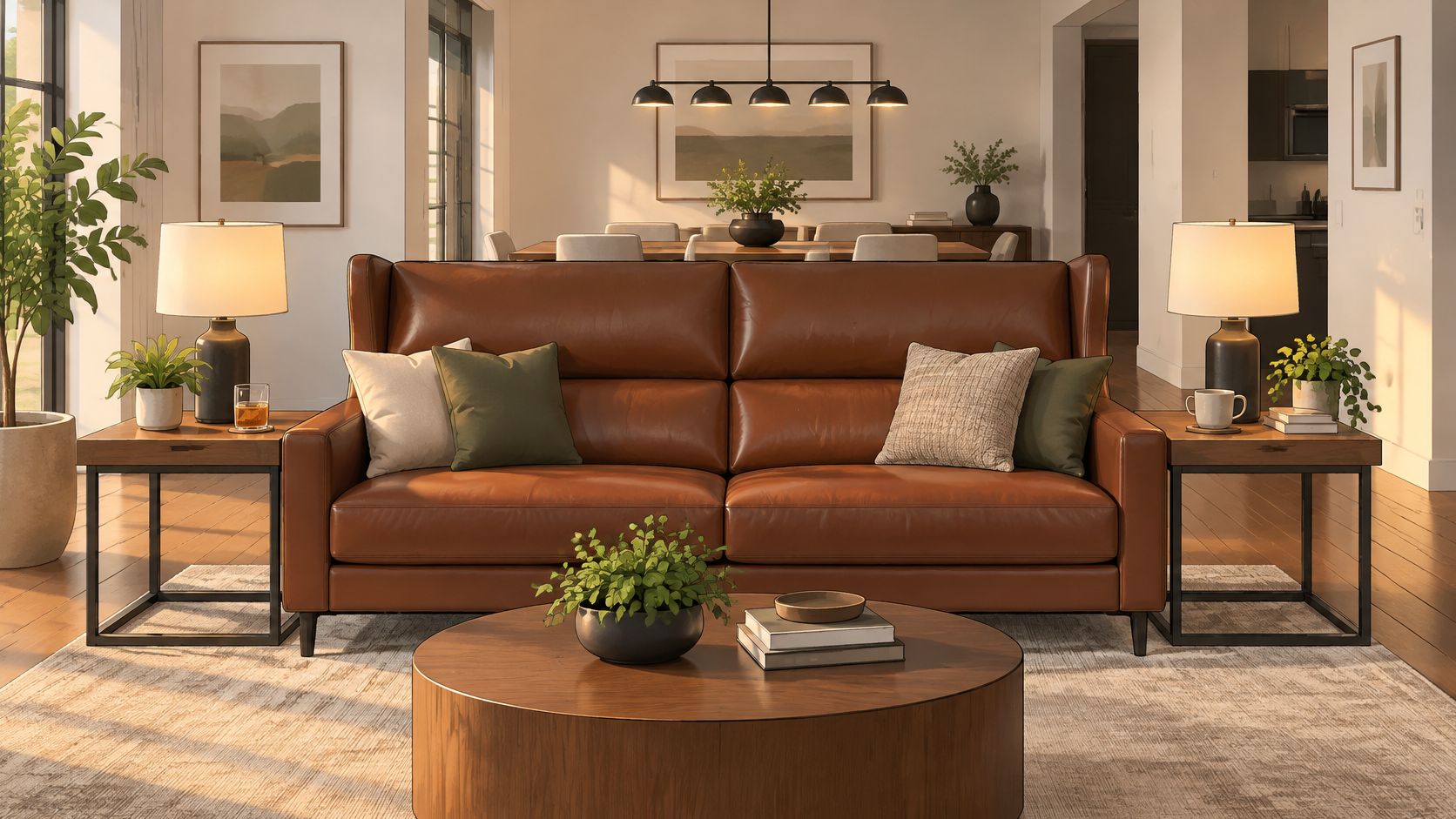
Choose a side table close to arm height so drinks, remotes, and reading glasses are easy to reach. Put a lamp on the reading side, angled to light a page without shining across the seat. A rug that catches the sofa's front legs helps define the seating area.
Match the leather finish and surrounding materials to how the room is used. A cognac top-grain sofa pairs well with a dark oak side table, while textured pillows or a folded blanket soften the tall back's strong line. Consider how the leather's finish will look alongside the table and fabrics, as well as the maintenance routine it calls for. For more pairing ideas, see this guide to decorating with leather furniture.
Safety belongs in the room plan
The sofa is rarely the tip-over concern; nearby furniture may be. The U.S. Consumer Product Safety Commission's Anchor It! campaign recommends securing bookcases and dressers to the wall, installing anti-tip devices promptly, and placing televisions on sturdy, low bases when wall anchoring is not possible.
Keep exits clear and cords out of children's reach. Follow the safety instructions for any recliner, lift mechanism, shelving, or storage piece in the room. For delivery access, use the frame section's guidance on tight turns and come-apart designs rather than repeating the same measurements here.
For apartments, condos, and senior living spaces, consider a smaller-scale high-back sofa. It can provide back support while leaving more room for walkways and the surrounding furniture. Check the full layout before choosing: a sofa that fits the wall still needs to leave useful space for movement and a reachable side table.
Caring for Leather So It Lasts
Good leather rewards a simple routine, and that's good news for busy households. The goal isn't constant product application. It's removing grit, handling spills quickly, and matching every cleaner to the specific finish on the sofa.
A routine that takes minutes, not weekends
- Vacuum weekly with a soft brush attachment: Lifting crumbs and grit from seams prevents abrasive particles from scratching the surface during daily use.
- Blot spills right away: Press a clean cloth into the spill without rubbing, since rubbing spreads moisture and can disturb the finish.
- Check the care label first: The manufacturer's instructions for that specific finish outrank general advice from friends, videos, or product labels.
- Test any cleaner in a hidden spot: Let the test area dry fully before judging color or sheen changes.
- Condition only as the finish allows: Some surfaces benefit from occasional conditioning, while others don't need it at all and can look dull if overtreated.
- Keep leather out of direct sun and away from heat vents: Prolonged sunlight and heat dry the surface and fade color over time.
- Rotate reversible seat cushions every few months: Spreading wear across cushions keeps one favorite seat from aging faster than the rest.
- Protect the high back with a throw or headrest cover: The upper back zone collects hair and skin oils during long sits, so a washable layer earns its place.
A generic conditioner is not automatically safe. Different finishes react differently to oils and solvents, so the approved product list matters more than good intentions.
A few common mistakes cause most of the trouble. Harsh household solvents can weaken finishes even when the hide underneath stays sound. Ignoring pet claws invites marks along the seat front and cushion edges, so trimmed nails and a protected favorite spot help. Skipping the hidden-spot test risks a visible reminder on the most-used cushion.
Before purchase, ask whether replacement cushions or covers are available and which cleaning products are approved for that finish. The step-by-step guidance on how to care for leather furniture makes a handy reference to keep with the warranty paperwork.
Test Your Next High-Back Sofa in Our Greenfield Showroom
Does the back support your head without pushing your chin forward? A photo can help you shortlist a style, but sitting in the sofa shows whether its seat depth, cushion firmness, and back angle work for you.
The sit test that tells the truth
Settle in for at least 10 to 15 minutes and try the positions you use at home: sit upright for conversation, lean back for reading, and put your feet where they naturally land during a movie. Check that your feet rest comfortably on the floor and that your head feels supported. Then stand without pushing hard on the arms. That simple movement helps you judge the combined effect of seat height, depth, and cushion firmness.
Keep the showroom checklist focused: wear clothes you would normally sit in, bring anyone who will use the sofa daily, and note which positions feel comfortable or awkward. Body proportions affect how the same seat feels, so each regular user should try it.
Custom choices, explained plainly
Ask which details can be selected for your home. BILTRITE offers custom options in fabric, leather, wood, finish, and hardware, and the team can explain available choices and order timing. The showroom is family-owned and has served Metro Milwaukee since 1928; the company describes itself as now in its fourth generation.
An in-person visit lets you compare leather finishes, cushions, and USA-made and Amish-made craftsmanship side by side. BILTRITE does not sell online, and the showroom is closed on Sundays, so plan your visit for another day. Take your time and ask about the trade-offs between the options that suit your room and daily routine.
For an affordable, better-quality leather sofa high back option to try in person, BILTRITE Furniture-Leather-Mattresses offers choices ranging from small-scale pieces to heavy-duty family seating. Visit the Greenfield showroom to sit, compare, and ask questions. The local team can help you find a comfortable fit without pressure.