Bed Headboards Bookcase: How to Choose the Right One


The spare bedroom has a bed, a lamp that keeps getting moved, and a stack of books with nowhere sensible to go. A separate nightstand would crowd the walkway, while wall shelves might leave the room feeling pieced together. That's where bed headboards bookcase designs earn attention. They combine a headboard with accessible storage and can give a small bedroom a more finished, organized appearance.
A bookcase headboard isn't automatically the right choice. It adds depth, weight, and a safety responsibility that a flat panel doesn't. The strongest choice depends on room measurements, mattress and frame compatibility, shelf use, construction quality, and secure wall attachment. The guidance below helps homeowners sort out those tradeoffs before choosing a piece.
Table of Contents
- Why a Bookcase Headboard Might Be the Smartest Bedroom Upgrade
- Measuring Your Room, Mattress, and Frame for a Clean Fit
- Choosing Materials and Construction That Actually Last
- Planning Storage, Shelves, and Daily Use Cases
- Balancing Storage With Wall Anchoring and Child Safety
- Styling With Lighting, Pillows, and Personal Touches
- Ordering Custom or In-Store and Bringing It Home Right
Why a Bookcase Headboard Might Be the Smartest Bedroom Upgrade
A couple furnishing a compact spare bedroom often faces the same frustrating calculation. The bed already takes most of the floor, a small table would make the walkway awkward, and everyday items such as reading glasses, chargers, and books still need a home. A bookcase headboard puts those needs behind the mattress instead of asking the room to absorb another freestanding piece.
That space-saving benefit is the main reason to consider this style. Bookcase headboards commonly add 8 to 14 inches of depth behind the pillow, giving the room useful vertical storage while preserving more floor area than a separate shelving unit would require, according to bookcase headboard measurement guidance. The shelves can hold a lamp, a current novel, a clock, a charging cable, or a small basket without spreading those objects across the room.
Three jobs in one footprint
A well-designed unit can serve as:
- A headboard: It gives the bed a finished visual anchor and protects the wall behind the pillows.
- A nightstand substitute: Daily essentials stay within reach without requiring matching tables.
- A display area: Books, framed photographs, and a few personal objects add warmth and character.
That last point matters. A solid-wood headboard can make a bed feel grounded and substantial, while an open shelf arrangement keeps the room personal. The look can be traditional, clean-lined, or softly finished, depending on the wood, stain, and proportions.
Practical rule: Storage should simplify the bedtime routine, not create a second chore.
The drawbacks deserve equal attention. Open cubbies can become cluttered, the headboard can make a room feel visually heavier, and a tall unit must be anchored properly. Buyers who frequently rearrange furniture may also find a wall-spanning headboard less flexible than a separate bed and shelf.
For design ideas, BILTRITE's guide to headboard styles includes bookcase headboards among the options that add shelving around the bed. The right version gives a small room function without making it look like a storage closet.
Measuring Your Room, Mattress, and Frame for a Clean Fit
Before choosing a finish, measure the actual room. Start at the wall behind the bed, measuring from trim to trim. Leave a little space on both sides so the headboard looks intentionally placed instead of squeezed into the opening. A storage headboard can improve organization, but its footprint also reduces walking space, so judge the room by clearances rather than mattress size alone.
Start with width and depth
Use these minimum width guidelines:
- Twin and full: At least 41 inches wide.
- Queen: At least 61 inches wide.
- King: At least 77 inches wide.
These measurements keep the headboard from looking narrower than the mattress. Finished dimensions still vary by design. One listed queen/full model measures 65.75 inches wide, 43 inches high, and 11 inches deep, while its twin version measures 40.5 inches wide, 48.5 inches high, and 8.75 inches deep, as shown in this product dimension listing.
Depth affects circulation quickly. Because the unit projects 8 to 14 inches, subtract that projection from the walkway beside the bed. A 30-inch path becomes tight once the mattress, frame, and nightstand are counted. Measure with doors open and drawers pulled out, not just with the furniture pushed against the wall. Shelf depth usually falls between 8 and 12 inches. Allow about 5 inches for standard paperbacks and roughly 8 to 9 inches for hardcovers.
| Bed Size | Min. Headboard Width | Recommended Shelf Depth |
|---|---|---|
| Twin | 41 inches | 8 to 9 inches |
| Full | 41 inches | 8 to 10 inches |
| Queen | 61 inches | 9 to 12 inches |
| King | 77 inches | 10 to 12 inches |
Check the frame and ceiling
Confirm how the headboard attaches before ordering. Bolt-on brackets must match the metal frame, while a wooden bed may require a cleat or another specified connection. A universal-fit assumption can leave the piece unstable or force an improvised installation. Check the frame, headboard, mattress, and foundation as one setup.
Ceiling clearance needs its own measurement. Record ceiling height, mattress thickness, foundation height, and finished headboard height. Twin units are often taller than queen units because their narrower width needs more vertical presence, so compare the finished height for each size instead of assuming one height across the collection. BILTRITE's mattress measuring guidance helps organize mattress and foundation measurements before a showroom visit.
Choosing Materials and Construction That Actually Last
The material underneath the finish determines how a bookcase headboard handles daily use. A shelf holding a light paperback collection has different demands from one carrying hardcovers, baskets, and a reading lamp. Construction quality also affects how the piece responds to moving, fastening, and years of cleaning.
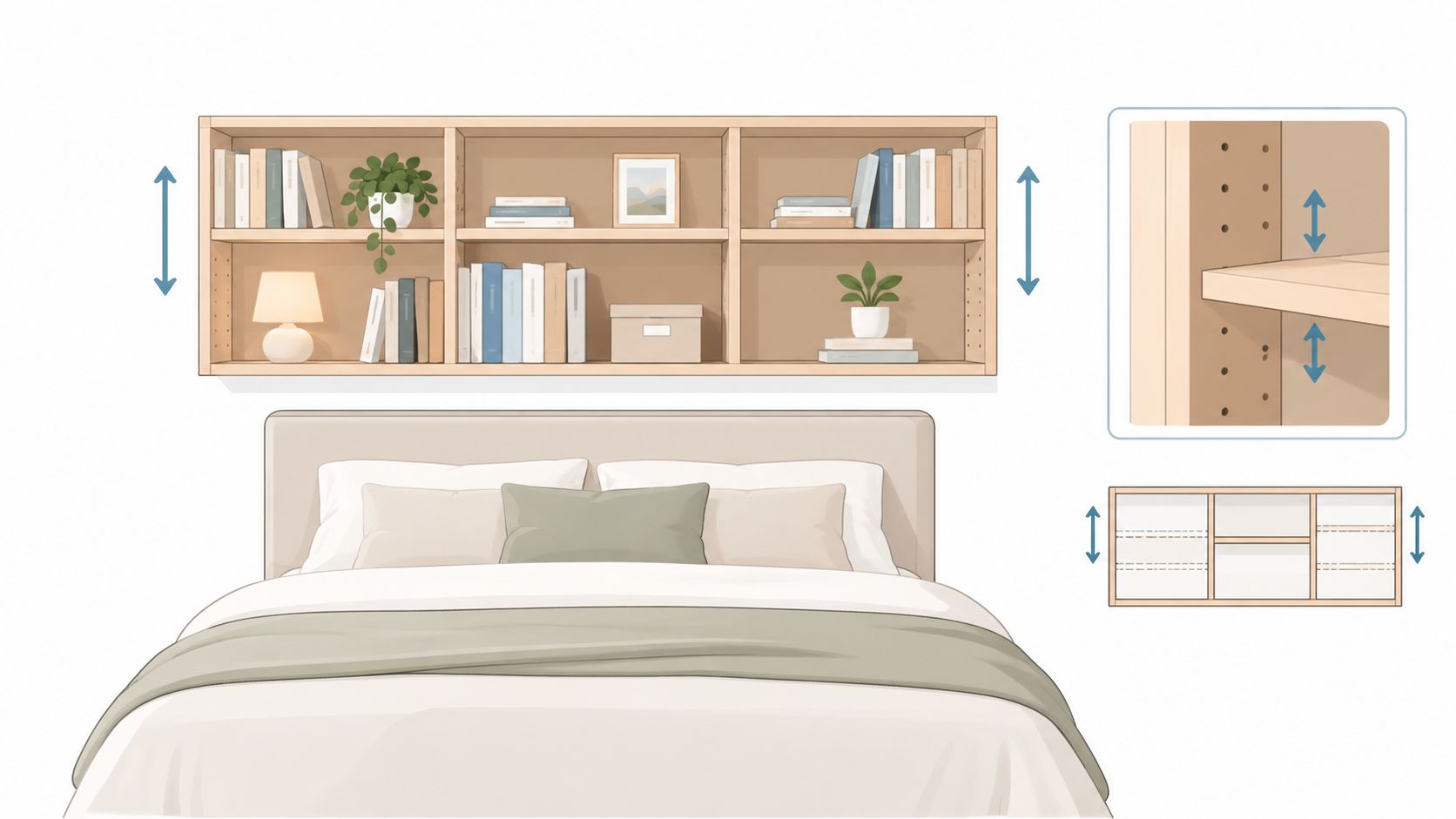
Compare the three common material categories
Manufactured wood can make sense for a rental, occasional guest room, or temporary setup. It usually weighs less and keeps the purchase more accessible, but edges and fastener points can be less forgiving. Particleboard, MDF, and veneer-over-fiberboard aren't interchangeable with solid lumber, so the construction details deserve close inspection.
Solid pine sits between those choices. It offers genuine wood grain and can handle ordinary family use, though pine is softer than many hardwoods and may show dents sooner. One listed solid pine twin example measures 9 inches deep, 41 inches wide, and 46 inches high, according to storage headboard examples and dimensions.
Solid hardwood is the long-term option for buyers who want a substantial piece. Oak, maple, and cherry can support a more durable structure, especially when the builder uses sound joinery, properly supported shelves, and a finish suited to regular use. Solid wood versions also vary considerably by size. One Amish solid-wood listing gives widths of 45.5 inches for twin, 59 inches for full, 66 inches for queen, 82 inches for king, and 78 inches for California king, as documented in the same solid-wood headboard reference.
Look beyond the label
A solid-wood label doesn't answer every question. Inspect shelf supports, back-panel attachment, drawer construction, hardware, and the way the unit meets the bed. Adjustable shelves are helpful, but they should rest on sturdy supports rather than flimsy fittings.
Solid wood also brings more weight. That can improve a sense of substance, but it makes delivery, stair access, and anchoring more important. BILTRITE's hardwood guidance offers useful background for shoppers comparing wood species, longevity, and finish character.
Planning Storage, Shelves, and Daily Use Cases
A bookcase headboard works better when its shelves have assigned jobs. Without a plan, the open spaces tend to collect random objects, and the piece loses the calm, organized feeling that made it appealing.
Start by deciding whether the headboard will replace nightstands, support a reading nook, or display décor. Those uses call for different shelf arrangements. A nightstand replacement needs a convenient surface for a phone, lamp, and glasses. A reading setup needs room for books and directed lighting. A display-focused arrangement can use more varied shelf heights and fewer daily-use objects.
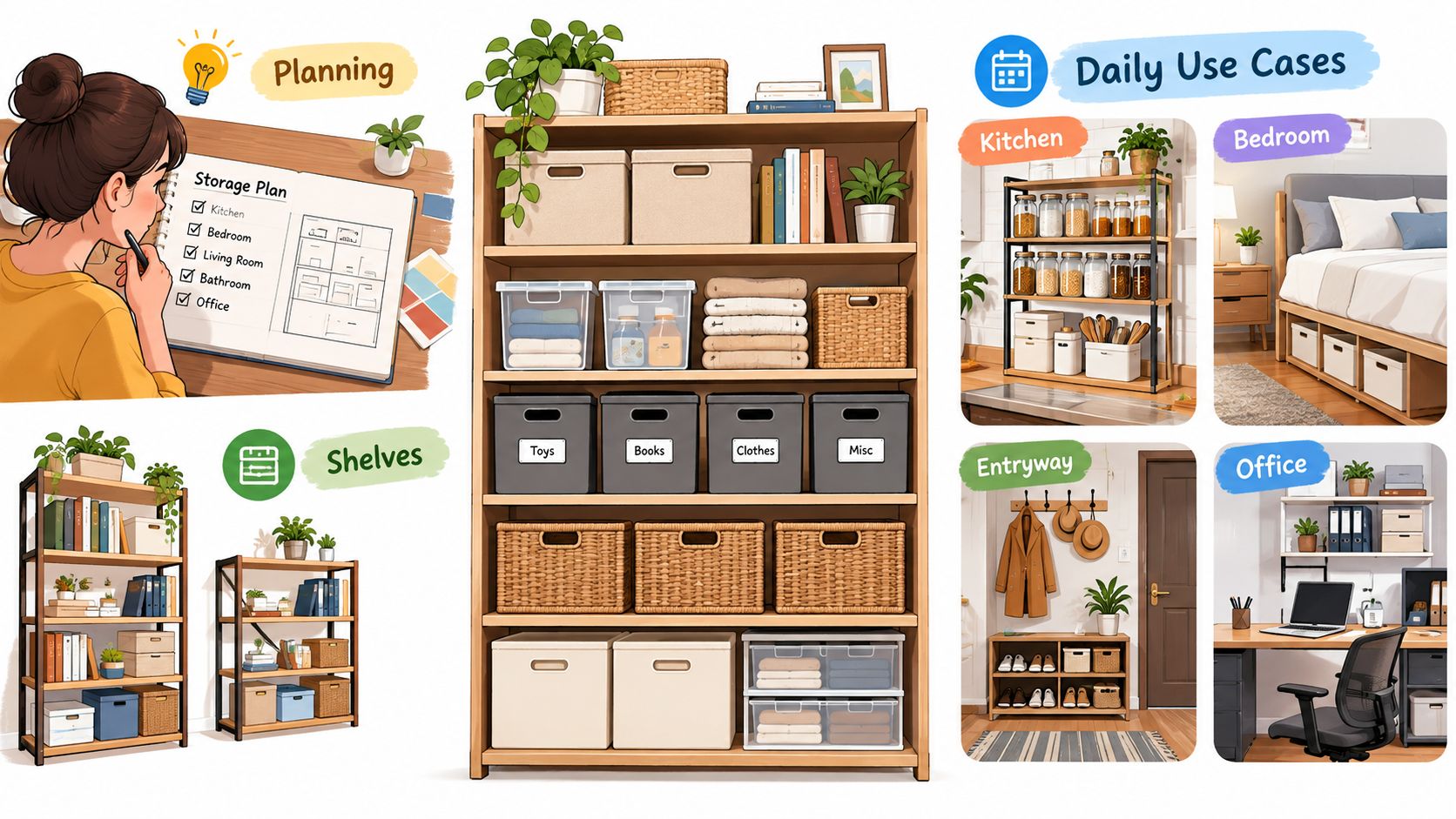
Match shelf height to the object
Paperbacks generally fit comfortably with 6 to 8 inches of shelf clearance, while hardcovers need about 9 to 11 inches to avoid awkward overhang. Use those dimensions as a starting point, then measure the books and objects already in the room.
A practical arrangement might include:
- Bedside zone: A reachable shelf for the alarm clock, phone, reading glasses, and a small lamp.
- Reading zone: A deeper inner bay for current books and a basket for chargers.
- Display zone: Upper shelves for lighter décor, framed art, or a small plant.
- Hidden zone: A drawer or closed compartment for items that make the room look busy.
The shelf depth should match the task. A shallow outer bay keeps small items easy to see, while a deeper central section can hold books. Very deep shelves may look generous on paper but can swallow remote controls, glasses, and other small pieces.
Sketch the bedtime routine
Before ordering, draw the headboard on paper and mark what goes in each opening. The drawing doesn't need to be artistic. It only needs to answer practical questions: Where does the charging cable go? Can a person reach the reading light without sitting up? Will a basket block the outlet?
BILTRITE's bedroom storage guidance can help shoppers think through storage features before choosing a configuration. The most useful headboard is the one that supports the room's actual habits, not an imaginary version of them.
Balancing Storage With Wall Anchoring and Child Safety
Storage value doesn't matter if the headboard can move, tip, or shed objects onto the bed. A bookcase headboard should be treated like any other tall or heavy furniture unit, especially when it stands near children or a sleeping surface.
The U.S. Consumer Product Safety Commission reported 1,100 emergency-department-treated injuries, representing 15% of the furniture injuries in its 2022 report, for shelving, shelving units, and bookcases. Its 2020 report recorded 1,500 such injuries, representing 17%. Those figures appear in the CPSC furniture tip-over report, and they show why open shelving deserves more than a style discussion.
Anchor the structure, not just the idea
Find the wall studs before positioning the headboard. Fasteners should land in the centers of studs, and through-back brackets or heavy-duty straps are preferable to relying on drywall anchors alone. FEMA guidance summarized in the cited safety material emphasizes that screws need to engage the studs behind a bookcase, not merely the wall surface.
The installation sequence should be deliberate:
- Assemble the headboard completely.
- Level it before loading any shelf.
- Mark the stud locations at the upper corners.
- Attach the anti-tip hardware with suitable fasteners.
- Test for wobble before placing books or décor.
Manage the load near children
Children under 6 consistently represent the highest-risk group in furniture tip-over incident data, according to the CPSC material. Pediatric furniture safety guidance also reports 11,521 pediatric furniture and television tip-over emergency-department visits in 2019, with the peak injury age at 2 years, as summarized in child furniture tip-over prevention guidance.
| Configuration | Tip-Over Risk Consideration |
|---|---|
| Tall, deep, top-loaded | Highest concern because height, projection, and upper weight increase leverage |
| Shallow shelves, low weight | Lower loading stress, but still requires secure attachment |
| Wall-anchored to stud | Stronger protection when hardware and installation are sound |
| Freestanding on hardwood | Not a safety solution by itself, since a hard floor doesn't prevent tipping |
Put dense books on the lowest shelves. Keep décor, electronics, and loose objects out of top cubbies, and block any hazardous gap behind the headboard where a small child could become trapped.
Styling With Lighting, Pillows, and Personal Touches
A bookcase headboard should feel like bedroom furniture, not a row of storage bins. Lighting, textiles, and a restrained selection of personal objects can soften the wood and make the shelves useful without making them visually noisy.
Begin with the light source. Wall-mounted swing-arm sconces preserve shelf space and direct light toward the reader. A slim LED strip tucked beneath an upper shelf can provide a gentle glow without placing a lamp on the bedside surface. Electrical work should be planned before installation, especially if a recessed USB and outlet combination will sit behind the headboard.
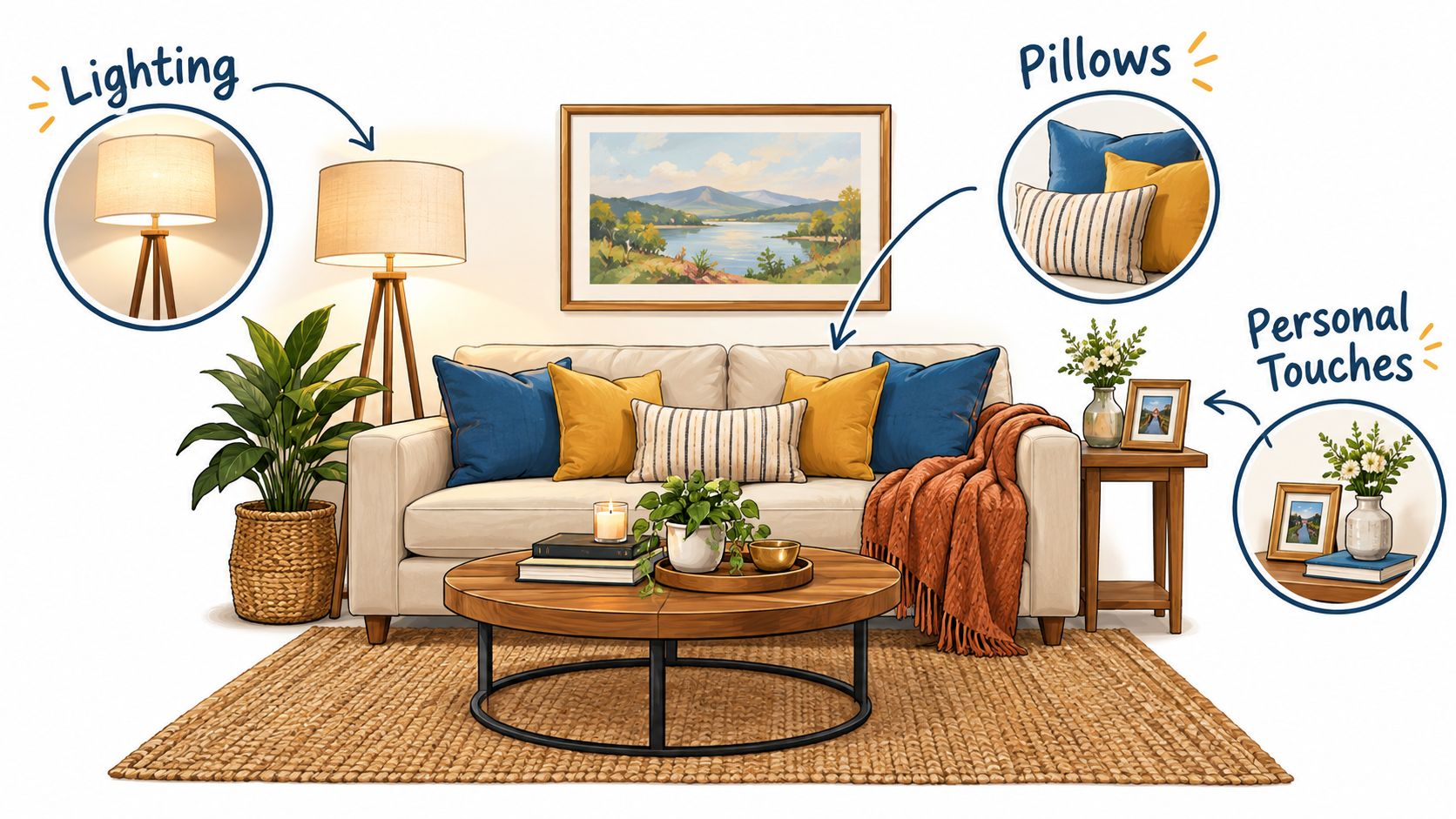
Keep the shelves visually breathable
The bed remains the focal point, so the shelves shouldn't compete with it. A simple styling mix can include:
- Books: Group a few by size or color, then leave room beside them.
- Soft texture: Add a folded wool throw or a fabric basket to balance the hard lines.
- Natural detail: Use one ceramic vessel or a small plant rather than filling every opening.
- Personal objects: Choose a framed photograph or meaningful keepsake with enough space around it.
Small rooms benefit from restraint. Groups of three create a natural rhythm, while leaving roughly 30% open space keeps the headboard reading as furniture rather than a packed storage wall. Avoid placing fragile or heavy objects over the sleeping area.
Build the bed from the center outward
Layer the bedding so the headboard has a comfortable foreground. Two large Euro shams can create height, standard sleeping pillows can sit behind them, and a 12-by-20-inch lumbar pillow can add a lower accent. A linen duvet, wool throw, ceramic accessory, and one plant bring contrasting textures to solid wood.
The finish should work with the room rather than dictate every other choice. A warm stain pairs naturally with quiet bedding, while a painted or lighter finish can help a compact room feel less enclosed. Cords should run behind or alongside the case, never across the pillows or down an open shelf.
Ordering Custom or In-Store and Bringing It Home Right
Generic dimensions can look convincing until the headboard reaches a doorway, meets an outlet, or sits too high above the mattress. A local showroom gives the buyer a chance to solve those problems before a piece is ordered, especially when the design involves substantial solid wood.
The strongest custom-order conversation starts with measurements, not color. Bring the mattress dimensions, foundation or box-spring height, frame details, ceiling height, and a photo of the wall showing outlets and trim. Those details help the furniture team assess proportion, attachment, delivery access, and the space left beside the bed.
Ask construction questions that affect daily use
A finish sample matters, but hardware and joinery matter just as much. Shoppers should ask about:
- Drawer construction: Dovetailed boxes generally signal more careful construction than stapled or lightly joined drawers.
- Shelf adjustment: Shelves should have dependable supports and enough flexibility for changing books and baskets.
- Doors and hinges: Soft-close hardware reduces noise in a bedroom and makes repeated use more pleasant.
- Finish choices: A stain, paint, or two-tone combination should be viewed beside the actual bedding and wall color.
- Delivery access: The builder or showroom should know whether the piece can pass through stairwells, hallways, and doorways.
A split design can solve a difficult delivery route, but that possibility needs to be discussed before production. The same applies to assembly and wall anchoring. A delivery team may offer assembly, but the buyer should confirm whether anchoring is included and what wall conditions are required.
Choose clarity over vague promises
A special-order conversation should produce specific answers about dimensions, materials, finish, hardware, delivery, assembly, and the expected lead time in weeks. A written order protects both sides and gives the household something concrete to review before work begins.
BILTRITE's custom-order guidance explains the kind of information shoppers can prepare before speaking with a furniture professional. BILTRITE Furniture-Leather-Mattresses is a fourth-generation, family-owned showroom serving Greenfield and Metro Milwaukee since 1928, with USA-made, Amish-made, solid-wood, small-scale, and heavy-duty furniture options. Its sales associates bring over 400 years of combined experience, and the store also has a mattress department with over 60 models, which can be useful when a new headboard purchase raises questions about mattress and foundation height.
The showroom is located at 5430 West Layton Avenue in Greenfield, Wisconsin and is closed on Sundays and Mondays for family time. That local, in-person approach gives shoppers the chance to sit, measure, inspect finishes, and discuss a bookcase headboard without guessing from a screen.
Come down to the Greenfield showroom to compare bookcase headboards, USA-made and Amish-made solid-wood furniture, small-scale pieces, and mattress options in person. Visit BILTRITE Furniture-Leather-Mattresses and bring the room measurements, mattress details, and a photo of the bed wall so the team can help find a safe, comfortable fit.