Sectional Sofa with Lounger: The Complete Buyer’s Guide


After a long Milwaukee day, the living room often becomes the family's landing place. Shoes come off, the television goes on, and someone claims the long end of the sofa for stretching out. A sectional sofa with lounger can make that daily ritual feel easier, but only if it fits the room, survives regular use, and makes it through the front door.
The hidden challenge isn't the showroom footprint. Older Metro Milwaukee homes may have narrow doorways, tight stair turns, radiators, smaller living rooms, and hallways that leave little room for improvising. The right purchase balances lounging comfort, construction, traffic flow, and delivery access from the beginning.
Table of Contents
- What Makes a Sectional Sofa With Lounger So Special
- Measuring Your Space for a Chaise Extension
- Construction and Comfort That Lasts for Years
- Fixed Lounger vs Modular Pit Sectionals
- Styling Ideas for Every Milwaukee Home
- Why We Love Helping You Shop in Person
- Answers to Your Top Sectional Questions
What Makes a Sectional Sofa With Lounger So Special
A sectional sofa with lounger pairs a standard seating run with an extended chaise. The connected design gives one person room to raise their legs, stretch out, read, nap, or watch a full movie while others remain seated nearby. Nobody has to pull an ottoman into place or rearrange the room first.
That arrangement creates two useful comfort zones in one footprint. Someone can relax at full length while others handle conversation, homework, or a game. A lounger sectional also gives the living room a clear gathering point around a television, fireplace, or coffee table.
Delivery access deserves equal attention. In older Metro Milwaukee homes, a sectional must clear narrow doorways, tight stair turns, radiators, and compact hallways. Choose a frame that comes apart when necessary, and confirm that each piece can turn through the home before you order. Smaller-scale configurations often serve these rooms better than a large online layout that looks manageable on a screen.
For a practical overview of the decisions involved, Sectionals 101 from BILTRITE explains the basics. Beyond the extra seat, the lounger creates a separate planning zone. That zone must support the body without taking over every walking path.
From adaptable furniture to everyday comfort
Sectional sofas have documented roots in the early 1800s. Historical accounts connect the modern connected, multi-piece seating system with apartment-focused design that appeared by the 1930s. In 1944, designer Harvey Probber introduced sofa sections that could be rearranged into multiple configurations, helping establish the modular format that later made lounger layouts practical in smaller, flexible homes, according to the documented design history of the sectional sofa.
The history points to a lasting advantage: sectionals organize several seating functions in one arrangement. Modular pieces can also adapt when a room changes, though every connection still needs solid construction and careful placement.
Why families keep choosing the format
Published market research reports strong demand for sectional sofas, with sectionals representing the largest share among sofa types in the cited market analysis (Grand View Research's sofa market report). The same research describes continued growth in the sectional-sofa market and a substantial share of revenue in North America.
Market figures do not determine whether a lounger fits your home. Daily use does. Families keep choosing the format because it supports conversation and individual relaxation in one piece. Match the proportions to the room, verify the delivery route, and inspect the frame and joinery before committing.
Measuring Your Space for a Chaise Extension
Before ordering a lounger sectional, measure the room and the route into it. In an older Metro Milwaukee home, a sofa can fit the living room and still fail at the front door, stair turn, or narrow landing. Record the long run, short return, chaise projection, openings, and walking paths.
Start with the complete footprint
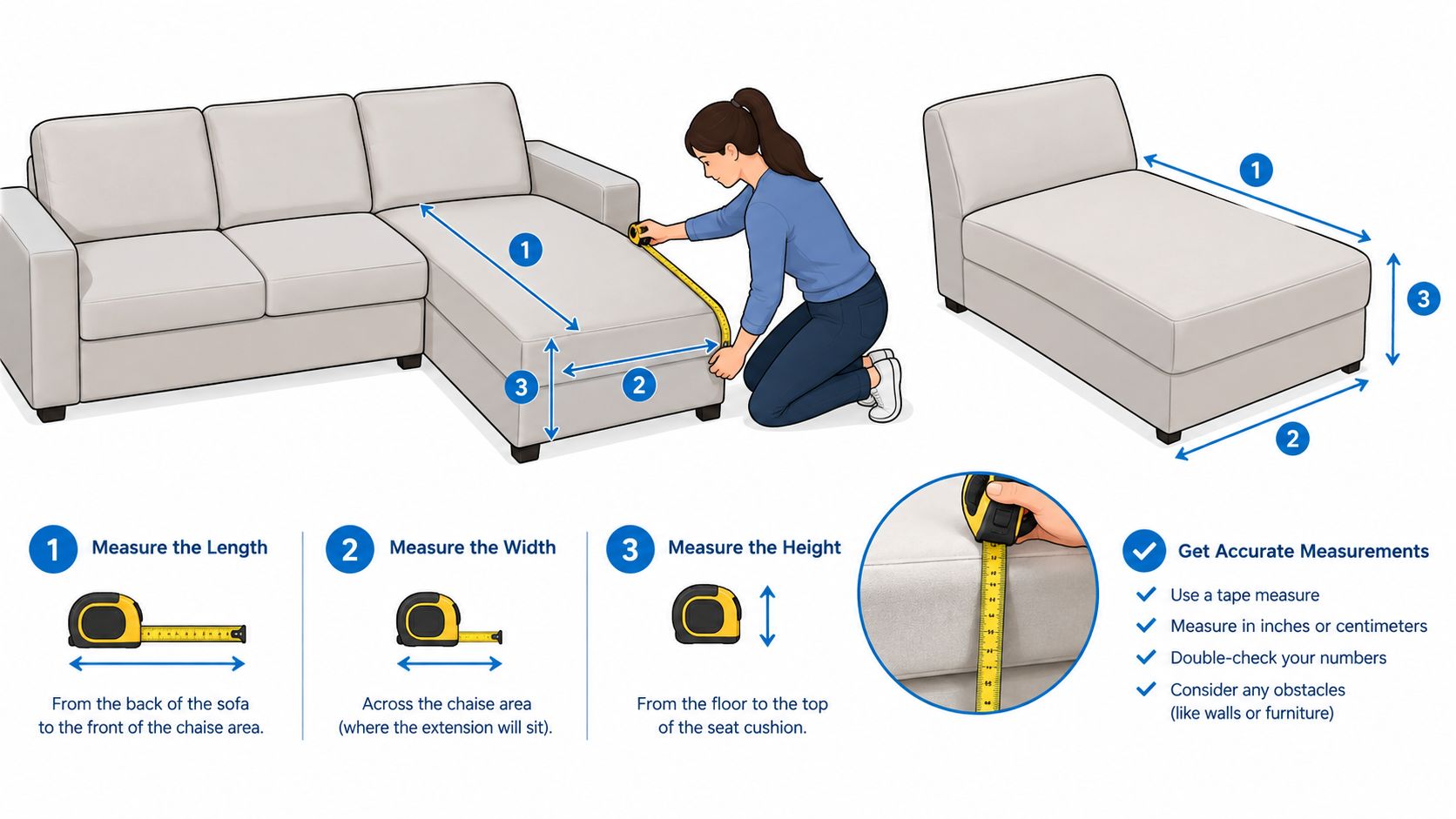
Measure the wall behind the long portion, then measure the return wall or open-room depth. Write down overall width, overall depth, and seat height. These three measurements set the starting point for sectional planning. For a fuller checklist, use BILTRITE's guide to measuring for a sectional sofa.
Measure the chaise from the back of the sectional to its front edge. A sectional sofa with lounger commonly needs about 60 to 72 inches of chaise projection, while overall widths often fall around 90 to 168 inches. Other sizing guidance places many sectionals around 94 to 156 inches in overall depth, with chaise extensions commonly measuring 60 to 72 inches.
Mark the full footprint on the floor with painter's tape. Leave it there while everyone walks through the room. Test the path to the entry, chairs, windows, and coffee table. A layout that works on paper may block the only route across the room or leave no comfortable space beside the extended seat.
Practical rule: Measure the walking path before choosing the upholstery. A beautiful lounger that blocks the only route across the room isn't a comfortable purchase.
Measure the delivery route, not just the room
Measure the usable opening of the front door, interior doors, stairwell, landing, and every sharp turn. Standard interior doorways are often 32 to 36 inches wide, while older homes may have openings of 28 to 30 inches. Individual sectional pieces are often 36 to 42 inches wide, so compare each delivered piece with the actual opening and turning space.
Check low windows, banisters, light fixtures, narrow corners, and trim before delivery day. Do not remove doorstop trim unless the delivery team confirms that approach. Ask how the sectional comes apart. Separate backs, arms, or connecting pieces can make delivery possible through an upper flat or tight Milwaukee stairway, where one rigid frame cannot turn.
Check seat depth and traffic flow
Deeper loungers support full-body relaxation, and 24 inches or more of seat depth is a useful comfort reference for deeper loungers. Extra depth also takes floor space, so judge comfort beside circulation rather than by the display alone.
A measurement visit should answer four questions:
- Can the lounger extend without touching a primary walkway?
- Can people pass between the sectional and nearby furniture?
- Can every piece turn through the entry route?
- Will the room still work when someone is fully stretched out?
If any answer is uncertain, choose a smaller-scale or come-apart configuration over a larger model that only fits after it reaches the room. That decision protects both daily traffic flow and the delivery plan.
Construction and Comfort That Lasts for Years
A lounger takes the hardest daily use in many sectionals. Someone may spend hours in the same position, concentrating pressure on the seat core, front edge, and frame connection. That makes construction especially important at the extended end, where comfort must hold up through repeated use.
Look inside the seat cushions
For a sofa used every day, polyurethane foam in the 1.8 to 2.2 lb/cu ft density range at minimum provides a useful baseline. Higher-density foam around 2.0 to 3.0 lb/cu ft generally retains its shape longer. A denser core can still have softer wrapping or layered cushioning, so the cushion may feel relaxed while resisting repeated compression.
Low-density foam often feels inviting during a brief showroom visit. Under daily family use, it can lose support sooner. Ask what sits inside the cushion, how it is wrapped, and whether the seat can be serviced later.
The front edge deserves close attention. It carries weight when someone sits down, shifts position, or stands. A knowledgeable associate should explain the cushion core, wrapping materials, suspension, and maintenance requirements rather than showing fabric samples alone.
Examine the frame and joinery
A durable frame should remain stable when someone sits at the corner, rises from the cushion, or shifts toward the lounger. Excessive movement, creaking, or a loose connection deserves attention before purchase. The frame can have a substantial feel without becoming oversized or awkward in a smaller Milwaukee room.
Ask how the sectional is joined and whether it can come apart for delivery or future service. Older Metro Milwaukee homes often have tight stairways, narrow landings, and turns that punish one-piece construction. A sectional with separable backs, arms, or connecting components gives the delivery team more workable options.
USA-made and Amish-made furniture can suit shoppers who value solid wood, careful joinery, and repairable construction. BILTRITE's dowel construction guide explains one traditional method for connecting wood components. Solid wood also brings a substantial feel and a finish that works in classic Milwaukee interiors as well as updated family rooms.
Match materials to household habits
Fabric, leather, and performance-oriented upholstery each require a different care routine. Families with children, pets, or frequent snacks should choose a surface based on actual use, not color alone. Removable or serviceable cushions can simplify cleaning, while the construction beneath them determines whether the sectional keeps its support.
Use this checklist:
- Daily family lounging: Choose a higher-density seat core and a sturdy frame.
- Frequent naps: Test the lounger for full-body support, including the head, hips, and legs.
- Pet-heavy rooms: Ask how the upholstery handles hair, claws, and spot cleaning.
- Formal living rooms: Consider a structured cushion and refined profile that hold their shape with less casual rearranging.
Test the whole seating position before deciding. The right sectional supports the household's routines, keeps its shape, and still fits the home's delivery realities.
Fixed Lounger vs Modular Pit Sectionals
The fixed chaise remains the straightforward choice for households that know how the room should function. A modular pit sectional earns its place when the room needs to change, whether because of guests, moves, children growing, or multiple seating arrangements.
Fixed and modular designs can both be comfortable. The better choice depends on whether the lounger's dedicated position or the furniture's ability to reconfigure matters more.
| Feature | Fixed Chaise Lounger | Modular Pit Sectional |
|---|---|---|
| Primary strength | Dedicated stretch-out position | Flexible seating arrangement |
| Room planning | Predictable footprint | Requires planning for several possible layouts |
| Best for | Households with a stable living-room setup | Households that rearrange, host, or move |
| Lounging feel | Clear, separate chaise zone | Deep, shared comfort area |
| Delivery consideration | May come apart, but configuration is fixed | Multiple pieces can simplify access |
| Long-term adaptability | Lower | Higher |
Choose the fixed chaise for defined comfort
A fixed lounger gives one person a clear place to stretch out without turning the entire sectional into a deep seating pit. It often preserves a more traditional L-shaped appearance, which works well in rooms that also need an accent chair, side table, or open walkway.
This format suits a household that watches television in the same arrangement, wants an obvious nap spot, and doesn't expect to move furniture often. The chaise side also helps establish orientation, so the room can be designed around the left- or right-facing return from the start.
Choose modular when the household changes
A modular system makes more sense when seating needs shift. Pieces can be separated for conversation, grouped for movie nights, or adjusted after a move. Some systems support configurations such as sofa-chaise arrangements and theater-style layouts, while deep-seated pit designs emphasize shared lounging (modular furniture guidance).
The tradeoff is visual and practical. A modular pit can feel wonderfully relaxed, but its depth may challenge shorter users, older adults, or anyone who prefers an easier rise. Loose pieces also need enough room to remain aligned and may require more attention to keep the layout looking organized.
The right question isn't whether modular is fashionable. It's whether the household will actually use the flexibility.
Fixed chaise sectionals are usually the better decision for a stable room with a clear traffic pattern. Modular pit sectionals earn the additional complexity when reconfiguration is a genuine need, not merely a feature that sounds appealing in a showroom.
Styling Ideas for Every Milwaukee Home
A lounger sectional carries visual weight, so the rest of the room should give it structure without making the space feel crowded. The design solution changes with the home. A compact condo needs breathing room, while a suburban basement can support a broader arrangement with additional seating.

Small homes need visual discipline
In an apartment, condo, or smaller bungalow living room, a small-scale sectional can deliver the lounger experience without swallowing the room. A lower-profile table, compact accent chair, and wall-mounted lighting keep the floor more open. The chaise should point into the room only when the remaining route stays comfortable.
A rug can define the seating zone, but it shouldn't become another obstacle. The front legs of the sectional can sit on the rug while the lounger remains fully supported on the floor, creating a finished appearance without requiring an oversized textile.
Larger rooms need an anchor
A broad family room or finished basement can handle a heavier-duty sectional, but a large empty area needs more than one giant sofa. A pair of movable chairs, a substantial coffee table, and lamps at different heights help divide the room into useful zones.
The lounger should face the activity it supports. A television-facing chaise encourages relaxation, while a chaise aimed toward a window can create a quieter reading position. A sofa that floats in a basement may need a finished back, whereas a wall-backed arrangement can tolerate a more compact rear profile.
Accessibility should guide placement
Senior living rooms benefit from clear paths, supportive seat heights, and furniture that doesn't require a difficult climb out. A lounger can be comfortable, but an exceptionally deep seat may make standing harder. A supportive accent chair or lift chair can balance the room while giving another household member a more accessible seating option.
Color and texture can soften a substantial sectional. Warm neutrals, patterned pillows, a wood accent table, and focused lighting keep the room welcoming rather than oversized. The goal is a living room that looks designed because every piece supports movement and use, not because decoration has been layered over a poor layout.
Why We Love Helping You Shop in Person
Furniture needs to be tested with the body, not judged only through a photograph. Seat depth, back angle, arm height, cushion recovery, and fabric feel reveal themselves when a shopper sits, shifts, stretches out, and stands. Those details become especially important with a sectional sofa with lounger because the extended end may feel wonderful to one person and awkward to another.
BILTRITE has served the Metro Milwaukee community since 1928 as a fourth-generation, family-owned furniture business. The showroom focuses on affordable, better-quality furniture, including USA-made, Amish-made, and solid-wood pieces, along with custom choices in fabric, leather, wood, finish, and hardware.
Advice without pressure
The sales associates bring over 400 years of combined experience to the showroom. Their role is to help shoppers compare dimensions, upholstery, construction, and delivery requirements without rushing the decision.
An in-person visit also makes customization practical. A shopper can compare a compact configuration with a heavier-duty one, sit on different cushion feels, inspect upholstery in real light, and discuss whether a come-apart design suits an older home. That conversation can prevent an expensive mismatch before delivery day.
Delivery is part of the purchase
A furniture plan isn't finished when the sectional is selected. The delivery route, room preparation, and placement all affect the experience. BILTRITE's white-glove delivery information outlines the kind of service shoppers should discuss before ordering, especially when stairs, narrow doors, or delicate flooring are involved.
The store doesn't sell online, and it closes on Sundays and Mondays to support family time. That local, face-to-face approach suits a purchase that needs measuring, sitting, planning, and honest conversation. Families can visit the Greenfield showroom, bring room measurements, and ask the team to pressure-test the choice before committing.
Answers to Your Top Sectional Questions
Can the chaise switch sides later?
Some modular designs allow pieces to be rearranged, while a fixed chaise usually has a set left- or right-facing orientation. The answer depends on the frame, connectors, and upholstery pattern, so the configuration should be confirmed before ordering rather than assumed from a photograph.
Households that expect to move should ask about reversible layouts, individual piece dimensions, and whether the back of each component is finished. A flexible configuration may be worth choosing even if the first room has only one obvious arrangement.
Which upholstery handles family life?
The best choice depends on the household's habits. Performance-oriented fabrics can be practical for active rooms, while leather offers a different feel and cleaning routine. Ask about manufacturer care instructions, recommended cleaners, cushion covers, and how quickly a spill must be addressed.
A simple maintenance routine helps any sectional last longer:
- Vacuum regularly: Use the appropriate upholstery attachment, including around seams and beneath removable cushions.
- Treat spills promptly: Blot rather than rub, then follow the fabric or leather care instructions.
- Rotate eligible cushions: Change positions only when the cushion design allows it.
- Protect the lounger zone: Keep sharp objects, pet claws, and food debris from concentrating in the same area.
What happens during delivery?
The delivery team should review the access route, protect the home as appropriate, bring the pieces inside, assemble the sectional, and place it according to the agreed plan. The household should clear hallways, secure pets, remove fragile décor, and point out low ceilings, stair turns, or flooring concerns before the crew arrives.
The final check should include connector stability, cushion placement, reclining or modular functions when applicable, and a walk-through of the room. If a sectional arrives in pieces, that is an advantage only when the pieces have been measured against the actual route.
What should shoppers bring to the showroom?
Bring room width and depth, ceiling or stair concerns, doorway measurements, photos of the room, and the preferred chaise side. A quick sketch showing windows, radiators, outlets, and walking paths helps the design conversation move quickly.
The strongest purchase usually comes from matching the furniture to real habits. If the family needs a dedicated movie-night lounger, a fixed chaise may be the sensible fit. If the room must change for guests or future moves, modular seating may earn the extra planning.
BILTRITE Furniture-Leather-Mattresses offers affordable, better-quality living-room furniture, including small-scale, heavy-duty, USA-made, Amish-made, solid-wood, and come-apart seating options. Visit BILTRITE Furniture-Leather-Mattresses in Greenfield with room measurements and delivery details, and let the family team help find a sectional sofa with lounger that fits the home as well as the household.