Twin Sleeper Chair: A Friendly Buyer’s Guide for Your Home


The guest room can turn into a catch-all fast. One day it's a reading chair, the next day it's where a grandkid sleeps after a game, and by Friday someone's asking where the extra bed went. That's usually where a twin sleeper chair earns its keep, because it gives one spot in the room two jobs without asking for a full sofa-sized footprint.
Families run into this puzzle in apartments, smaller homes, home offices, and senior living spaces all the time. A chair that sits comfortably during the day and opens into a real sleeping surface at night feels a lot like a good utility knife, simple on the outside, very useful when things get tight. The trick is knowing what kind of sleeper chair you're looking at, how much room it really needs, and whether the build matches the way the home gets used.
Why a Twin Sleeper Chair Might Be the Smartest Seat in Your Home
A narrow living room has a way of making every piece of furniture argue for its place. A love seat feels too bulky, a folding cot feels temporary, and the spare bedroom might already be doing double duty as an office, craft room, or exercise spot. In that kind of home, a twin sleeper chair can solve the daytime seating problem and the overnight guest problem at the same time.
The reason this category keeps coming back isn't new at all. Scholars tracing the history of twin beds describe a long rise-and-fall arc from roughly 1870 to 1970, with twin beds becoming especially fashionable in the 1920s and then losing that modern appeal by the 1940s (A Cultural History of Twin Beds). That history matters because the same logic still applies today, a compact sleep solution fits changing household space, guest needs, and ideas about comfort.
A twin sleeper chair takes that older sleeping idea and shrinks it into a piece that can live in a corner, a den, or a senior apartment. It's not a novelty item, it's a practical answer for homes that need flexibility without clutter.
Practical rule: if a room has to work harder than one use, the furniture should do the same.
The product makes the most sense when a homeowner wants a real seat every day and a real bed only when company stays over. BILTRITE's small-space furniture guidance fits that same idea, and it's worth pairing this kind of chair with a room plan before anyone falls in love with the fabric swatch. For a broader look at compact-room planning, small space furniture solutions can help frame the decision.
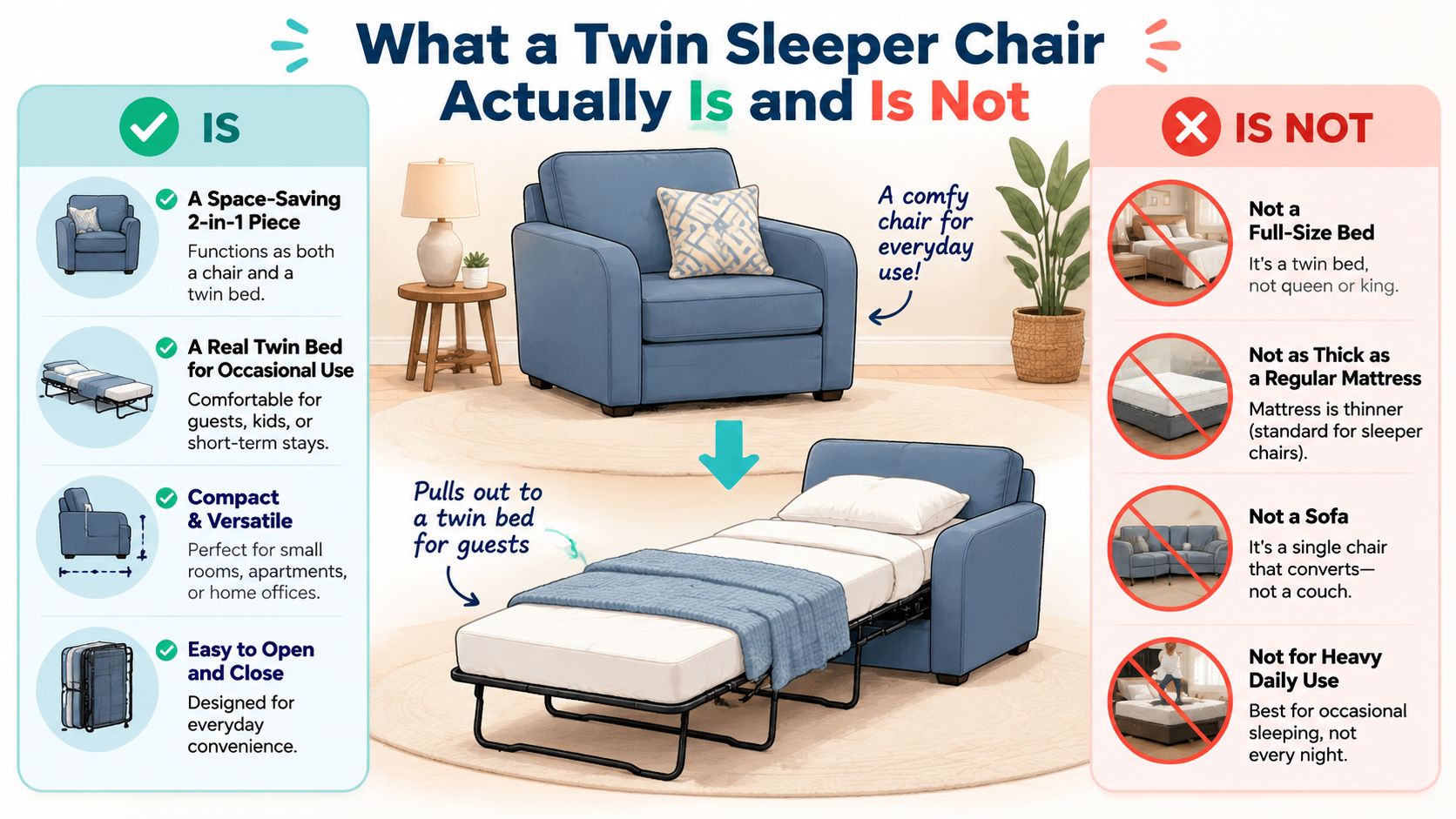
What a Twin Sleeper Chair Is and Is Not
A twin sleeper chair is a chair that opens into a twin-size sleeping surface. The name sounds simple, but the build usually falls into two product families. One uses a pull-out mechanism with a hidden mattress, while the other lets the cushions or seat sections flatten into the bed surface.
That distinction matters more than many shoppers expect. A pull-out design works like mechanical furniture, while a cushion-conversion design behaves more like a lounge seat that changes shape. One can feel closer to a small bed, and the other can feel more like a better nap chair, so comfort depends on how the chair transforms, not only on the upholstery.
Room fit matters just as much as the sleep surface. One example chair measures about 54.0"W × 38.5"D × 38.0"H, then opens to an overall sleeper length of 90.5", with a mattress around 71.5" × 32" × 5.5" (BILTRITE twin sleeper chair dimensions). That means the chair needs not only width, but also open floor space in front of it, much like a fold-out tool that asks for room to work once it opens.
How the bed side differs from the chair side
A sleeper chair is different from a sleeper sofa, a daybed, or a chair-and-a-half. A sleeper sofa spreads the sleeping load across a much larger frame, while a daybed usually stays visually open and does not hide a conversion system in the same way. A chair-and-a-half may give generous lounging room, but it does not necessarily promise a bed at all.
The simplest way to judge a model is to ask two questions. Does it pull out, or does it flatten? Once it is open, does the sleep surface feel like a hidden mattress or like repurposed cushions?
A helpful product guide notes that sleeper chairs can lay flat into a bed and may use either cushion-conversion or pull-out systems, which is why buyers should verify the mechanism before judging comfort or fit. For shoppers comparing chair-style sleep pieces more broadly, futon vs sofa bed is a useful companion read.
Mechanism Options and How They Feel in Daily Use
The moving parts matter because this is not just upholstery with a mattress tucked inside. A sleeper chair gets used differently than a regular chair, and the mechanism has to hold up through sitting, folding, unfolding, and sleeping in a real home. One model may feel smooth and solid, while another feels stiff or awkward from the first week.
A true pull-out mechanism usually feels closer to a small bed system. Product descriptions can spell this out clearly, such as a twin sleeper chair with a smooth pullout mechanism, a metal-frame bed, and a 5-1/2-inch-thick innerspring mattress. Another product description lists a 69-1/2" overall width, 40" overall depth, and 36-1/2" overall height, which shows how the chair shell and the hidden bed assembly work together.
Pull-out versus cushion conversion
A pull-out style is usually easier to picture for frequent overnight use because the sleeping surface is built into the mechanism. The chair stays a chair during the day, then opens into a more defined bed at night. That often feels more familiar to a guest who expects a mattress-like setup.
A cushion-conversion style can be simpler in concept and may fit a tighter room where the user wants less hardware under the frame. It can also be easier to understand at a glance, since the seat itself becomes the sleep surface. The trade-off is that the sleep feel depends more on cushion structure and daily wear.
Some shoppers should treat this as a mechanical purchase first and a style choice second.
BILTRITE's own category guidance on seating mechanisms follows the same idea, because the right sleeper chair depends on how often it changes form and how easily a household wants to operate it. For readers comparing moving seating pieces, power reclining seating types offers another way to examine motion, mechanism behavior, and everyday convenience.
The better question is not which one is best. It is which one matches the way the home really lives. A one-person apartment may lean toward the easier, lower-fuss option, while a guest room that sees regular weekend use may justify a more bed-like pull-out system.
Measuring Your Room So the Chair Fits the First Time
A tape measure saves more regret than a showroom day ever could. Before anyone worries about fabric, cushions, or mattress feel, the room has to answer a simple question, will the chair fit closed, and will it still fit when it opens?
Start with the seated footprint, then measure the runout in front of the chair. The example spec above shows why both matter, because the chair may sit at about 54.0"W × 38.5"D × 38.0"H, but the sleeper length grows to 90.5" when deployed (BILTRITE measuring guidance). That means a room can look generous until the bed opens and suddenly claims the walking path.
A simple room check
- Measure the wall space first. Confirm the chair can live where the room wants it to live, not where a wishful sketch puts it.
- Check the front clearance. The sleeper needs room to lay flat without hitting a coffee table, ottoman, or desk.
- Watch the doorway path. Hallways, turns, and stairwells can be a bottleneck, not the living room itself.
- Think about delivery corners. Tight apartments and older homes sometimes need come-apart furniture or a different delivery plan to get the piece inside.
That last point matters a lot in narrow entries and upstairs spaces. A chair might fit the room beautifully and still be miserable to deliver if the path to the room is too tight. In homes with tricky stairwells or small landings, matching the furniture to the delivery route can be just as important as matching it to the décor.
Measure the room twice, then measure the route once more. That's cheaper than discovering the hard way that the chair made it to the front door and stopped there.
Shoppers who've dealt with awkward hallways already know this lesson. A sleeper chair isn't only a seating decision, it's a movement decision too. Once those measurements are on paper, the rest of the buying process gets much calmer.
Frames, Fabrics, and Customization Choices That Matter
A sleeper chair that feels solid after years of use usually starts with the frame. That's where the difference shows up between a piece built for short-term guest duty and one built to handle frequent conversion. Real solid wood, USA-made, and Amish-made options tend to signal a deeper commitment to structure, repairability, and day-to-day reliability.
That doesn't mean every buyer needs the heaviest build on the floor. It does mean the household should match the frame to the job. A small apartment with occasional guests may want a lighter-scale option, while a family room or senior living suite may need a stronger frame and easier-to-manage access.
Choosing the build style
| Build Style | Best For | What to Look For |
|---|---|---|
| Heavy-duty build | Frequent use, multi-user homes, senior living spaces | Reinforced frame, stable mechanism, upholstery that can handle repeated conversion |
| USA-made build | Buyers who want domestic craftsmanship and solid construction | Clear build labeling, quality joinery, durable support under the seat |
| Small-scale build | Apartments, condos, compact guest rooms | Narrow footprint, easy clearance, dimensions that fit the room without crowding it |
BILTRITE's mix of USA-made, Amish-made, solid wood, and heavy-duty furniture lines fits this kind of decision-making. The store also offers custom choices for fabric, leather, wood finish, stain color, and hardware, which matters because a sleeper chair has to look good in the room even when it's behaving like a machine. For upholstery decision-making, upholstery materials helps buyers think through texture, cleanability, and long-term use.
A family with pets and grandkids may care more about easy cleaning than ornate trim. A homeowner building a polished den may want a fabric that disappears into the room visually while still surviving the transition from chair to bed. That's the customization advantage; the piece can be tuned to the household instead of forcing the household to adapt to the piece.
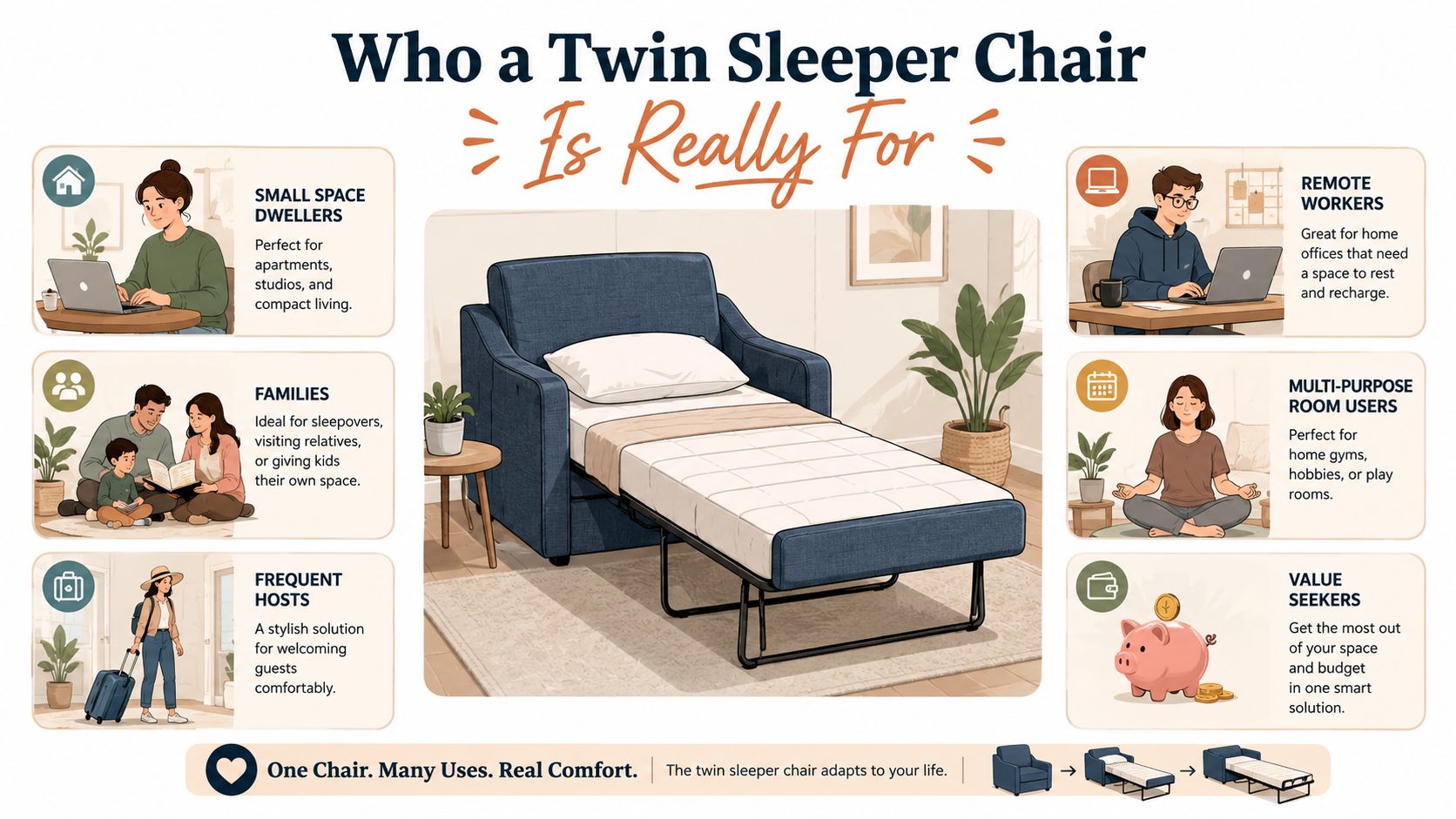
Who a Twin Sleeper Chair Is Really For
A twin sleeper chair fits best when the home needs a flexible seat that can also host sleepovers without swallowing the whole room. An apartment dweller might use one in a living room corner that doubles as a guest nook, while an empty nester may like the way it welcomes grandkids for a weekend without rearranging the house. Those two situations look different, but they both reward compact furniture that works hard.
Four common household fits
An office that turns into a nap spot during the day needs something that feels neat and intentional, not like a temporary cot was dragged in. A sleeper chair can hold its own as seating while staying ready for a quick rest when the workday runs long.
A caregiver furnishing a senior living suite may look for supportive seating, manageable height, and a bed function that doesn't demand too much fuss. In that setting, the chair needs to be easy to sit in, easy to exit, and easy to convert without a wrestling match.
A bunk room or bonus room can also benefit from one, especially when the room already has a purpose and just needs one more sleep option. The chair becomes a flexible extra bed that doesn't force the room to stop being what it already is.
The pattern is simple. If the room serves more than one life, the furniture should too.
Care, Cleaning, and Keeping the Mechanism Happy
A sleeper chair lasts longer when the owner treats it like moving furniture, not just fabric on legs. That means checking the mechanism now and then, keeping crumbs and dust out of the frame, and giving the sleeping surface a little attention so it doesn't get flat in one spot. Small habits make the piece feel better every time someone opens it.
Easy maintenance habits
- Vacuum under and around the cushions. Dust and grit can work their way into the moving parts and make the mechanism feel rough.
- Rotate or air out the mattress when the design allows it. That helps the sleep surface wear more evenly.
- Use the right cleaner for the upholstery. Fabric and leather need different care, and the wrong product can shorten the life of the finish.
- Check the pull-out action occasionally. A sticky joint or loose feel is easier to address early than after months of strain.
The same sleep-care mindset shows up in BILTRITE's broader mattress department, where the store offers protective extras and mattress removal on qualifying purchases as part of its sleep-focused service set. That's useful because a sleeper chair lives in the same world as the mattress in a bed, both need some routine attention to stay comfortable and usable.
Good furniture is maintained the way a good skillet is seasoned, little acts over time keep the whole thing working.
For a family that opens the bed often, those little acts matter even more. Clean the fabric, respect the mechanism, and the chair can keep doing both jobs without getting fussy.
Bringing It All Together and Visiting Our Showroom
A smart sleeper-chair purchase comes down to four things, space, mechanism, materials, and how the room gets used. A buyer who measures first, checks whether the chair pulls out or flattens, and thinks about frame quality is already ahead of most first-time shoppers. That approach turns the search from guesswork into a simple, practical decision.
BILTRITE Furniture-Leather-Mattresses has been helping Metro Milwaukee families since 1928, and that fourth-generation history shows up in the way the showroom talks through fit, construction, and comfort. Our team brings more than 400 years of combined experience, so shoppers can ask about small-scale pieces, heavy-duty frames, and custom finishes without feeling rushed.
For anyone weighing a twin sleeper chair for a guest room, office, apartment, or senior living space, the smartest next step is to sit in a few examples and try the mechanism with real hands. That's where the details become obvious, and where a good fit starts to feel clear.
Visit BILTRITE Furniture-Leather-Mattresses in Greenfield to see sleeper chairs, test the pull-out action, and talk through fabric, leather, wood, and finish choices with our team. We'd love to help you find a piece that fits your room, your routine, and your family's way of living.