Narrow Chaise Lounge Chair Buying Guide for Small Spaces


A small Milwaukee apartment or condo can create a familiar furniture puzzle. There's room for one relaxing seat, but a full sofa would swallow the living area, while a recliner might feel too bulky or visually heavy. A narrow chaise lounge chair can fill the middle ground, giving one person a supported place to read, rest, or stretch out without taking over the room.
The right choice requires more than measuring the outside width. Seat depth, back angle, arm clearance, standing comfort, delivery access, and everyday circulation all matter. BILTRITE has helped Metro Milwaukee households solve space challenges since 1928, and the store's small-space furniture solutions offer a useful starting point for shoppers comparing compact seating.
Table of Contents
- Why a Narrow Chaise Lounge Chair Works in a Small Room
- What Makes a Chaise Narrow and Still Comfortable
- Ideal Dimensions for Small Spaces
- Frames and Upholstery Choices That Last
- Getting It Home and Delivery Fit
- Styling Your Narrow Chaise in Real Rooms
- Your Next Step to Lounging Comfortably
Why a Narrow Chaise Lounge Chair Works in a Small Room
A chaise lounge combines the support of a chair with the lengthwise comfort of a daybed. It lets one person recline with the legs supported, but it doesn't require the full seating capacity or width of a conventional sofa. That makes it especially useful in a reading corner, bedroom, senior living room, or narrow living room where every inch has a job.
The form has a long history. European daybed designs established the basic idea of a seat with an inclined back and dedicated leg support, and the chaise longue became especially visible in refined interiors during the late eighteenth and nineteenth centuries. Jacques-Louis David's 1800 portrait of Madame Récamier helped cement the image of a person reclining elegantly on a chaise lounge, as documented in this history of the chaise longue.
That history matters because the chaise isn't just a decorative chair with extra length. Its defining purpose is to let the body rest lengthwise without requiring a full sofa. A narrow version keeps that same function while adapting the frame to smaller homes and tighter circulation areas.
The small-room advantage
A compact chaise can anchor a corner without forcing the rest of the room into a rigid furniture arrangement. A window-side chaise may create a quiet reading spot. A bedroom chaise can provide a place to sit while putting on shoes. In a long, narrow living room, it can face the room while leaving the main walkway open.
The best placement depends on the room's traffic pattern. A chaise should support relaxation without creating a hurdle between the entry, kitchen, hallway, or bathroom. The outside footprint matters, but the usable space around the arms, reclining hardware, and leg rest matters just as much.
Why the middle ground matters
A full sofa offers more seating than one person may need. A standard chair provides a smaller footprint but may not support the legs during extended lounging. A chaise bridges those two uses, offering a supported reclining posture without couch-sized seating capacity.
BILTRITE's family-owned, local approach suits this kind of decision. A showroom visit lets Metro Milwaukee shoppers compare scale in person instead of judging a compact piece from a product photo alone. The goal isn't to squeeze the smallest item into the room. The goal is to find a chaise that makes the room more comfortable and easier to live in.
What Makes a Chaise Narrow and Still Comfortable
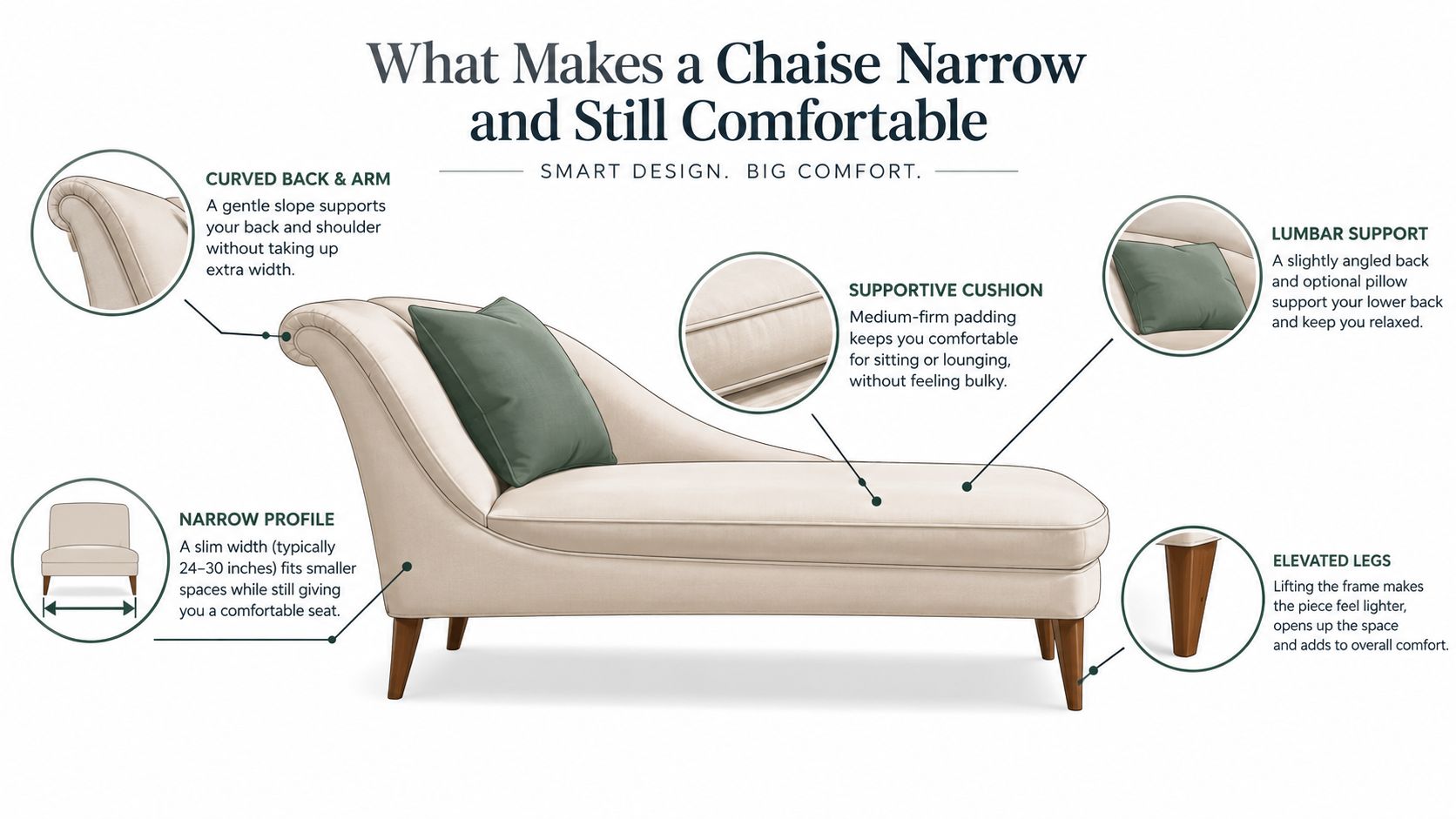
A narrow chaise should be judged by functional geometry, not by outside width alone. A frame may look slim, yet its thick arms can steal usable space, its seat can be too deep, or its back can leave the body poorly supported. A chaise is a lot like a shoe. The outside shape may look right, but comfort disappears if the fit pinches the wrong places.
Five measurements deserve attention:
- Back inclination: The back should support a relaxed recline rather than forcing the sitter upright or allowing the head and shoulders to collapse.
- Usable seat depth: The cushion needs enough room for the pelvis and thighs without pushing shorter users too far forward.
- Leg support: The seat should continue far enough to support the lower legs without creating an awkward gap or pressure point.
- Arm clearance: Arms should provide useful support without narrowing the sitting zone excessively.
- Total footprint: Overall width and length must work with the room, the walkway, and the furniture already in place.
Practical rule: A comfortable narrow chaise saves space through efficient frame design, not by compressing the sitting surface below ergonomic needs.
The chaise occupies an intermediate position between a chair and a sofa. It offers more length and reclining support than a chair, but it doesn't aim to seat several people like a couch. That distinction helps shoppers avoid a common mistake: choosing a piece because it looks compact, then discovering that the sitting area is too restricted for daily use.
A quick showroom vocabulary
Seat depth describes how far the sitting surface extends from the front edge toward the back. Seat width describes the usable space between the arms, not merely the outside width of the frame. Seat height affects how easily a person can sit down and rise, especially when the chaise will serve an older adult or someone with limited mobility.
Arm position also deserves a hands-on check. An arm that looks elegant but blocks shoulder room can make a narrow chaise feel cramped. A slimmer arm may improve fit, while a firm arm at a useful height may make entry and exit easier.
The right model preserves the longitudinal lounging function while reducing unnecessary bulk. A shopper should sit fully back, recline, shift position, and check whether the shoulders, hips, and legs remain supported. Appearance starts the conversation. Functional geometry makes the decision.
Ideal Dimensions for Small Spaces
A narrow chaise earns its place by fitting both the room and the person using it. Body proportions, recline posture, cushion construction, arm design, and intended user all affect the right dimensions. Ergonomic benchmarks provide a useful starting point, but an in-person fit test should make the final call.
Cornell ergonomics guidance identifies approximately 16.5 inches as a recommended fixed-seat depth and 14 to 18.5 inches for adjustable seats. The same guidance gives approximately 20 to 22 inches of seat width for accommodating clothed users, as summarized in this ergonomic furniture dimension study. These figures show how aggressive narrowing can limit hip movement, clothing clearance, and stable leg positioning.
A separate anthropometric chair study reported recommended dimensions that included a 33.2-centimeter seat height, 43.6-centimeter seat width, and 42-centimeter seat depth. It also calculated a 36-centimeter depth from the fifth percentile of buttock-to-popliteal length. That range supports matching the chaise to its intended users rather than judging comfort from exterior measurements alone. Review the anthropometric study of chair dimensions for the underlying measurements.
Compact chaise guidance commonly places small-space models around 28 to 32 inches wide and 60 to 75 inches long, with roughly 24 to 30 inches of circulation allowance. Use those figures for room planning, then confirm the usable seat area after accounting for the arms. For full standard and compact size charts, see BILTRITE's chaise lounge dimensions guide. The compact chaise planning guide offers the same general layout guidance.
Narrow chaise dimension benchmarks
| Measurement | Ergonomic Benchmark | What It Means for You |
|---|---|---|
| Fixed seat depth | Approximately 16.5 inches | A useful reference for a non-adjustable seat, while leg length still determines comfort. |
| Adjustable seat depth | 14 to 18.5 inches | A broader adjustment range can support different postures and body proportions. |
| Seat width | Approximately 20 to 22 inches | Usable space for a clothed user, not the chaise's outside width. |
| Compact chaise width | Approximately 28 to 32 inches | A practical small-space range when the arms preserve enough seating room. |
| Compact chaise length | Approximately 60 to 75 inches | Enough length for lounging, depending on height and preferred leg position. |
| Circulation allowance | Approximately 24 to 30 inches | A planning reference for walking space, not a replacement for measuring the room. |
Chasing the narrowest possible frame often backfires. A slightly wider model with a shallower seat, supportive arms, and a seat height that helps controlled standing can serve shorter adults, seniors, caregivers, or mobility-limited users more effectively.
Older adults may struggle with excessive seat depth because their feet cannot reach the floor comfortably, their posture may slump, and standing may require more effort. Research on seating for older adults examines seat depth, seat height, and armrests. A recent accessibility discussion reports that 60% of older adults want furniture adapted to their own body dimensions, including adjustable seat height, depth, and width, as described in this seating accessibility research.
Test the chaise before ordering. Sit fully back, keep both feet supported, use the arms when standing, and rise without pulling on a wall, table, or loose cushion. Also measure the delivery path from the entry door through every hallway and turn. In Milwaukee homes with tight stairs or older doorways, a come-apart frame can make the difference between a good fit and a failed delivery.
Frames and Upholstery Choices That Last
Once the dimensions work, materials determine how the chaise handles everyday life. A narrow frame still needs strong joints, stable support, and construction suited to the people who will use it. A lightweight appearance doesn't have to mean flimsy construction.
Solid wood deserves attention because it offers a substantial foundation and can support furniture designed for long-term use. American-made and Amish-made furniture also appeal to shoppers who value domestic craftsmanship and traditional construction. In the BILTRITE showroom, icons identify USA Made, Amish made, and solid wood pieces, making it easier to compare construction without relying on a sales pitch.
Frame choices and daily use
A chaise for occasional reading may have different priorities than one used every evening by a busy family. A senior living room may need firm edge support, stable arms, and a non-sliding base. A family room may place more pressure on cushion recovery, cleanability, and seam construction.
Shoppers should ask to see the frame information, warranty terms, cushion construction, and care instructions. A frame can be attractive and still be a poor choice if the seat feels unstable or the reclining mechanism projects into a walkway.
Custom construction can also solve a room-specific problem. BILTRITE offers affordable custom options with choices in fabric, leather, wood, finish, and hardware, allowing shoppers to coordinate the chaise with an existing room instead of accepting a one-size-fits-all combination.
Upholstery by lifestyle
Performance fabric makes sense for households with children, pets, or frequent guests because maintenance is part of ownership. Leather offers a different combination of durability, cleanability, and visual character. Traditional upholstery may provide the exact color or texture a room needs, but care instructions should be understood before purchase.
More information about choosing among upholstery types is available in BILTRITE's guide to upholstery materials. The right material depends on use, not on a universal ranking.
There's also a technical safety check for upholstered furniture intended for the United States. The Consumer Product Safety Commission states that upholstered furniture manufactured, imported, or reupholstered on or after June 25, 2021, must comply with the flammability test method in California Technical Bulletin 117-2013 under 16 C.F.R. part 1640, as explained in the CPSC upholstered furniture guidance.
The permanent label should state, “Complies with U.S. CPSC requirements for upholstered furniture.” That label addresses smolder resistance involving the cover fabric, resilient filling, barrier material, and decking material. It doesn't establish comfort, durability, cushion density, frame quality, or warranty coverage, so those factors still require separate inspection.
Getting It Home and Delivery Fit
A chaise can fit beautifully in a room and still fail the delivery test. Tight Milwaukee housing, older door openings, sharp hallway turns, stair landings, and elevator entrances can create problems that a simple room measurement won't reveal.
Three measurements should be treated separately:
- Product footprint: Measure the assembled chaise, including the arms, base, reclining mechanism, and extended leg rest.
- Delivery path: Measure the narrowest doorway, hallway, turn, stair landing, elevator, and threshold between the truck and the room.
- Post-delivery circulation: Measure the walking route that must remain open after the chaise is in place.
The packaged dimensions may be larger than the assembled dimensions, so those figures need to be requested before ordering. Shoppers should also ask whether the legs come off, whether the base can rotate, and whether the frame separates into manageable pieces.
The painter's-tape fit test
Painter's tape gives a room a quick, low-risk trial layout. Mark the outside footprint on the floor, then mark the intended walking route around it. Open doors, walk through the taped space, and notice whether the chaise would interfere with a hallway, coffee table, kitchen path, or emergency exit.
The same test can be used in a showroom. The sitter should:
- Sit fully back: Check whether the lower back and shoulders feel supported.
- Confirm foot contact: Make sure the feet can reach the floor when seated in the intended position.
- Test the arms: Use them for balance without pulling on movable cushions.
- Rise naturally: Stand without pushing against a nearby table, wall, or unstable arm.
- Recline carefully: Confirm that moving parts don't project into the walking route.
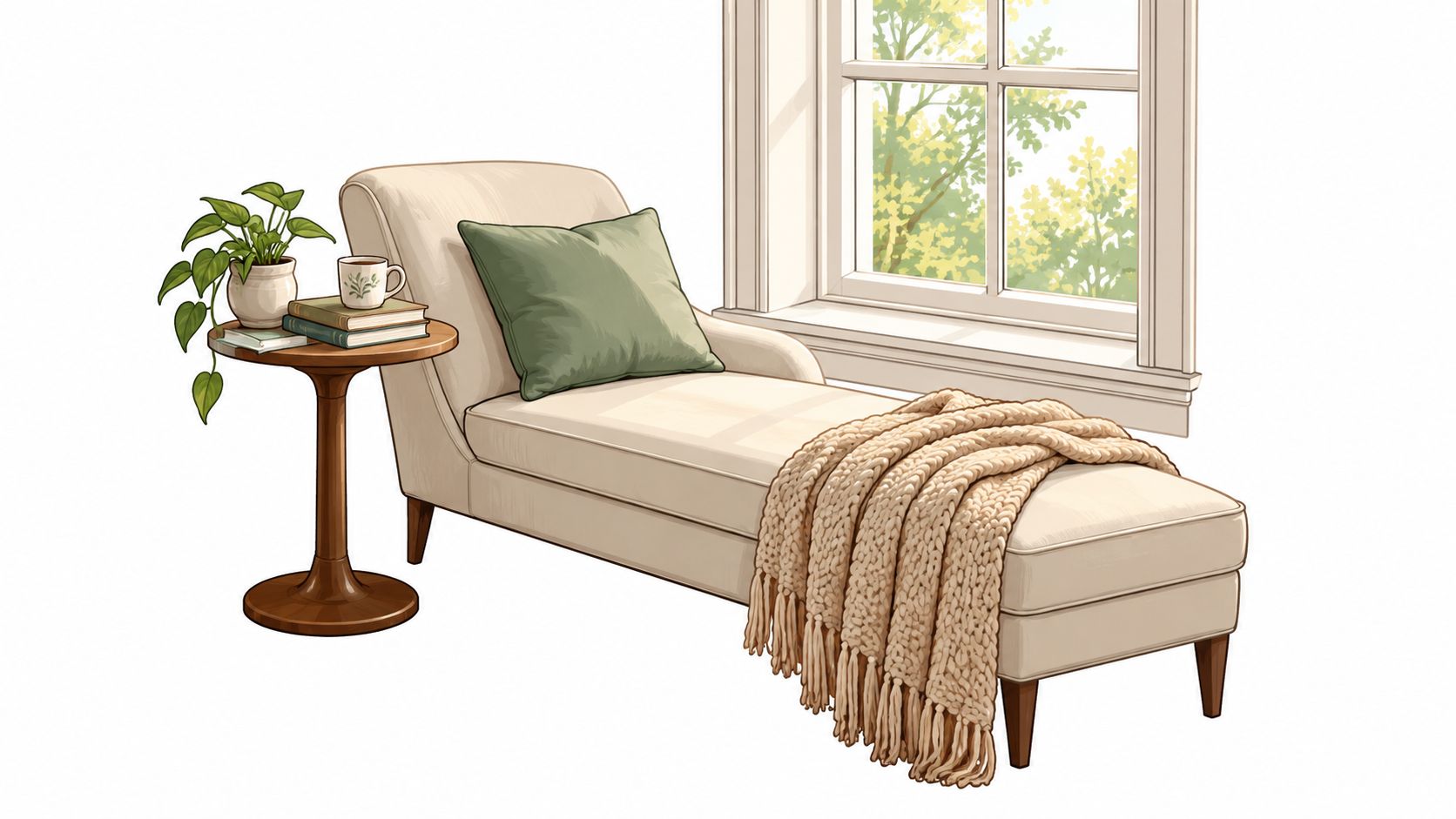
Come-apart construction can change the answer for an apartment, condo, senior living community, or older Milwaukee home. A piece that separates for delivery may fit where a rigid frame won't. BILTRITE identifies come-apart options with an in-store icon, and shoppers can also review how white-glove delivery service handles placement and access questions.
When another format makes more sense
An armless chaise may preserve the lounging function while reducing side clearance. A compact loveseat may be better when two people need seating more often than one person needs full leg support. A modular piece or reversible chaise can offer more flexibility when the room layout may change.
The best choice is the one that reaches the room, leaves a usable path, and supports the people who will sit there. A small exterior footprint isn't helpful if the frame can't pass through the building or the arms make the seat uncomfortable.
Styling Your Narrow Chaise in Real Rooms
A narrow chaise can look intentional rather than squeezed in when the surrounding pieces respect its proportions. A window-side reading nook needs only a slim side table, a focused lamp, and a soft throw that doesn't cover the sitting surface. The chaise becomes a destination without requiring a complete furniture set.
At the foot of a bed, a chaise can provide a convenient place to sit while putting on shoes or folding laundry. The bedroom benefits from a compact profile, especially when the piece needs to leave room for drawers, closet doors, and the main walking route.
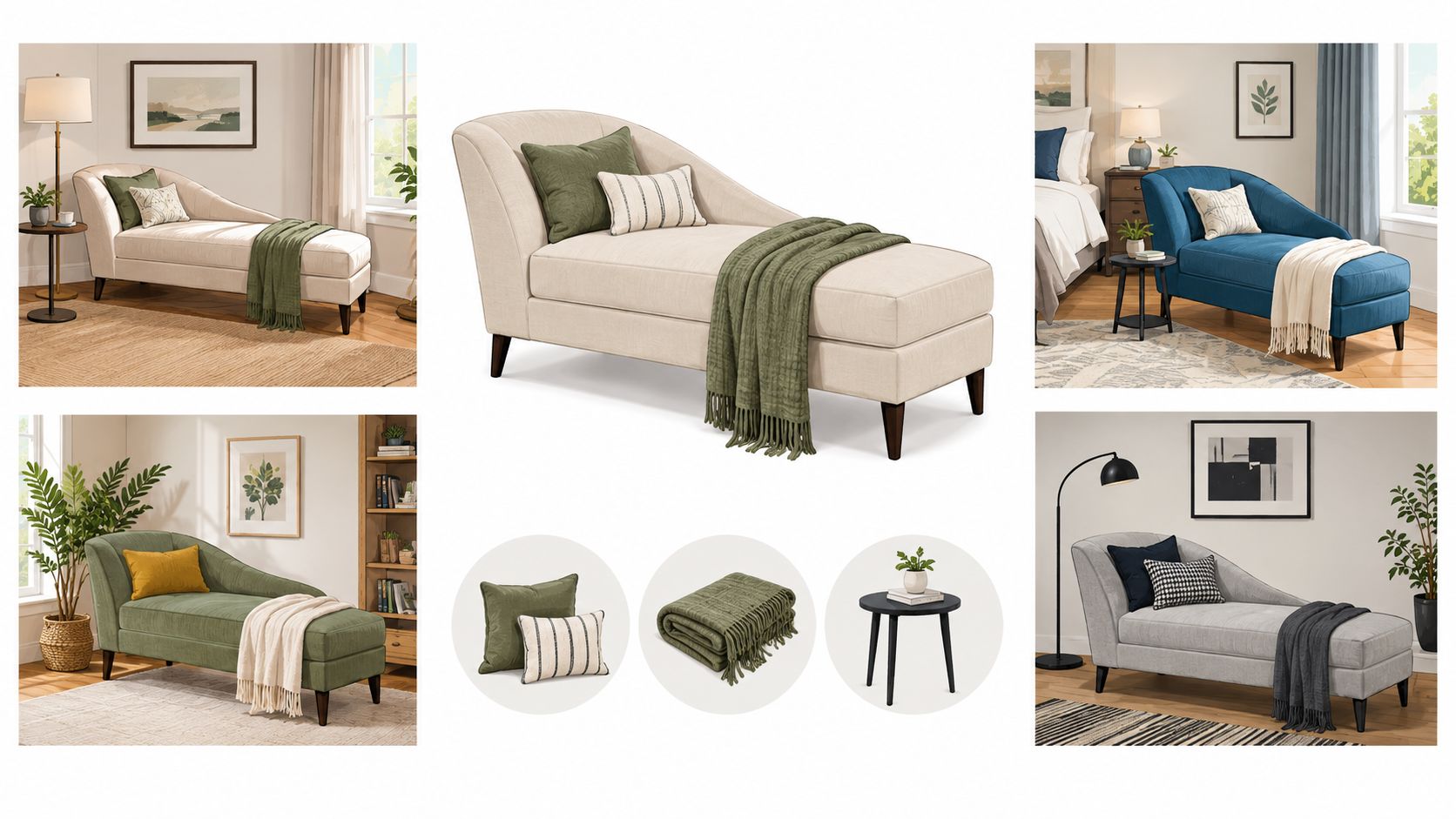
In a senior living room, appearance comes after support. A firm, easy-to-stand chaise with useful arms may serve better than a lower, softer piece that looks smaller but makes transfers difficult. A supportive chaise can also create a more open look than a bulky recliner when the room needs clear sightlines.
A narrow living room often benefits from placing the long side against a wall, provided the arms and back don't block a doorway. A small rug can define the lounging zone without adding bulk. Pillows should add softness at the back or side, but too many can reduce the usable seat depth.
Simple placement rules
- Protect the walkway: Keep the everyday route open rather than forcing people to walk around the foot of the chaise.
- Use a slim companion: Choose a side table that holds a lamp, book, or drink without competing with the chair.
- Keep accessories practical: Select a throw that can be moved easily and pillows that don't consume the sitting area.
- Repeat a room detail: A wood finish, fabric tone, or metal accent can connect the chaise to nearby furniture.
- Let the chaise breathe: Avoid crowding the long side with storage pieces or oversized tables.
For additional small-room layout ideas, shoppers can review BILTRITE's guidance on sofa ideas for small living rooms. The same principle applies to a chaise: style should support movement, comfort, and the way the household uses the room.
Your Next Step to Lounging Comfortably
Before choosing a narrow chaise lounge chair, a shopper should have four answers ready:
- Room fit: What are the usable room dimensions, including doors and existing furniture?
- Delivery fit: Can the packaged piece pass through every doorway, turn, landing, and elevator?
- Body fit: Does the seat support the sitter's depth, width, legs, shoulders, and preferred recline?
- Daily fit: Can the sitter rise safely, and does the chaise preserve a clear walking path?
The materials deserve the same direct review. Look for a stable frame, appropriate cushion support, upholstery suited to household use, and the required compliance label on upholstered furniture. Marking the footprint with painter's tape before purchase can reveal a circulation problem before delivery day.
BILTRITE is a fourth-generation, family-owned business founded in Milwaukee in 1928. Its value approach centers on affordable, better-quality furniture rather than just offering the cheapest piece available. The showroom includes USA-made, Amish-made, solid-wood, small-scale, heavy-duty, and senior-living options, along with a large mattress department for shoppers handling more than one furnishing need.
The Greenfield showroom is located at 5430 West Layton Avenue. It's open Tuesday through Thursday from 10:00 a.m. to 6:00 p.m., Friday from 10:00 a.m. to 7:00 p.m., and Saturday from 10:00 a.m. to 5:00 p.m. The store is closed Sunday and Monday for family time, so showroom visits should be planned for Tuesday through Saturday. Those hours are listed on the BILTRITE contact page.
A chaise is most accurately judged from the seat, not the screen. A showroom visit gives shoppers the chance to compare seat depth, arm support, standing comfort, upholstery, and delivery options with help from experienced local associates, without pressure.
BILTRITE Furniture-Leather-Mattresses offers small-scale seating, USA-made and Amish-made furniture, solid-wood options, custom upholstery choices, and delivery solutions for challenging spaces. Metro Milwaukee shoppers looking for a narrow chaise lounge chair can visit BILTRITE Furniture-Leather-Mattresses in Greenfield to test comfort, check fit, and talk through the right option for home.