


Swivel Base for Recliners: Installation & Buying Guide


The morning routine is familiar. Someone settles into a recliner for the news, then twists toward the television, turns again to answer a question from the kitchen, and cranes around the chair to see who's coming through the hallway. By lunchtime, the chair still feels comfortable, but the fixed direction feels limiting.
A swivel base for recliners changes that daily experience by letting the chair turn toward the conversation, the screen, a window, or a nearby table without dragging the furniture across the floor. The upgrade sounds simple, but the important details are underneath: not every recliner can accept a swivel base, and a worn or poorly matched base can create a safety problem. A careful buyer checks the chair model, mounting pattern, clearance, load rating, and condition before making a change.
Table of Contents
- Why a Swivel Base Changes Your Living Room Routine
- How Swivel Bases Work and What Makes Them Durable
- Types and Materials for Different Homes and Budgets
- Measuring Your Recliner and Checking Compatibility
- Step-by-Step Installation and Safety Tips
- Maintenance, Troubleshooting, and When to Replace
- Where to Find Quality Swivel Bases and Expert Guidance
Why a Swivel Base Changes Your Living Room Routine
A fixed recliner asks the room to stay organized around one direction. That works well when the chair faces one television or sits against one wall. It becomes less convenient when the living room also serves as a reading spot, a family conversation area, or a view into the kitchen.
A swivel recliner gives one person more control without asking the whole room to change. During a morning news program, the sitter can face the screen. When a family member starts preparing breakfast, the chair can turn toward the kitchen. Later, the same seat can face a window or a side table for reading. This movement keeps the sitter involved instead of forcing an awkward neck turn or a full chair relocation.
Practical rule: A swivel base earns its floor space when the sitter regularly needs to face more than one focal point.
The benefit becomes especially clear in an open-plan home. A chair placed near the boundary between the living room and kitchen can support both spaces, while a fixed recliner may create a visual and social barrier. In a smaller room, that flexibility can make the seating arrangement feel less rigid, provided the chair has room to rotate and recline safely.
Furniture designers have been refining rotating seating for a long time. One commonly cited milestone is Thomas Jefferson's 1775 swivel chair, while later furniture history places swivel seating in broader household use by the 20th century. Stressless entered the market in 1971 in Norway with a recliner designed around body movement and support, later becoming known internationally as a swivel recliner concept. This development is described in the history of modern swivel chairs.
A swivel base doesn't automatically make a chair more comfortable. It does make the chair more useful when people move between activities. Families considering a new layout can find more ideas in these living room arrangement ideas, then test whether a rotating recliner would improve the way people use the room.
How Swivel Bases Work and What Makes Them Durable
A recliner swivel base works much like a sturdy turntable. One part stays attached to the chair frame, while another part rotates above it. Between them sits a bearing race, which lets the chair move smoothly without relying on one central pivot point to carry every force.
Most residential assemblies use two steel plates separated by a bearing race. The stationary plate fastens to the frame, and the rotating plate carries the recline mechanism. Steel ball bearings or heavy-duty nylon races commonly provide the rotating action, including full 360-degree movement. A common square mounting pattern measures 8 inches by 8 inches, so bolt spacing matters as much as the overall shape of the base. These construction details are outlined in this recliner swivel-base installation guide.
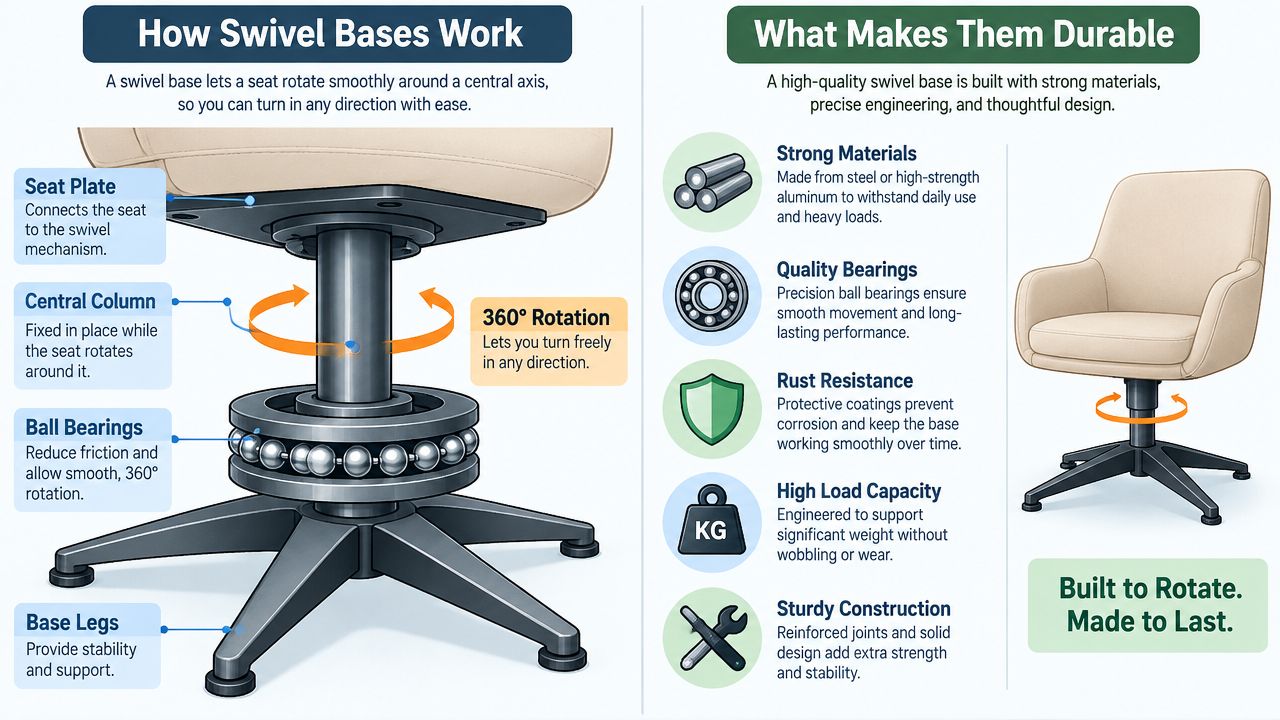
What shoppers should inspect
A quality base should rotate without grinding, catching, or shifting from side to side. The main variables deserve attention:
- Bearing type: Steel balls and durable nylon races can both work, but the bearing assembly should match the chair's size and expected use.
- Mounting accuracy: Misaligned holes can leave bolts under uneven stress and create wobble.
- Load rating: A capacity of 300 pounds or more is commonly recommended to reduce bearing wear and premature structural fatigue under the combined user-and-chair load. The same installation guide explains why the rating must account for the entire moving load, not just the sitter.
Larger rings spread rotational forces over a wider area. Replacement-base examples include 22-inch, 24-inch, and 25.5-inch rings, while heavier designs may use welded steel crossbars and three-quarter-inch high-test steel tube rings. Larger rings can distribute weight more evenly, which may help bearing life in frequently used or heavier recliners. Published replacement specifications also show assemblies with a 10.25-inch square swivel plate, 65 three-eighths-inch ball bearings, an 8-inch by 8-inch mounting pattern, and an installed height of about 1.75 inches. These examples appear in the replacement swivel assembly specifications.
Patent activity reinforces that the base is a real mechanical subsystem, not just decorative hardware. A U.S. patent for a “base for swivel chairs” was issued on July 17, 1951, and later furniture patents continued refining bases with rotors, retainers, and bearing surfaces. That history helps explain why small differences in steel, retention, and fit can affect how a chair feels after years of use. A broader patent record for swivel-chair bases provides the technical background.
For shoppers who want a deeper look at rotating seating, a guide to the swivel rocker glider offers useful context about how movement can be built into different furniture designs.
Types and Materials for Different Homes and Budgets
A family may use one recliner for quiet reading, daily television, and visits from older relatives. Another chair may sit in a rarely used corner. Those routines call for different swivel-base designs, but compatibility comes first. A recliner cannot accept a swivel base just because the platform looks large enough. Amish-made chairs and heavy-duty specialist models may use model-specific frames, plates, or mounting points, so confirm the chair design before choosing hardware.
A notable 1971 innovation from Norway introduced a recliner designed around body movement and support, later becoming known internationally as a swivel recliner concept. That history illustrates an important point: the base is part of the chair's movement system, not a universal accessory.
| Base category | Typical construction | Published size or capacity examples | Practical fit |
|---|---|---|---|
| Standard residential assembly | Steel plates with a bearing race | Around 10.25 inches square, with an 8-inch by 8-inch mounting pattern | Common household recliners with a compatible frame |
| Ring-style residential base | Circular steel ring and rotating plate | Examples around 16.5 inches, 22 inches, 24 inches, and 25.5 inches in diameter | Chairs needing a broader footprint |
| Reinforced heavy-duty base | Welded steel crossbars and high-test steel tube ring | Market examples range from 150 kg to 500 kg in static load ratings | Larger recliners and frequent-use seating |
| Contract-grade style hardware | Heavy plate and load-bearing ring structure | Recliner-sized plates often fall around 200 to 215 mm in diameter | Demanding settings where stability matters |
These published examples show the range of available construction and dimensions. The load figures come from heavy-duty swivel-hardware guidance, while the replacement dimensions appear in published replacement-base listings.
Matching the base to the household
A senior-friendly lift chair or plump recliner can place greater demands on its base than a compact reading chair. A wider ring spreads weight across a larger footprint, much like snowshoes spread a person's weight, but it also needs more open floor around the chair. Heavy-duty steel may provide steadier support, while adding weight that makes the recliner harder to move.
Material choice affects the room as well. A finished steel plate usually stays beneath the chair. An exposed ring or crossbar can raise the seat, change the chair's visual character, or reduce clearance near a wall, rug, table, or walkway. Leave enough space for the chair to rotate without striking nearby furniture, especially after installation and before regular use.
Upholstery remains part of the household decision. Families may want to compare cleaning needs and surface feel using this fabric selection guide. The best base fits the chair's mounting points, supports the combined load, and leaves enough room for natural movement. A standard assembly may suit a compatible chair used lightly, while a reinforced design can better match a larger frame and demanding routine.
Measuring Your Recliner and Checking Compatibility
A chair can fit the room and still reject a swivel base. You may have plenty of open floor, yet the recliner's frame, mounting points, or movement path may not support a rotating platform. Check the chair before buying hardware.
Compatibility varies by model. Some frames are built around a fixed or rocking base, while certain wall-hugger designs cannot accept a separate swivel assembly. Model-specific guidance matters because frame construction and bolt patterns differ across recliner lines. A qualified furniture associate or the chair manufacturer can confirm whether your model accepts a swivel base. This recliner swivel-base replacement guidance also explains why a visual match alone is not enough.
A careful measuring routine
Identify the exact chair model. Check beneath the chair, on the frame, or in the original paperwork. Two chairs with nearly identical upholstery may use different hardware.
Measure the bolt pattern. Access the mounting points safely, then measure from the center of one hole to the center of the opposite hole in both directions. An 8-inch by 8-inch square pattern appears often, but that measurement alone does not prove the base will fit.
Record the plate and base dimensions. Published replacement options include square plates around 10 inches and ring bases from about 16.5 inches to 25.5 inches. Confirm that the assembly fits below the frame without touching levers, motors, cables, or the footrest.
Check the installed height. Some assemblies add about 1.57 to 2 inches, while another published example measures roughly 1.75 inches. A small increase can change leg support, footrest alignment, and the ease of standing up.
Map the chair's movement. Mark the upright footprint, then measure the reclined depth and the space swept by the rotating armrests. Allow roughly 18 to 24 inches of clearance behind the upright position for a standard swivel recliner, following this clearance and setup guidance. Check walls, tables, rugs, and walkways before installation.
Power and wall-hugger warnings
Power recliners need a cable check as well as a measurement check. During rotation, a wire can catch on the base, rub against metal, or pull tight. Trace its full movement and confirm that it remains clear.
Wall-hugger recliners follow a specific travel path. Their frame may lack a suitable attachment point, even when the chair appears compatible at first glance. Do not assume a replacement base works just because its dimensions seem close.
Before ordering, confirm the model with the manufacturer, a qualified repair professional, or an experienced furniture associate. Use this furniture measuring guide to organize room and chair measurements, then match those measurements to model-specific guidance.
Step-by-Step Installation and Safety Tips
A replacement base can look straightforward on the floor and become surprisingly awkward once the chair's weight is involved. Preparation keeps the work controlled. The chair should sit on a protected surface, with a second adult available for lifting and positioning.
Prepare before removing anything
Gather a socket set or suitable wrenches, a screwdriver, a tape measure, a marker, protective blankets, and a flashlight. Thread-locking compound may help keep properly fitted bolts secure, but it should be used only when compatible with the hardware and service guidance.
Take clear photographs of the original mounting points before removal. Mark the front of the chair and the front of the replacement base. That small step prevents a rotating chair from being installed backward, which can place the recline lever, motor cable, or footrest in an inconvenient position.

The installation sequence
Unplug the chair if it has power features, then keep the cord clear of the work area.
Secure the recliner in a closed position so the footrest and back don't move unexpectedly.
Remove the original base while supporting the chair frame. Don't let the frame hang from a single remaining bolt.
Position the new base according to the photographs and front mark. Align every mounting hole before tightening anything.
Start all bolts by hand. Once the plate sits flat, tighten them gradually in an alternating pattern. This helps the plate settle evenly instead of pulling sideways.
Test slowly. Rotate the chair through its available range, then operate the recline mechanism. Listen for scraping, check the cord path, and confirm that the chair stays stable.
Safety check: A chair that rotates smoothly while empty still needs testing with normal seated weight before regular use.
Heavy-duty recliners and power chairs may justify professional installation. A technician can identify hidden frame limitations, protect electrical components, and verify that the base and recline mechanism work together. Anyone moving a substantial chair through a tight entry or upstairs should also review this guide to moving heavy furniture upstairs.
Maintenance, Troubleshooting, and When to Replace
A swivel base usually gives advance warning before it becomes unusable. A chair that starts squeaking, wobbling, leaning, dragging, or rotating unevenly deserves attention rather than continued daily use.
Start with a simple inspection. Remove dust and debris from accessible areas, check the mounting bolts, and look for rust, bent plates, cracked welds, or damaged retainers. Lubrication should follow the base or chair maker's guidance, because the wrong lubricant can collect grit or reach upholstery and electrical parts.
Match the symptom to the likely cause
- Squeaking: Dry contact points, loose hardware, or worn bearings may be responsible. Tighten approved fasteners and inspect the bearing area before adding lubricant.
- Stiff rotation: Debris, a damaged race, a misaligned plate, or excessive load can restrict movement.
- Wobbling or leaning: Loose bolts, an uneven mounting surface, bent steel, or a failing bearing assembly may be involved.
- Dragging: The ring or plate may be contacting the floor, or the chair may sit too low for the replacement base.
A loose bolt can sometimes be corrected with careful re-bolting. A clean bearing assembly with sound steel may justify repair. Replacement becomes more sensible when the plate is warped, the ring is cracked, corrosion has weakened the structure, or the chair frame itself is no longer reliable.
Worn parts shouldn't be judged by noise alone. A chair that leans under normal use or shifts unexpectedly can feel unsafe, especially for an older adult or anyone transferring in and out of the seat. When the base has reached that point, the owner should stop using the chair until a qualified person evaluates it.
Where to Find Quality Swivel Bases and Expert Guidance
A recliner can look compatible in a photograph and still reject a swivel base in real life. At a showroom, sit in the chair, turn naturally, operate the recline mechanism, and notice whether the seat stays planted. This hands-on check matters for senior-friendly, heavy-duty, and power recliners, where movement, balance, and cord placement affect daily safety.
Not every recliner accepts a swivel base. Some frames, power systems, wall-hugger mechanisms, and factory-mounted bases are designed for a specific assembly. A knowledgeable associate can check the model, mounting points, seat height, footrest alignment, and the space needed behind and beside the chair. Ask about the room's traffic path too. A chair may fit its footprint yet block a walkway when rotated.
BILTRITE Furniture-Leather-Mattresses is a family-owned showroom serving Greenfield and Metro Milwaukee. Its furniture selection includes USA-made, Amish-made, solid-wood, small-scale, and heavy-duty options, along with swivel glider recliners, lift chairs, and pieces that can come apart for difficult deliveries. The store also has a mattress department.
The showroom makes comparison practical. Shoppers can feel upholstery, inspect visible construction, sit in different sizes, and discuss model-specific compatibility with sales associates who have combined experience in furniture. BILTRITE does not sell online and is closed on Sundays and Mondays, reflecting its local, community-first approach.
Questions worth bringing along
- Does this recliner model accept a swivel base from the factory?
- Will the base change seat height or footrest alignment?
- How much rear and side clearance is needed for safe movement?
- Can the power cord move without pulling, twisting, or catching?
- Is the current base worn, bent, or otherwise unsuitable for reuse?
- Would a standard residential or reinforced heavy-duty assembly fit the household?
- Can the chair and its new base pass through the home's doors and hallways?
Ask about timing as well. After installation, keep the chair stationary until the installer confirms that the fasteners, rotation, cord routing, and surrounding clearance are safe. That small pause can prevent damage to the chair, wall, flooring, or wiring.
A visit to the Greenfield showroom lets families answer these questions before buying a base or a new recliner. A stable, comfortable seat that fits the room, supports the household, and keeps working through everyday life is the result to aim for, rather than a chair that turns.
BILTRITE Furniture-Leather-Mattresses offers swivel glider recliners, lift chairs, small-scale seating, heavy-duty furniture, and USA- and Amish-made pieces for homes around Metro Milwaukee. Visit BILTRITE Furniture-Leather-Mattresses in Greenfield to test the movement, check the fit, and discuss a swivel recliner suited to the room.