RV Bed Mattress: Your Complete Buyer’s Guide

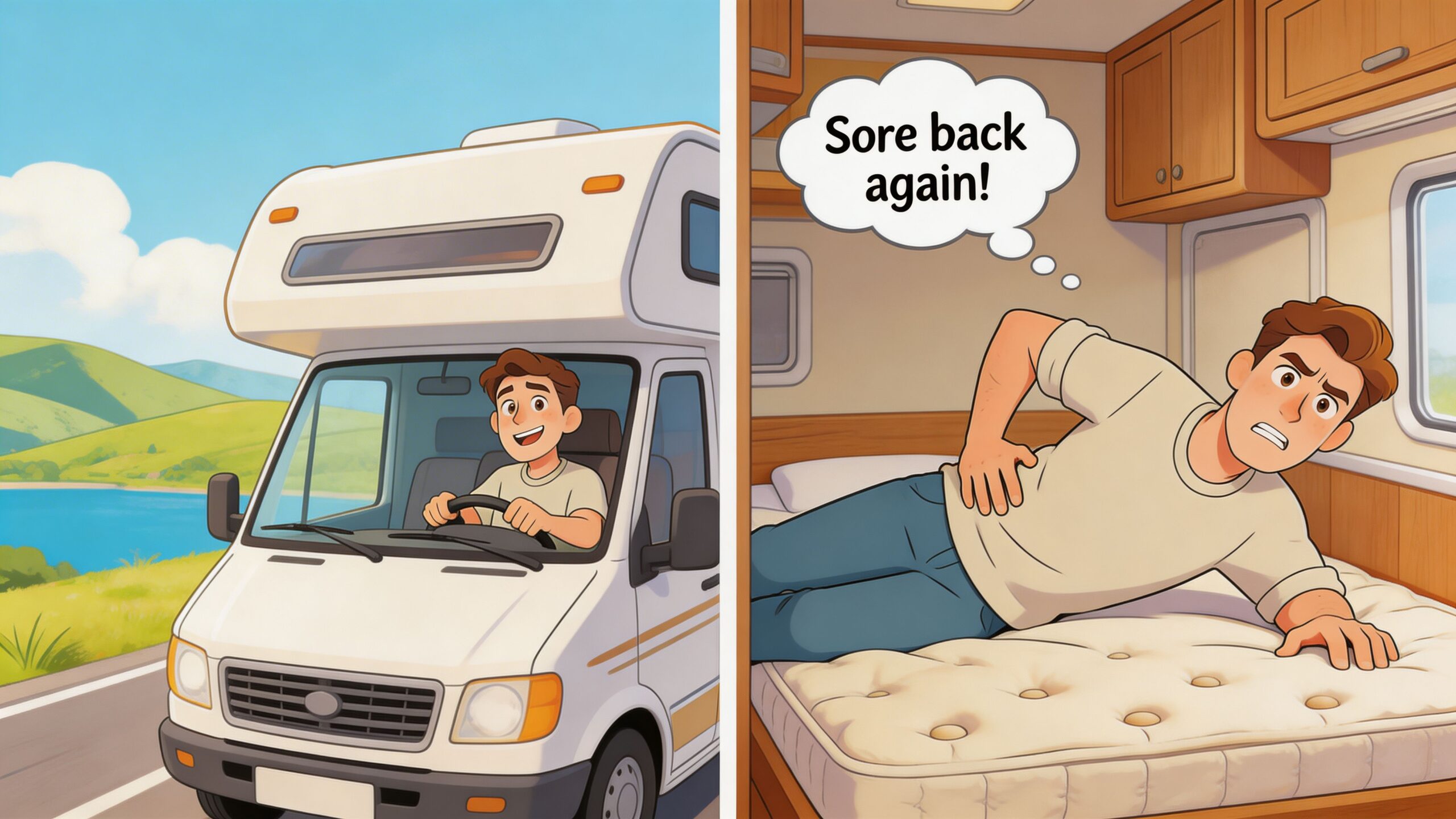
You load up the RV, pack the snacks, map out the campground, and head north feeling good. Then night one hits. The view is great, the campfire was fun, and the mattress feels like a folded gym mat on top of plywood.
We hear that story all the time from folks around Metro Milwaukee. A new camper or motorhome can feel like freedom on wheels, but the factory mattress is often the first thing owners want to replace.
Sleep changes the whole trip. If your hips ache, your back tightens up, or you wake up every time your partner rolls over, that “weekend getaway” starts feeling like work. A better rv bed mattress can turn your RV from a place you crash into a place you rest.
That matters to us because good sleep is home business in Wisconsin. We’ve been helping Milwaukee-area families sleep better since 1928, and after four generations in furniture and mattresses, we’ve learned one simple truth. Comfort on the road still comes down to the same basics as comfort at home. The size has to fit. The build has to last. The support has to suit the sleeper.
If sleep has been the weak link in your RV setup, start with a few practical sleep basics and then come back to your mattress choice. Our guide on how to have a good night sleep is a helpful place to begin.
Your Adventure Deserves Better Sleep
The first surprise for many RV owners is that “queen” does not always mean what they think it means. In a house, mattress sizes are fairly predictable. In an RV, builders shave inches, clip corners, and shorten lengths to make the room work.
That can be confusing at first, but there’s a good reason for it. RV interiors need walking space, storage clearance, and room for slide-outs, cabinetry, or curved walls. The mattress has to work with the coach, not fight it.
The two queen sizes people mix up most
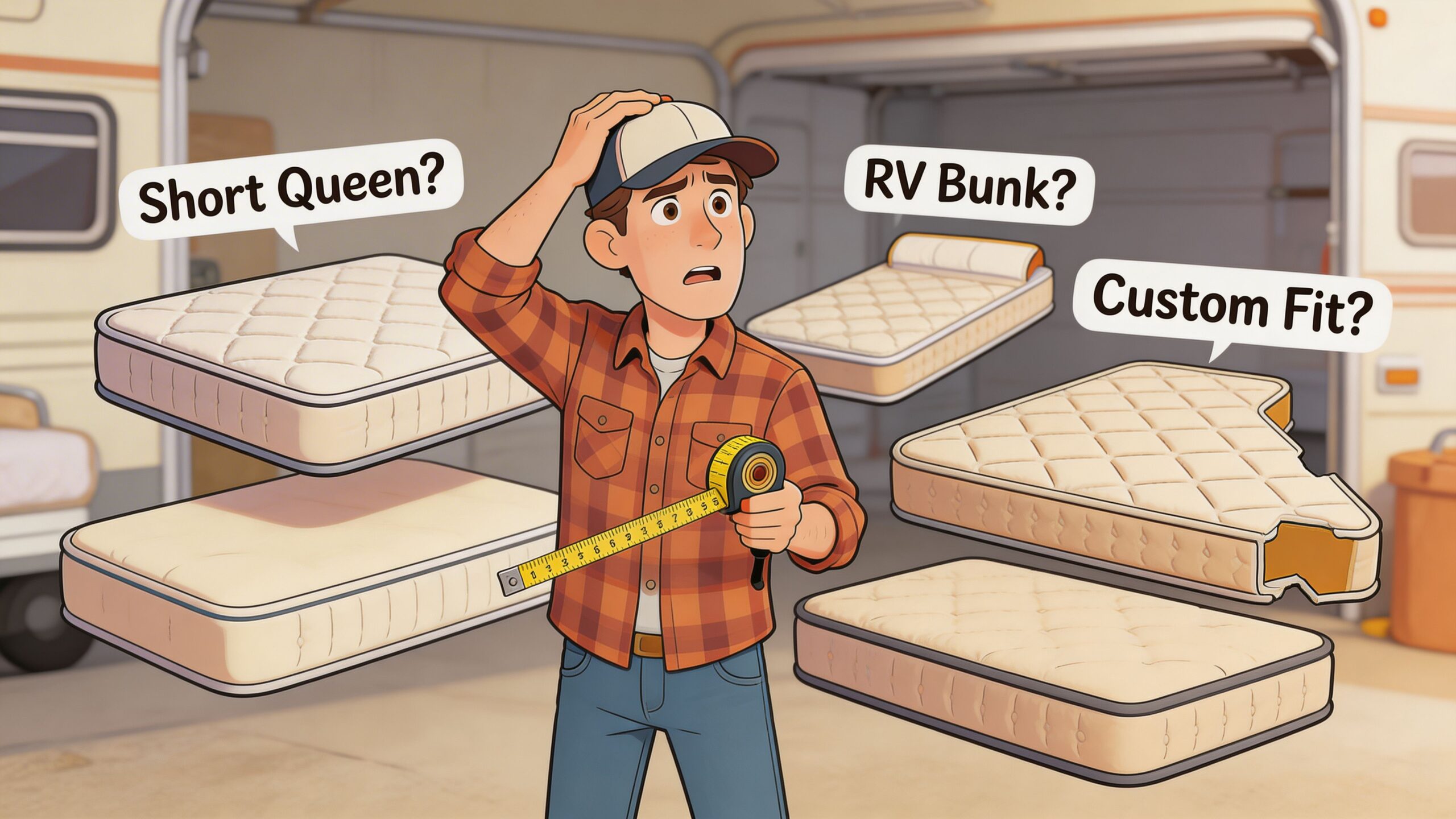
The big one to know is the difference between an RV Queen and an RV Short Queen.
According to this RV mattress size guide from Beloit Mattress, the RV Queen is 60×80 inches and matches a standard queen mattress. It is commonly found in larger motorhomes. The RV Short Queen is 60×75 inches and is more common in standard RVs because it saves 5 inches of floor space while still fitting two adults comfortably.
That missing length is not a mistake. It often creates just enough room to move around the bed without turning sideways like you’re squeezing past a cooler.
Other common RV bed shapes
You may also run into these:
- RV Full or Double: Often found in dimensions similar to residential full or double mattresses, varying in specific width and length depending on the setup. These show up in medium-sized RVs and can work well for solo sleepers.
- RV Twin or bunk sizes: Built narrow for bunks and smaller spaces.
- Corner-cut or radius mattresses: Common in bunks and tight layouts where a square corner would block movement or hit a wall.
A tape measure settles a lot of arguments. If you are not sure what size you have, measure the mattress and the platform before shopping.
Why this matters before you buy
Many people assume they can drop in a mattress from home. Sometimes they can. Often they can’t. Even when the width and length seem close, an RV frame may have rounded corners, side cabinets, or a hinged platform underneath.
If you want a quick refresher on standard residential sizing before comparing it with your RV bed, this mattress size chart makes the differences easier to spot.
The main takeaway is simple. A good rv bed mattress is not just about comfort. It has to fit the room, the frame, and the way you move around inside the coach.
How to Measure Your RV Bed for a Great Fit
A lot of mattress trouble starts with a guess. “It looks like a queen” is how people end up wrestling the wrong bed into a camper doorway.
Measure first. Then measure again.
Start with the platform, not just the old mattress
The old mattress may have compressed, bowed, or shifted over time. Your platform tells you the true space available.
Use a tape measure and write down:
- Width: Measure from side to side at the widest usable point.
- Length: Measure from the head to the foot of the platform.
- Height clearance: Check nearby cabinets, windows, and slide-out areas so a taller mattress does not create a new problem.
If your RV has a tight walkway, also note where your feet land when you step around the bed. That everyday movement matters more than people think.
Watch for corners and wall shapes
Bunk mattresses can be the trickiest. According to Camping World’s RV mattress guide, RV bunk mattresses often range from 28 to 35 inches wide, are about 10 inches narrower than a standard twin, and may include cut-out corners. That design can increase usable floor space by 15 to 20%.
Those corners are not decorative. They are there so the mattress clears a ladder, wall, cabinet, or bedpost.
If you have an odd corner, measure:
- The full width and full length first
- The depth of the cut
- The length of the angled or rounded section
- Which corner is altered when viewed from the foot of the bed
A simple trick for weird shapes
Cardboard helps. Lay a piece over the corner area, trace the shape, and label it clearly. That gives you a physical template you can carry into a showroom.
Label your template with “head,” “foot,” “driver side,” or “passenger side.” That keeps a custom shape from getting mirrored by mistake.
For help with the measuring basics, this guide on how to measure furniture is useful even though your “room” happens to have wheels.
A few mistakes to avoid
- Measuring only the old mattress: It may not reflect the actual frame.
- Ignoring hinge access: Some RV beds lift for storage.
- Forgetting bedding tuck: A tight fit can make sheet changes harder.
- Skipping doorway checks: The new mattress still has to get inside.
Good measuring is not glamorous, but it saves a lot of frustration. In RVs, a close fit is not always a good fit.
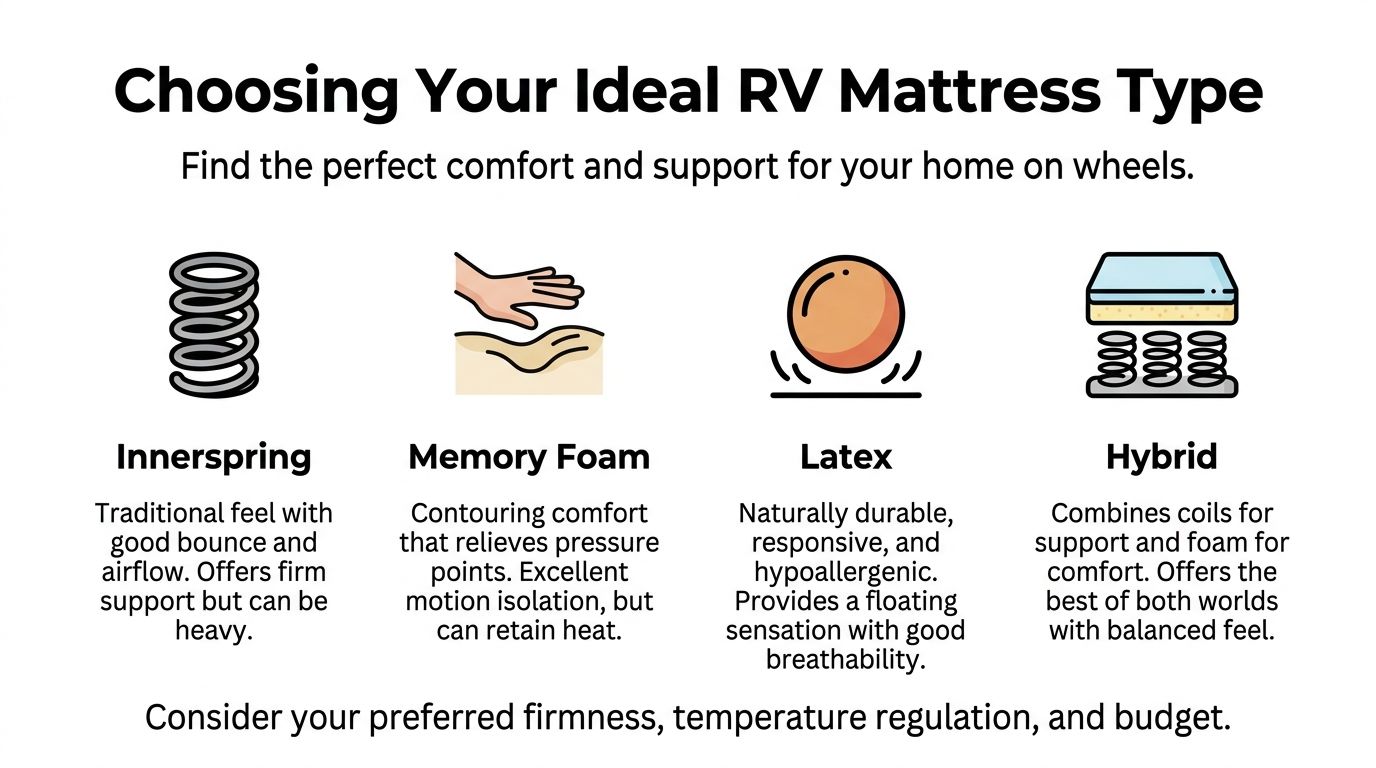
Choosing Your Ideal RV Mattress Type
Once the size is handled, the next question is feel. Shoppers usually ask, “I know what I like at home, but will that work in the RV?”
Sometimes yes. Sometimes the RV changes the answer.
The big tradeoffs in an RV
An RV mattress has to do more than feel nice for five minutes in a showroom. It has to fit a compact space, deal with motion, and stay manageable around cabinetry and platforms.
According to Purple’s RV mattress guide, RV mattress thickness is typically limited to 8 to 11 inches to clear slide-outs and cabinetry. The same guide notes that hybrid mattresses with pocketed coils can minimize motion transfer by 30 to 50% compared to basic foam.
That motion piece matters. In a smaller sleeping space, every movement feels closer.
Comparing the main mattress types
| Mattress type | What it feels like | Why RV owners like it | What to watch |
|---|---|---|---|
| Innerspring | Bouncier, more traditional | Familiar feel and airflow | Can feel less motion-friendly and may be bulky depending on build |
| Memory foam | Close contouring, slower response | Cushions pressure points and packs easily in many designs | Some sleepers find it warmer or harder to move around on |
| Latex | Responsive, buoyant | Durable feel with nice pushback | Availability in RV-specific shapes can vary |
| Hybrid | Balanced support and cushioning | Mixes coil support with foam comfort | Need to confirm the profile works with your RV’s height limits |
Who tends to like what
Some broad patterns help:
- Side sleepers often like more pressure relief around shoulders and hips.
- Back sleepers usually want a more even, steady support feel.
- Combination sleepers often prefer a mattress that is easy to move on.
- Couples may care most about motion control and edge support.
A hybrid often lands in the middle. That’s one reason people ask about them so often. If you want a plain-English breakdown, this article on what is a hybrid mattress explains how the layers work together.
Keep the RV itself in the conversation
Your body is only half the equation. Ask these practical questions too:
Does the mattress need to clear anything
Look at nearby cabinets, windows, bed lifts, and slide mechanisms. A mattress that feels great but blocks storage access can turn into a daily annoyance.
How much motion do you notice
If your partner gets up early, shifts often, or you camp on uneven ground, motion isolation becomes more important.
How easy is it to handle
An RV bedroom is not a wide-open master suite. Tight corners and narrow entries can make installation harder, especially with heavier builds.
The best rv bed mattress is the one that fits your sleeping style and your coach layout at the same time.
A mattress that works beautifully at home may still be the wrong call in an RV if it is too tall, too rigid, or awkward to maneuver. That is why comparing materials through an RV lens helps so much.
Why a Flip-able Mattress is a Smart RV Investment
Most factory RV mattresses are built to be good enough for delivery day. That’s different from being built for years of camping, road vibration, and repeated use in a small space.
That’s where a flip-able mattress earns its keep.
Why one-sided mattresses wear out faster in RV use
In many RVs, you sleep on the same narrow surface in the same position trip after trip. Add motion from travel, changes in humidity, and thin support underneath, and wear can show up fast.
According to this Camping World product page discussing flippable mattress durability, forum users frequently report stock RV mattresses sagging within 1 to 2 years, while industry studies show that rotating a two-sided mattress can extend its comfortable life by 50 to 100%.
That is a major difference in long-term value.
What “flip-able” really gives you
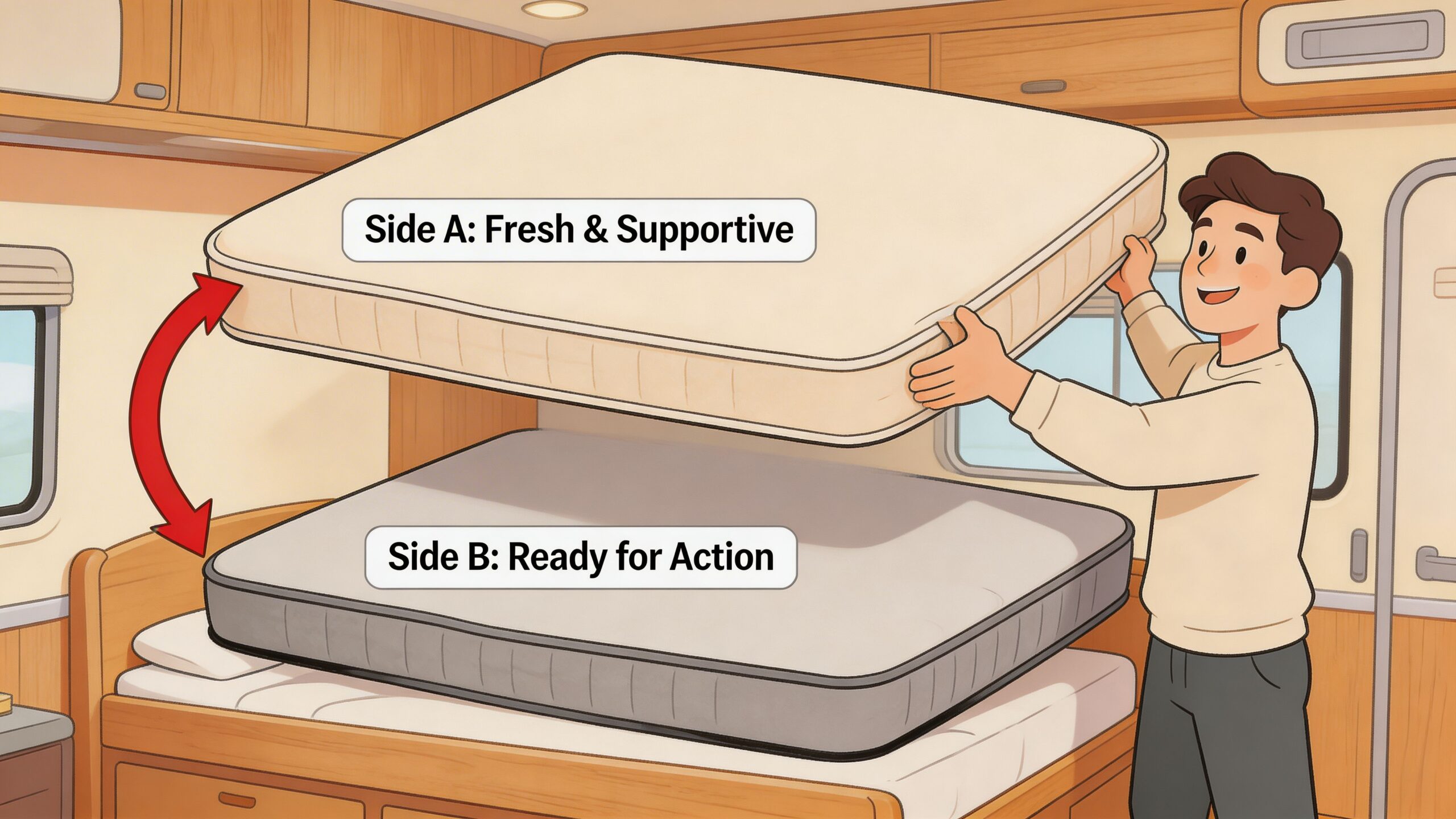
A two-sided mattress gives you more ways to spread out wear. Instead of using the same comfort surface nonstop, you can rotate and flip on a schedule.
That helps with:
- More even wear: Less body impression in one favorite spot
- Longer comfort life: You are using both sleeping surfaces over time
- Better value: Replacement often gets pushed farther down the road
- More consistent support: The mattress stays more balanced trip after trip
Why heavy-duty construction matters in an RV
RV owners often focus on fit first and forget durability. That makes sense because the size puzzle is so odd. But once fit is solved, build quality becomes the bigger story.
A heavier-duty mattress usually feels more stable, especially if the original bed felt flimsy from day one. That does not mean you need the tallest or hardest mattress in the room. It means the mattress should be made to handle repeat use without giving up too early.
If you want a deeper look at why two-sided construction still matters, this guide on the benefits of a two-sided mattress is worth your time.
If you camp often, a cheap mattress is rarely cheap for long. You pay for it in sore mornings, then you pay again when it needs replacing.
For RV living, durability is comfort. They are tied together.
Custom Solutions for Unique RVs and Campers
Some RVs are straightforward. Others have a bed shape that looks like it was designed by a puzzle company.
That is especially true in van conversions, compact campers, older trailers, and bunk setups with curved walls or clipped corners. A standard mattress can come close and still be wrong enough to annoy you every night.
Where standard sizes fall short
The usual trouble spots are easy to recognize once you know them:
- Radius corners that soften one edge of the mattress
- Notches around cabinetry or posts
- Murphy beds that need a certain profile to fold correctly
- Lift platforms where weight and flexibility matter
- Vintage campers with dimensions that do not match modern labels
According to Mattress Insider’s cut-corner RV mattress guide, compact RVs and vanlife models make up 15% of the US market, and the need for custom-sized mattresses with notched or radius corners is growing.
Why DIY cutting is risky
People are handy. Milwaukee folks especially. We respect that.
But DIY foam cutting can get messy fast. If the angle is off, the mattress may gap at the wall or crowd the aisle. Some materials also do not respond well to home trimming, and once you cut, you own the result.
A local specialist can help match the shape, the support level, and the intended use. That matters even more if the sleeper needs easier entry and exit, a more supportive feel, or a mattress for a compact space that still needs daily comfort.
Good custom thinking is not only about shape
Sometimes “custom” means a special corner. Sometimes it means choosing a feel and profile that suits the person using it.
A senior-friendly RV setup, for example, may need:
- A mattress that is easier to get in and out of
- Steadier edge support
- A height that works with the bed base and the sleeper’s mobility
- A shape that clears a tight path to the bathroom at night
The right rv bed mattress can solve more than one problem at once. In a small camper, every inch and every movement count.
Installing and Caring for Your New Mattress
Buying the right mattress is the big decision. Getting it set up well is what helps it stay comfortable.
RV bedrooms are tighter, more humid, and more active than most home bedrooms. A little care goes a long way.
Getting the mattress into place
Before installation day, clear the path from the door to the bed area. Remove sharp objects, open any tight turns, and check whether the bed platform lifts or folds.
When you place the mattress:
- Set the head and foot correctly if the shape is custom.
- Check all clearances around cabinets and bed lifts.
- Make sure the mattress sits flat without bunching at the corners.
- Test daily use right away by opening storage, closing doors, and walking around it.
If the fit is tight, do not force corners down and hope they relax later. A mattress under constant stress can wear unevenly.
Airflow matters more in an RV
Moisture can build underneath any mattress, especially in a compact sleeping area. That can leave the underside feeling damp or stale.
A few simple habits help:
- Lift bedding regularly: Let the surface breathe after sleeping.
- Check under the mattress: Especially after humid nights or long storage periods.
- Use a breathable base if possible: Solid platforms can trap more moisture.
- Avoid sealing in dampness: Do not make the bed tightly if everything still feels clammy.
If your RV has been closed up for a while, give the sleeping area fresh air before a trip. Your mattress will thank you.
Protecting it from everyday camping life
Campgrounds are fun, but they are not spotless. Dirt, sunscreen, bug spray, wet swimsuits, and snack crumbs all somehow end up where you sleep.
Use a mattress protector that fits the mattress shape well. Vacuum the surface now and then, spot-clean spills quickly, and follow the maker’s care guidance. If you have a two-sided mattress, keep a simple flip and rotation calendar so you remember to do it.
You do not need a complicated system. Just a few steady habits.
Visit Us for the Best RV Mattress in Milwaukee
A good RV trip starts in daylight, but it gets judged the next morning. If you slept well, everything feels easier. Coffee tastes better. The drive feels shorter. The campground looks nicer.
That is why choosing the right rv bed mattress is worth doing carefully.
Why seeing mattresses in person still matters
Mattresses are personal. Two people can lie on the same bed and have two completely different opinions.
That is one reason some local stores still believe in showrooms. You can try the feel, compare builds, ask questions, and talk through the odd details of your RV layout with someone who has helped other shoppers do the same thing.
What makes local guidance helpful
When you visit a family-run showroom, you can bring the measurements, the corner template, even photos of the bed platform. That changes the conversation from “What size do you think?” to “Let’s solve this.”
At BILTRITE in Greenfield, we’re proud of doing exactly that. We’ve served Metro Milwaukee since 1928, and our team brings centuries of combined experience to the showroom. We also carry a wide selection of mattress models and specialize in USA-made, Amish-made, heavy-duty, small-scale, and flip-able options that fit real-life needs.
Why we keep it personal
We do not sell online, and that is intentional. We want people to lie down, compare, ask, laugh a little, and leave feeling informed instead of rushed. We are also closed on Sundays and Mondays because family time matters to us.
If your RV mattress has been the weak spot in your camping setup, bring your notes and stop by our Greenfield showroom. We’d love to help you sort out the size, shape, comfort, and durability questions face to face.
Frequently Asked Questions About RV Mattresses
A few questions come up again and again when folks start shopping for an RV mattress. Here are the short answers we give most often.
Can I use a regular mattress from home in my RV
Sometimes, yes. Often, no.
The main issue is not just the label on the mattress. It is whether the dimensions, profile, and shape work with your RV frame and clearances. A home mattress may be too long, too tall, or too square at the corners.
If your RV happens to take a residential queen, great. If not, forcing a home mattress into the space usually creates a daily headache.
Is a mattress topper a good fix
A topper can help if the current mattress is only a little too firm or if you need a short-term comfort boost.
It is less helpful when the mattress underneath is sagging, unsupportive, or the wrong shape. In those cases, the topper can feel like putting fresh paint on a dented fender. Better than before, maybe, but not a real solution.
How do I stop condensation under the mattress
Start with airflow. Lift the bedding in the morning, check under the mattress now and then, and avoid trapping moisture after a damp night.
If the RV sits closed up for long stretches, air it out before and during trips when you can. Keeping the sleeping area dry and ventilated is one of the simplest ways to protect the mattress and keep it feeling fresh.
Are custom RV mattresses worth it
They are when the shape is unusual or the standard size leaves awkward gaps. A well-fit mattress makes the whole sleeping area easier to use.
This is especially true in bunks, van builds, older campers, and spaces with rounded or notched corners.
Does a two-sided mattress really make a difference
For many campers, yes. Being able to flip and rotate the mattress helps spread out wear, which is useful in RVs where the same sleep positions and support points get used over and over.
That can mean better long-term comfort and fewer complaints a year or two down the road.
If you’re ready to upgrade your RV sleep setup, visit BILTRITE Furniture-Leather-Mattresses in Greenfield. We’re a fourth-generation, family-owned Milwaukee-area showroom serving local families since 1928, and we’d love to help you find a durable, comfortable mattress that fits your RV and your sleep style. Come say hi, bring your measurements, and let our experienced team help you rest easier on the road.