Black Metal Bed Frame Twin: Sizes, Styles and Buying Tips

Does a black metal label mean a twin frame is sturdy, safe, and kinder to the air in the room? It doesn't. A black metal bed frame twin is a system: the frame, the foundation under the mattress, the room it has to enter, and the safety details you can verify yourself. Metal can be a smart, compact choice. The label alone doesn't prove the joints, the support, or the finish.
Table of Contents
- Twin Frame Dimensions and Mattress Fit Chart
- Black Metal Twin Frame Styles and the Rooms They Suit
- Sturdiness and Safety Checks for Standard and Bunk Use
- Matching Your Mattress and Foundation to the Frame
- Finish, Materials and Indoor Air Questions to Ask
- How to Assemble and Deliver Your Twin Frame
- Choose In-Stock or Custom at Our Greenfield Showroom
Twin Frame Dimensions and Mattress Fit Chart
A standard twin mattress measures 38 by 75 inches, about 97 by 191 centimeters. A Twin XL is the same width and typically 5 inches longer, so plan on 38 by 80 inches and bedding cut for that length. Some references list twin width as 39 inches because tolerances and older standards vary, so measure the mattress you already own before you trust a catalog name. Those footprints come from widely used U.S. bed-size references.
Before a 1922 Bureau of Standards conference, mattresses reportedly ran from 6 feet to 6 feet 5 inches long and from 3 feet to 4 feet 6 inches wide, with plenty of odd sizes mixed in. That conference set four standard widths and a common 73-inch length, and the 3-foot-3-inch width became the twin. By the early to mid twentieth century, spring production settled the everyday twin near 38 by 75 inches. That's why a current twin frame usually takes stock sheets, protectors, and replacement mattresses instead of a custom order. Our twin size bed measurements page is a handy companion when you're comparing those numbers at home.
| Item | Dimension | What to check |
|---|---|---|
| Standard twin mattress | 38 x 75 in (about 97 x 191 cm) | Frame interior opening should match this footprint |
| Twin XL mattress | 38 x 80 in (typically 5 in longer) | Only pair with a frame and bedding made for this length |
| Frame exterior | Several inches larger than the mattress | Compare with room size, doorway width and bedside clearance |
| Platform or slat height | Set by the frame design, not by the mattress name | Sets bed height, bedside reach and under-bed storage room |
| Bunk-style height | Foundation above 30 in | Triggers federal bunk-bed rules, covered in the safety section |
The interior opening matters more than the outside silhouette. Too tight, and the rails squeeze the mattress edge so it won't drop in cleanly. Too loose, and the mattress shifts, rubs, and ticks every time someone turns over.
Rails, legs, and headboard posts push the exterior several inches past the mattress. Measure the floor, the doorway, and the path around the bed, not just the sleeping surface.
Practical rule: Measure the mattress, read the frame's interior opening, then mark the floor with a few spare inches on each side so you can still make the bed.
Black Metal Twin Frame Styles and the Rooms They Suit
Picking a frame style is a lot like picking a picture frame. The bed is the picture, and the metal has to suit the wall, the light, and how often you'll dust it.
Ornate scrolled wrought iron with tall headboard bars fits cottage, farmhouse, and traditional bedrooms. The scrolls look rich, and they also catch dust, so a weekly wipe beats a once-a-year deep clean. Keep a tall headboard against a stable wall so it isn't the first thing a shoulder bumps.
Slim tubular steel with curved, rounded rails reads mid-century and a little retro. The bends are easier on shins in a narrow room, and the lighter look won't crowd a small wall. You'll still want enough clearance that the curve doesn't clip a nightstand.
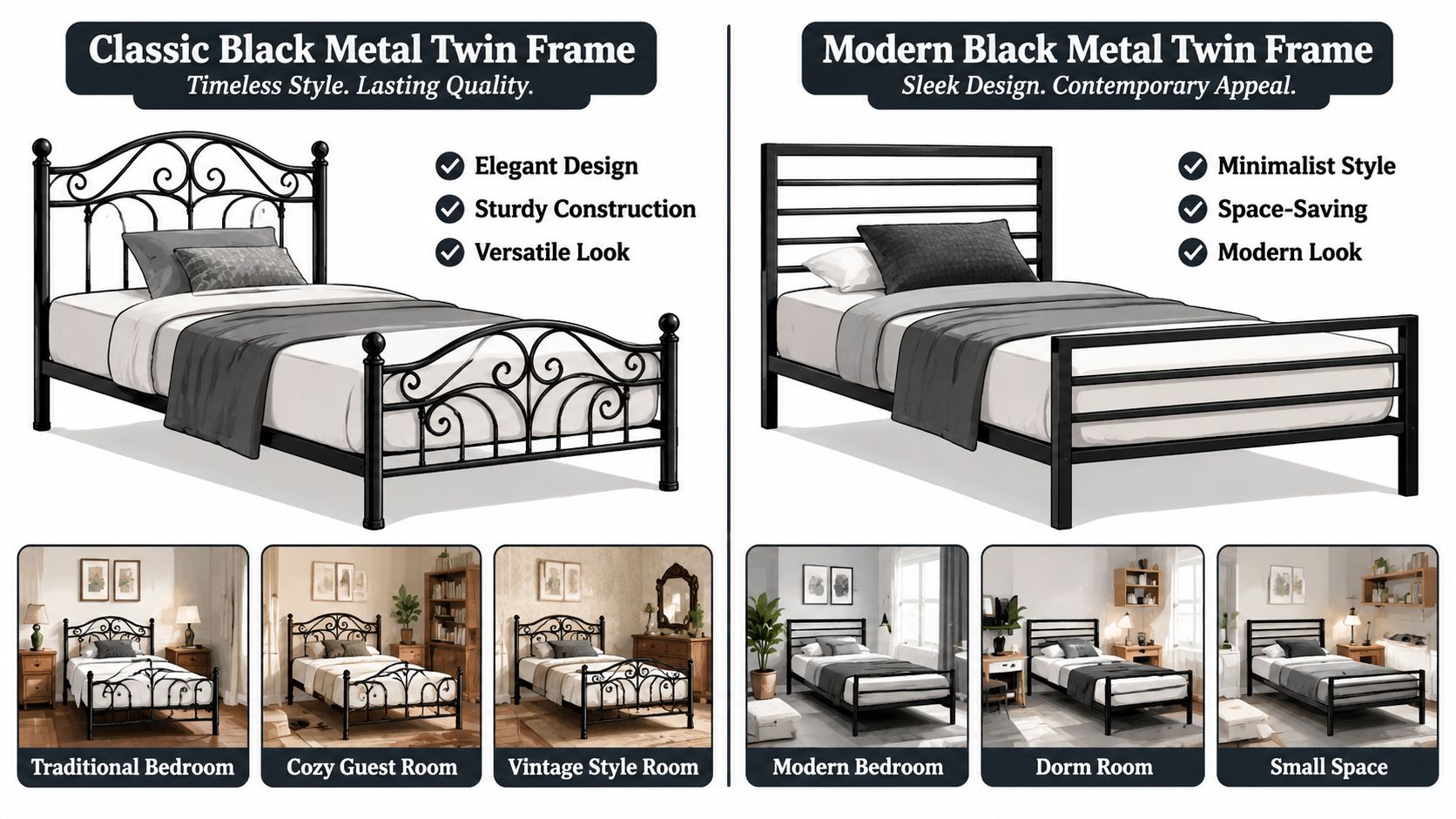
A straight-lined modern platform with flat steel panels suits contemporary bedrooms and small apartments. The geometry is calm, and fingerprints show on plain black panels, so a soft cloth lives nearby. This is the style that disappears into a studio and leaves the bedding to do the talking.
Mixed frames pair metal rails with a wood headboard. Warm wood and cool metal meet in transitional rooms, which is a nice bridge if the rest of the house isn't all one mood. Ask whether that wood is solid, plywood, or particleboard before you fall for the photo.
Black is a surface finish, not a metal type. The frame may be steel, wrought iron, cast iron, or a mix, so ask what the metal is. If you're sorting styles before you visit, our guide to types of beds lays out how headboards, platforms, and rails change the room.
A compact twin earns its keep in children's rooms, guest rooms, studio apartments, and dorm-style spaces. Every inch along the wall is doing a job.
Sturdiness and Safety Checks for Standard and Bunk Use
Metal does not equal sturdy, and it does not equal safe. Two black frames can look alike and behave nothing alike once someone sits on the edge every morning.
What a weight rating really covers
A posted capacity should cover the mattress, the bedding, and everyone who sleeps or sits there. One 2025 retail listing put a black metal twin platform at 74.5 inches long, 37.5 inches wide, and 18 inches high, with a stated 2,000-pound capacity, according to that product listing. Read a number like that as a ceiling the maker tested under set conditions, not a promise that the deck won't rattle or that every bolt will stay snug in your house.
Real stability comes from a center support under the long span, slats close enough that the mattress can't sag between them (or a solid deck), sound welds, joint design that doesn't rely on one skinny fastener, and enough bolts to share the load. Heavier sleepers, active kids, and anyone who gets in and out often need extra margin. If the listing won't say where the center leg sits, the big number isn't much help. Our notes on the strongest bed frame traits are worth a look before you trust a finish photo.
Everyday checks on a standard twin
Federal bunk rules are not automatic on an ordinary low twin. These checks still are:
- Edges and welds: Run a hand (carefully) along rails and corners. Sharp edges and rough welds snag sheets and skin.
- Headboard gap: Measure the space between mattress and headboard. If the mattress can slide into that slot, it will.
- Center support: Confirm the slats or platform rest on that middle leg, not just hover near it.
- Rock test: Set the frame on the floor where it will sit. Uneven boards and thick carpet both make a square frame wobble.
- Wall clearance: Leave room so the headboard doesn't knock the wall every time someone sits up.
- Fasteners: Retighten bolts after the first week, then every few months. Vibration walks hardware loose.
Young children, seniors, and active sleepers need that extra pass. Use only the mattress thickness the maker recommends. A thicker replacement changes how the edge meets the rail, and on a bunk it changes guardrail height.
A durable-looking steel frame can still be a poor choice if the support, the edge treatment, or the way it holds the mattress is undocumented.
When bunk rules kick in
Those federal rules apply when the frame is built as a bunk, or when the underside of the foundation sits more than 30 inches above the floor. A lower bunk doesn't need guardrails when its foundation is 30 inches or less above the floor.
The U.S. Consumer Product Safety Commission bunk bed guidance requires at least two upper guardrails, one on each side. The wall-side rail should run continuously from one end to the other. On the open side, the opening between the guardrail and an end structure can't exceed 15 inches. Guardrails must extend at least 5 inches above the top of the mattress.
Decorative metal geometry isn't a safety test. Openings that look pretty can still be entrapment gaps, which is why the CPSC uses wedge and sphere checks rather than a style opinion. A thicker mattress lowers the guardrail's effective height and can take a bunk out of compliance.
Ask for the rated capacity in writing, and ask someone to show you where the center support sits before the frame leaves the floor.
Matching Your Mattress and Foundation to the Frame
The frame only does its job with the stack on top. The 38 by 75 inch footprint is the starting point, and the slat system plus the mattress warranty determine the actual fit. Foam mattresses often have stricter slat-spacing rules than innerspring designs, so check both before you buy. A frame that's too tight compresses the edge. One that's too loose lets the mattress walk, as mattress foundation sizing guidance points out when it treats nominal size as a starting point, not a guarantee.
| Mattress or foundation | Works on a black metal twin frame? | Check before you buy |
|---|---|---|
| Foam mattress on slats | Yes, when slats are spaced as the manufacturer requires | Slat gaps and warranty limits, which can be stricter than for innerspring |
| Innerspring mattress on slats or platform | Yes, usually | Firm, even support so springs do not sag between slats |
| Hybrid mattress | Yes, if the foundation meets its requirements | Follow whichever spacing rule is stricter |
| Box spring foundation | Yes, when its width and length match the frame | Added height changes bedside reach |
| Platform with no box spring | Yes, with a solid or closely spaced deck | Deck gaps and center support |
| Pillow-top or very thick mattress | Yes, with extra height | Total bed height, and bunk guardrail rules if used as a bunk |
Foam on wide slats is the combo that fails without warning. The mattress looks fine on day one, then a valley shows up between slats and the warranty won't cover it. Innerspring models usually tolerate a bit more gap, and they still need a firm, even deck so the springs aren't bridging open air. Hybrids should follow the stricter of the two spacing rules, not the friendlier one.
A box spring adds height, so add its depth to the mattress thickness before you pick side-rail height. A platform with no box spring wants a solid panel or closely spaced slats, which is the idea behind a platform bed frame.
- Confirm the size name. It should be a standard twin, not a Twin XL, unless the frame was built for that extra length.
- Match slat spacing to the warranty. If the paperwork wants a maximum gap, the frame has to meet it, not the other way around.
- Add the heights. Frame plus foundation plus mattress should land near your nightstand and at a comfortable edge height for the person getting in and out.
Our mattress department carries over 60 models, and our sales associates, with over 400 years of combined experience, are glad to set a mattress on a frame and see whether the edge, the height, and the support actually agree.
Finish, Materials and Indoor Air Questions to Ask
Product pages love the word durable and rarely say what the black coating is, or whether it can smell after you open the box. That's the gap.
The EPA identifies pressed-wood products made with urea-formaldehyde adhesives as likely major household formaldehyde sources. Federal emission standards for common pressed-wood articles set limits of 0.05 parts per million for hardwood plywood, 0.09 for particleboard, and 0.11 for medium-density fiberboard, as explained in the EPA's guide to formaldehyde and indoor air quality.
A metal frame doesn't prove itself chemical-free. Paint, powder coating, packaging adhesives, and any upholstered panel can still need a straight answer. Treat the listing like a food label. The word on the front isn't the ingredient list.
- Coating: Is it powder coat or paint, and who can describe the cure?
- Low-VOC claims: Is there documentation, or only a phrase on the tag?
- Wood parts: Which pieces are solid wood, plywood, or particleboard?
- After delivery: What ventilation does the maker recommend before you dress the bed?
Unpack in a room you can air out, and let the frame sit before sheets go on. A metal twin may mean less pressed-wood adhesive than a composite-wood bed. It isn't automatically the cleaner choice without finish and component paperwork. Our team can tell you which parts are real solid wood, which is the comparison that actually helps.
If the listing won't name the coating or the wood, you don't have a materials story yet. You have a color.
How to Assemble and Deliver Your Twin Frame
Delivery questions come before the Allen key. A frame that won't turn the stair landing isn't a bedroom problem yet. It's a hallway problem.
Measure doorways, hallway turns, and stairwells, and write down the tightest point. Ask whether the frame arrives in one piece or in sections, and which delivery options apply to the piece you want. Confirm any details before you plan the move, especially if stairs or a narrow entry are part of the path. Our walk-through on assembling a bed frame pairs well with that measuring pass.
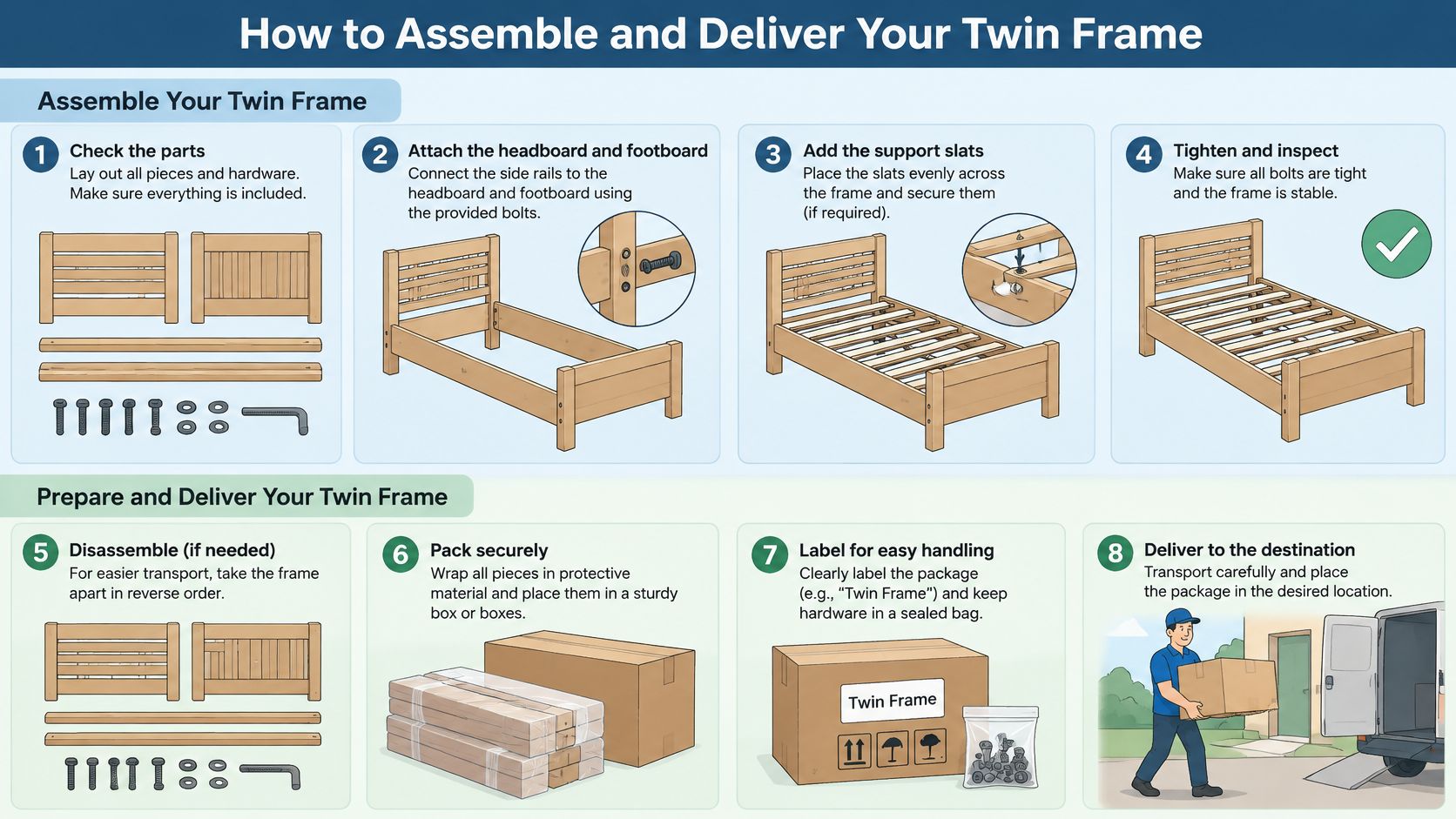
Build it where it will stay. Dragging a half-built metal frame through a doorway is how rails get twisted.
- Unpack and count. Open the cartons in the bedroom and match every part to the list before a single bolt goes in.
- Join the big pieces loosely. Lay out the side rails and headboard, then start the bolts by hand so the holes can still shift.
- Add support. Attach the center support, then the slats or platform, so the span is held before you lock everything down.
- Tighten in a cross pattern. Snug opposite corners, then make one even final pass. Forcing one corner first pulls the frame out of square.
- Set the mattress. It should sit centered, with no rail biting an edge and no wide gap that lets it creep.
- Listen once. If a joint squeaks, a small felt or rubber pad at the metal contact point usually quiets it. Keep the instructions and spare hardware. You'll want both if you ever move.
Choose In-Stock or Custom at Our Greenfield Showroom
We've been family-owned and operated since 1928, and we're proud to serve Metro Milwaukee from our Greenfield showroom. We don't sell online, so the showroom is where you see the finish, rock the frame, and ask the questions a photo can't answer. We're not the cheapest shop on the block. We aim for affordable, better-quality furniture, with a strong lean toward USA-made, Amish-made, and real solid wood when that's the right material for the piece.
In-stock frames come from what is on the floor. You can measure the exact piece, check the welds, and take it home without waiting on a mystery carton.
Custom options let you choose fabric, leather, wood, finish, and hardware when you need a specific look or size. That's the path when a stock twin is close but the headboard, the wood, or the hardware isn't quite right. Small-scale pieces for apartments sit alongside heavy-duty options for families, so a twin doesn't have to be an afterthought.
Bring the mattress measurements, the room and doorway sizes, who will sleep there, and any safety worries. Then ask for the rated capacity in writing, where the center support sits, the mattress thickness limit, whether the bed is a bunk or a standard twin, and what documentation exists for the coating and any wood parts.
Our associates are here to help, not to pressure. We're closed on Sundays, and on Mondays too, so our families get that time. If mobility seating is also on the list, Wisconsin exempts power lift recliners from sales tax, which makes that kind of help a little easier to budget. Come on down, test the comfort, and ask us anything. No speech required.
At BILTRITE Furniture-Leather-Mattresses you can compare a black metal twin with solid wood and USA-made bedroom pieces, then match it to a mattress from a department with over 60 models. Bring your room measurements and we'll walk the fit, the support, and the finish with you, no pressure and no online checkout. Visit BILTRITE Furniture-Leather-Mattresses in Greenfield and see the frame in person.