Leather Barrel Swivel Chair Guide: Size, Leather, Comfort


A rounded leather chair catches a shopper's eye across the showroom. It looks cozy enough for an evening with a book, but there's a practical question before anyone gets comfortable: does it turn, and would it clear the end table at home?
That's the appeal, and the catch, of a leather barrel swivel chair. The right choice can connect a conversation area with a window view, but choosing well takes more than liking the color. Room measurements, seat fit, leather finish and the mechanism underneath all deserve a closer look.
Table of Contents
- What a Leather Barrel Swivel Chair Really Is
- Sizes and Prices at a Glance
- Measuring the Room for a Full Turn
- Seat Height and Comfort for Daily Sitting
- Leather Finishes and How to Care for Each
- Swivel Strength, Heavy-Duty Ratings and Senior-Friendly Picks
- Which Households Suit Genuine Leather
- Test the Chair in Our Greenfield Showroom
What a Leather Barrel Swivel Chair Really Is
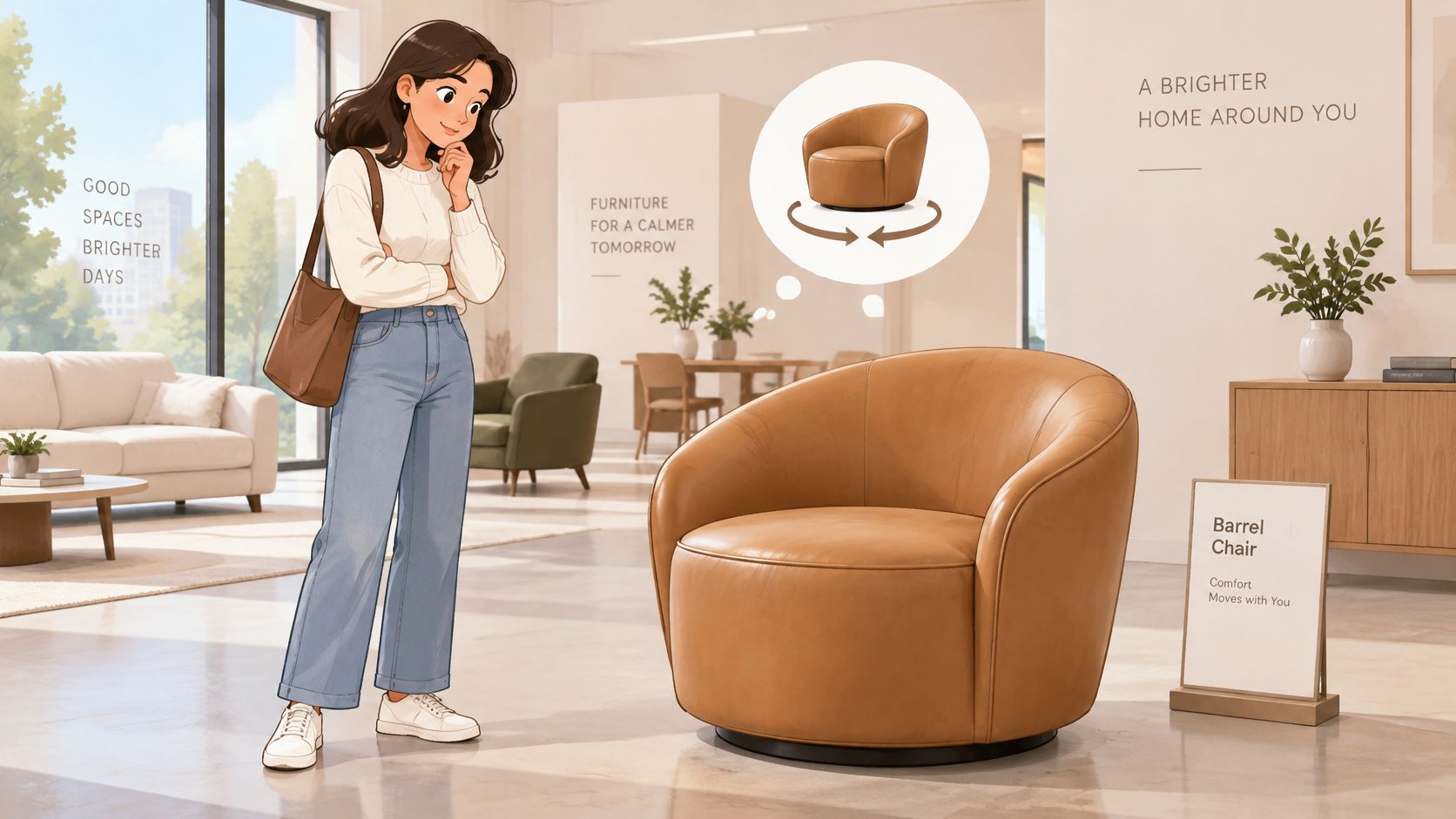
A leather barrel swivel chair pairs a rounded, wrap-around back and arms with a leather covering and a rotating base. The curved shell gives the chair its enclosed profile, while the base determines whether it turns.
The Parts Behind the Shape
The back and arms curve around the sitter, creating a more enclosed feel than an open-sided armchair. Inside that shell, cushion firmness, seat depth and the angle of the back shape the sitting experience. A supportive cushion and a relaxed lounge cushion can feel quite different in the same style of chair.
The base supplies the rotation. Some bases sit mostly out of view, so a pedestal shape alone does not confirm that a chair swivels. Check the product details, then rotate the chair in person to see whether it turns smoothly and stays steady. BILTRITE's swivel and accent chair information covers these seating categories, but the motion can vary by model.
An Established Shape With a Separate Mechanical History
The rounded barrel form has roots in early twentieth-century modern design, including the chair documented by the Vitra Design Museum. For buyers, the practical point is to assess the chair in front of them: upholstery and base construction are separate features, even when they appear together in one familiar silhouette.
The Historical Society of Montgomery County reports that swivel seating is believed to date to the eighteenth century and became widely produced in the late nineteenth century, when cast-iron mechanisms could support a sitter during rotation. Its account also documents leather paired with swivel seating during that later period.
On the showroom floor, focus on three details:
- Shape: Does the curved enclosure support the sitter without crowding the shoulders?
- Leather finish: Does the surface suit the household's habits?
- Swivel base: Does the chair rotate smoothly and feel stable?
A fixed pedestal may look similar at a glance. Confirm the movement before choosing.
Sizes and Prices at a Glance
A chair's exterior dimensions show how much floor space its body occupies, while the seat dimensions show how much room the sitter gets. Compare both before judging whether a barrel chair will fit your space or feel comfortable.
Reading Beyond the Outside Dimensions
Overall width and depth describe the chair's stationary footprint. A curved back and thick arms can leave a narrower seat than the outside measurements suggest, so check interior seat width and depth as well. The available seat space matters more than exterior width alone when comparing how roomy two chairs feel.
Seat height is a separate comfort measurement. It helps you assess how the chair may feel to sit in, while overall height describes its visual scale. Confirm the measurements for the specific chair rather than assuming that chairs with a similar barrel shape share the same proportions.
- Overall size: Use height to judge visual scale and width and depth to assess the chair's footprint.
- Interior seat width and depth: Check the usable space between the arms and from the front of the seat to the back.
- Seat height: Compare this measurement with the seating that will be near the chair.
- Price: Confirm the upholstery, quantity and configuration included before comparing total cost.
There is no single price or size range here that applies to every leather barrel swivel chair. Construction, leather, cushion design and base hardware can vary, so a price by itself cannot establish comfort or quality. Ask for the model's dimensions and specifications alongside its price.
Shopping shortcut: Complete measurements make it easier to judge fit before focusing on price.
BILTRITE carries American-made and Amish-made furniture, including solid wood pieces. Those craftsmanship categories do not specify a leather chair's dimensions or construction, so ask about the particular model's measurements, materials and price.
Measuring the Room for a Full Turn
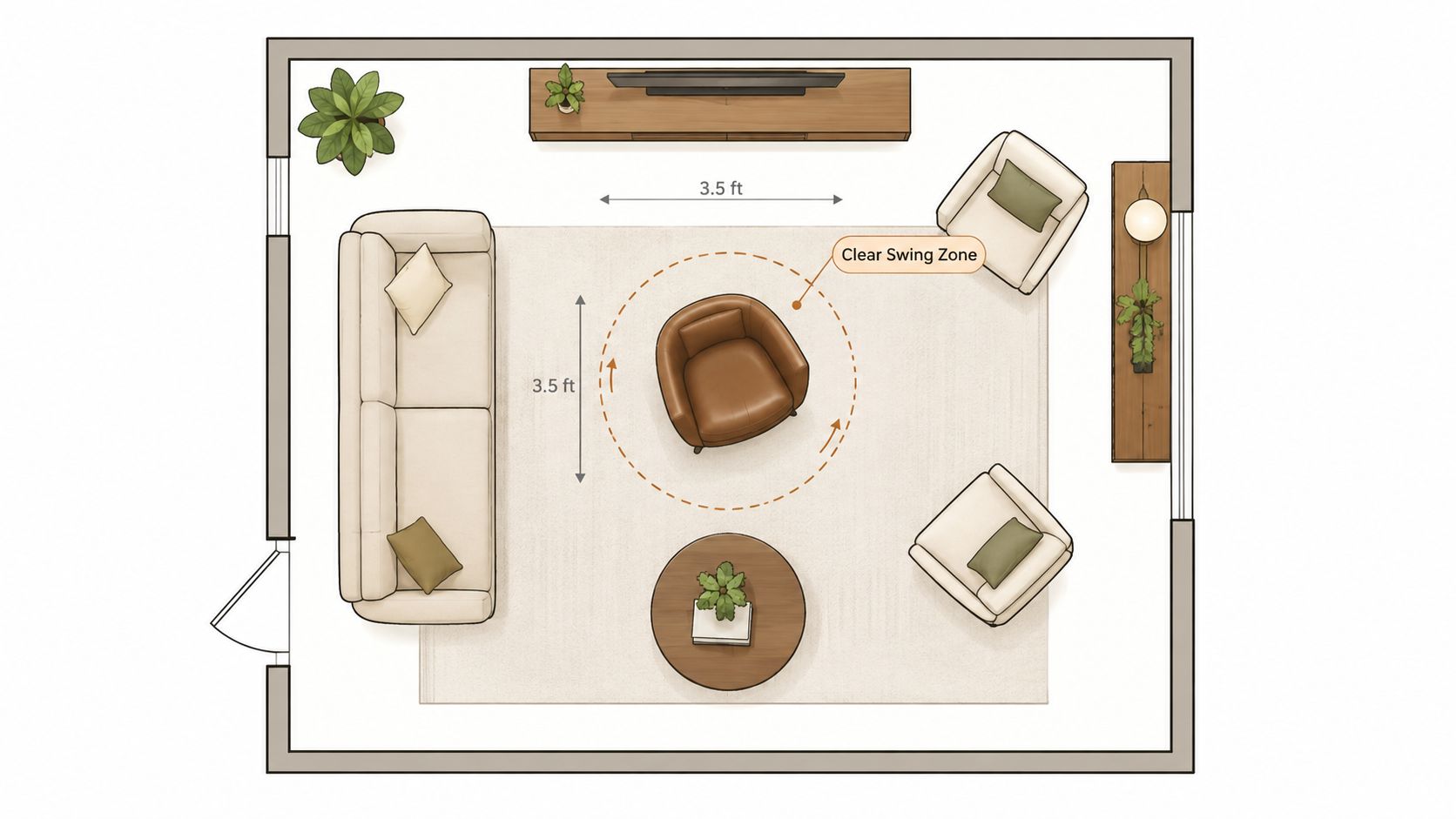
A swivel chair needs room to sweep a circle. Its stationary footprint is only the starting measurement, much like a revolving door needs clear space around its moving panels.
For preliminary planning, allow a clear circle about 36 to 40 inches across, with roughly 10 to 12 inches of clearance from nearby walls, tables and lamps. These are planning guidelines, not a guarantee for every chair: the actual chair's outermost moving edge must clear every obstacle throughout its turn.
A Tape Measure and Painter's Tape Test
- Record the chair's dimensions. Write down overall width and depth, including any part that extends beyond the base. Ask whether the base is centered, because the chair's sweep may not match a simple circle drawn around its cushion.
- Measure the delivery route. Check the clear doorway opening with the door in place, then hallway pinch points, elevator openings and stair turns. Handrails, low ceilings and landings can stop a delivery even when the entrance is wide enough.
- Mark the proposed turning area. Use painter's tape to outline a circle on the floor. Keep the tape suitable for the floor finish, and leave surrounding furniture in its normal position.
- Rehearse everyday use. Sit in a nearby chair and imagine turning toward the sofa, window and television. Check the lamp base, end-table corner, curtain and anything a seated person might reach.
- Check the usable interior. Measure between the arms rather than treating the outside width as seating space. A chair can fit the room and still feel too narrow for its main user.
BILTRITE's furniture measuring guide can help organize those measurements before a showroom visit.
When a Swivel Doesn't Save Space
A swivel helps only where open floor already exists. In a tight corner, a visually compact but deep chair may interrupt circulation more than a slimmer stationary chair.
A chair that turns freely but blocks the route to the sofa still doesn't fit the room.
For apartments, condos and senior living spaces, preserve the walking route first. Ask about delivery orientation, packaging and any approved removable components before ordering. Never assume an upholstered barrel chair comes apart just because other furniture does.
Seat Height and Comfort for Daily Sitting
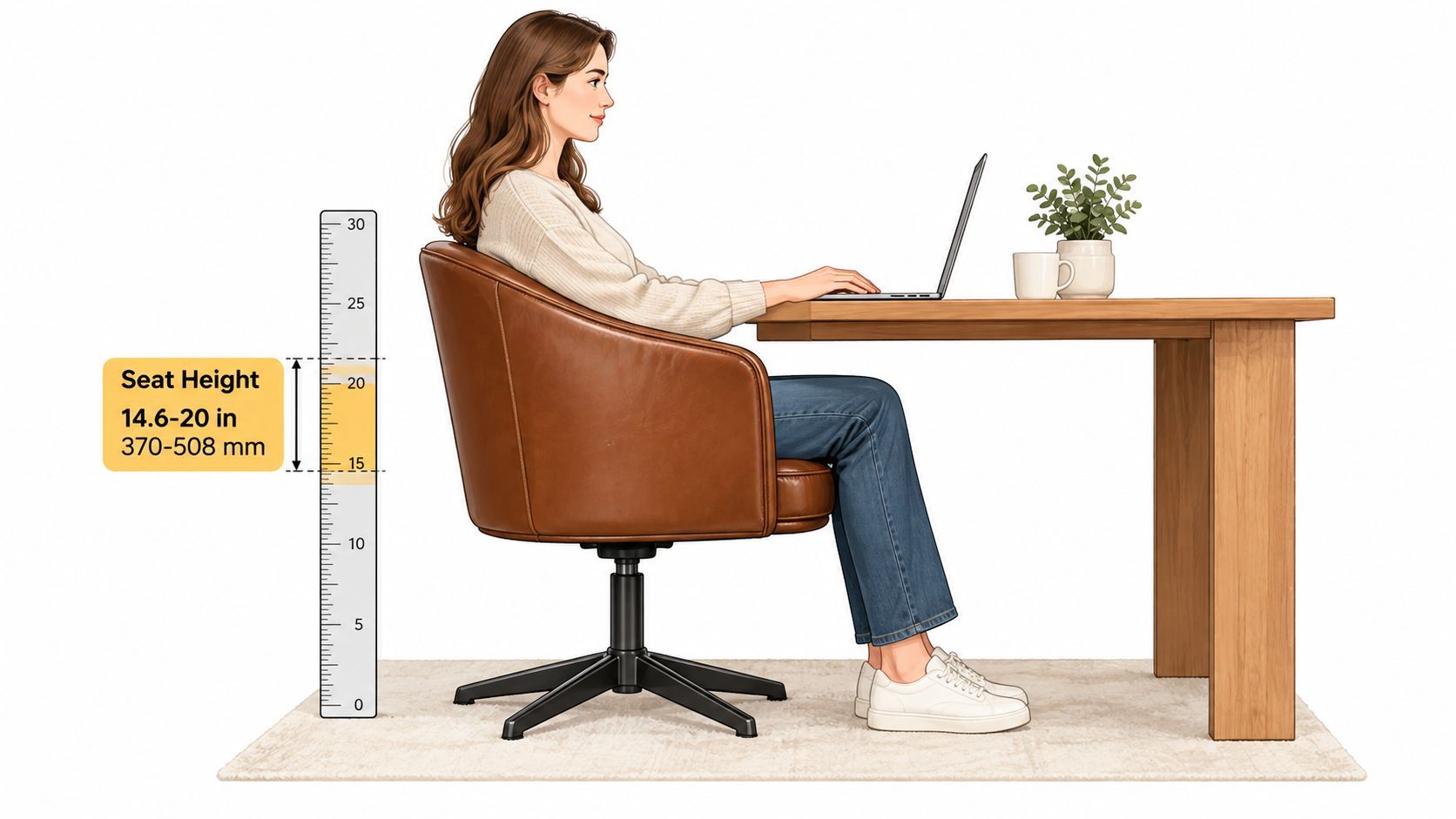
Fit matters more than a handsome silhouette. For desk or table use, BIFMA's computer-use ergonomics guidance identifies a seat-height range of approximately 370–508 mm (14.6–20.0 inches), with feet supported by the floor or a footrest and a torso-to-thigh angle of at least 90 degrees.
That range is a reference for computer-use seating, not a promise that every lounge chair within it will fit every person. Body proportions and cushion compression still matter.
What Poor Fit Feels Like
A seat that's too high can press against the backs of the thighs while leaving feet dangling. A seat that's too low closes the hips and knees more sharply and can make standing harder.
Depth creates another problem. If a shorter sitter must slide forward to bend the knees comfortably, the backrest stops providing useful support. Adding a loose pillow may change the feel, but it doesn't automatically correct the chair's overall fit.
Before shopping, gather these measurements:
- Table or desk height: Include the underside and any apron that limits thigh clearance.
- Floor-to-knee height: Measure with the sitter's usual indoor footwear.
- Occupied seat height: Assess the cushion while someone sits on it, because leather and foam settle under weight.
Match the Chair to the Job
In a shared household, prioritize the people who will use the chair most. Each should be able to sit back, rest the feet and turn without wrenching the torso against a reluctant mechanism.
For older adults, the standing test matters as much as the sitting test. Check whether the arms provide a comfortable hand position and whether the sitter can rise without struggling out of a soft pocket.
For long computer sessions, an adjustable task chair with appropriate back support is the better benchmark. A leather barrel swivel chair is primarily a lounge choice, even when it looks attractive beside a desk.
Leather Finishes and How to Care for Each
Leather finishes compared by feel, stain tolerance and care
| Finish | What it feels like | Stain and fade tolerance | Care approach |
|---|---|---|---|
| Protected (pigmented) | Smooth and even in color | High relative tolerance; not sunproof | Wipe with a cleaner made for that finish |
| Corrected-grain | Uniform, sanded surface | High when protected by a suitable finish | Dust and wipe with a mild cleaner made for that finish |
| Semi-aniline | Soft, with visible natural grain | Moderate | Use a gentle cleaner, testing it on a hidden spot first |
| Aniline | Most natural, develops patina over time | Low | Blot spills at once and keep out of direct sun |
| Faux leather (not genuine) | Uniform surface, often lower cost | Check the coating's stain and light-resistance specifications | Follow the maker's care instructions |
The finish affects upkeep more than the word leather alone. Protected leather is generally more forgiving with ordinary spills. Natural-looking finishes retain more visible variation and marks, so they suit households comfortable with a surface that changes over time.
Corrected-grain leather has a surface altered for uniformity, and the protective coating determines its cleaning tolerance. Semi-aniline keeps more natural character with lighter protection; aniline develops a more noticeable patina. Faux leather is a separate material, so don't assume it should be treated with genuine-leather conditioner.
A Straightforward Care Routine
- Dust weekly. Wipe with a soft, dry cloth, including along piping and seams where grit collects.
- Test cleaners out of sight. Apply a small amount to a hidden area before cleaning a visible surface. Household degreasers, disinfectants and improvised mixtures can damage the finish.
- Handle spills immediately. Blot instead of scrubbing. If the finish permits, follow with a barely damp cloth. Avoid saturating seams or leaving moisture on the cushion.
- Condition selectively. Use conditioner only if the upholstery maker recommends it for that finish. Extra product can be unnecessary, and some coated surfaces do not need conditioning.
- Choose the location carefully. Keep the chair away from radiators, heat vents and direct sunlight. A sunny window may suit a reading spot, but it can be hard on leather.
For practical cleaning guidance, consult BILTRITE's leather furniture care guide alongside the chair's own written instructions.
Storage Needs Attention Too
Follow the upholstery maker's requirements when storing a leather chair. Avoid placing it beside a basement heater or against a damp wall, and keep it away from overly dry or damp conditions that can affect the material.
Genuine leather needs regular care. A more forgiving finish can make everyday upkeep easier, but the chair still needs sensible placement and prompt cleanup.
Swivel Strength, Heavy-Duty Ratings and Senior-Friendly Picks
When a chair turns smoothly under load, the seat's mechanism, frame connections and base are doing the work. A leather cover alone says little about how those parts will handle regular use. Some models also offer height adjustment, so confirm that feature on the specific chair.
What a Documented Rating Can Establish
A summary of ANSI/BIFMA seating standards describes testing protocols for applicable seating categories that include 100,000 loaded seat cycles, 20,000 corner-loading cycles and 120,000 repeated 360-degree swivel cycles. These figures are benchmarks for testing, not proof that a residential barrel chair has passed.
Ask which standard applies, which model was tested and what the documentation covers. A written, model-specific rating gives you more useful information than a claim based on thick leather.
- Base service: Ask whether the swivel assembly can be serviced or replaced and whether parts are available.
- Weight capacity: Look for a capacity stated for the specific model.
- Household match: Match the rating to the heaviest user and how often the chair will be used.
- Warranty coverage: Check whether the mechanism, frame and upholstery have separate coverage.
BILTRITE's heavy-duty living room furniture information can help guide questions about documented ratings, wood and frame options. A sturdy appearance alone does not establish that two chairs have the same construction or rating.
Turning Assistance Isn't Standing Assistance
A swivel chair can help someone turn toward a companion or a nearby table without shifting the whole chair. Check how freely the seat rotates, especially if the user needs the chair to stay in place while getting seated or moving away from it. The right choice depends on whether turning or a stable seat matters more.
Mobility distinction: Lift recliners are a separate product. They help with standing and sitting, while a swivel chair allows the seat to turn.
For a person who needs help rising, consider a lift recliner rather than treating swivel action as standing assistance. For someone who mainly needs to turn toward nearby items or people, a swivel may suit the task, provided its movement feels manageable. The care routine should match the leather finish, not assumptions based on its appearance.
Which Households Suit Genuine Leather
Genuine leather suits households willing to match the chair to how it will be used and cared for. Pets, young children, direct sunlight, spills and frequent sitting all affect how the upholstery holds up. The material name alone does not predict a chair's useful life.
| Household situation | Practical check |
|---|---|
| Homes with pets | Check whether the chair's location and household routines make claw contact likely. |
| Homes with toddlers | Consider how quickly spills can be wiped away and whether the chair will be used during meals or play. |
| Mobility limitations | Check that the seat and arms support a comfortable sit-to-stand movement. |
| Rental homes | Measure the chair and delivery path, and consider whether its location will receive direct sun. |
| Formal rooms | Decide whether the leather's appearance and the changes it develops over time suit the room. |
| Daily heavy use | Ask for the model's written weight rating and whether its swivel base can be serviced. |
For a family comparing upholstery labels, BILTRITE's explanation of bonded leather and genuine leather clarifies what those terms mean. Ask which materials cover the seating surfaces, outside panels and less-visible areas. The answer can vary within one chair.
Check the Permanent Safety Label
The U.S. Consumer Product Safety Commission states that 16 C.F.R. Part 1640 requires covered upholstered furniture to comply with TB 117-2013, which evaluates cover fabric, resilient filling, barrier and decking materials. The national requirement became effective June 25, 2021, as described by the Commission. Covered furniture must carry a permanent compliance label.
Look for the label on the chair. If it is missing or unclear, ask the retailer or manufacturer for documentation for that model. Genuine leather by itself does not establish compliance.
The label addresses a safety requirement, not fireproofing. Keep candles, space heaters and cigarettes carefully separated from upholstered furniture.
Questions Worth Taking to the Store
- Finish type: Which leather finish is used on this model?
- Frame construction: What supports the seat, and how is the base attached?
- Weight capacity: What written rating applies to this exact chair?
- Cleaning instructions: Which products and methods are approved?
- Replacement parts: Can cushions or mechanism components be obtained?
- Warranty terms: What exclusions apply to scratches, stains and normal wear?
- Swivel serviceability: Who handles repairs, and can the assembly be replaced?
For a busy household, serviceability matters alongside appearance. Clear care instructions help set expectations, while obtainable parts can make repairs more practical. Ask about both before choosing, especially if the chair will see frequent use.
Test the Chair in Our Greenfield Showroom
A few measurements can make a showroom visit more useful. Bring the chair's planned location and nearby furniture dimensions, plus the clearance beneath any desk or table it will sit beside. Measure doorways, halls and stair turns to check the delivery route.
Also note who will use the chair and any mobility concerns. In the showroom, compare the chair's size with your measurements, then sit back and check the seat depth and height. Rotate it through its available movement. Stand up and notice the effort required, then check whether the arms meet your elbows comfortably and the back supports you.
Make the Comfort Test Count
Ask about the specific model's leather finish, care instructions and swivel mechanism. BILTRITE's showroom lets you see the finish and feel the leather in person, and staff can answer model-specific questions. A hands-on check helps you judge comfort and fit before choosing.
Local Roots and Straightforward Value
BILTRITE is a fourth-generation, family-owned business serving Metro Milwaukee since 1928, with its showroom in Greenfield. The store is closed Sundays and Mondays. Its selection includes small-scale seating, heavy-duty furniture and affordable custom options, with choices of fabric, leather, wood, finish and hardware.
Look for the store's USA-made, Amish-made, solid-wood and heavy-duty furniture icons to identify those features. The showroom also carries mattresses, so households can compare furniture and mattress options during a visit.
BILTRITE Furniture-Leather-Mattresses offers leather seating, small-scale and heavy-duty furniture, plus USA-made, Amish-made and solid wood options across the showroom. Visit BILTRITE Furniture-Leather-Mattresses in Greenfield to test comfort, ask questions and assess how a chair fits your home before deciding.