How to Choose a Leather Couch Mid Century Modern at BILTRITE


A shopper walks into a furniture showroom and spots it immediately: a low, graceful leather couch with slim arms, warm wood, and just enough room to stretch out. The shape feels polished without looking fussy. Then the practical questions arrive. Will the leather hold up to children or pets? Will the frame stay quiet? Will the couch fit through the doorway and still leave room to move around the living room?
Choosing a leather couch mid century modern style means looking past the tapered legs and handsome color. The strongest choice balances period-inspired design with leather grade, frame strength, suspension, cushion support, room scale, and everyday care. A showroom visit matters because leather texture, seat firmness, back height, and visual weight can be difficult to judge from a photograph.
Table of Contents
- What to Look for in a Mid Century Modern Leather Couch
- Understanding Authentic Mid Century Modern Proportions and Silhouettes
- Choosing the Right Leather Grade and Finish for Your Household
- Evaluating Frame Quality, Suspension, and Cushion Construction
- Styling and Caring for Your Leather Mid Century Modern Couch
- Where to See, Test, and Customize Your Leather Couch in Greenfield
What to Look for in a Mid Century Modern Leather Couch
Picture a shopper comparing two caramel couches with nearly identical silhouettes. One feels soft on day one, while the other remains supportive after years of movie nights. The difference may be hidden beneath the same low profile and elegant legs. Leather grade, frame construction, suspension, and cushion design work together to determine how that couch will feel and hold up in a real living room.
That distinction matters because two couches can look authentically mid-century modern while offering very different durability. Clean lines can conceal a weak frame, and beautiful leather can cover an underbuilt suspension system. A photograph cannot reveal loose joints, cushion recovery, seat support, or how the upholstery responds to regular use.
Start with the life the couch will lead
A formal sitting room has different demands from a family room where people eat snacks, nap, and climb on and off the cushions. Households with children, pets, or heavy traffic may prefer a protective finish and easy cleanability over a completely natural surface. A quieter room may suit leather selected for visible grain and a patina that develops with use.
The phrase “genuine leather” leaves important questions unanswered. Ask about the hide category, protective finish, frame material, suspension, cushion core, and abrasion resistance. A practical guide to leather furniture quality can help organize those questions before a showroom visit.
The construction should make sense as a system. Leather is the outer layer, much like a well-made shoe's upper, but it cannot compensate for a frame that flexes or joints that loosen. A strong frame needs suspension that distributes weight, while cushions need a core that supports the body and recovers after use. If one part is underbuilt, the couch may sag, squeak, or lose its shape sooner than its styling suggests.
Practical rule: The right couch should look good on day one, feel supportive during a long sit, and match the household's willingness to maintain it.
The style's history also explains its restraint. Mid-century modern furniture emerged as a defined movement roughly between 1933 and 1965. The term became broadly popular in 1984, after Cara Greenberg's influential book helped codify the style. These historical points are outlined in this history of mid-century modern design. The Eames Lounge Chair, introduced in 1956, became an important benchmark for luxury leather lounge furniture and helped shape the modern leather couch in the postwar market.
Start by admiring the silhouette, then inspect the choices that make it comfortable and durable. The couch should support the household as well as the room's decorating theme.
Understanding Authentic Mid Century Modern Proportions and Silhouettes
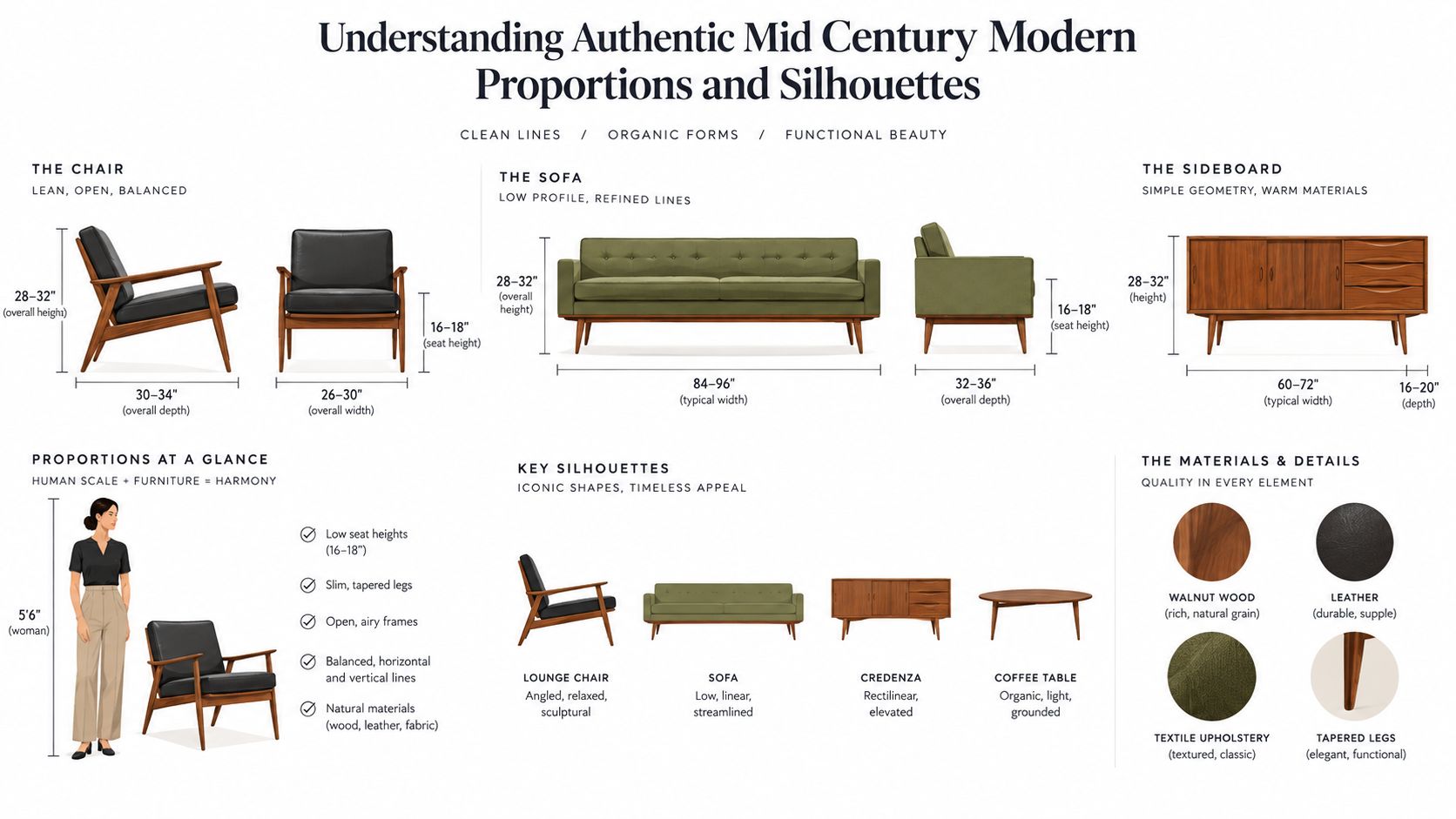
A leather couch can look perfectly mid-century in a photograph yet overwhelm a real living room. The difference often comes down to proportion. Authentic mid-century modern seating usually combines visual lightness with useful form: a clean rectangular or gently rounded back, slim arms, exposed legs, and restrained decoration. The frame should appear lifted from the floor, not planted like a bulky traditional sofa.
A low profile alone does not establish the style. Heavy rolled arms, ornate carving, deep button tufting, and a thick enclosed base usually point elsewhere. Comfort comes from the relationship between seat depth, cushion shape, frame height, and support. Leather adds the outer character, while the frame and suspension determine whether that shape stays comfortable after repeated use.
Use dimensions as a screening tool
A couch that looks compact online may dominate a small apartment after you account for its arms, walking space, and delivery route. Representative mid-century modern leather couches commonly fall within these ranges, based on typical listings and upholstery guidance:
| Measurement | Representative Range |
|---|---|
| Overall width | 71 to 86 inches |
| Overall depth | 29 to 35 inches |
| Seat height | 17 to 18 inches |
| Seat depth | 21 to 23 inches |
The mid-century modern leather couch measurements and upholstery guidance offers one product listing for comparison, not proof of category-wide benchmarks. Listings in this category often fall around 80 to 88 inches wide, 32 to 36 inches deep, and 29 to 34 inches high, as shown by these published sofa dimensions. Treat both examples as reference points rather than universal standards.
Measurements begin the decision. A 21-inch seat depth may suit upright conversation, while a deeper seat can support lounging. A lower seat may reinforce the period look but make standing harder for some adults. Check the room, doorway, stair turns, and elevator before choosing a silhouette.
Check the silhouette from every angle
Use this quick checklist:
- Back line: Does the back look structured without seeming oversized?
- Arms: Are the arms slim enough to preserve usable seating width?
- Legs: Do exposed legs leave breathing room beneath the frame?
- Scale: Is there space for walking, tables, and lamps?
- Function: Can household members sit upright, lounge, and stand comfortably?
A compact two-seater can suit an apartment, but a smaller footprint should not create cramped seating. Modular pieces may help with open layouts or difficult delivery routes, provided their separate frames still create one clean visual rhythm. Before buying, sit long enough to notice whether the cushions, suspension, and frame support the relaxed posture the silhouette promises.
Choosing the Right Leather Grade and Finish for Your Household
You may love the warm brown sample in the showroom, then discover that your dog's claws, children's snacks, or afternoon sun tell a different story. The right leather grade and finish should suit those daily conditions before it suits the room's color scheme.
Leather grade describes how much of the hide's natural surface remains. Full-grain leather keeps the most natural character and is generally the most durable category. Top-grain leather has some surface variation removed, giving it a more consistent appearance while maintaining a strong balance between durability and design. Corrected-grain leather receives heavier surface treatment, which can make the color more uniform but may reduce breathability. Bonded leather is the least durable option and can peel within a few years.
The surface finish matters just as much as the grade. It works like a protective jacket over the hide, influencing how the couch handles spills, friction, sunlight, and repeated sitting. For pets, children, or frequent guests, protected or top-grain leather may be a smarter choice than a more character-rich surface. A market guide covering durability, cleanability, customization, and household use reaches the same practical focus in its leather sofa market guidance about durability, cleanability, customization, and household use.
Match the surface to daily habits
A minimally finished leather surface can develop a distinctive patina, much like a well-used wooden table. Choose it if your household welcomes visible change and can respond quickly to spills. A protected finish is more forgiving in an active living room, although it still needs sensible care and approved cleaning products.
View samples in ordinary daylight rather than only beneath bright showroom lamps. Flex one gently, inspect it from several angles, and ask the seller:
- Which leather category covers the seating areas?
- Is the surface protected, pigmented, or minimally finished?
- How might the color change with use and sunlight?
- Which cleaning products are approved?
- Is abrasion information available?
Martindale abrasion resistance offers a useful technical screen. Residential upholstery is commonly rated at 15,000 to 20,000 cycles, while 30,000 or more cycles suits heavier use, according to published leather upholstery performance guidance. Treat the figure as one part of the decision. A high rating cannot compensate for a weak frame or poor suspension, just as a beautiful hide cannot make an uncomfortable couch comfortable.
| Leather Category | Durability | Best For |
|---|---|---|
| Full-grain leather | Highest natural durability, with visible character | Lower-traffic rooms and households that value patina |
| Top-grain leather | Strong balance of durability and consistent appearance | Everyday living rooms with a refined look |
| Protected leather | More forgiving surface, depending on finish | Children, pets, guests, and active households |
| Corrected-grain leather | Less breathable because of heavier surface treatment | Shoppers prioritizing uniform color |
| Bonded leather | Least durable and vulnerable to peeling | Buyers with careful expectations |
Leather demand continues to grow, but market momentum matters less than whether the finish fits your household. Industry coverage of upholstered furniture and leather demand can provide broader context, while your living room provides the definitive test.
Evaluating Frame Quality, Suspension, and Cushion Construction
The hidden support system decides whether a leather couch remains comfortable after the initial excitement fades. Leather is only one layer. A durable seating piece also needs a stable frame, dependable suspension, and cushions that recover after people stand up.
A reinforced wood frame is a strong starting point because it gives the upholstery a stable foundation. Joinery deserves attention too. A shopper can place a hand on each arm and gently test for movement, then press along the back and front rail. Excessive shifting, creaking, or a frame that feels loose may signal construction that needs closer inspection.
Compare the support stack
A useful inspection sequence moves from the outside inward:
- Frame: Reinforced wood should feel stable at the arms, corners, and back.
- Joints: Corners should stay quiet and firm when the couch is gently tested.
- Suspension: Spring support or high-quality webbing should distribute weight without a sharp drop.
- Cushion core: Dense foam or a carefully balanced blend should provide support without feeling rigid.
- Back support: The back should hold the body comfortably rather than collapsing under light pressure.
Industry buying guidance consistently emphasizes checking the hide grade first, then the frame, suspension, and cushion core. It also identifies reinforced wood, dense foam, and spring support as important parts of the durability stack, as explained in this guide to sofa frames, cushions, suspension, and upholstery materials.
Test the couch like a household member
One person should sit upright. Another can try the corner, stretch out, and rise from the seat. That simple test reveals whether the couch serves conversation, lounging, or both.
Seat depth and cushion firmness need to work together. A deeper seat with a soft cushion may suit relaxed lounging, while a shallower seat with firmer support may help people sit upright. Neither is automatically right. The right combination depends on body size, preferred posture, and whether the couch serves as the main family seat.
A useful sofa and chair inspection checklist can help shoppers remember the details that showroom excitement often hides. The couch should be tested with hands and body, not judged from its legs alone.
Styling and Caring for Your Leather Mid Century Modern Couch
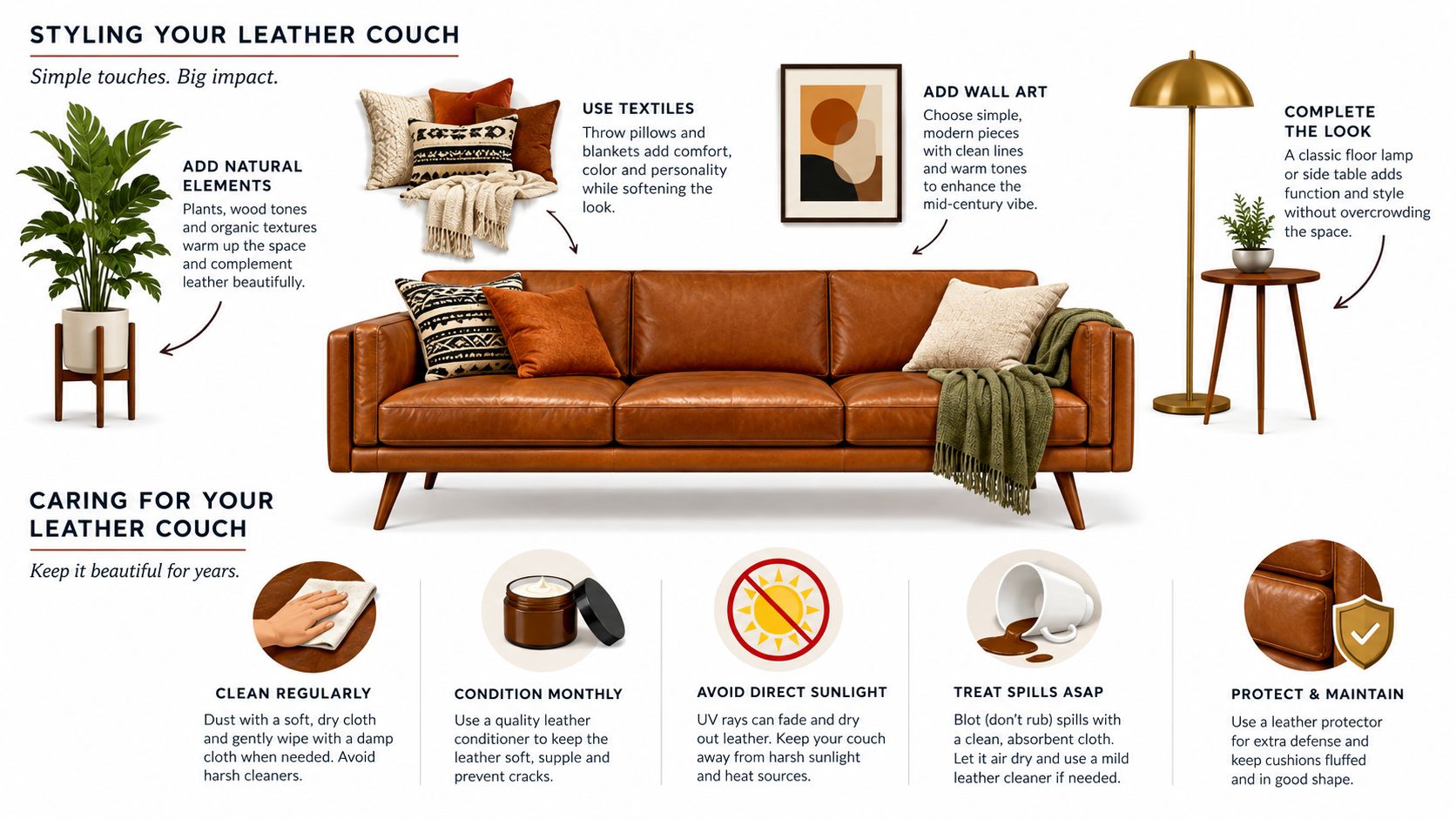
A mid-century modern leather couch looks at home with warm wood, a restrained rug, and lighting with a simple geometric profile. A tan or cognac surface can soften a room with pale walls, while darker leather can anchor lighter floors and textiles. The surrounding pieces should leave the couch room to breathe. Too many heavy accents can erase the visual lightness that gives the style its appeal.
Placement protects the upholstery as much as it supports the decorating plan. Strong sunlight can accelerate fading and surface drying, while heat sources can dry leather and contribute to cracking. Furniture care guidance recommends keeping leather away from direct heat and strong sunlight, and some manufacturers recommend at least 12 inches from radiators or other heat sources, while others advise about two feet, as noted in this leather placement and care guidance.
Keep care simple and consistent
A practical routine looks like this:
- Remove dust: Use a soft, dry cloth or a vacuum with a brush attachment.
- Handle spills promptly: Blot or wipe with a lightly damp cloth instead of allowing moisture to sit.
- Avoid harsh chemicals: Ammonia, bleach, excess water, and aggressive cleaners can dry, stain, or damage leather.
- Condition appropriately: Follow the upholstery maker's recommendations rather than applying an untested product.
- Watch the environment: Use placement, window coverings, and sensible room conditions to reduce drying and cracking.
Detailed leather sofa conditioning guidance can help households build a care schedule that suits the finish. The key is restraint. Overcleaning can cause its own problems, and a leather couch usually benefits from gentle maintenance rather than constant treatment.
A family room also needs practical styling. A washable-looking neutral rug, a wood coffee table with softened edges, and a few textured pillows can add warmth without covering the couch's shape. The result should feel welcoming enough for ordinary evenings, not staged only for guests.
Where to See, Test, and Customize Your Leather Couch in Greenfield
A leather couch is a hands-on purchase. In a showroom, shoppers can compare grain, feel the difference between cushion cores, test seat height, and notice whether the arms reduce usable seating space. They can also check the couch's visual weight beside nearby tables and chairs, something a product image can't fully communicate.
Delivery access deserves the same attention. Measurements should include the entry door, hallway, stairwell, turns, and room location. A couch that fits the wall may still fail at the doorway. Small-scale furniture and come-apart seating can help apartments, condos, older homes, and rooms with tight access, but the delivery path should be discussed before an order is finalized.
Build the couch around the room
Custom upholstery can open choices in leather, wood tones, finish, and hardware. Custom leather upholstery options give shoppers a way to connect the couch's mid-century modern shape with the household's preferred color, finish, and use pattern.
BILTRITE Furniture-Leather-Mattresses is a fourth-generation, family-owned showroom serving the Metro Milwaukee community since 1928. Its selection includes affordable, better-quality furniture, USA-made and Amish-made pieces, solid-wood furniture, small-scale seating, heavy-duty options, and a mattress department with over 60 models. The sales associates bring over 400 years of combined experience, offering practical help without pressure.
That local conversation can clarify choices that are easy to miss online, including leather protection, cushion firmness, room scale, and delivery access. BILTRITE doesn't sell online, and the Greenfield showroom is closed on Sundays and Mondays to support family time. The store is located at 5430 West Layton Avenue in Greenfield, Wisconsin, where shoppers can sit down, compare options, and discuss what works for the actual room.
BILTRITE Furniture-Leather-Mattresses offers leather seating, custom upholstery choices, USA-made and Amish-made furniture, and small-scale options for Metro Milwaukee homes. Families can visit the Greenfield showroom, test a mid-century modern leather couch in person, and talk with the experienced team about leather grade, comfort, construction, and delivery fit.