Solid Wood Table with Bench: Buying & Style Guide


A weekday dinner can turn into a family meeting, a homework station, or an impromptu game night. The right dining furniture makes room for all of it. A solid wood table with bench seating gives a dining area a sturdy center, flexible seating, and the relaxed feeling that encourages people to stay a little longer.
The practical details matter as much as the style. Wood moves with seasonal humidity, benches need the right height and depth, and a beautiful table can still disappoint if its supports block knees or its finish can't handle daily spills. The following guide focuses on those often-overlooked decisions, so a dining set feels good on the first day and continues serving the household for years.
Table of Contents
- Why Solid Wood Table and Bench Sets Belong in Your Home
- Choosing the Right Wood Species and Finish
- Understanding Construction and Joinery Quality
- Bench Seating Versus Chair Options
- Sizing and Layout Planning for Your Dining Space
- Caring for Your Solid Wood Furniture
- USA and Amish-Made Quality You Can Trust
Why Solid Wood Table and Bench Sets Belong in Your Home
A child slides onto the bench while someone clears a space for a board game. A grandparent takes the end seat, a serving dish moves across the tabletop, and nobody worries about matching every chair. That easy, informal arrangement is one reason a solid wood table with bench feels so natural in a busy home. It supports meals, celebrations, homework, crafts, and conversations without making the room feel overly formal.

Built for everyday togetherness
A bench changes the social rhythm of a dining room. Children can sit closer together, guests can shift along the seat, and the furniture often feels less rigid than a table surrounded entirely by individual chairs. The bench can also slide under the tabletop when it isn't needed, keeping walkways clearer.
That flexibility has limits, though. A long bench doesn't automatically provide comfortable seating for every person, particularly when the table base or apron occupies knee space. The best sets balance a welcoming look with sound dimensions and carefully designed supports.
A durable centerpiece, not disposable décor
Solid wood dining furniture sits inside a broad and growing furniture category. The global solid wood dining table market was valued at $12.4 billion in 2025 and is projected to reach $20.1 billion by 2034, with a projected 5.5% CAGR from 2026 through 2034, according to market data on solid wood dining tables. Dining tables accounted for 28.5% of solid wood table market revenue in 2025, representing about $5.58 billion, which helps explain why matching benches remain a meaningful part of the category.
A well-built solid wood table can also be repaired, refinished, and kept in service far longer than short-life furniture. Lifespan guidance describes solid wood dining tables as pieces that commonly last 15 to more than 40 years, while some well-maintained solid wood furniture can reach 30 to 100+ years, as described in furniture lifespan guidance.
Practical rule: Choose a table and bench for the life the household actually leads, not just for the room's staged appearance.
Bench dining has history behind it, too. Furniture history records bench seating at long dining tables in the 16th century, while a rectangular wooden table found in architect Kha's tomb dates to about 1375 B.C., according to this overview of furniture origins. The format has lasted because it solves a simple human need, bringing people together around a strong, useful surface.
Choosing the Right Wood Species and Finish
Wood species determines much of a table's personality, but construction and finish determine how that personality performs in a dining room. Start by deciding whether the room needs a light, casual appearance, a warm traditional tone, or a deeper, more dramatic finish. Then examine the actual sample in person, because screens flatten grain and alter color.
For a useful foundation, review this guide to the best wood for furniture. The most familiar choices each bring a different balance of grain, color, hardness, and visual warmth.
Common Wood Species Comparison
| Wood Type | Durability | Color Range | Best For |
|---|---|---|---|
| Oak | Strong and practical for busy dining rooms | Pale cream through honey and medium brown | Families wanting visible grain and traditional character |
| Maple | Hard, smooth, and resistant to everyday wear | Light cream with subtle variation | Clean, bright interiors and simple modern styling |
| Cherry | Durable with a naturally warm appearance | Light pink-brown that deepens with age | Traditional rooms and furniture with rich warmth |
| Walnut | Strong with distinctive grain and darker color | Chocolate brown, often with lighter variation | Statement pieces and rooms needing visual depth |
Match the finish to the workday
A stain changes color while allowing the wood's grain to remain visible. It can help coordinate a new table with existing flooring or cabinetry, but the same stain may look different on oak, maple, cherry, or walnut. A painted finish creates a more uniform surface and can suit a farmhouse or two-tone room, though worn edges may be more noticeable over time.
Natural oils bring out grain and offer a tactile appearance, but they require a different maintenance routine than a sealed finish. For a busy dining space, the important question isn't which finish sounds most natural. It's whether the finish is appropriate for repeated contact, food spills, wiping, and the owner's willingness to maintain it.
Inspect the piece, not just the sample
In a showroom, run a hand across the tabletop and bench seat. The surface should feel smooth without rough transitions, raised edges, or uneven finish. Look across the top at an angle to catch ripples, cloudy patches, or areas where the coating appears thin.
Grain variation is normal in real wood and can add character. Excessive inconsistency isn't automatically a defect, but shoppers should ask whether the appearance comes from natural boards, stain variation, or a deliberate design choice. Bring a cabinet, floor, or fabric sample if color matching matters. Natural light can reveal undertones that warm showroom lighting hides.
Understanding Construction and Joinery Quality
A table's quality isn't proven by weight alone. A heavy piece can still have weak connections, while a thoughtfully engineered table can remain stable without feeling bulky. Shoppers should examine how the legs meet the apron, how the bench rails connect, and how the tabletop attaches to the base.
What strong joinery does
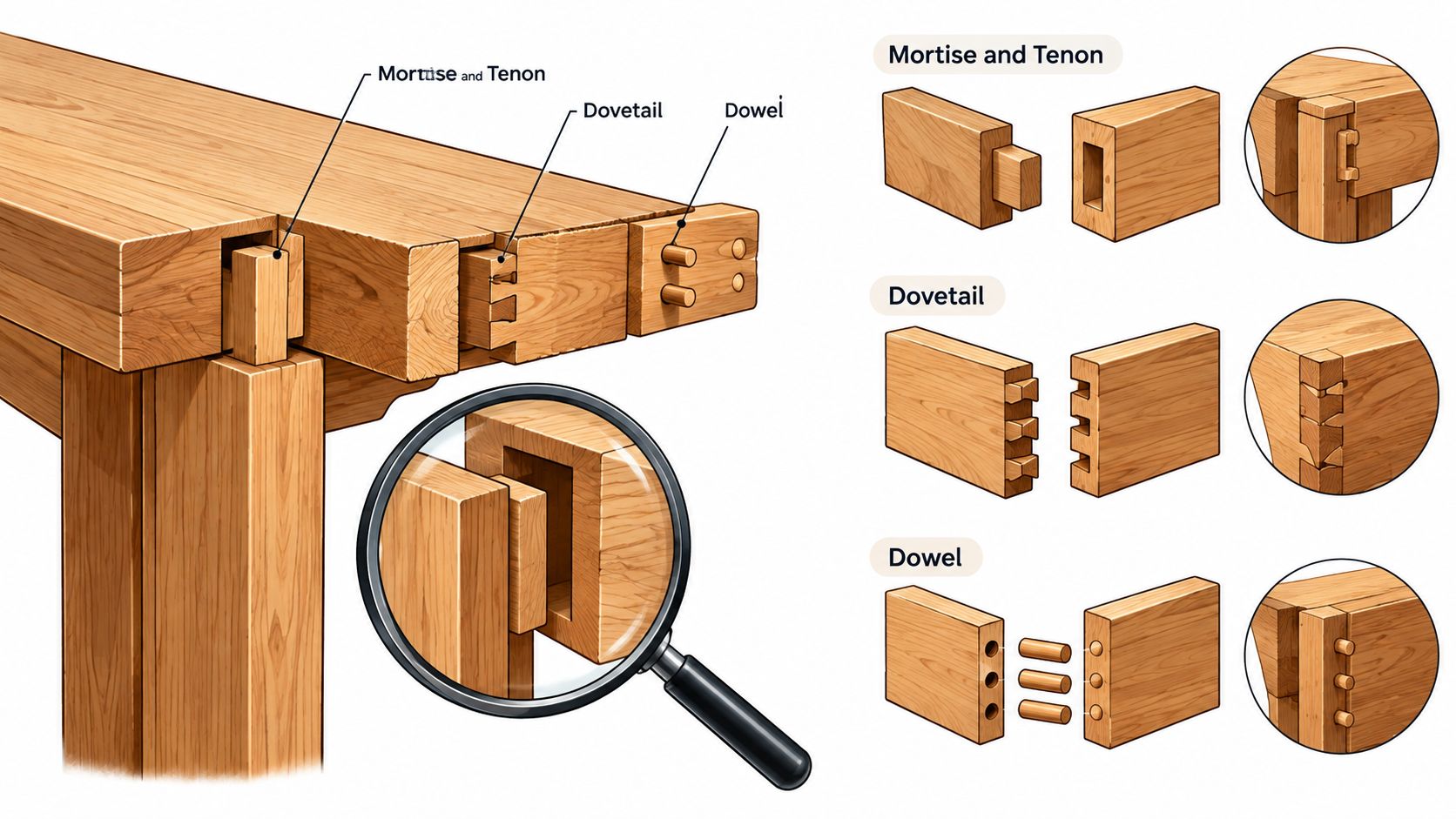
A mortise and tenon joint places one shaped piece inside a matching opening. A dowel connection aligns components with wooden pins, while dovetail construction uses interlocking tapered shapes, often in drawers or casework. These methods use geometry and surface contact to distribute force, rather than asking staples or glue to carry every load.
Readers who want a closer explanation can explore what a mortise and tenon joint is. On a dining set, the visible goal is simple: legs shouldn't wobble, rails shouldn't pull away, and the bench should remain quiet and solid when people sit down or shift position.
Wood movement is part of the design
Solid wood expands and contracts mainly across the grain. Woodworking guidance explains that a typical hardwood such as white oak or cherry can move about one quarter of a percent across the grain for every 1% change in equilibrium moisture content. On a 30-inch tabletop, that can mean about one quarter inch of width change between wet winter and dry summer conditions, according to guidance on solid wood tabletop movement.
That movement isn't a sign of failure. The problem begins when construction prevents the top from moving naturally. Elongated mortises, slotted fasteners, or attachment points that hold the center while allowing the outer areas to slide help reduce the risk of cupping, splitting, and joint stress.
Breadboard ends can add traditional character and help manage movement when properly built, but they aren't required for every durable table. The larger lesson is to ask how the tabletop connects to the base, rather than assuming a decorative detail guarantees quality.
Examine the weight-bearing details
Look for substantial aprons, well-supported legs, and bench attachments that don't rely on a single small fastener. A bench needs enough structure to resist side-to-side racking, especially when children climb onto it or several people sit down together.
Kiln-dried lumber also matters because controlled moisture content gives the maker a more stable starting material. No construction method makes wood inert, but properly dried boards and movement-accommodating joinery give the table a better chance of staying stable through ordinary indoor conditions.
Bench Seating Versus Chair Options
A family gathers for a long dinner, and the seating choice becomes obvious. A bench makes it easy for children to sit close together and lets people shift positions, while chairs provide each person with defined support. Many households get the best balance by placing a bench on one side and chairs on the other.
Before deciding, explore our bench seating options to compare styles, materials, and dimensions. A bench suits flexible seating, easy movement, and a relaxed room. Chairs work better when individual support, simpler access, or a more formal arrangement matters.
Bench Versus Chair Comparison
| Feature | Benches | Chairs |
|---|---|---|
| Space use | Can tuck under the table and reduce visual clutter | Usually occupy more floor area around the table |
| Seating flexibility | People can shift positions and children can sit close together | Each person has a defined seat |
| Back support | Often limited or unavailable | Built-in back support is readily available |
| Accessibility | Requires stepping over or sliding into place | Easier for some users to approach and leave |
| Style | Casual, communal, and family-friendly | Formal, individual, and easy to mix |
| Cleaning | One continuous seat surface | Multiple separate surfaces |
Comfort depends on usable space
A backless bench can slide beneath the tabletop, though it offers no lumbar support. That makes it less suitable for seniors, guests with mobility concerns, or anyone who spends extended time at the table. A chair with a backrest gives each diner a steadier posture and a clearer path in and out.
Independent dining bench design guidance places a comfortable bench seat height at 17 to 19 inches for a 29 to 30-inch dining table, with about 14 to 18 inches of seat depth and 10 to 12 inches of knee clearance beneath the tabletop. Cushion thickness, apron depth, and stretchers can reduce the space that appears available on paper.
Seat width matters just as much. Allow roughly 22 to 26 inches per person for comfortable use. A longer bench does not automatically create more practical seats if diners feel crowded or cannot move their knees freely.
A showroom test reveals details that measurements miss. Sit down, shift position, and check whether your thighs press against the underside or your knees meet a support. Also check how the bench feels after several minutes, not only during a quick sit.
A mixed arrangement often serves a family best. Chairs at the ends provide back support, while a bench along one side keeps the set casual and space-conscious. Choose around daily users first, then consider occasional holiday seating.
Sizing and Layout Planning for Your Dining Space
A dining set should be measured twice, once on paper and once in the room. Start with the table's overall length and width, then add the bench depth, chair depth, and the space needed for people to pull seats out. A set that fits between four walls can still make the room frustrating if the walkway disappears.
Use this dining table size guide before visiting a showroom, and record doorways, stair turns, heating vents, and nearby cabinetry. Those details affect both delivery and everyday use.
Build a simple floor plan
Mark the table footprint with painter's tape or flattened boxes. Place a second outline where the bench will sit when pulled out, then walk around it while carrying a plate or serving bowl. This quick test often exposes pinch points that a bare measurement misses.
Keep the bench on the side with the clearest approach if family members need easy entry. In a corner arrangement, leave enough room for the bench to slide out rather than trapping one end against the wall. In an open-concept room, the dining set can define the eating area without blocking the path between the kitchen and living space.
Check height and support placement
A typical dining table sits around 29 to 30 inches high, which is why the matching bench height matters. The apron, stretcher, and table legs should leave genuine knee clearance, not merely an open-looking gap. A lower or thicker cushion can change the body's position enough to make a well-proportioned bench feel cramped.
Bench length should reflect comfortable seating rather than maximum capacity. Two people may prefer generous room, while children can share more easily, but the supports beneath the seat must not land where ankles and knees need to move.
Let the room guide the shape
A rectangular table works well in a long dining area, while a smaller footprint may suit a square breakfast nook. Benches are especially useful where one side borders a wall, because they can remain tucked away until needed. Tall ceilings don't require an oversized table, either. Scale the furniture to the room's floor area and circulation first, then consider visual height through lighting, wall color, or artwork.
Caring for Your Solid Wood Furniture
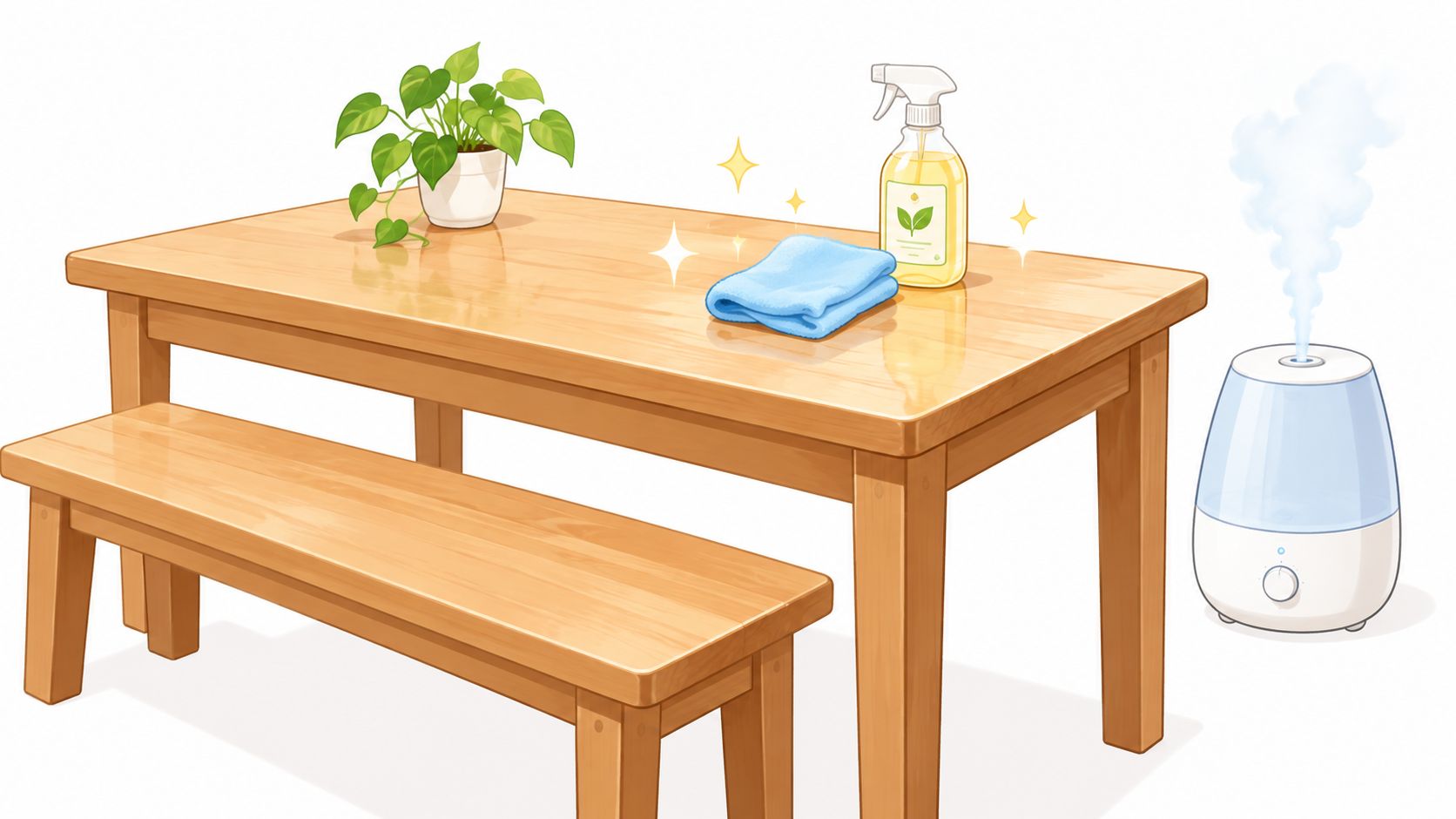
Solid wood responds to its surroundings, so care starts with the room rather than the cleaning bottle. Furniture guidance recommends keeping solid wood pieces at roughly 35% to 50% relative humidity and normal room temperature. Moisture gain can cause swelling, while moisture loss can contribute to checking, open joints, and distortion, as explained in solid wood furniture care guidance.
Make daily care uncomplicated
Use placemats, coasters, or a tablecloth under hot dishes, wet glasses, and serving pieces. Keep the set away from direct sunlight and heat sources, and wipe spills promptly rather than allowing moisture to sit at glue lines or finish breaks. A soft, dry cloth handles routine dusting, while mild soap or a suitable wood cleaner can help with deeper cleaning, as recommended in wood furniture care instructions.
Avoid harsh chemicals and abrasive pads. They can dull or damage the finish, leaving the surface less protected during the next spill.
Use polish sparingly
Care products don't need constant application. A major furniture care guide recommends two to four applications per year and advises against using polish, oil, or wax as a dusting method. It also recommends wiping with the wood grain rather than making circular motions, as detailed in this furniture care guide.
Minor scratches and small dents may respond to a finish-specific touch-up product, but the owner should test any product in an inconspicuous area first. Deeper damage may call for professional refinishing, which is one advantage of solid wood. General furniture guidance highlights that solid wood can be repaired and refinished after scratches and dents, rather than discarded, as discussed in this long-term furniture materials guide.
USA and Amish-Made Quality You Can Trust
American-made and Amish-made furniture appeals to shoppers who want visible craftsmanship and a purchase grounded in durability. Traditional building methods often emphasize careful material selection, strong joinery, hand-finished details, and repairable construction. Those qualities don't replace sensible inspection, but they give shoppers more meaningful features to evaluate than a low price alone.
A solid wood table with bench should feel substantial without being awkward to use. The finish should invite touch, the edges should feel smooth, and the bench should remain steady when someone enters or leaves. In-person shopping makes those judgments possible.
A local approach to furniture shopping
BILTRITE is a fourth-generation, family-owned business serving the Metro Milwaukee community since 1928. The Greenfield showroom focuses on affordable, better-quality furniture, including USA-made, Amish-made, and solid wood pieces, with options that range from small-scale furniture for apartments to heavy-duty choices for active families.
Shoppers can learn more about USA-made wood furniture and then see how different tables, benches, chairs, finishes, and proportions feel in person. BILTRITE's sales associates bring over 400 years of combined experience to the showroom, with an emphasis on helping customers make an informed choice rather than applying pressure.
The store also carries furniture for living rooms, bedrooms, dining rooms, home offices, and other spaces, along with a mattress department featuring over 60 models. That wider selection can help households coordinate a dining purchase with the practical needs of the rest of the home, while keeping the decision rooted in comfort, construction, and value.
BILTRITE Furniture-Leather-Mattresses offers affordable, better-quality dining furniture with USA-made, Amish-made, and solid wood options, along with choices for small spaces and busy families. Visit BILTRITE Furniture-Leather-Mattresses in Greenfield to sit on the benches, test the table proportions, compare finishes, and talk with the experienced team about a dining set that fits the way your household lives.